SinoTechIntel Academic Portal
🏛️ Indexed Academic JournalImpact Factor: 2.7 (Q2 - Springer)

Information Technology & Electronic Engineering

2.7 (Q2 - Springer)

Total Research Papers: 153
Access: 100% Free Open Access
Browse by Publication Year & VolumeReset All Filters ✕

Published Research PapersFiltered: Year 2025 • Vol. 32 • Issue 8

Showing 14 of 153 peer-reviewed papers with full Graphical Abstracts.

Original ResearchVol. 32, Issue 8 • pp. 847-859DOI: 10.1631/FITEE_2401002Aug 24, 2025

Long working distance portable smartphone microscopy for metallic mesh defect detection

Authors: Zhengang LU, Hongsheng QIN, Jing LI, Ming SUN, Jiubin TAN

Metallic mesh is a transparent electromagnetic shielding film with a fine metal line structure. However, in production preparation or actual use it can develop defects that affect the optoelectronic performance. The development of in situ non-destructive testing (NDT) devices for metallic mesh requires long working distances, reflective optical path design, and miniaturization. To address the limitations of existing smartphone microscopes, which feature short working distances and inadequate transmi
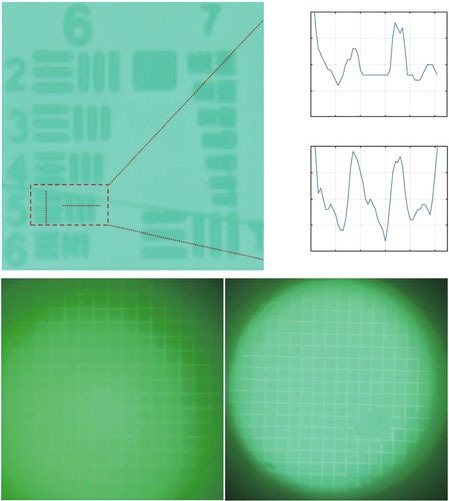
Long working distance portable smartphone microscopy for metallic mesh defect detection
Graphical Abstract
Original ResearchVol. 32, Issue 8 • pp. 283-295DOI: 10.1631/FITEE_2400459Aug 23, 2025

CRGT-SA: an interlaced and spatiotemporal deep learning model for network intrusion detection

Authors: Jue CHEN, Wanxiao LIU, Xihe QIU, Wenjing LV, Yujie XIONG

To address the challenge of cyberattacks, intrusion detection systems (IDSs) are introduced to recognize intrusions and protect computer networks. Among all these IDSs, conventional machine learning methods rely on shallow learning and have unsatisfactory performance. Unlike machine learning methods, deep learning methods are the mainstream methods because of their capability to handle mass data without prior knowledge of specific domain expertise. Concerning deep learning, long short-term memor

CRGT-SA: an interlaced and spatiotemporal deep learning model for network intrusion detection
Graphical Abstract
Original ResearchVol. 32, Issue 8 • pp. 455-467DOI: 10.1631/FITEE_2400612Aug 21, 2025

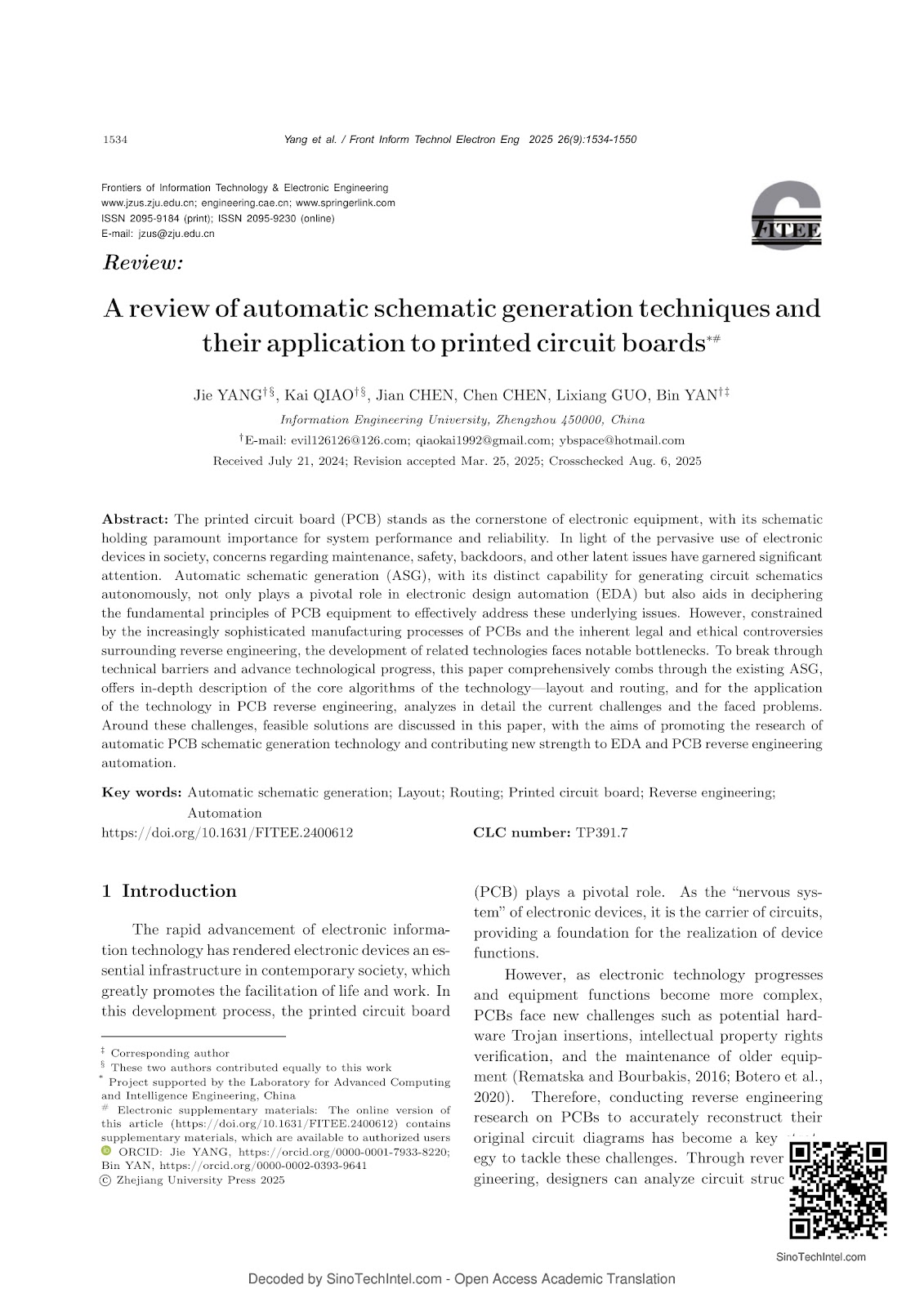
A review of automatic schematic generation techniques and their application to printed circuit boards

Authors: Jie Yang, Kai Qiao, Jian Chen, Chen Chen, Lixiang Guo, Bin Yan

The printed circuit board (PCB) stands as the cornerstone of electronic equipment, with its schematic holding paramount importance for system performance and reliability. In light of the pervasive use of electronic devices in society, concerns regarding maintenance, safety, backdoors, and other latent issues have garnered significant attention. Automatic schematic generation (ASG), with its distinct capability for generating circuit schematics autonomously, not only plays a pivotal role in elect

A review of automatic schematic generation techniques and their application to printed circuit boards
Graphical Abstract
Original ResearchVol. 32, Issue 8 • pp. 627-639DOI: 10.1631/ENG_ITEE_2026_0044Aug 19, 2025

Three-dimensional affordance segmentation for object point cloud driven by language instructions

Authors: Jiaxuan DU, Hao WU, Qing MA, Guohui TIAN, Zhixian ZHAO, Shuwen LENG

The location where a robot grasps an object is closely related to the task type. For the same object, different user requirements may necessitate different grasping strategies. Visual affordance serves as a reliable source of prior knowledge for manipulation. Existing methods learn affordance from images or videos, but planar affordance lacks the spatial information required for 6-degree-of-freedom (6-DoF) manipulation. Furthermore, current approaches are limited to affordances associated with p

Three-dimensional affordance segmentation for object point cloud driven by language instructions
Graphical Abstract
Original ResearchVol. 32, Issue 8 • pp. 863-875DOI: 10.1631/FITEE_2500304Aug 18, 2025

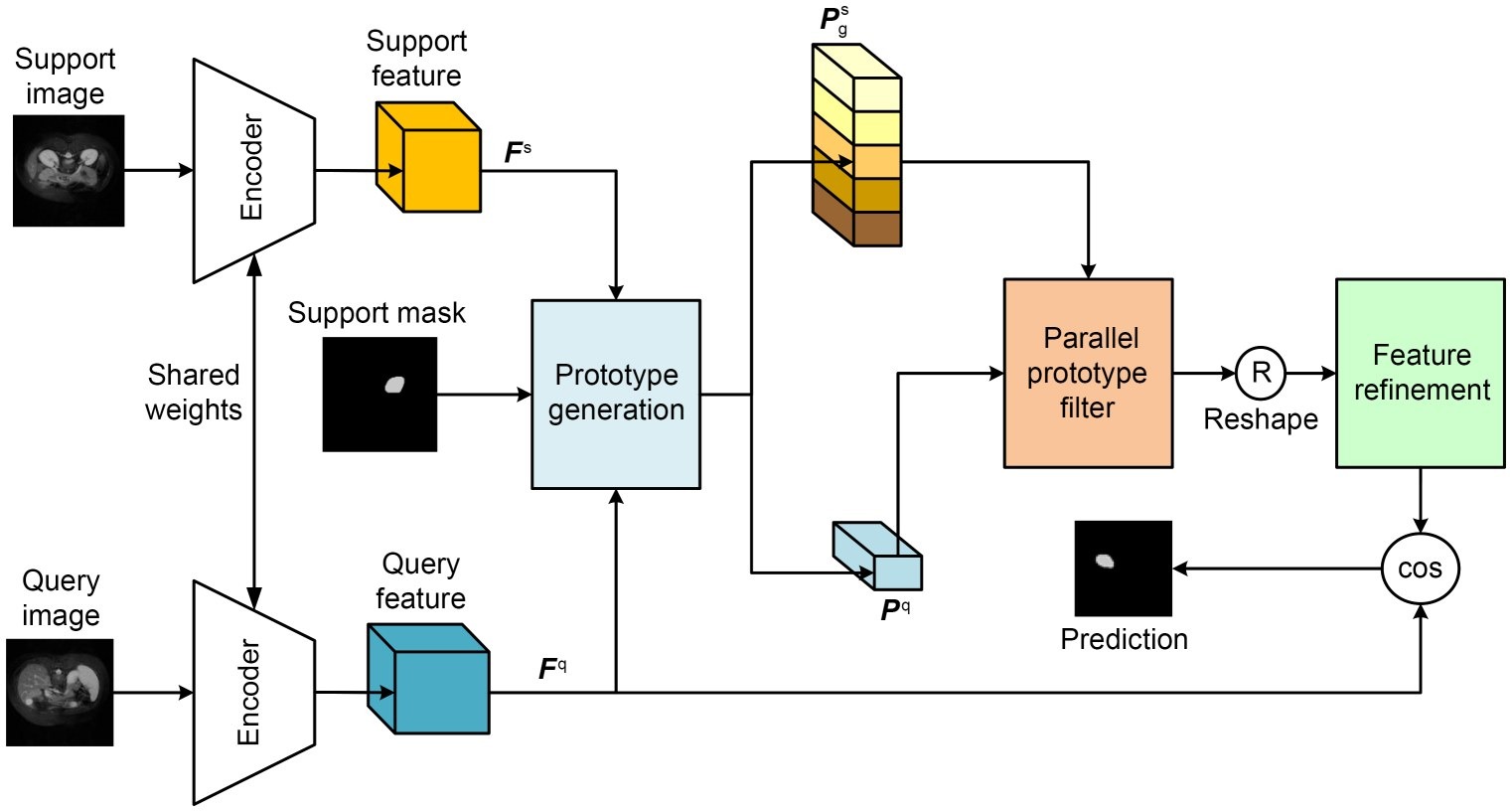
Parallel prototype filter and feature refinement for few-shot medical image segmentation

Authors: Haoxiang ZHU, Houjin CHEN, Yanfeng LI, Jia SUN, Ziwei CHEN, Jiaxin LI

Medical image segmentation is critical for clinical diagnosis, but the scarcity of annotated data limits robust model training, making few-shot learning indispensable. Existing methods often suffer from two issues—performance degradation due to significant inter-class variations in pathological structures, and overreliance on attention mechanisms with high computational complexity (O(n²)), which hinders the efficient modeling of long-range dependencies. In contrast, the state space model (SSM) o

Parallel prototype filter and feature refinement for few-shot medical image segmentation
Graphical Abstract
Original ResearchVol. 32, Issue 8 • pp. 235-247DOI: 10.1631/FITEE_2400513Aug 16, 2025

A power optimization approach for mixed polarity Reed–Muller logic circuits based on multi-strategy fusion memetic algorithm

Authors: Mengyu ZHANG, Zhenxue HE, Yijin WANG, Xiaojun ZHAO, Xiaodan ZHANG, Limin XIAO, Xiang WANG

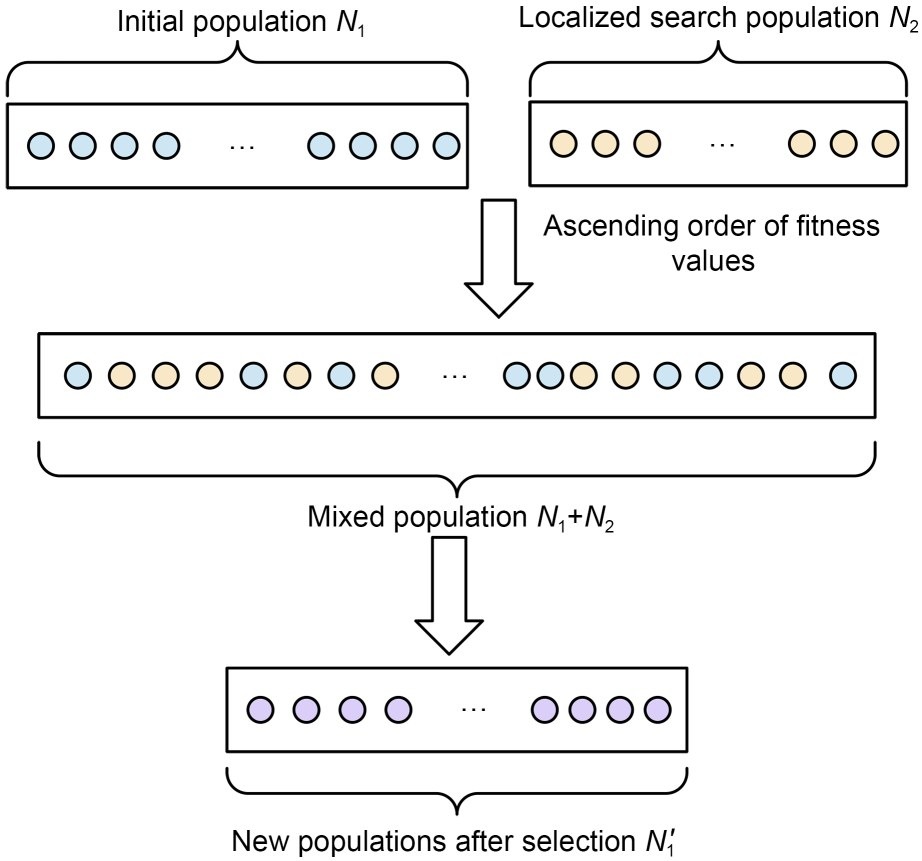
The power optimization of mixed polarity Reed–Muller (MPRM) logic circuits is a classic combinatorial optimization problem. Existing optimization approaches often suffer from slow convergence and a propensity to converge to local optima, limiting their effectiveness in achieving optimal power efficiency. First, we propose a novel multi-strategy fusion memetic algorithm (MFMA). MFMA integrates global exploration via the chimp optimization algorithm with local exploration using the coati optimizat

A power optimization approach for mixed polarity Reed–Muller logic circuits based on multi-strategy fusion memetic algorithm
Graphical Abstract
Original ResearchVol. 32, Issue 8 • pp. 471-483DOI: 10.1631/FITEE_2500402Aug 15, 2025

Entropy-statistical approach to phase-locking detection of oscillations

Authors: Petr BORISKOV, Vadim PUTROLAYNEN, Andrei VELICHKO, Kristina PELTONEN

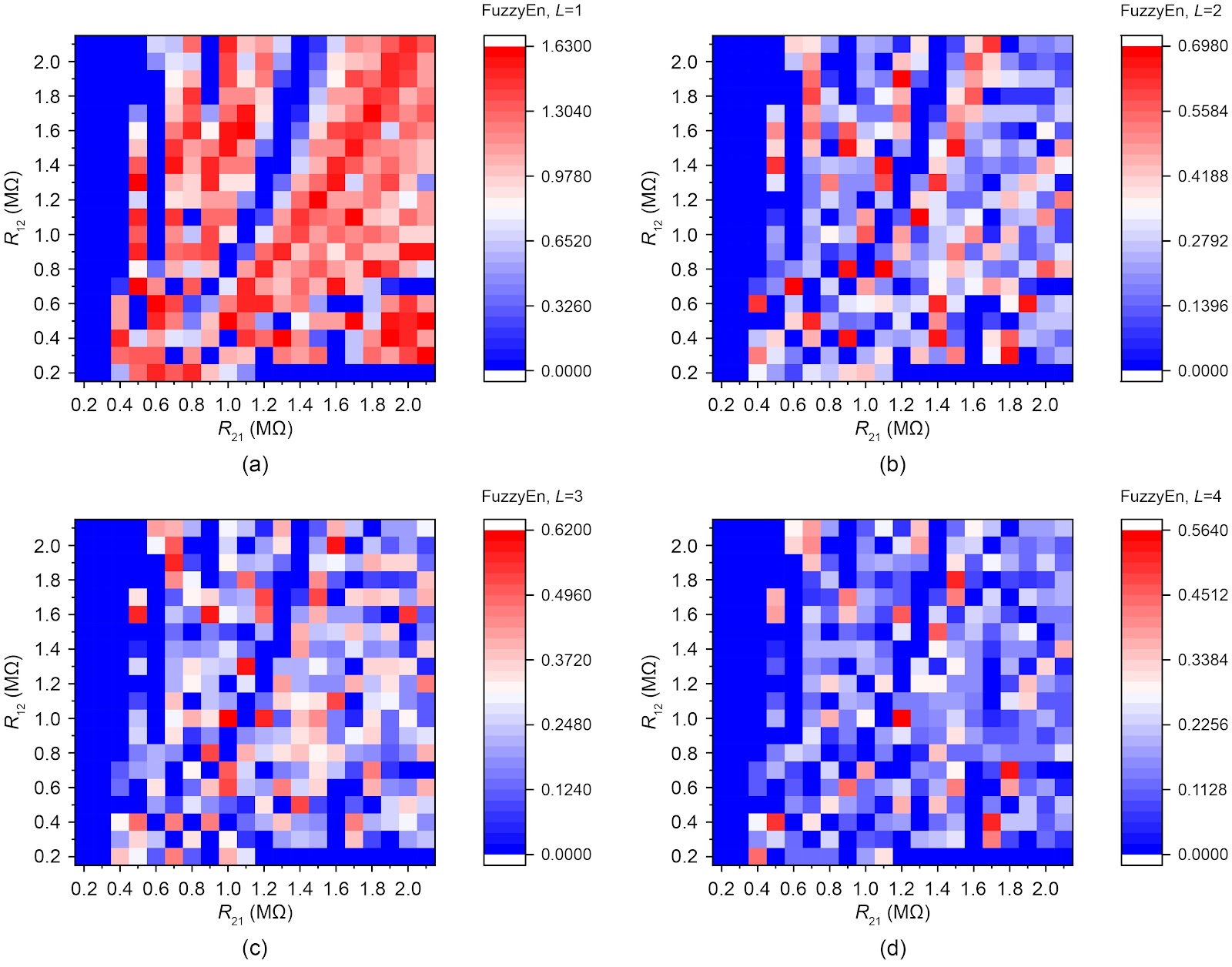
This study proposes a method for analyzing synchronization in oscillator systems, illustrated by modeling the dynamics of a circuit of two resistively coupled pulse oscillators. The dynamic characteristic of synchronization is the fuzzy entropy (FuzzyEn), which is calculated from a time series composed of the ratios of the number of pulse periods (subharmonic ratio, SHR) at phase-locking intervals. Low and high entropy values indicate strong and weak synchronization between the two oscillators,

Entropy-statistical approach to phase-locking detection of oscillations
Graphical Abstract
Original ResearchVol. 32, Issue 8 • pp. 643-655DOI: 10.1631/FITEE_2400080Aug 13, 2025

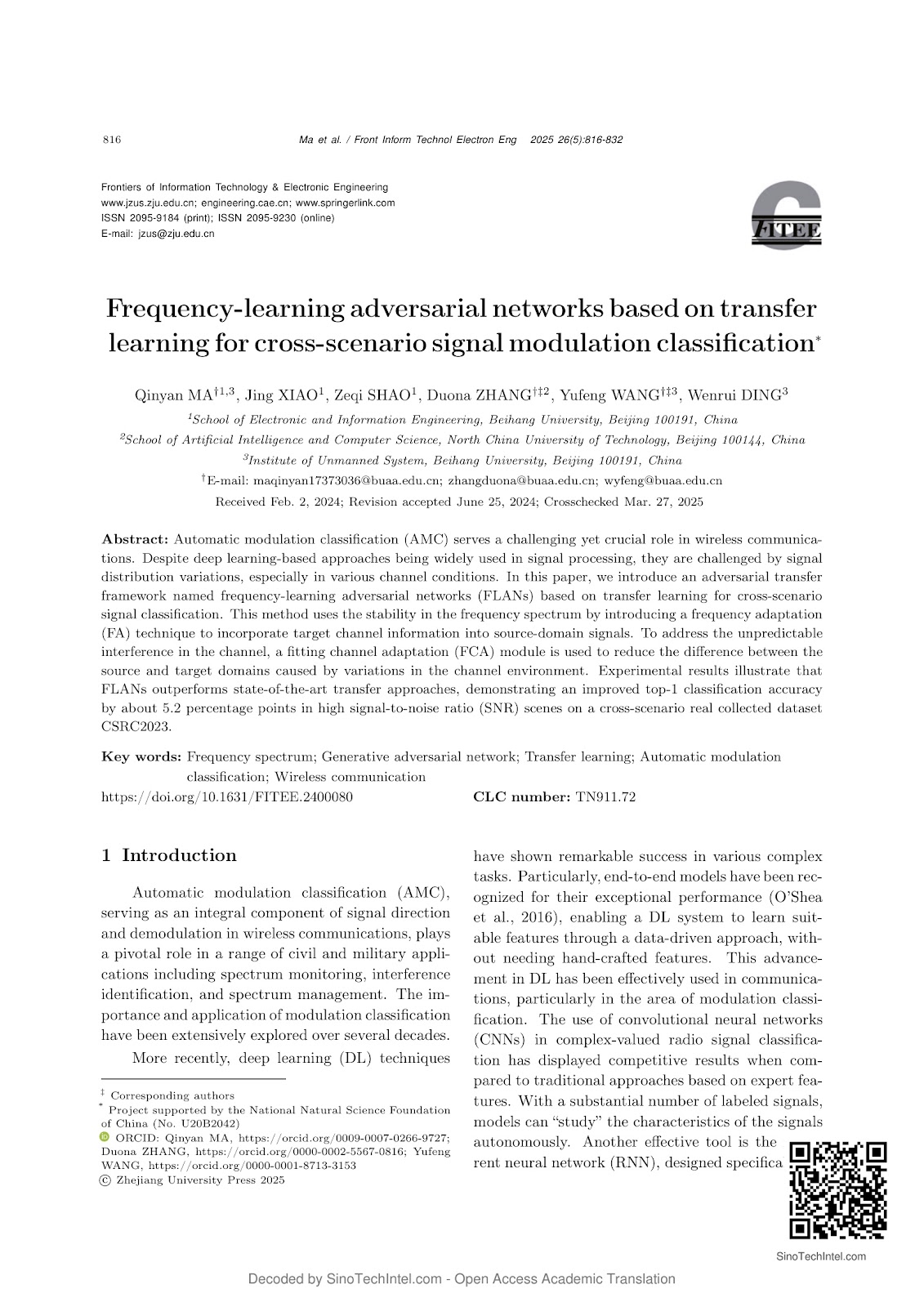
Frequency-learning adversarial networks based on transfer learning for cross-scenario signal modulation classification

Authors: Qinyan MA, Jing XIAO, Zeqi SHAO, Duona ZHANG, Yufeng WANG, Wenrui DING

Automatic modulation classification (AMC) serves a challenging yet crucial role in wireless communications. Despite deep learning-based approaches being widely used in signal processing, they are challenged by signal distribution variations, especially in various channel conditions. In this paper, we introduce an adversarial transfer framework named frequency-learning adversarial networks (FLANs) based on transfer learning for cross-scenario signal classification. This method uses the stability

Frequency-learning adversarial networks based on transfer learning for cross-scenario signal modulation classification
Graphical Abstract
Original ResearchVol. 32, Issue 8 • pp. 251-263DOI: 10.1631/FITEE_2400471Aug 10, 2025

A unified shared control architecture for underwater vehicle–manipulator systems using task priority

Authors: Zhangpeng TU, Yuanchao ZHU, Xin WU, Canjun YANG

It is challenging for underwater vehicle–manipulator systems (UVMSs) to operate autonomously in unstructured underwater environments. Relying solely on teleoperation for both underwater vehicle (UV) and underwater manipulator (UM) imposes a considerable cognitive and physical load on the operator. In this paper, we propose a unified shared control (USC) architecture for the UVMS, integrating divisible shared control (DSC) and interactive shared control (ISC) to alleviate the operator’s workload.

A unified shared control architecture for underwater vehicle–manipulator systems using task priority
Graphical Abstract
Original ResearchVol. 32, Issue 8 • pp. 423-435DOI: 10.1631/ENG_ITEE_2025_0023Aug 8, 2025

Miniaturized bandpass filter with a wide upper stopband using isomeric resonators in a cavity

Authors: Chengyang Zhang, Ying Xue, Qingyuan Lu, Jianxin Chen

This paper presents a miniaturized bandpass filter (BPF) with a wide upper stopband employing isomeric resonators inside a cavity. The filter consists of two ridge waveguide (WG) resonators coupled through a half-wavelength resonant slot (HWRS) resonator. A tuning post (Tup) embedded in the central region of the ridge significantly reduces the resonant frequency of the fundamental TE101 mode while leaving the first harmonic TE102 mode almost unchanged, thereby enabling both miniaturization and w

Miniaturized bandpass filter with a wide upper stopband using isomeric resonators in a cavity
Graphical Abstract
Original ResearchVol. 32, Issue 8 • pp. 659-671DOI: 10.1631/FITEE_2520000Aug 7, 2025

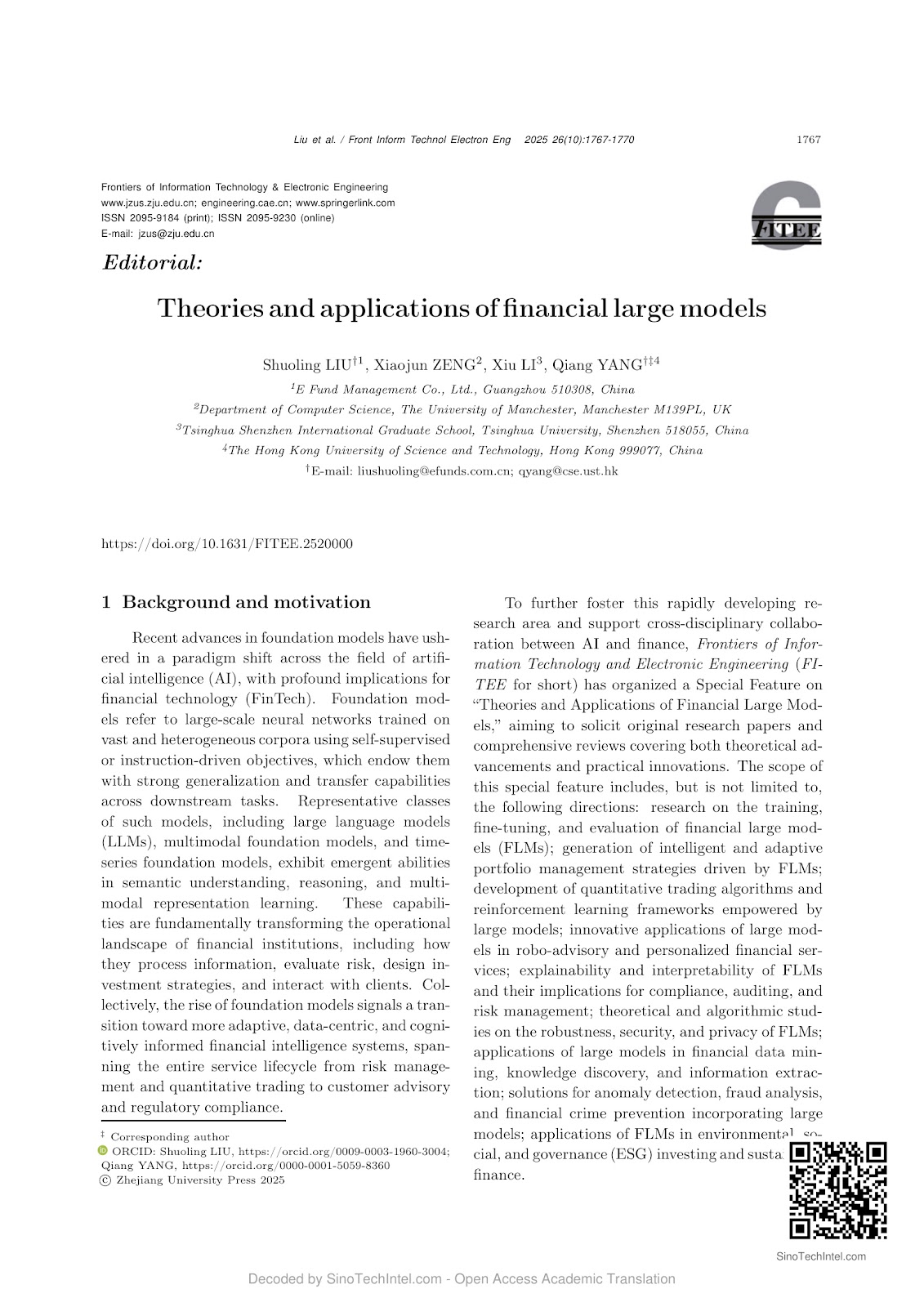
Theories and applications of financial large models

Authors: Shuoling LIU, Xiaojun ZENG, Xiu LI, Qiang YANG

This editorial introduces the Special Feature on 'Theories and Applications of Financial Large Models' in Frontiers of Information Technology & Electronic Engineering. It highlights the transformative impact of foundation models on financial technology, outlines the scope of the special issue, and summarizes the eight accepted papers across three themes: foundational frameworks, theoretical advances, and application-oriented research. The aim is to bridge theoretical research and practical deplo

Theories and applications of financial large models
Graphical Abstract
Original ResearchVol. 32, Issue 8 • pp. 831-843DOI: 10.1631/FITEE_2400800Aug 5, 2025

TransRAG for parallel transportation: toward reliable and trustworthy transportation systems via retrieval-augmented generation

Authors: Jing Yang, Xingyuan Dai, Yisheng Lv, Levente Kovács, Fei-Yue Wang

Parallel transportation serves as a holistic paradigm for achieving intelligent traffic management and control, focusing on addressing the complexity of human and social factors. Recently, the emergence and development of foundational models (FMs) have ushered in a new era for the realization of parallel transportation. However, the inherent issues of “hallucinations,” outdated knowledge, and the “black-box” nature of FMs render their generated decisions unreliable and untrustworthy. To address

TransRAG for parallel transportation: toward reliable and trustworthy transportation systems via retrieval-augmented generation
Graphical Abstract
Original ResearchVol. 32, Issue 8 • pp. 267-279DOI: 10.1631/FITEE_2500541Aug 4, 2025

Eixão-UAM: LLM-assisted iterative design of a low-altitude urban air mobility corridor in Brasilia

Authors: Li WEIGANG, Juliano Adorno MAIA, Emilia STENZEL, Lucas Ramson SIEFERT

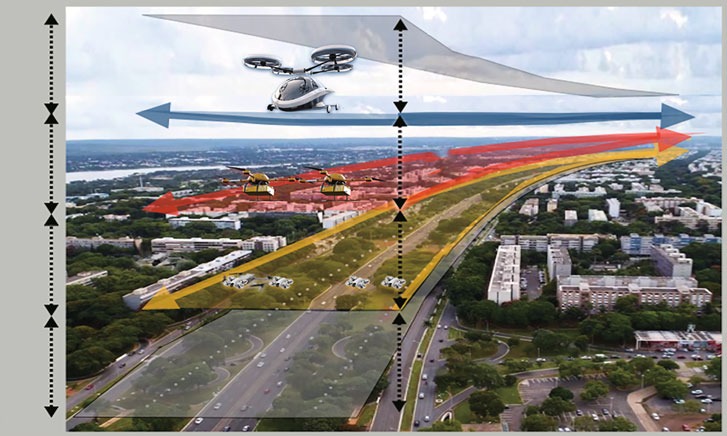
The development of urban air mobility (UAM) systems requires scalable, regulation-aware planning of low-altitude airspace and supporting infrastructure. This study proposes an end-to-end framework for the design, simulation, and iterative optimization of a structured UAM corridor over Brasilia's central road axis (Eixão-UAM), aligned with the Brazilian unmanned aircraft traffic management (BR-UTM) ecosystem. In addition, this study proposes a multilayered aerial configuration stratified by unman

Eixão-UAM: LLM-assisted iterative design of a low-altitude urban air mobility corridor in Brasilia
Graphical Abstract
Original ResearchVol. 32, Issue 8 • pp. 439-451DOI: 10.1631/FITEE_2400465Aug 2, 2025

A UAV-enabled mobile edge computing paradigm for dependent tasks based on a computing power pool

Authors: Xuebin LAI, Yan GUO, Ming HE, Hao YUAN, Wei LI, Xiaonan CUI

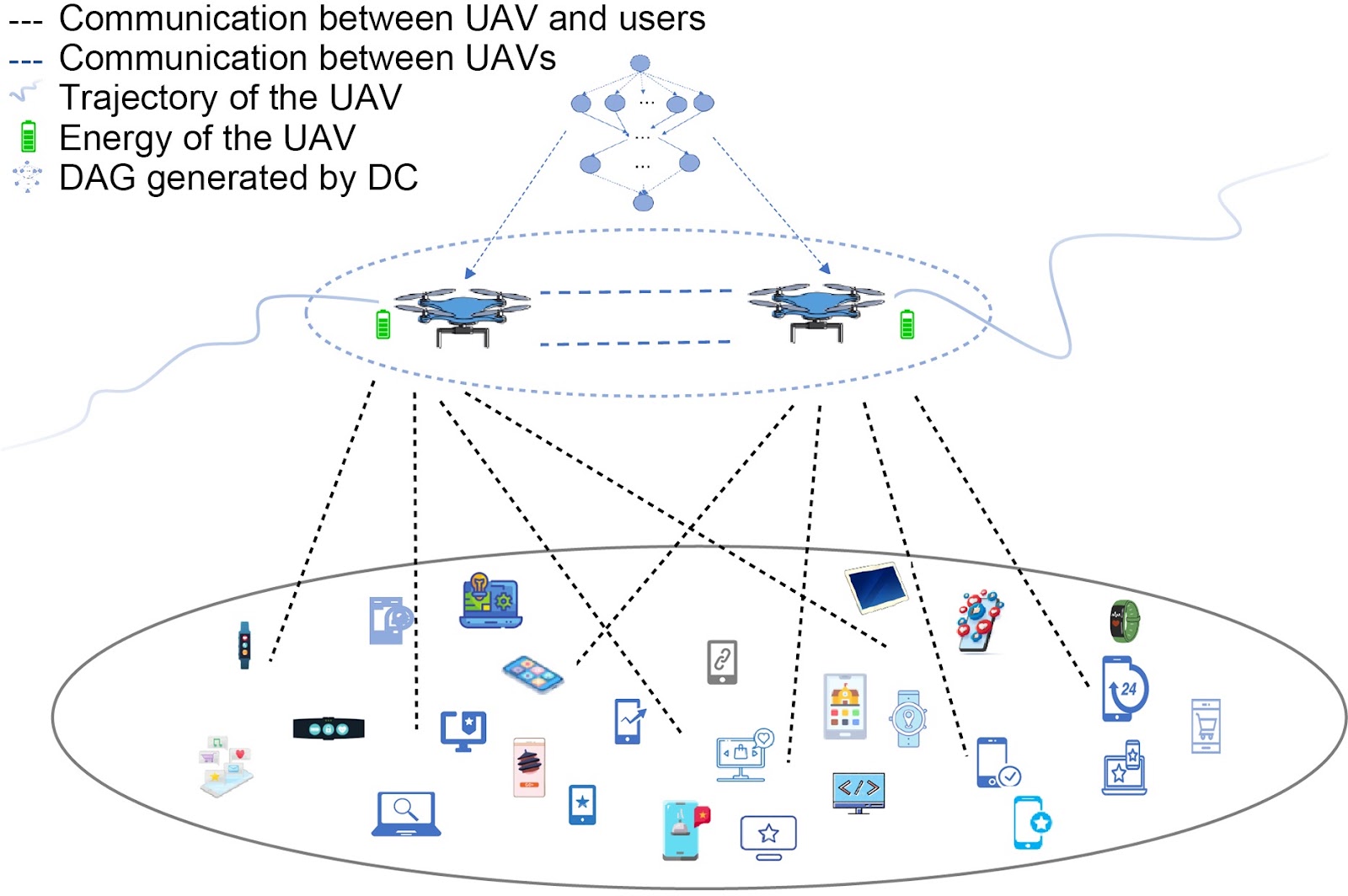
With the evolution of 5th generation (5G) and 6th generation (6G) wireless communication technologies, various Internet of Things (IoT) devices and artificial intelligence applications are proliferating, putting enormous pressure on existing computing power networks. Unmanned aerial vehicle (UAV)-enabled mobile edge computing (U-MEC) shows potential to alleviate this pressure and has been recognized as a new paradigm for responding to data explosion. Nevertheless, the conflict between computing

A UAV-enabled mobile edge computing paradigm for dependent tasks based on a computing power pool
Graphical Abstract