Key Takeaways & Executive Findings
- •• Proposes a UAV-enabled MEC paradigm based on a computing power pool that exploits task repeatability and dependency to optimize resource sharing. • Joint optimization of offloading strategy, task scheduling, and resource allocation balances UAV energy consumption in a computationally intensive environment. • A two-stage alternate optimization algorithm combining SCA and improved GA effectively solves the NP-hard resource management problem. • Simulation results demonstrate average reductions of 18.41% in time consumption and 21.68% in energy consumption, improving UAV working efficiency.
Abstract
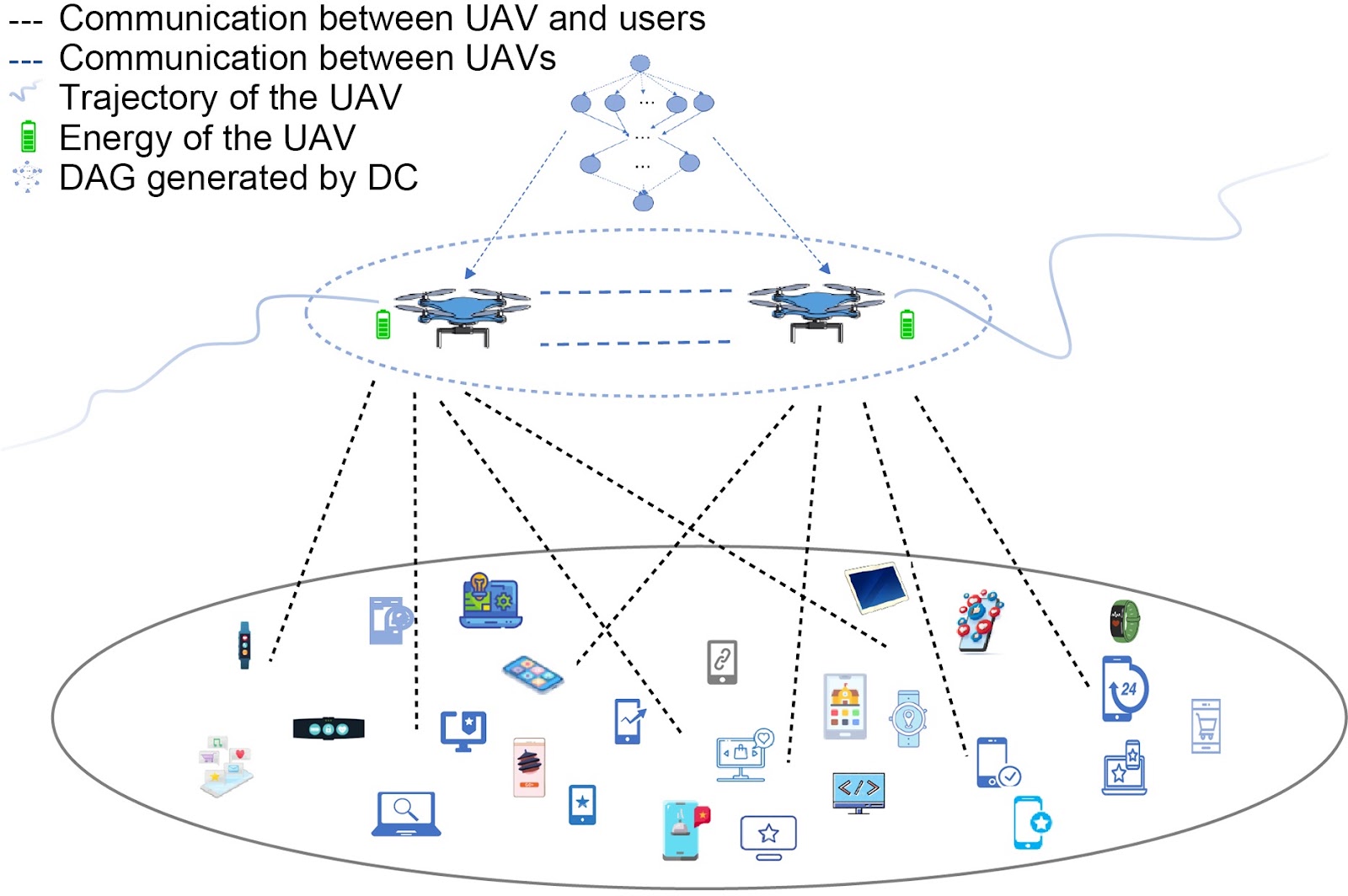
With the evolution of 5th generation (5G) and 6th generation (6G) wireless communication technologies, various Internet of Things (IoT) devices and artificial intelligence applications are proliferating, putting enormous pressure on existing computing power networks. Unmanned aerial vehicle (UAV)-enabled mobile edge computing (U-MEC) shows potential to alleviate this pressure and has been recognized as a new paradigm for responding to data explosion. Nevertheless, the conflict between computing demands and resource-constrained UAVs poses a great challenge. Recently, researchers have proposed resource management solutions in U-MEC for computing tasks with dependency. However, the repeatability among the tasks was ignored. In this paper, considering repeatability and dependency, we propose a U-MEC paradigm based on a computing power pool for processing computationally intensive tasks, in which UAVs can share information and computing resources. To ensure the effectiveness of computing power pool construction, the problem of balancing the energy consumption of UAVs is formulated through joint optimization of an offloading strategy, task scheduling, and resource allocation. To address this NP-hard problem, we adopt a two-stage alternate optimization algorithm based on successive convex approximation (SCA) and an improved genetic algorithm (GA). The simulation results show that the proposed scheme reduces time consumption by 18.41% and energy consumption by 21.68% on average, which can improve the working efficiency of UAVs.
1. Introduction
As research on 5th generation (5G) and 6th generation (6G) wireless communication technologies continues to advance, various Internet of Things (IoT) devices have become ubiquitous. According to Machina Research, the number of global IoT devices is expected to increase to 27 billion by 2025 (AII, 2023). The applications of artificial intelligence (AI) technologies are also increasing, such as large language models (LLMs) and augmented reality (AR). The computing tasks of these applications are mostly delay-sensitive and computationally intensive, making them beyond the capacity of mobile devices (Zhang PY et al., 2021; Michailidis et al., 2022; Ning et al., 2023).
The traditional method is to adopt cloud computing technology, but cloud servers cannot meet the low-latency requirements of a massive influx of tasks (Lin et al., 2020). Mobile edge computing (MEC) technology can address these shortcomings to a certain extent and is applied to the network edge closer to users (Kato et al., 2019). Nevertheless, traditional mobile edge servers have limitations in deployment and cannot be rapidly deployed in some emergency situations, deserts, and wilderness places (Kato et al., 2019; CCID, 2020). Fortunately, the development of unmanned aerial vehicles (UAVs) is gradually maturing. UAVs are flexible and easy to deploy, so a new paradigm of UAV-enabled MEC (U-MEC) has emerged.
The U-MEC system enables a wide range of applications that can perform data collection, extend the communication range, share the load of a terrestrial base station (BS) or access point (AP), and perform computational tasks for IoT devices that do not have direct access to communication infrastructure (Ning et al., 2023). However, the constraints of weight, power, energy, and other factors impose limitations on the communication and computation capabilities of UAVs during data processing. Consequently, the objective of research is to propose efficient resource management methods for limited resources in U-MEC systems (Abrar et al., 2021). The user tasks provide essential insight into optimal organization and utilization of resources, thereby facilitating a more targeted approach to resource management grounded in the characteristics of user tasks. The interdependency of subtasks represents a fundamental characteristic of computational tasks. Most computing tasks can be classified into a series of subtasks, each with a defined sequence of completion, collectively referred to as dependent tasks (Huang et al., 2023; Liu CT et al., 2023). The rationale behind task dependency is that developers typically embrace modularity when constructing tasks.
Loading authentic research manuscript (Pages 1–5)...
Xuebin LAI, Yan GUO, Ming HE, Hao YUAN, Wei LI, Xiaonan CUI (2025). A UAV-enabled mobile edge computing paradigm for dependent tasks based on a computing power pool. Frontiers of Information Technology & Electronic Engineering. https://doi.org/10.1631/FITEE_2400465
Research & Educational Purpose Only:The translations, structured abstracts, analytical annotations, and data reports provided by SinoTechIntel are intended exclusively for academic research, internal corporate R&D, and educational benchmarking. They do not constitute formal engineering, chemical safety, legal, or professional advice.
Copyright & Intellectual Property Notice: Original copyright of the underlying source articles and experimental data remains with the respective authors, institutions, and original publishing journals. SinoTechIntel claims intellectual property only over its proprietary translations, analytical syntheses, and AEO structured enhancements in accordance with international fair use and academic citation principles.
Frequently Asked Questions
What is UAV-enabled mobile edge computing (U-MEC)?
U-MEC is a paradigm where unmanned aerial vehicles serve as mobile edge computing platforms, providing computation and communication services to IoT devices, especially in areas without direct access to terrestrial infrastructure.
What problem does this paper address?
It addresses the conflict between computationally intensive dependent tasks and the limited communication, computation, and energy resources of UAVs, while also considering task repeatability that prior resource management solutions ignored.
How does the proposed computing power pool work?
The computing power pool enables UAVs to share information and computing resources, allowing coordinated processing of dependent and repeatable tasks through joint optimization of offloading strategy, task scheduling, and resource allocation.
What optimization algorithm is used?
A two-stage alternate optimization algorithm based on successive convex approximation (SCA) and an improved genetic algorithm (GA) is adopted to solve the NP-hard joint optimization problem.
What performance gains are achieved?
Simulation results show average reductions of 18.41% in time consumption and 21.68% in energy consumption, improving UAV working efficiency.
Related Technical Papers & Translations

Design and optimization of a high-efficiency distillation process for cellulosic fuel ethanol integrated with thermal coupling and molecular sieve adsorption
To address the challenges of high energy consumption and prominent costs in the traditional three-columns distillation process for cellulosic fuel ethanol, a distillation—molecular sieve coupling separation process is proposed. This process integrates a three-column (crude distillation column, first distillation column, second distillation column) system with a 3A molecular sieve adsorption deep dehydration unit. A thermal coupling network is constructed via differential pressure design (steam from medium/high-pressure columns as mutual heat sources, reboiler liquid waste heat for feed preheating), and molecular sieve adsorption conditions are optimized. The study first performs a thermodynamic consistency test on the ethanol—water system, determines optimal non-random two-liquid (NRTL) model binary interaction parameters via experimental data regression for Aspen Plus simulation. Aiming at minimum total annual cost (TAC), Aspen Plus is used to optimize process parameters (theoretical tray number, feed location, reflux ratio, side-draw position, etc.). Economic analysis shows this process reduces CO2 emission costs by 27.56%, TAC by 15.58% (to 5.123 × 10⁶ USD·a-1), and increases ethanol purity to >99.6%, providing an effective solution for green, efficient separation.

A cohesion loss model for determining residual strength of deep bedded sandstone
Rock residual strength, as an important input parameter, plays an indispensable role in proposing the reasonable and scientific scheme about stope design, underground tunnel excavation and stability evaluation of deep chambers. Therefore, previous residual strength models of rocks established were reviewed. And corresponding related problems were stated. Subsequently, starting from the effects of bedding and whole life-cycle evolution process, series of triaxial mechanical tests of deep bedded s

Federated model with contrastive learning and adaptive control variates for human activity recognition
Recent attention to privacy issues demands a communication-safe method for training human activity recognition (HAR) models on client activity data. Federated learning (FL) has become a compelling technique to facilitate model training between the server and clients while preserving data privacy. However, classical FL methods often assume independent and identically distributed (IID) data among clients. This assumption does not hold true in practical scenarios. Human activity in real-world scena