Key Takeaways & Executive Findings
- •• MFMA integrates chimp optimization and coati optimization with adaptive weight factor to balance global and local search, overcoming slow convergence and local optima pitfalls. • Achieves a maximum power saving rate of 72.30% and an average optimization rate of 43.37% on MCNC benchmark circuits, significantly outperforming existing methods. • Provides a robust and efficient solution to the combinatorial explosion in MPRM polarity search, enabling faster convergence and higher-quality solutions. • Establishes a practical framework for low-power IC design, with implications for portable devices and heat-dissipation cost reduction.
Abstract
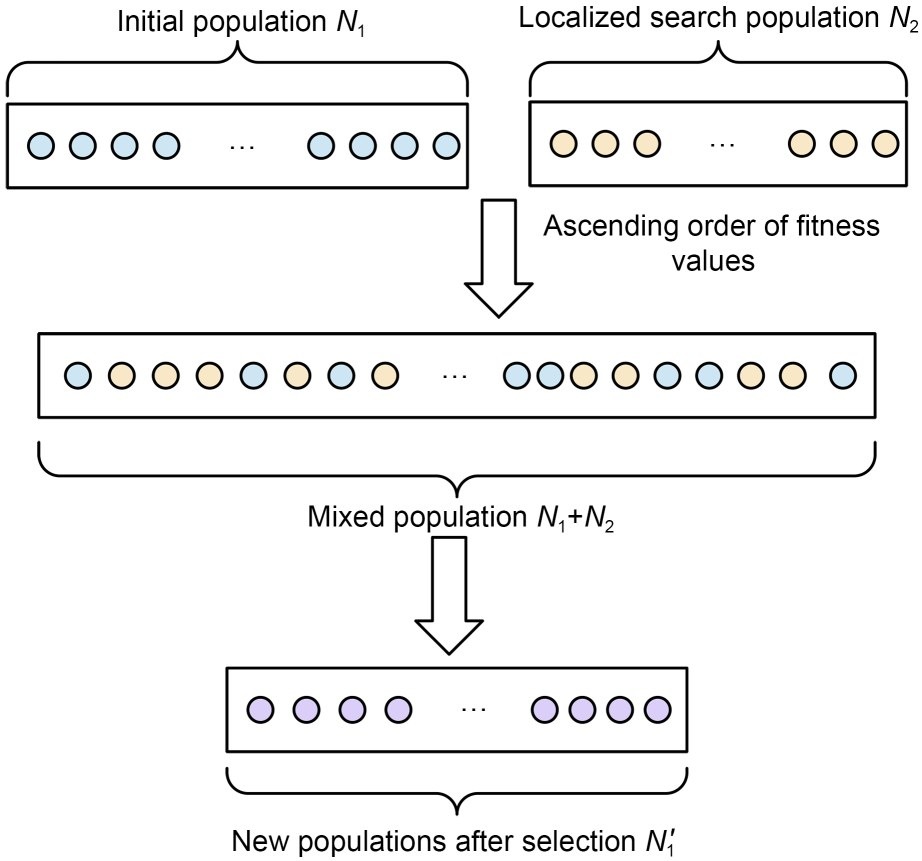
The power optimization of mixed polarity Reed–Muller (MPRM) logic circuits is a classic combinatorial optimization problem. Existing optimization approaches often suffer from slow convergence and a propensity to converge to local optima, limiting their effectiveness in achieving optimal power efficiency. First, we propose a novel multi-strategy fusion memetic algorithm (MFMA). MFMA integrates global exploration via the chimp optimization algorithm with local exploration using the coati optimization algorithm based on the optimal position learning and adaptive weight factor (COA-OLA), complemented by population management through truncation selection. Second, leveraging MFMA, we propose a power optimization approach for MPRM logic circuits that searches for the best polarity configuration to minimize circuit power. Experimental results based on Microelectronics Center of North Carolina (MCNC) benchmark circuits demonstrate significant improvements over existing power optimization approaches. MFMA achieves a maximum power saving rate of 72.30% and an average optimization rate of 43.37%; it searches for solutions faster and with higher quality, validating its effectiveness and superiority in power optimization.
1. Introduction
As the integrated circuit (IC) industry rapidly evolves alongside advancements in electronic information technology, the significance of IC in digital systems, computer manufacturing, communication equipment, and various other domains continues to grow (Huan et al., 2021). However, with this rapid progress comes a notable issue: the escalating power of IC. This increase not only poses challenges for portable devices, causing power difficulties and chip overheating, but also impacts the cost of heat dissipation and packaging. Consequently, optimizing chip power has emerged as a pivotal factor in IC design and optimization.
Digital logic circuits can be implemented using either Boolean logic circuits, which rely on AND/OR/NOT operations, or Reed–Muller (RM) logic circuits, which use XNOR/OR or XOR/AND operations. Numerous studies have indicated that for certain circuits (Zhao GC et al., 2024), RM logic circuits offer more significant advantages over Boolean logic circuits in terms of power, area efficiency, reliability, and testability. Consequently, RM logic circuits have garnered considerable attention as research focuses on the field of IC design and optimization (Lopera et al., 2021). The most prevalent forms of RM logic circuits are the XNOR/OR-based mixed polarity RM (MPRM) logic circuits and the XOR/AND-based fixed polarity RM (FPRM) logic circuits. For any n-variable Boolean logic circuit, there exist 3n different mixed polarities and 2n different fixed polarities. As a result, MPRM logic circuits provide a large optimization space and a great potential for improved performance compared to FPRM logic. Furthermore, varying input variables yield different circuit expressions, corresponding to distinct polarities (Liu et al., 2024). Optimizing power in MPRM circuits involves identifying the optimal polarity configuration that minimizes power, thereby posing a typical combinatorial optimization problem.
In MPRM logic circuits, the exhaustive search method effectively finds the optimal polarity for circuits with fewer input variables. However, as the number of input variables increases, the optimization space grows exponentially, making exhaustive methods time-consuming and inefficient, ultimately failing to yield optimal solutions within a reasonable timeframe. Due to their simple structure, fast search capabilities, and resistance to local optima, swarm intelligence optimization algorithms have found widespread application in MPRM circuit optimization.
Loading authentic research manuscript (Pages 1–5)...
Mengyu ZHANG, Zhenxue HE, Yijin WANG, Xiaojun ZHAO, Xiaodan ZHANG, Limin XIAO, Xiang WANG (2025). A power optimization approach for mixed polarity Reed–Muller logic circuits based on multi-strategy fusion memetic algorithm. Frontiers of Information Technology & Electronic Engineering. https://doi.org/10.1631/FITEE_2400513
Research & Educational Purpose Only:The translations, structured abstracts, analytical annotations, and data reports provided by SinoTechIntel are intended exclusively for academic research, internal corporate R&D, and educational benchmarking. They do not constitute formal engineering, chemical safety, legal, or professional advice.
Copyright & Intellectual Property Notice: Original copyright of the underlying source articles and experimental data remains with the respective authors, institutions, and original publishing journals. SinoTechIntel claims intellectual property only over its proprietary translations, analytical syntheses, and AEO structured enhancements in accordance with international fair use and academic citation principles.
Frequently Asked Questions
What is the main contribution of this paper?
The paper proposes a multi-strategy fusion memetic algorithm (MFMA) that integrates chimp optimization for global exploration and coati optimization with adaptive weight factor for local exploration, applied to power optimization of mixed polarity Reed-Muller (MPRM) logic circuits. It achieves significant power savings over existing methods.
How does the proposed MFMA work?
MFMA combines global exploration via the chimp optimization algorithm with local exploration using the coati optimization algorithm based on optimal position learning and adaptive weight factor (COA-OLA). It also uses truncation selection for population management, balancing exploration and exploitation effectively.
What results were achieved by MFMA?
Experimental results on MCNC benchmark circuits show that MFMA achieves a maximum power saving rate of 72.30% and an average optimization rate of 43.37%, demonstrating faster convergence and higher solution quality compared to existing power optimization approaches.
Why is MPRM logic circuit power optimization important?
MPRM logic circuits offer advantages in power, area, reliability, and testability over Boolean circuits. Optimizing their polarity configuration can significantly reduce power consumption in integrated circuits, addressing issues like overheating and portable device battery life.
What benchmark circuits were used in the experiments?
The experiments were conducted on Microelectronics Center of North Carolina (MCNC) benchmark circuits, which are standard test circuits used to evaluate the performance of VLSI design optimization algorithms.
Related Technical Papers & Translations

Design and optimization of a high-efficiency distillation process for cellulosic fuel ethanol integrated with thermal coupling and molecular sieve adsorption
To address the challenges of high energy consumption and prominent costs in the traditional three-columns distillation process for cellulosic fuel ethanol, a distillation—molecular sieve coupling separation process is proposed. This process integrates a three-column (crude distillation column, first distillation column, second distillation column) system with a 3A molecular sieve adsorption deep dehydration unit. A thermal coupling network is constructed via differential pressure design (steam from medium/high-pressure columns as mutual heat sources, reboiler liquid waste heat for feed preheating), and molecular sieve adsorption conditions are optimized. The study first performs a thermodynamic consistency test on the ethanol—water system, determines optimal non-random two-liquid (NRTL) model binary interaction parameters via experimental data regression for Aspen Plus simulation. Aiming at minimum total annual cost (TAC), Aspen Plus is used to optimize process parameters (theoretical tray number, feed location, reflux ratio, side-draw position, etc.). Economic analysis shows this process reduces CO2 emission costs by 27.56%, TAC by 15.58% (to 5.123 × 10⁶ USD·a-1), and increases ethanol purity to >99.6%, providing an effective solution for green, efficient separation.

A cohesion loss model for determining residual strength of deep bedded sandstone
Rock residual strength, as an important input parameter, plays an indispensable role in proposing the reasonable and scientific scheme about stope design, underground tunnel excavation and stability evaluation of deep chambers. Therefore, previous residual strength models of rocks established were reviewed. And corresponding related problems were stated. Subsequently, starting from the effects of bedding and whole life-cycle evolution process, series of triaxial mechanical tests of deep bedded s

Federated model with contrastive learning and adaptive control variates for human activity recognition
Recent attention to privacy issues demands a communication-safe method for training human activity recognition (HAR) models on client activity data. Federated learning (FL) has become a compelling technique to facilitate model training between the server and clients while preserving data privacy. However, classical FL methods often assume independent and identically distributed (IID) data among clients. This assumption does not hold true in practical scenarios. Human activity in real-world scena