Parameters Optimization of Pulse Electrodeposited Ni-Cu Coatings on Aluminum Alloy Based on Combination of Improved Artificial Hummingbird Algorithm and CRITIC-TOPSIS Method
Authors: WU Wenwei, WU Zhihao, XU Xiaobin, YE Bing, ZHOU Fei
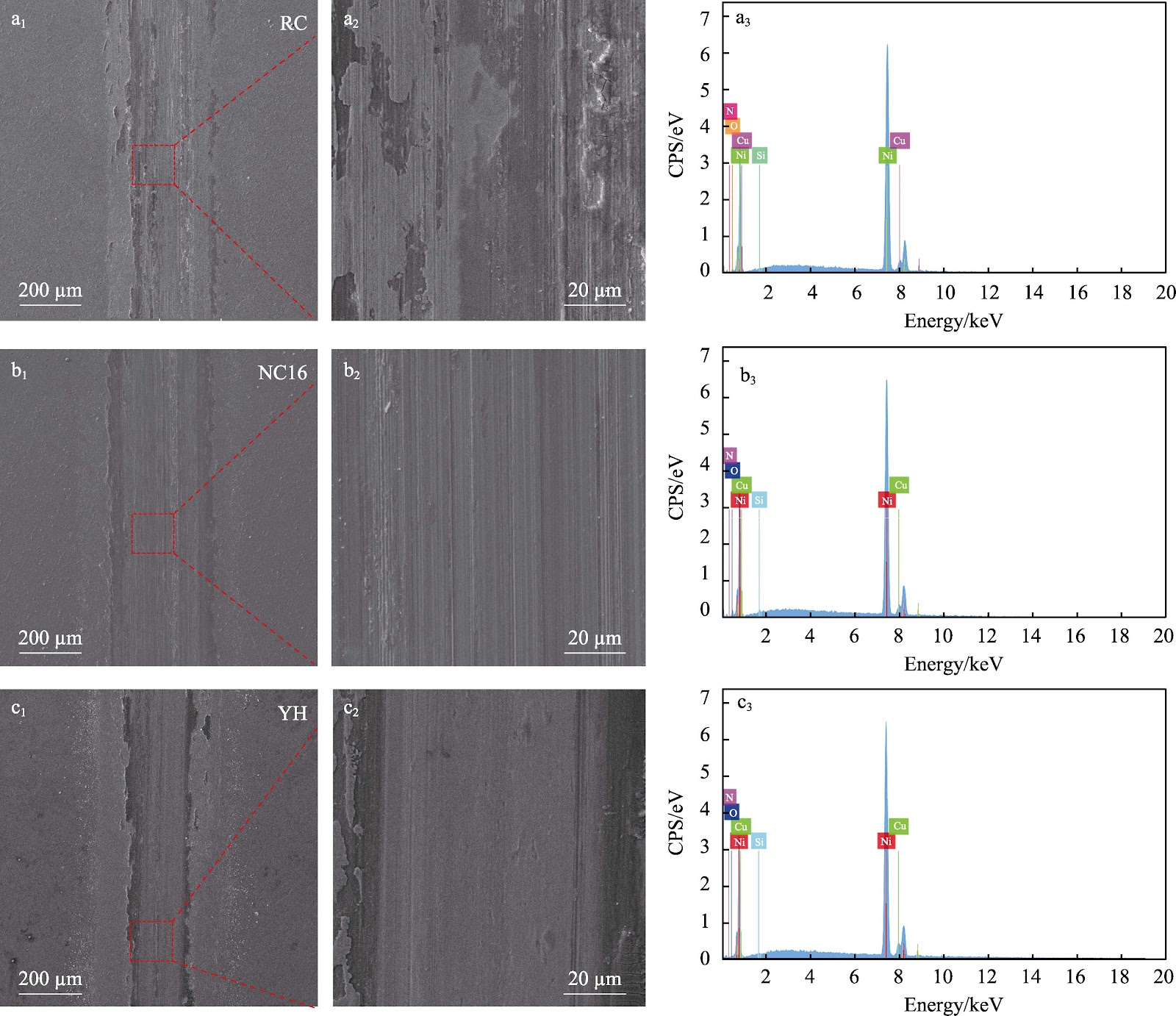
The performance coupling contradictions among corrosion resistance, wear resistance, and thermal conductivity of 6061 aluminum alloy under harsh service conditions were addressed by developing a multi-objective optimization strategy for pulse electrodeposited Ni-Cu coatings. An L16 orthogonal array quantified the effects of current density (1.5–4.5 A/dm²), pulse duty cycle (30%–75%), and pulse frequency (200–1400 Hz) on coating properties. An improved multi-objective Artificial Hummingbird Algorithm (MOAHA) incorporating Fuch chaotic mapping for initial population distribution and an enhanced crowding distance mechanism based on Euclidean metrics was combined with CRITIC-TOPSIS decision-making. The optimized parameters—current density 3.87 A/dm², duty cycle 75%, and frequency 262 Hz—produced a coating (designated YH) with microhardness 273.70 HV0.05, thermal conductivity 11.11 W/(m·K), corrosion current density 1.21 μA/cm², and wear rate 1.092×10⁻⁵ mm³/(N·m). Microstructural analysis confirmed a dense, fine-grained structure without compositional variation, validating that the multi-objective strategy achieves synergistic enhancement of hardness, thermal conductivity, corrosion resistance, and wear resistance. This approach effectively balances the competing performance requirements of Ni-Cu coatings on aluminum alloy, providing a viable technical pathway for surface protection under demanding conditions.