Electrochemical impurity removal from spent ternary lithium battery graphite anodes and their performance study
Authors: Rui Zhang, Yong Tian, Weili Zhang, Jiayin Song, Jie Min, Bo Pang, Jianjun Chen
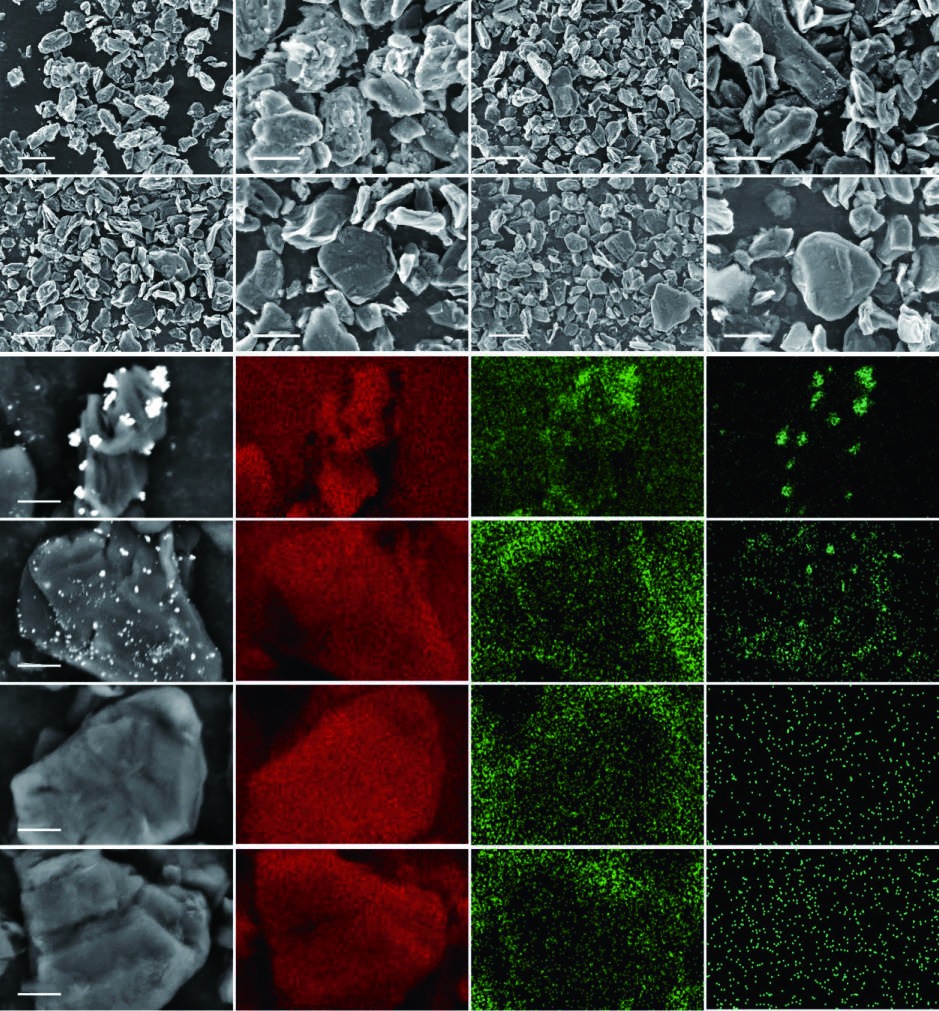
With the rapid development of new energy vehicles, power lithium-ion batteries are increasingly widely used, and a large number of lithium batteries are also ushering in a peak period of retirement. The comprehensive recycling and utilization of spent lithium batteries has attracted high attention from various countries. The layered structure of the graphite anode in spent lithium batteries is basically unchanged, so high-temperature graphitization is not required during recycling, and only the removal of internal impurities needs to be considered. In this paper, the spent graphite anode was treated by heat treatment, ultrasonic separation, and acid leaching, and then an innovative electrochemical treatment was adopted to deeply remove internal metal impurities. Comparing graphite at different recycling stages, it was found that the presence of organic impurities in graphite seriously affects various electrochemical properties, while trace amounts of inorganic impurities such as Cu and Fe have little effect on the initial discharge specific capacity but reduce the cycling stability of graphite. The final recovered graphite had internal major metal impurity content below 20 mg/kg, with a discharge specific capacity of 358.7 mAh/g at 0.1 C rate, and a capacity retention rate of 95.85% after 150 cycles. Compared with reported spent graphite recycling methods, this method can deeply remove impurities inside the graphite anode, solving the problems of large acid-base consumption, incomplete impurity removal, and high energy consumption. The recovered regenerated graphite anode has good electrochemical performance, providing a new recycling and regeneration path for spent lithium battery graphite anodes.