Key Takeaways & Executive Findings
- •• Graphdiyne (GDY) is a novel carbon allotrope with unique sp-sp2 hybridization, uniform pores, and high π-conjugation, offering excellent electronic conductivity and ion transport properties for energy storage. • GDY addresses key challenges in aqueous ion batteries (e.g., Zn, Mg, Al) by improving electrode stability, separator design, and interfacial pH control, enhancing cycling performance and electrochemical stability window. • The bottom-up molecular design of GDY enables facile modification and doping, leading to GDY analogs with optimized structures and superior electrochemical performance. • This review systematically summarizes GDY's structure, properties, synthesis, and its applications in aqueous zinc, magnesium, and aluminum ion batteries, highlighting future research directions and challenges.
Abstract
Graphdiyne (GDY) is a new carbon material with special carbon hybridization arrangement, unique chemical and electronic structure, and unique pore structure, which has good application prospects in the field of electrochemical energy storage. Emerging aqueous ion batteries have the advantages of low cost and high safety. However, the development of high-performance electrode materials, the design of new separator systems, and strategies for stable interfaces are still major challenges for aqueous ion batteries. Graphdiyne can improve ion transport and interface deposition behavior, electrolyte instability, etc. in terms of anode protection, cathode coating, separator design, and stabilizing interface pH. In particular, the bottom-up molecular structure design strategy of graphdiyne makes it easy to modify and dope, and modified graphdiyne analogs have more excellent performance, broadening its application in aqueous ion batteries. This paper systematically reviews the structure, properties, and synthesis methods of graphdiyne, and especially summarizes the research of graphdiyne in aqueous ion batteries. In addition, the existing problems and challenges in the application of graphdiyne in aqueous ion batteries are discussed, and the development of graphdiyne in aqueous ion batteries is prospected.
1. Introduction
In 2010, the discoverers of graphene were awarded the Nobel Prize in Physics. In the same year, Chinese scientist Academician Li Yuliang and his team successfully synthesized a new carbon allotrope film through chemical synthesis, naming it graphdiyne (GDY) [1]. Since then, GDY, which previously existed only in theoretical calculations and not in nature, has been truly presented to humanity, adding a new member to the carbon material family [2–4].
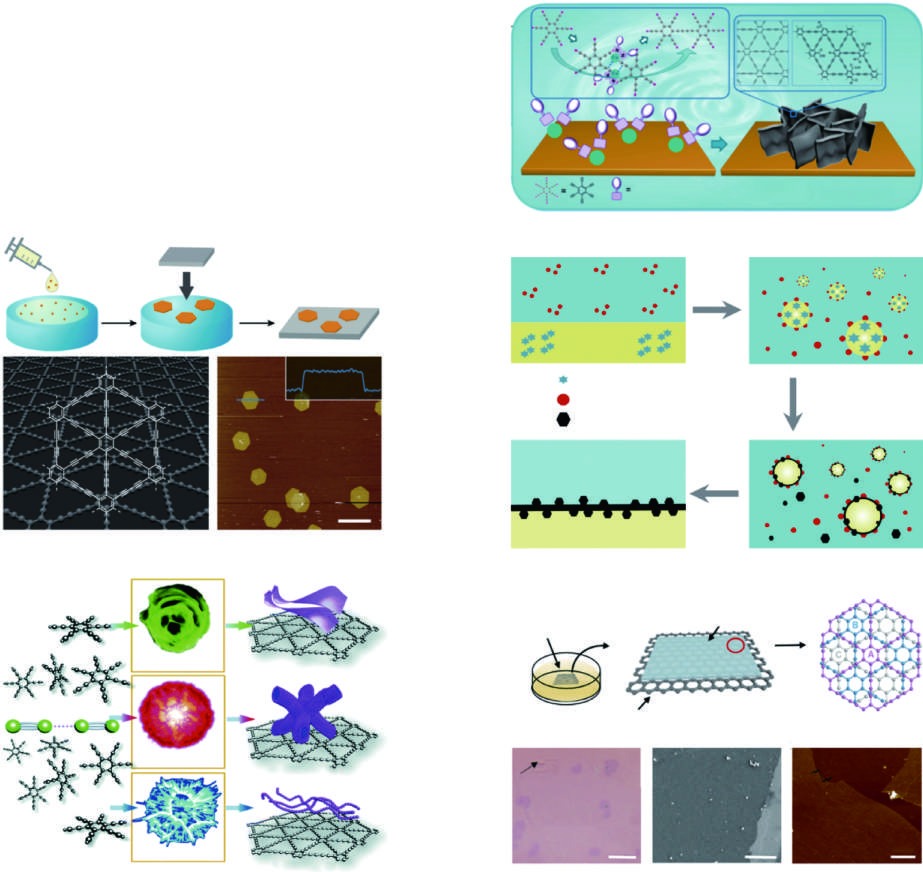
Graphdiyne is a new two-dimensional carbon allotrope with unique sp-sp2 carbon atoms, uniform pores, and a highly π-conjugated structure, giving it broad application prospects in energy, gas separation, catalysis, water remediation, humidity sensors, and related fields [5–13]. GDY has an intrinsic bandgap and is an intrinsic semiconductor. It also has two distinct Dirac cones near the Fermi level, which are special band structures where the energy bands meet at the Fermi level in a conical shape, named after the Dirac equation that describes the energy-momentum relation [14,15]. Studies have shown that Dirac cones are closely related to excellent physical properties such as high carrier mobility. Due to the presence of Dirac cones, GDY exhibits excellent electrical conductivity and carrier mobility [16,17]. Furthermore, GDY possesses both a two-dimensional planar structure and a three-dimensional pore structure, with abundant alkyne units giving a pore size of 5.46 Å, allowing ions to diffuse both in-plane and out-of-plane, making it suitable as an electrode material for high-energy-density storage.
Aqueous ion batteries are secondary batteries that use water as the electrolyte solvent. Compared with traditional non-aqueous ion batteries using organic electrolytes, aqueous ion batteries have advantages such as high safety, low cost, and excellent rate performance, making them a key research direction in electrochemical energy storage [18–23]. Emerging aqueous ion batteries such as aqueous zinc-ion batteries, aqueous magnesium-ion batteries, and aqueous aluminum-ion batteries have developed rapidly in recent years [24–31]. However, the poor cycling performance, narrow electrochemical stability window, and many side reactions of aqueous ion batteries restrict their development. Graphdiyne has excellent electrochemical stability, and its porous structure can adjust the solvation structure, facilitating the formation of a stable and uniform electrode-electrolyte interphase (SEI) layer, thus effectively addressing the issues of poor cycling performance, narrow electrochemical stability window, and side reactions in aqueous ion batteries [32,33]. Therefore, graphdiyne has achieved good applications in the development of high-performance electrode materials, design of novel separator systems, and strategies for stable interfaces in aqueous ion batteries. In addition, the bottom-up molecular structure design strategy of graphdiyne makes it easy to modify and dope, and the configuration and electronic arrangement of modified graphdiyne analogs are optimized, enhancing ion transport and electron transport capabilities, expanding its application in aqueous ion batteries [34].
Loading authentic research manuscript (Pages 1–5)...
Xu Xianmin, Feng Wencong, Ren Jingke, Luo Wen (2024). Research progress of graphdiyne in aqueous ion batteries. New Carbon Materials. https://doi.org/10.1016/S1872-5805_N
Research & Educational Purpose Only:The translations, structured abstracts, analytical annotations, and data reports provided by SinoTechIntel are intended exclusively for academic research, internal corporate R&D, and educational benchmarking. They do not constitute formal engineering, chemical safety, legal, or professional advice.
Copyright & Intellectual Property Notice: Original copyright of the underlying source articles and experimental data remains with the respective authors, institutions, and original publishing journals. SinoTechIntel claims intellectual property only over its proprietary translations, analytical syntheses, and AEO structured enhancements in accordance with international fair use and academic citation principles.
Frequently Asked Questions
What is graphdiyne (GDY)?
Graphdiyne is a new two-dimensional carbon allotrope composed of sp- and sp2-hybridized carbon atoms, featuring a unique porous structure and high π-conjugation. It was first synthesized in 2010 by Li Yuliang's team and has shown promise in energy storage applications.
Why are aqueous ion batteries important?
Aqueous ion batteries use water as the electrolyte solvent, offering advantages such as high safety, low cost, and excellent rate performance compared to traditional organic electrolyte batteries. They are considered a promising direction for large-scale energy storage.
How does graphdiyne improve aqueous ion batteries?
Graphdiyne can enhance the performance of aqueous ion batteries by improving electrode stability, facilitating uniform ion deposition, designing effective separators, and stabilizing the electrode-electrolyte interface pH, thereby addressing issues like poor cycling stability and narrow electrochemical windows.
What are the main challenges for graphdiyne in aqueous ion batteries?
Challenges include the need for scalable synthesis methods, understanding the long-term stability of GDY in aqueous environments, and optimizing its performance in different battery chemistries. Further research is required to fully exploit its potential.
What are the future directions for graphdiyne research in aqueous ion batteries?
Future research may focus on developing modified graphdiyne analogs with enhanced properties, exploring new battery systems, and integrating GDY into practical devices. Additionally, understanding the fundamental mechanisms of ion transport and interfacial reactions will be crucial.
Related Technical Papers & Translations

Design and optimization of a high-efficiency distillation process for cellulosic fuel ethanol integrated with thermal coupling and molecular sieve adsorption
To address the challenges of high energy consumption and prominent costs in the traditional three-columns distillation process for cellulosic fuel ethanol, a distillation—molecular sieve coupling separation process is proposed. This process integrates a three-column (crude distillation column, first distillation column, second distillation column) system with a 3A molecular sieve adsorption deep dehydration unit. A thermal coupling network is constructed via differential pressure design (steam from medium/high-pressure columns as mutual heat sources, reboiler liquid waste heat for feed preheating), and molecular sieve adsorption conditions are optimized. The study first performs a thermodynamic consistency test on the ethanol—water system, determines optimal non-random two-liquid (NRTL) model binary interaction parameters via experimental data regression for Aspen Plus simulation. Aiming at minimum total annual cost (TAC), Aspen Plus is used to optimize process parameters (theoretical tray number, feed location, reflux ratio, side-draw position, etc.). Economic analysis shows this process reduces CO2 emission costs by 27.56%, TAC by 15.58% (to 5.123 × 10⁶ USD·a-1), and increases ethanol purity to >99.6%, providing an effective solution for green, efficient separation.

A cohesion loss model for determining residual strength of deep bedded sandstone
Rock residual strength, as an important input parameter, plays an indispensable role in proposing the reasonable and scientific scheme about stope design, underground tunnel excavation and stability evaluation of deep chambers. Therefore, previous residual strength models of rocks established were reviewed. And corresponding related problems were stated. Subsequently, starting from the effects of bedding and whole life-cycle evolution process, series of triaxial mechanical tests of deep bedded s

Federated model with contrastive learning and adaptive control variates for human activity recognition
Recent attention to privacy issues demands a communication-safe method for training human activity recognition (HAR) models on client activity data. Federated learning (FL) has become a compelling technique to facilitate model training between the server and clients while preserving data privacy. However, classical FL methods often assume independent and identically distributed (IID) data among clients. This assumption does not hold true in practical scenarios. Human activity in real-world scena