Key Takeaways & Executive Findings
- •• Bimetallic catalysts overcome limitations of single-metal catalysts by altering electronic structure and creating novel active sites, enhancing CO2 reduction performance. • The review systematically covers synthesis methods, characterization techniques, and catalytic mechanisms for both atomically dispersed and non-atomic bimetallic catalysts. • Synergistic effects between adjacent metal atoms optimize intermediate adsorption, improving selectivity and activity for desired products. • Challenges such as competing hydrogen evolution and complex reaction pathways are addressed, guiding future catalyst design.
Abstract
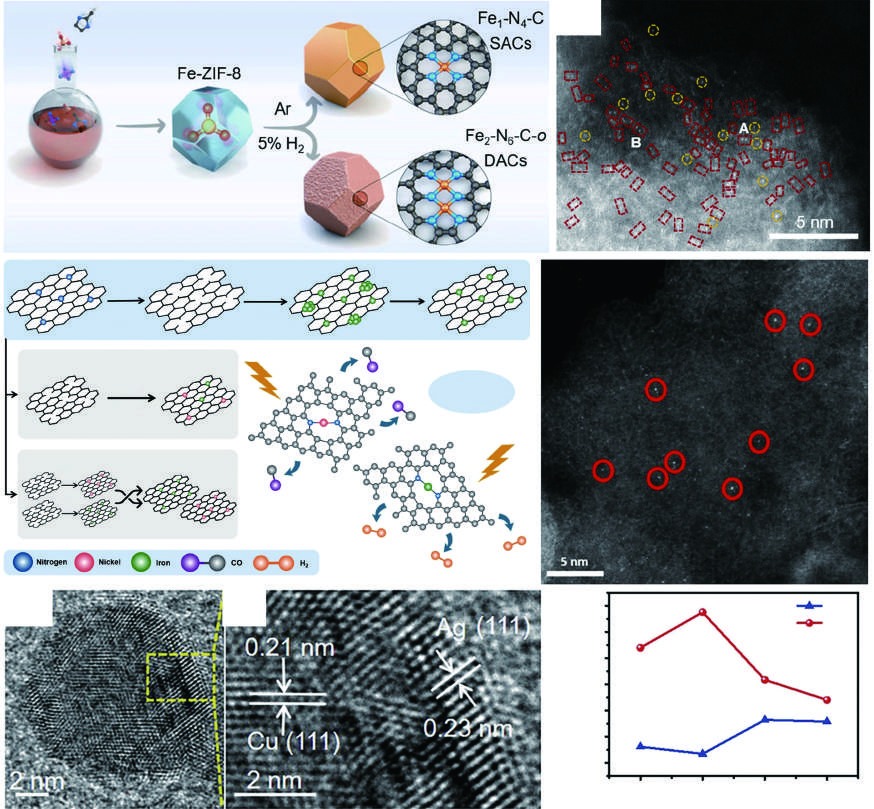
The electrocatalytic CO2 reduction reaction (CO2RR) is an environmentally friendly way to convert CO2 into valuable chemicals. However, CO2 conversion is a complex process, which contains 2, 4, 6, 8, and 12 electron transfer processes. It is very important to develop efficient catalysts to precisely control the number of electron transfers for the chemicals required. Single-metal catalysts have some deficiencies, including slow reaction kinetics, low product selectivity and inadequate stability. In response to these challenges, bimetallic catalysts have received significant attention owing to their unique structure and improved performance. The introduction of secondary metals alters the catalyst’s electronic structure, and creates novel active sites, as well as optimizing their interaction with the intermediates. This review provides a comprehensive account of atomically distributed bimetals based on carbon materials and non-atomic distributed bimetals such as alloys and heterostructures, including their synthesis methods, characterization, and the outcomes of different catalysts. Catalytic mechanisms of different bimetallic catalysts are proposed and challenges encountered in the CO2RR are considered.
1. Introduction
Carbon dioxide emissions resulting from the overconsumption of fossil fuels have led to serious climate hazards, the overarching effects of which are often irreversible within 1,000 years. As a result, it is imperative to either reduce CO2 emissions or convert it to valuable chemicals. The electroreduction of CO2 is an effective and clean strategy for CO2 reduction. CO2 reduction involves a variety of reaction paths (Table 1). Commonly there are 2, 4, 6, 8 and 12 electron transfer processes. The resulting products, such as CO and syngas (CO+H2), can be used to produce hydrocarbons or oxygenates by the Fischer-Tropsch synthesis method, and other chemicals such as methanol, formaldehyde, methane, ethanol, and several others can also be obtained from CO2 reduction. The products of CO2 reduction are sensitive to the practical applications and tends to produce a variety of products, which is one of the significant challenges in this area. On the other hand, considerable thermodynamic and kinetic barriers caused by the stable C=O bond exist in the process of CO2 reduction. Additionally, a competing hydrogen evolution reaction (HER) is also unavoidable. Therefore, it is of great significance to develop efficient catalysts to improve CO2 reduction reaction (CO2RR).
Single-atom catalysts (SACs) have attracted significant attention in the field of CO2RR due to their good catalytic performance. The unsaturated coordination configuration of atoms in SACs makes them more active in many reactions. In addition, SACs allow for the design of active sites with well-defined positions through the tunable coordination environment, resulting in excellent activity and selectivity for specific reactions. For instance, Yang et al. designed a catalyst containing high dispersions of Fe-N4 moieties with a hierarchical structure, which prevented the migration and aggregation of Fe3+ due to the strong binding between metal ions and nitrogen. The porous structure of the catalyst also facilitated fast ion transfer and allowed for sufficient exposure of active sites, ultimately improving the selectivity of the catalyst. The Faraday efficiency of CO (FECO) achieved by this catalyst was up to 89%. However, SAC has only one active site and faces challenges in breaking the linear proportional relationship between intermediates when more complex reactions are conducted.
Recent researches have shown that the synergistic effect between adjacent atoms in bimetallic catalysts can significantly improve catalytic performance compared to isolated atoms. First, the introduction of secondary metals can alter the electronic structure of catalyst surface, thereby optimizing the adsorption and desorption of intermediates, and ultimately improving catalytic efficiency. For example, Gao et al. prepared In-Ga metal-organic-frameworks with abundant In-Ga bimetallic sites (InGa MOFs). The atomic bridging between Ga and In atoms effectively optimized the electronic structure of In, weakening In-C hybridization and enhancing In-O hybridization. This modification reduced the adsorption of the key intermediate *COOH involved in the competitive CO pathway, while enhancing the adsorption of *OCHO (formate pathway), in the end, promoting CO2 reduction.
Loading authentic research manuscript (Pages 1–5)...
LIAO Yin-li, HUANG Heng-bo, ZOU Ru-yu, SHEN Shu-ling, LIU Xin-juan, TANG Zhi-hong (2024). A review of the synthesis, characterization, and mechanism of bimetallic catalysts for electrocatalytic CO2 reduction. New Carbon Materials. https://doi.org/10.1016/S1872-5805_N
Research & Educational Purpose Only:The translations, structured abstracts, analytical annotations, and data reports provided by SinoTechIntel are intended exclusively for academic research, internal corporate R&D, and educational benchmarking. They do not constitute formal engineering, chemical safety, legal, or professional advice.
Copyright & Intellectual Property Notice: Original copyright of the underlying source articles and experimental data remains with the respective authors, institutions, and original publishing journals. SinoTechIntel claims intellectual property only over its proprietary translations, analytical syntheses, and AEO structured enhancements in accordance with international fair use and academic citation principles.
Frequently Asked Questions
What are the main advantages of bimetallic catalysts over single-metal catalysts for CO2 reduction?
Bimetallic catalysts offer improved catalytic performance due to synergistic effects between adjacent metal atoms. They can alter the electronic structure, create novel active sites, and optimize intermediate adsorption, leading to higher activity, selectivity, and stability compared to single-metal catalysts.
What types of bimetallic catalysts are discussed in this review?
The review covers atomically distributed bimetals based on carbon materials (such as dual-atom catalysts) and non-atomic distributed bimetals like alloys and heterostructures. It discusses their synthesis methods, characterization, and catalytic performance.
How do bimetallic catalysts improve the selectivity of CO2 reduction products?
By tuning the electronic structure and geometry, bimetallic catalysts can stabilize specific reaction intermediates, thereby directing the reaction pathway toward desired products. For example, In-Ga bimetallic sites weaken *COOH adsorption (CO pathway) and enhance *OCHO adsorption (formate pathway), promoting formate production.
What are the key challenges in CO2 electroreduction that bimetallic catalysts address?
Challenges include slow reaction kinetics, low product selectivity, competing hydrogen evolution reaction, and stability issues. Bimetallic catalysts help overcome these by providing synergistic active sites that lower activation barriers, suppress HER, and enhance durability.
What is the significance of this review for future research?
This review provides a comprehensive understanding of bimetallic catalyst design, synthesis, and mechanisms, offering guidance for developing more efficient and selective catalysts for CO2 conversion, which is crucial for sustainable energy and environmental remediation.
Related Technical Papers & Translations

Design and optimization of a high-efficiency distillation process for cellulosic fuel ethanol integrated with thermal coupling and molecular sieve adsorption
To address the challenges of high energy consumption and prominent costs in the traditional three-columns distillation process for cellulosic fuel ethanol, a distillation—molecular sieve coupling separation process is proposed. This process integrates a three-column (crude distillation column, first distillation column, second distillation column) system with a 3A molecular sieve adsorption deep dehydration unit. A thermal coupling network is constructed via differential pressure design (steam from medium/high-pressure columns as mutual heat sources, reboiler liquid waste heat for feed preheating), and molecular sieve adsorption conditions are optimized. The study first performs a thermodynamic consistency test on the ethanol—water system, determines optimal non-random two-liquid (NRTL) model binary interaction parameters via experimental data regression for Aspen Plus simulation. Aiming at minimum total annual cost (TAC), Aspen Plus is used to optimize process parameters (theoretical tray number, feed location, reflux ratio, side-draw position, etc.). Economic analysis shows this process reduces CO2 emission costs by 27.56%, TAC by 15.58% (to 5.123 × 10⁶ USD·a-1), and increases ethanol purity to >99.6%, providing an effective solution for green, efficient separation.

A cohesion loss model for determining residual strength of deep bedded sandstone
Rock residual strength, as an important input parameter, plays an indispensable role in proposing the reasonable and scientific scheme about stope design, underground tunnel excavation and stability evaluation of deep chambers. Therefore, previous residual strength models of rocks established were reviewed. And corresponding related problems were stated. Subsequently, starting from the effects of bedding and whole life-cycle evolution process, series of triaxial mechanical tests of deep bedded s

Federated model with contrastive learning and adaptive control variates for human activity recognition
Recent attention to privacy issues demands a communication-safe method for training human activity recognition (HAR) models on client activity data. Federated learning (FL) has become a compelling technique to facilitate model training between the server and clients while preserving data privacy. However, classical FL methods often assume independent and identically distributed (IID) data among clients. This assumption does not hold true in practical scenarios. Human activity in real-world scena