SinoTechIntel Academic Portal
🏛️ Indexed Academic JournalImpact Factor: 3.7 (Q2 - Elsevier)Original: 新型炭材料

New Carbon Materials

3.7 (Q2 - Elsevier)

Total Research Papers: 47
Access: 100% Free Open Access
Browse by Publication Year & VolumeReset All Filters ✕

Published Research PapersFiltered: Year 2024 • Vol. 39 • Issue 5

Showing 5 of 47 peer-reviewed papers with full Graphical Abstracts.

Original ResearchVol. 39, Issue 5 • pp. 824-843DOI: 10.1016/S1872-5805_NJan 15, 2024

Recent advances in producing hollow carbon spheres for use in sodium−sulfur and potassium−sulfur batteries

Authors: QI Zi-xin, LUO Sai-nan, RUAN Jia-feng, YUAN Tao, PANG Yue-peng, YANG Jun-he, ZHENG Shi-you

Sodium-sulfur (Na-S) and potassium-sulfur (K-S) batteries for use at room temperature have received widespread attention because of the abundance and low cost of their raw materials and their high energy density. However, their development is restricted by the shuttling of polysulfides, large volume expansion and poor conductivity. To overcome these obstacles, an effective approach is to use carbon-based materials with abundant space for the sulfur that has sulfiphilic sites to immobilize it, and a high electrical conductivity. Hollow carbon spheres (HCSs) with a controllable structure and composition are promising for this purpose. We consider recent progress in optimizing the electrochemical performance of Na-/K-S batteries by using these materials. First, the advantages of HCSs, their synthesis methods, and strategies for preparing HCSs/sulfur composite materials are reviewed. Second, the use of HCSs in Na-/K-S batteries, along with mechanisms underlying the resulting performance improvement, are discussed. Finally, prospects for the further development of HCSs for metal−S batteries are presented.
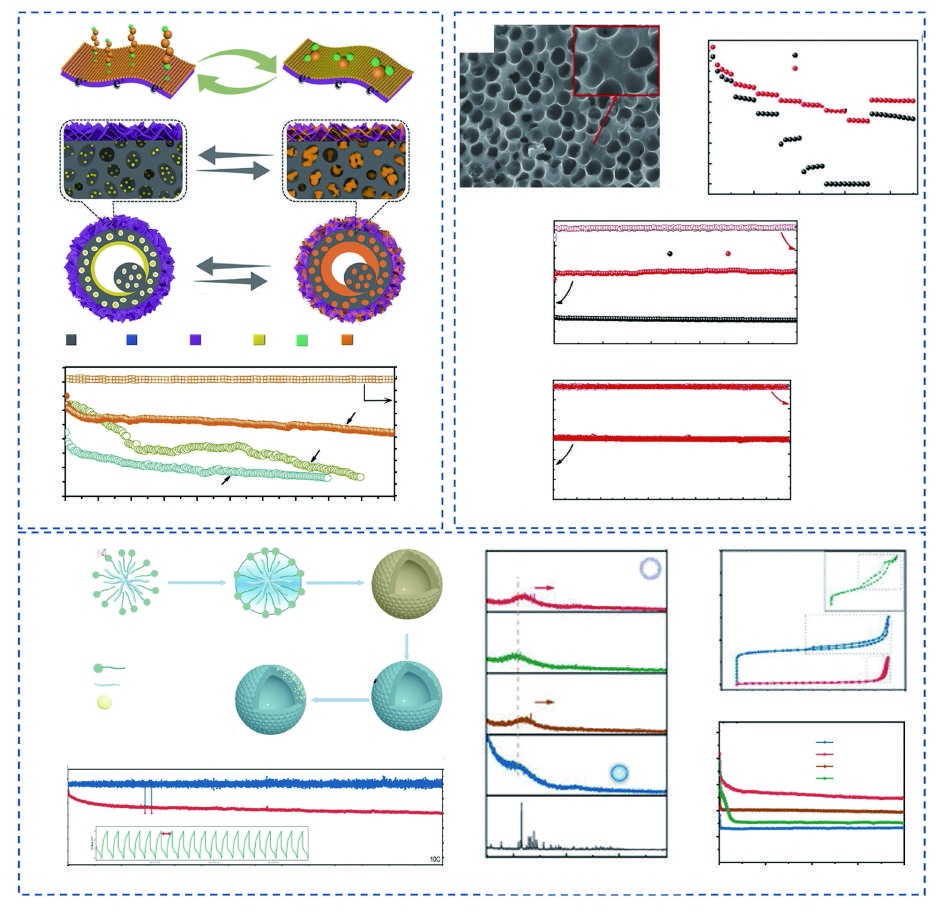
Recent advances in producing hollow carbon spheres for use in sodium−sulfur and potassium−sulfur batteries
Graphical Abstract
Original ResearchVol. 39, Issue 5 • pp. 796-823DOI: 10.1016/S1872-5805_NJan 15, 2024

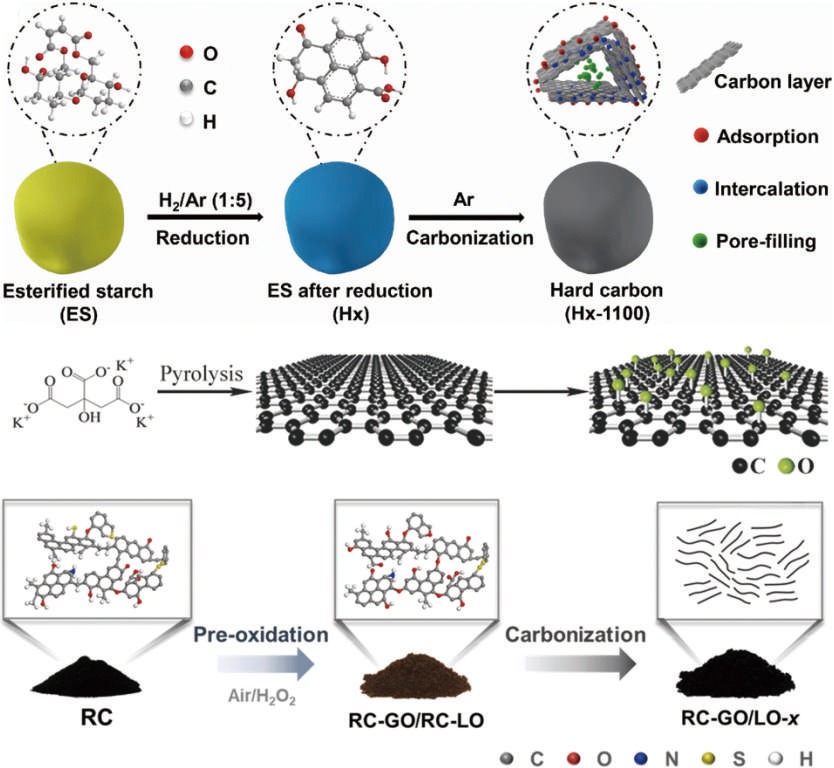
A review of hard carbon anodes for rechargeable sodium-ion batteries

Authors: MU Bao-yi, CHI Chun-lei, YANG Xin-hou, HUANGFU Chao, QI Bin, WANG Guan-wen, LI Zhi-yuan, SONG Lei, WEI Tong, FAN Zhuang-jun

Hard carbons (HCs) are recognized as potential anode materials for sodium-ion batteries (SIBs) because of their low cost, environmental friendliness, and the abundance of their precursors. The presence of graphitic domains, numerous pores, and disordered carbon layers in HCs plays a significant role in determining their sodium storage ability, but these structural features depend on the precursor used. The influence of functional groups, including heteroatoms and oxygen-containing groups, and the microstructure of the precursor on the physical and electrochemical properties of the HC produced are evaluated, and the effects of carbonization conditions (carbonization temperature, heating rate and atmosphere) are also discussed.

A review of hard carbon anodes for rechargeable sodium-ion batteries
Graphical Abstract
Original ResearchVol. 39, Issue 5 • pp. 770-795DOI: 10.1016/S1872-5805_NJan 15, 2024

The preparation and properties of N-doped carbon materials and their use for sodium storage

Authors: YUAN Ren-lu, HOU Ruo-yang, SHANG Lei, LIU Xue-wei, LI Ang, CHEN Xiao-hong, SONG Huai-he

Defect engineering by heteroatom doping gives carbon materials some new characteristics such as a different electronic structure and a high electrochemical activity, making them suitable for high-performance applications. N-doping has been widely investigated because of its similar atom radius to carbon, high electronegativity as well as many different configurations. We summarize the preparation methods and properties of N-doped carbon materials, and discuss their possible use in sodium ion storage. The relationships between N content/configuration and crystallinity, electronic conductivity, wettability, chemical reactivity as well as sodium ion storage performance are discussed.

The preparation and properties of N-doped carbon materials and their use for sodium storage
Graphical Abstract
Original ResearchVol. 39, Issue 5 • pp. 100-112DOI: 10.1016/S1872-5805_NJan 15, 2024

A review of anode materials for sodium ion batteries

Authors: Syed Ali Riza, Xu Ri-gan, Liu Qi, Muhammad Hassan, Yang Qiang, Mu Dao-bin, Li Li, Wu Feng, Chen Ren-jie

Lithium-ion batteries (LIBs) are used in electric vehicles and portable smart devices, but lithium resources are dwindling and there is an increasing demand which has to be catered for. Sodium ion batteries (SIBs), which are less costly, are a promising replacement for LIBs because of the abundant natural reserves of sodium. The anode of a SIB is a necessary component of the battery but is less understood than the cathode. This review outlines the development of various types of anodes, including carbon-based, metallic and organic, which operate using different reaction mechanisms such as intercalation, alloying and conversion, and considers their challenges and prospects. Strategies for modifying their structures by doping and coating, and also modifying the solid electrolyte interface are discussed. In addition, this review also discusses the challenges encountered by the anode of SIBs and the solutions.

A review of anode materials for sodium ion batteries
Graphical Abstract
Original ResearchVol. 39, Issue 5 • pp. 729-740DOI: 10.1016/S1872-5805_NJan 15, 2024

High-Energy-Density and Fast-Charging Sodium-Ion Battery Carbon Anodes: Progress and Challenges

Authors: Jinghong Li, Yibo Zhang, Yiran Jia, Chenxu Yang, Yue Chu, Jun Zhang, Ying Tao, Quanhong Yang

Sodium-ion batteries (SIBs) have become the preferred next-generation non-resource-limited high-efficiency energy storage system due to their excellent fast-charging capability, low-temperature performance, and the abundance and low cost of sodium resources. Amorphous carbon materials, as key anode materials for the practical application of SIBs, possess advantages such as high initial Coulombic efficiency, low sodium insertion plateau, and good stability. However, current amorphous carbon anodes suffer from sluggish plateau sodium storage kinetics and the inability to simultaneously achieve high plateau capacity and high plateau potential, making it difficult to comprehensively balance fast-charging performance, energy density, and safety, which severely hinders the industrialization of SIBs. This review focuses on the key bottlenecks restricting the development of carbon anodes for SIBs, analyzes the kinetic behavior of each elementary step in the plateau sodium storage of amorphous carbon, and summarizes the research progress on constructing high-energy-density and fast-charging SIBs from two aspects: electrode–electrolyte interface and microstructure regulation of amorphous carbon. It also discusses the key factors affecting plateau sodium storage kinetics and plateau potential. Finally, it provides a brief commentary and outlook on the development direction and key challenges of carbon anodes for SIBs, aiming to promote the development of practical carbon anode materials for SIBs.

High-Energy-Density and Fast-Charging Sodium-Ion Battery Carbon Anodes: Progress and Challenges
Graphical Abstract