Physical Trend for Critical Temperature in Bi2Sr2CaCu2O8 High-temperature Superconductors
Authors: SHI Xun
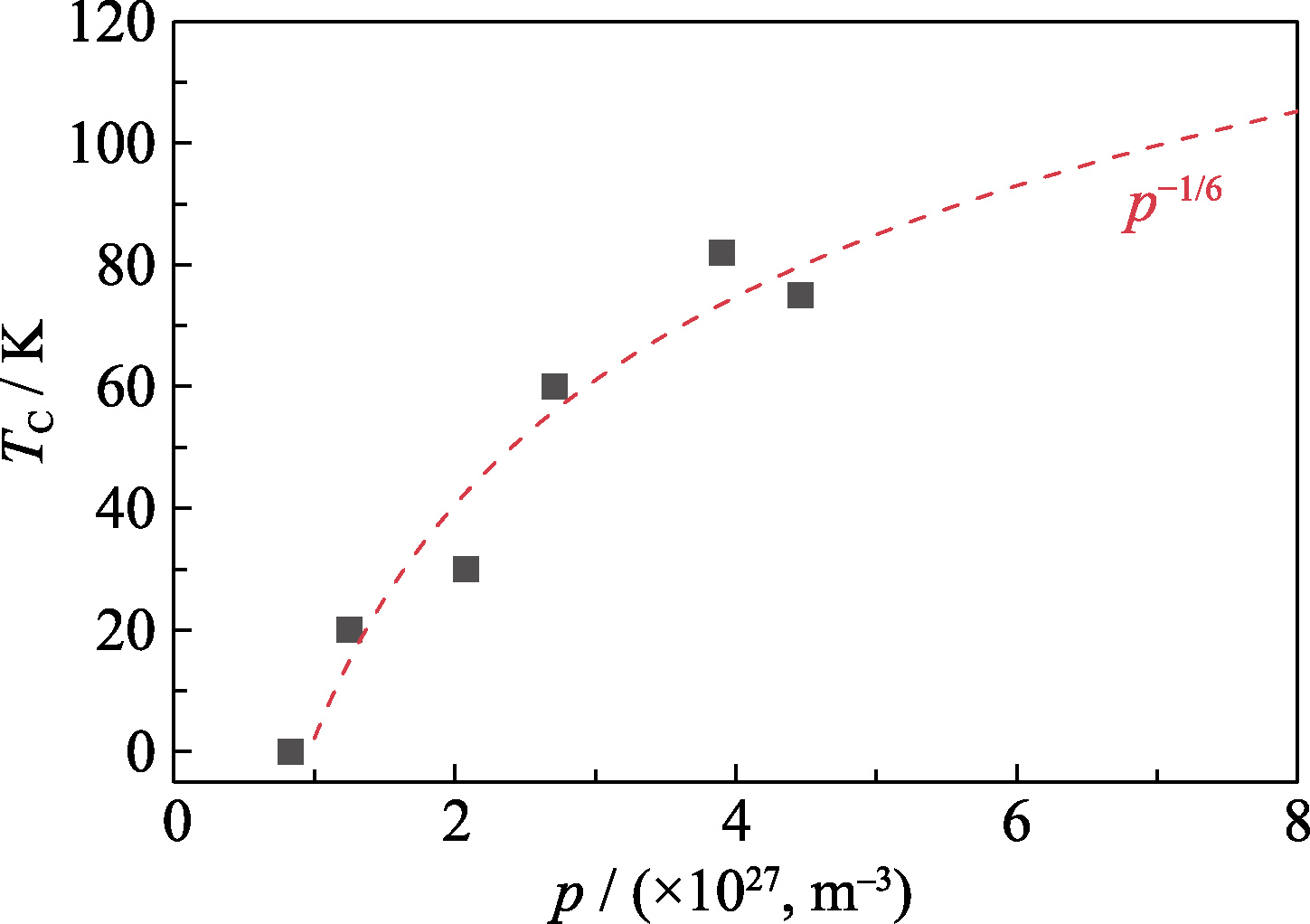
Superconductivity remains a central challenge in condensed matter physics and materials science, with high-temperature superconductors lacking a unified theoretical framework. This work investigates the relationship between critical temperature (TC) and hole concentration in Y-doped Bi2Sr2CaCu2O8 (Bi-2212), a cuprate superconductor. By systematically varying the hole concentration through Y substitution, we establish a power-law scaling: TC ∝ p^0.5, where p is the hole concentration per CuO2 plane. The exponent of 0.5 indicates a quadratic dependence, suggesting that increased hole concentration enhances superconducting pairing strength. Our data reveal that TC increases monotonically with hole concentration up to the optimal doping level, reaching a maximum of 95 K at p ≈ 0.16, beyond which over-doping suppresses superconductivity. This trend holds across the under-doped and optimally-doped regimes, providing a predictive tool for optimizing TC in Bi-2212 and related cuprates. The findings underscore that hole concentration is a critical control parameter, and achieving high TC requires precise doping control. This work offers practical guidance for the design of new high-temperature superconductors with enhanced performance, potentially enabling operation at liquid-nitrogen temperatures and above, which is crucial for technological applications such as magnetic resonance imaging, particle accelerators, and power transmission.