Key Takeaways & Executive Findings
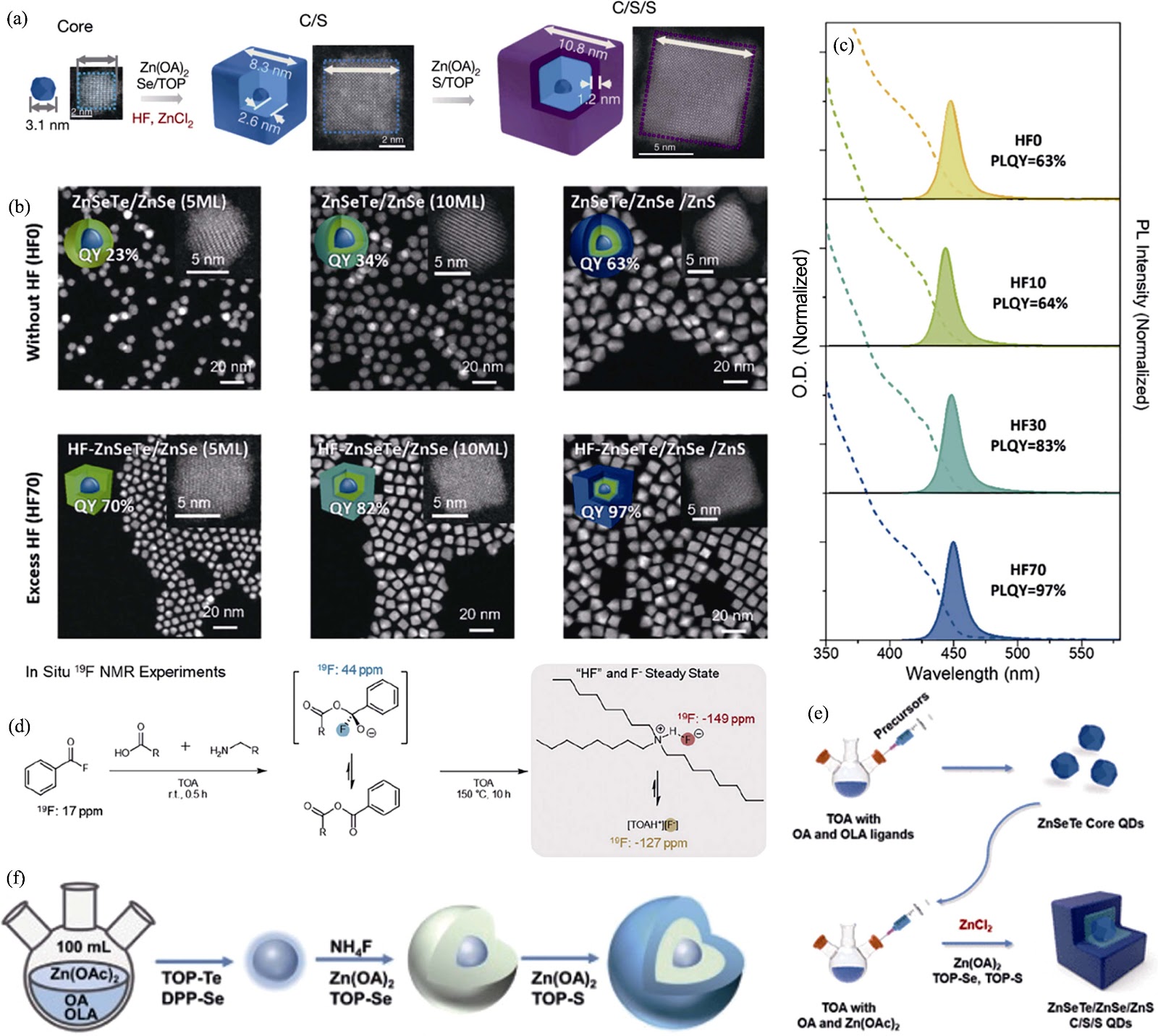
- •• • ZnSeTe QDs achieve near-unity photoluminescence quantum yield (PL QY) up to ~100% through NH4F molecular-assisted synthesis, enabling highly efficient blue QLEDs with external quantum efficiency (EQE) exceeding 20% (ref. [49]). This addresses the critical efficiency bottleneck for heavy-metal-free blue emitters. • • Shell engineering reduces emission linewidth to ~20 nm for pure-blue ZnSeTe QDs, achieving high color purity with CIE coordinates approaching (0.15, 0.06) (ref. [55]). This meets the stringent color gamut requirements for next-generation displays (e.g., BT.2020). • • Morphological inhomogeneity in ZnSe1–XTeX nanocrystals significantly impacts excitonic states, with Te composition fluctuations causing spectral broadening and efficiency loss (ref. [43]). Controlling Te homogeneity via molecular additives (e.g., tellurium homogenization) is essential for stable blue emission. • • ZnF2-assisted synthesis of InP/ZnSe/ZnS QDs demonstrates that fluoride-based surface treatments can enhance electroluminescence stability, with device operational lifetime (LT50) exceeding 1000 hours at 100 cd/m² (ref. [44]). This strategy is transferable to ZnSeTe systems to mitigate degradation.
Abstract
Colloidal quantum dots (QDs) are promising emissive materials for optoelectronic devices owing to their tunable emission wavelength, high color purity, and solution processability. Quantum-dot light-emitting diodes (QLEDs), an important complementary technology to organic light-emitting diodes, have demonstrated considerable potential in display applications. However, the inherent toxicity of conventional Cd- and Pb-based QDs has driven the development of heavy-metal-free QDs systems. Currently, heavy-metal-free blue QLEDs still lag significantly behind their red and green counterparts in device efficiency and operational stability, representing a critical bottleneck to their practical application. To address this issue, ZnSeTe QDs have attracted significant research interest due to their tunable bandgap and excellent blue emission properties. In this work, a comprehensive review of ZnSeTe QDs is provided. Firstly, their nucleation and growth mechanisms, as well as typical synthesis methods are introduced, and the key factors affecting their optical properties are discussed. On this basis, various performance optimization strategies, including band engineering, surface etching, shell passivation, and ligand regulation, are systematically summarized. Furthermore, electroluminescence mechanisms of QLEDs and recent progress on the application of ZnSeTe QDs in blue-emitting devices are reviewed. Finally, the current challenges, such as low emission efficiency, limited device lifetime, and charge injection imbalance, are discussed, and potential future development directions are proposed.
1. Introduction
Conventional Cd- and Pb-based quantum dots (QDs) offer superior optical properties but pose severe toxicity and environmental hazards, restricting their commercialization in displays and lighting. Heavy-metal-free alternatives such as InP and ZnSeTe have emerged, yet blue-emitting devices based on these materials suffer from low efficiency and poor operational stability compared to their red and green counterparts. The primary bottleneck lies in achieving high photoluminescence quantum yield (PL QY) and spectral stability while maintaining balanced charge injection in device architectures.
This review systematically addresses these challenges by focusing on ZnSeTe QDs, which exhibit tunable bandgap and excellent blue emission. It details nucleation and growth mechanisms, synthesis methods, and key factors affecting optical performance. Optimization strategies including band engineering, surface etching, shell passivation, and ligand regulation are critically analyzed. Recent advances demonstrate near-unity PL QY and narrow emission linewidths, yet device lifetime remains limited. The review identifies charge injection imbalance and defect-mediated degradation as major hurdles, proposing future directions such as advanced shell structures and interface engineering to achieve industrially viable blue QLEDs.
Loading authentic research manuscript (Pages 1–5)...
FEI Wenlong, WANG Yakun, LIAO Liangsheng (2026). Research Progress on Controllable Synthesis of Blue-emitting ZnSeTe Quantum Dots and Quantum-dot Light-emitting Diode Devices. Journal of Inorganic Materials (无机材料学报). https://doi.org/10.15541/jim20260115
Research & Educational Purpose Only:The translations, structured abstracts, analytical annotations, and data reports provided by SinoTechIntel are intended exclusively for academic research, internal corporate R&D, and educational benchmarking. They do not constitute formal engineering, chemical safety, legal, or professional advice.
Copyright & Intellectual Property Notice: Original copyright of the underlying source articles and experimental data remains with the respective authors, institutions, and original publishing journals. SinoTechIntel claims intellectual property only over its proprietary translations, analytical syntheses, and AEO structured enhancements in accordance with international fair use and academic citation principles.
Frequently Asked Questions
What is the highest reported external quantum efficiency (EQE) for blue ZnSeTe QLEDs, and what synthesis strategy enables this performance?
The highest reported EQE for blue ZnSeTe QLEDs exceeds 20%, achieved through NH4F molecular-assisted synthesis that yields near-unity photoluminescence quantum yield (PL QY ~100%) (ref. [49]). This fluoride-assisted approach effectively passivates surface defects and improves radiative recombination.
How does Te composition inhomogeneity affect the emission linewidth and color purity of ZnSeTe QDs, and what mitigation strategies exist?
Te composition fluctuations cause spectral broadening and reduced color purity. For instance, morphological inhomogeneity in ZnSe1–XTeX nanocrystals leads to excitonic state variations (ref. [43]). Mitigation strategies include molecular-additive-assisted tellurium homogenization (ref. [47]) and shell engineering to reduce linewidth to ~20 nm (ref. [55]), achieving high color purity.
What are the primary degradation mechanisms limiting the operational lifetime of blue ZnSeTe QLEDs, and how can they be addressed?
Degradation is primarily driven by charge injection imbalance and defect-mediated non-radiative recombination under electrical stress. ZnF2-assisted synthesis has been shown to enhance electroluminescence stability in InP-based QDs, with LT50 exceeding 1000 hours at 100 cd/m² (ref. [44]). Similar fluoride treatments and robust shell passivation are proposed for ZnSeTe to improve device longevity.
What are the scalability challenges for synthesizing high-quality ZnSeTe QDs for industrial production?
Scalability challenges include maintaining Te homogeneity and shell uniformity across large batches. Molecular-additive-assisted synthesis (ref. [47]) and controlled shell growth (ref. [56]) have demonstrated near-unity PL QY, but these methods must be adapted to high-volume reactors. Additionally, the use of air-stable precursors and low-cost processing is critical for cost parity with Cd-based QDs.
How do the optical properties of ZnSeTe QDs compare to Cd-based blue emitters in terms of color purity and efficiency?
ZnSeTe QDs can achieve near-unity PL QY and narrow emission linewidths (~20 nm), comparable to Cd-based QDs. However, blue ZnSeTe QLEDs still lag in operational stability. Recent advances in shell engineering and ligand passivation have narrowed the efficiency gap, with EQE exceeding 20% (ref. [49]), but further improvements in device lifetime are needed for commercial adoption.
Related Technical Papers & Translations
Blasting Failure Characteristics of Rock Specimens under In-Hole Layered Column Charge
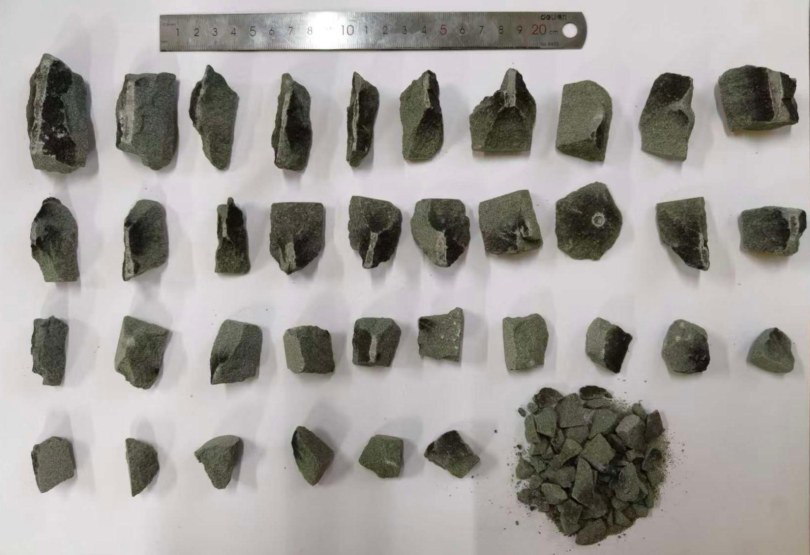
To improve rock fragmentation in open-pit deep-hole blasting, an in-hole layered column charge configuration was designed. Small-scale blasting tests on sandstone specimens were conducted under continuous and layered column charges to capture the failure process and final fragmentation. DEM-PBM coupled simulations visualized the dynamic fracture evolution and validated the experimental observations. Results show that under continuous charge, the top quarter of the specimen developed only a single blast-induced crack, splitting it into two parts, with horizontal fragment velocity of 2.0 m·s⁻¹ and a maximum block size of 9.0 cm. In contrast, layered charge produced multiple cracks in the top quarter, fragmenting it into smaller pieces, increasing horizontal velocity to 7.0 m·s⁻¹, and eliminating blocks larger than 5.0 cm. Simulations confirmed these trends, with maximum block size reduced from 8.8 cm to below 5.0 cm and velocity reaching 6.8 m·s⁻¹, closely matching experiments. Field trials in an open-pit coal mine overburden blasting demonstrated that layered charge reduced the boulder yield from 48.1% to 5.6%, significantly improving fragmentation. The findings confirm the practical effectiveness of in-hole layered column charge in enhancing rock breakage in deep-hole bench blasting.
Review on Ship Structural Damage and Protection Subjected to Underwater Contact Explosions
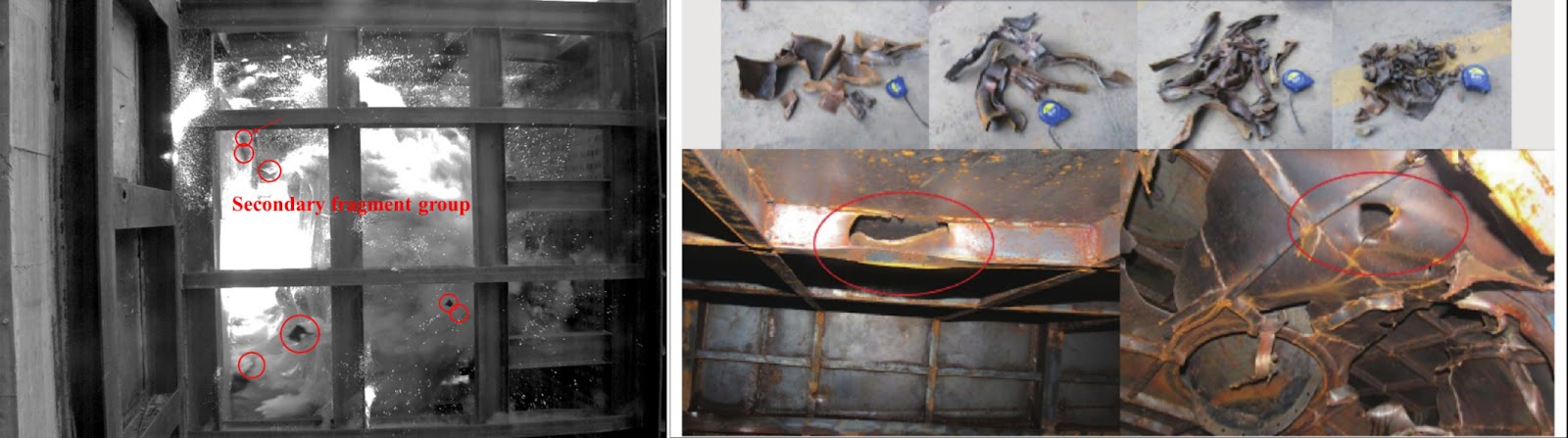
Underwater contact explosions from torpedoes and mines pose severe threats to ship survivability. The coupled effects of shock waves, bubbles, and secondary fragments induce complex structural damage. This review first analyzes the load characteristics of underwater contact explosions, detailing the spatial-temporal evolution of shock waves, bubbles, and secondary fragments. Subsequently, it examines protective mechanisms from two perspectives: multi-cabin structural protection and composite structure/material protection, focusing on damage suppression and energy dissipation. Finally, key technical challenges are summarized to guide future research. The review highlights that shock waves cause initial indentation and perforation of the outer plate, while bubble pulsation and collapse jets dominate subsequent large deformation and tearing of bulkheads. Experimental studies show that stiffened plates exhibit significant strain growth during bubble pulsation, potentially exceeding shock wave effects. Multi-cabin designs, such as liquid-filled compartments, effectively mitigate damage through energy absorption and impedance mismatch. Composite materials offer enhanced blast resistance but face scalability issues. The paper underscores the need for high-fidelity numerical methods and experimental validation to resolve controversies regarding dominant damage mechanisms. This work provides a comprehensive reference for advancing ship structural protection against underwater contact explosions.
Reaction-Growth Behavior of Energetic Materials under Mass-Inertial Confinement
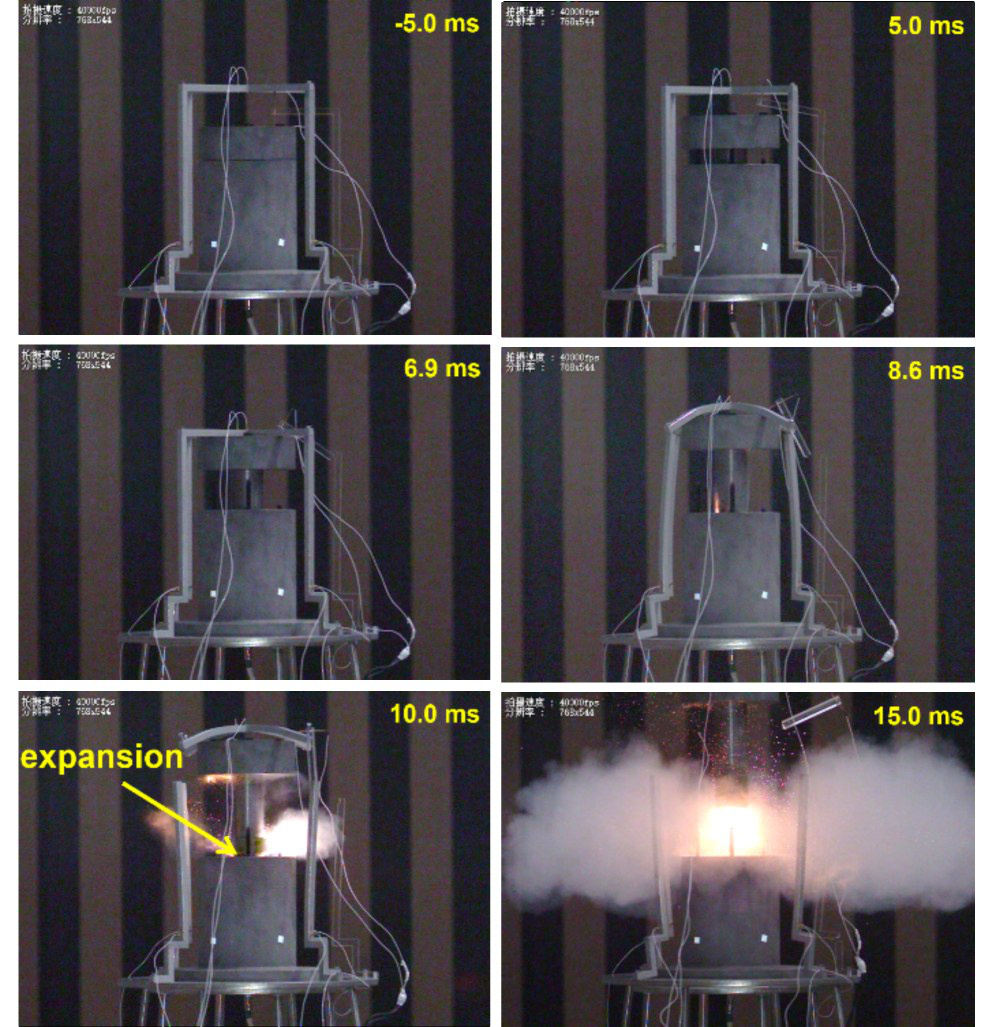
To investigate the reaction-growth behavior of propellants and polymer-bonded explosives (PBX) after non-shock ignition under mass-inertial confinement, a thick-walled cylinder experimental setup was constructed. The setup provided strong radial structural confinement and incorporated a large mass block with a mass ratio exceeding 45:1 relative to the energetic material. Laser ignition (250 W) was used to initiate reactions, and multiple photonic Doppler velocimetry (PDV) probes simultaneously measured radial expansion velocity of the cylinder and axial velocity of the mass block top. High-speed photography and recovered debris analysis were employed to compare reaction evolution processes. Results show that mass-inertial confinement enhances pressure buildup during the early reaction phase, but the type of energetic material determines reaction-growth characteristics and violence under identical confinement. For the composite propellant (containing AP, aluminum, RDX, and energetic binder), mass-inertial confinement dominated early pressurization; the system exhibited axial mass block acceleration without yielding of the thick-walled cylinder. Maximum reaction pressure was below 50 MPa, reaction fraction was less than 1%, and nearly all propellant was recovered, indicating a burning reaction. For the PBX (containing HMX and CL-20), early pressurization was jointly influenced by mass-inertial and structural confinement; the cylinder underwent yielding and radial expansion, and the mass block showed local upsetting deformation. Maximum reaction pressure reached 2 GPa, reaction fraction exceeded 50%, and no explosive was recovered, indicating a violent explosion. These findings provide insights into non-shock ignition reaction-growth mechanisms and safety design of structural charges.