Key Takeaways & Executive Findings
- •• • Sulfate attacks reduce ballast durability by an average of 50%, the most severe stressor, necessitating sulfate-resistant aggregate selection or protective measures in affected regions. • • Freeze–thaw cycles cause a 20% average durability loss, highlighting the need for frost-resistant ballast in cold climates to prevent accelerated breakdown. • • Extreme cold (−20°C) and warm (+100°C) temperatures degrade durability by 40% and 35%, respectively, indicating that both ends of the thermal spectrum compromise aggregate integrity. • • Empirical formulations derived from the data enable prediction of degradation indices (e.g., Los Angeles abrasion, micro-Deval wear) under specific thermal and environmental conditions, facilitating proactive maintenance scheduling.
Abstract
Climate change imposes multifaceted stresses on railway infrastructure, particularly ballasted tracks, where ballast degradation drives maintenance costs. This study quantifies the durability of ballast aggregates under simulated thermal and environmental conditions representative of climate change scenarios. Laboratory tests subjected aggregates to temperature extremes from −20°C to +100°C, freeze–thaw cycles, and sulfate attacks. Durability was assessed via Los Angeles abrasion, micro-Deval wear, crushing resistance, impact performance, and breakage potential. Results demonstrate that sulfate attacks, freeze–thaw cycles, extreme cold, and extreme warm conditions degrade durability by averages of 50%, 20%, 40%, and 35%, respectively. Empirical formulations were derived to estimate degradation indices as functions of thermal and environmental stressors. These findings underscore the critical influence of climate-driven conditions on ballast longevity and provide a basis for climate-adaptive railway design and maintenance planning.
1. Introduction
Climate change imposes unprecedented thermal and environmental stressors on railway infrastructure, yet the combined effects on ballast aggregate durability remain poorly quantified. Existing design standards largely ignore the synergistic impacts of temperature extremes, freeze–thaw cycling, and sulfate attack, leading to premature track deterioration and escalating maintenance costs. The UK Rail Safety and Standards Board (RSSB) categorizes climate risks into temperature fluctuations, rainfall effects on soil beds, and runoff impacts on drainage, but this framework oversimplifies region-specific vulnerabilities and overlapping stressors. Consequently, railway operators lack reliable data to select aggregates and design ballast layers that withstand future climate scenarios.
This study addresses that gap by systematically simulating climate-change-induced conditions in the laboratory and measuring their effects on key durability indices. Unlike prior work that examined single stressors, this protocol integrates temperature cycling (−20°C to +100°C), freeze–thaw cycles, and sulfate exposure, providing a holistic assessment. The derived empirical formulations translate experimental data into predictive tools, enabling engineers to estimate degradation rates under site-specific conditions. This approach directly supports climate-adaptive design, offering a quantitative basis for material selection and maintenance prioritization in the face of a changing climate.
Loading authentic research manuscript (Pages 1–5)...
Hamidreza Heydari, Morteza Esmaeili, Sina Nadermohammady (2026). Thermal–environmental effects on degradation of railway ballast aggregates: a climate change perspective. Railway Engineering Science (铁道工程科学). https://doi.org/10.1007/s40534-025-00412-5
Research & Educational Purpose Only:The translations, structured abstracts, analytical annotations, and data reports provided by SinoTechIntel are intended exclusively for academic research, internal corporate R&D, and educational benchmarking. They do not constitute formal engineering, chemical safety, legal, or professional advice.
Copyright & Intellectual Property Notice: Original copyright of the underlying source articles and experimental data remains with the respective authors, institutions, and original publishing journals. SinoTechIntel claims intellectual property only over its proprietary translations, analytical syntheses, and AEO structured enhancements in accordance with international fair use and academic citation principles.
Frequently Asked Questions
What is the relative severity of sulfate attack versus freeze-thaw cycles on ballast durability, and what mechanisms drive the differences?
Sulfate attack is the most severe, causing an average 50% reduction in durability indices, compared to 20% for freeze-thaw cycles. Sulfates react with aggregate minerals to form expansive products (e.g., ettringite), inducing internal stresses and microcracking, whereas freeze-thaw damage arises from water expansion upon freezing. The higher severity of sulfate attack suggests that in sulfate-rich environments, aggregate selection must prioritize chemical resistance, while freeze-thaw resistance is critical in cold, wet climates.
How do extreme temperature variations (−20°C to +100°C) affect the mechanical integrity of ballast aggregates beyond standard freeze-thaw testing?
Extreme cold (−20°C) and heat (+100°C) degrade durability by 40% and 35%, respectively, independent of freeze-thaw cycling. Thermal expansion mismatches between mineral phases induce microcracking, while high temperatures may cause dehydration and weakening of certain minerals. These findings imply that ballast in regions with large diurnal or seasonal temperature swings requires aggregates with low thermal expansion coefficients and high thermal fatigue resistance.
Can the proposed empirical formulations be used to predict long-term ballast degradation under real-world climate scenarios, and what are their limitations?
The formulations provide a first-order estimate of degradation indices based on controlled laboratory conditions. They are valid for the tested aggregate types and stress ranges. Extrapolation to field conditions requires calibration with in-situ data, as factors like moisture content, loading, and contamination are not fully captured. Nevertheless, they offer a practical tool for comparative assessments and preliminary design.
What are the practical implications of these findings for railway maintenance scheduling and aggregate selection?
The quantified degradation rates (e.g., 50% loss under sulfate attack) indicate that ballast life can be significantly shortened in aggressive environments. Maintenance intervals should be adjusted accordingly, and aggregates with superior resistance to the dominant local stressor should be prioritized. For instance, in sulfate-prone areas, use aggregates with low sulfate reactivity; in cold regions, ensure high freeze-thaw durability.
How do the durability indices (Los Angeles abrasion, micro-Deval, etc.) correlate with each other under the tested conditions, and which is most sensitive to environmental stressors?
The study reports average degradation across all indices, but does not provide individual correlations. However, Los Angeles abrasion and micro-Deval are commonly sensitive to mechanical breakdown, while crushing and impact tests reflect strength. Under environmental stressors, micro-Deval may be more sensitive to chemical attack due to its wet testing condition. Detailed statistical analysis would be required to establish specific correlations, but the overall trend indicates consistent degradation across indices.
Related Technical Papers & Translations
Research Progress on Design, Fabrication, Mechanical Properties, and Shock-Induced Energy Release Characteristics of Reactive Tungsten Alloys
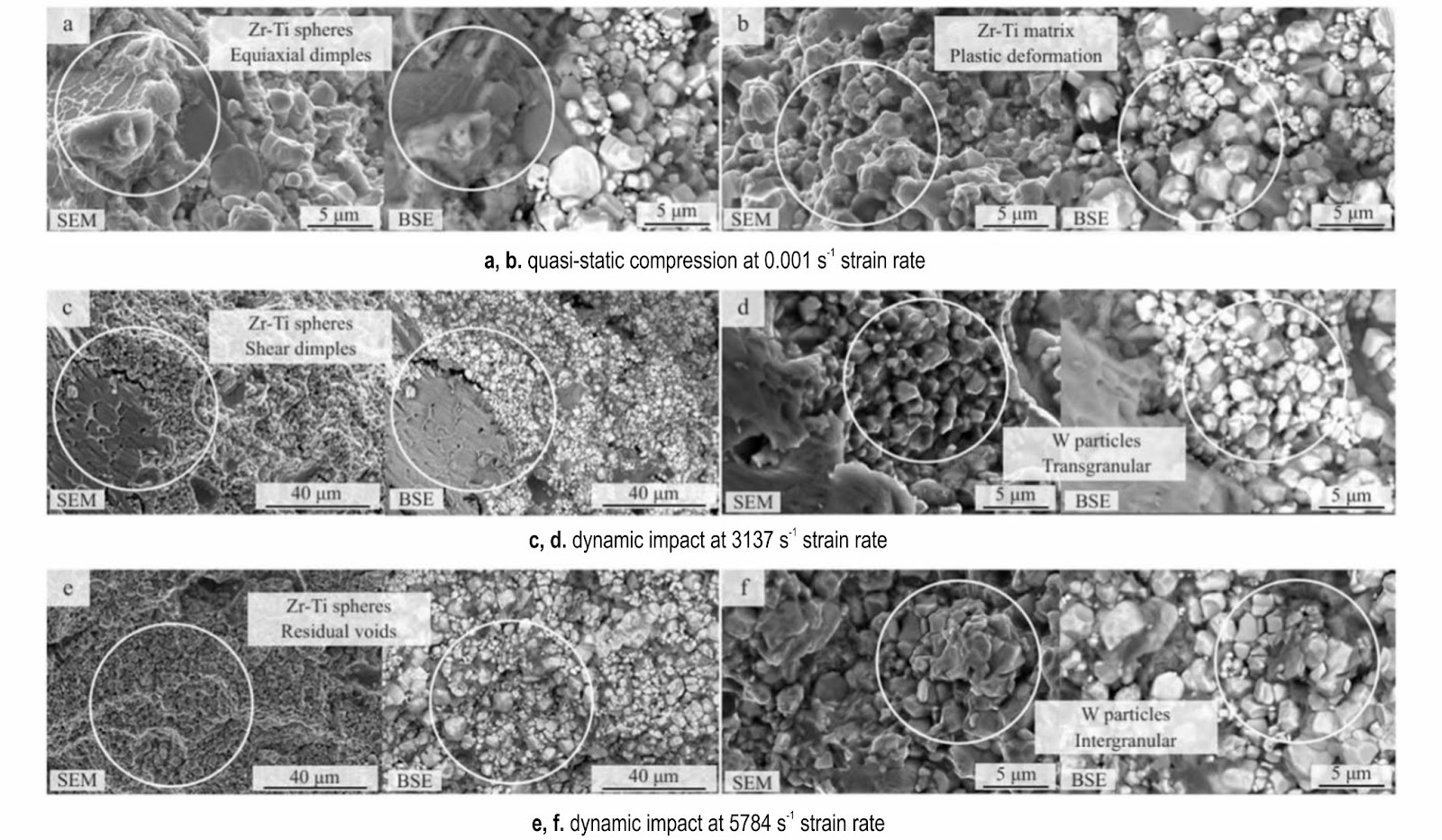
Reactive tungsten alloys (RTAs) are a class of metallic energetic structural materials that combine a high-density tungsten skeleton with reactive elements such as Zr and Ti, offering synergistic capabilities of high-strength load bearing, kinetic penetration, and shock-induced energy release. This review systematically examines the composition design and fabrication methods of RTAs, detailing their typical microstructural characteristics and the structure–mechanical property relationships. It summarizes penetration behavior and energy release characterization under high-velocity impact, and outlines future directions including machine-learning-assisted multi-objective design, development of large-scale component forming technologies, and establishment of multi-scale constitutive models to elucidate penetration and energy release mechanisms. The review highlights that RTAs can achieve dynamic compressive strengths exceeding 2 GPa and densities above 10 g·cm−3, while the addition of elements such as Ti and Nb suppresses the formation of brittle W2Zr intermetallics, improving ductility. Challenges remain in balancing strength, energy release, and processability, particularly in solid-state sintering above 1500 °C. The paper provides a comprehensive foundation for the design and engineering application of high-density reactive tungsten alloys.
Effect of Particle Size on Ignition and Combustion Performance of Al-Li-Mg Alloys
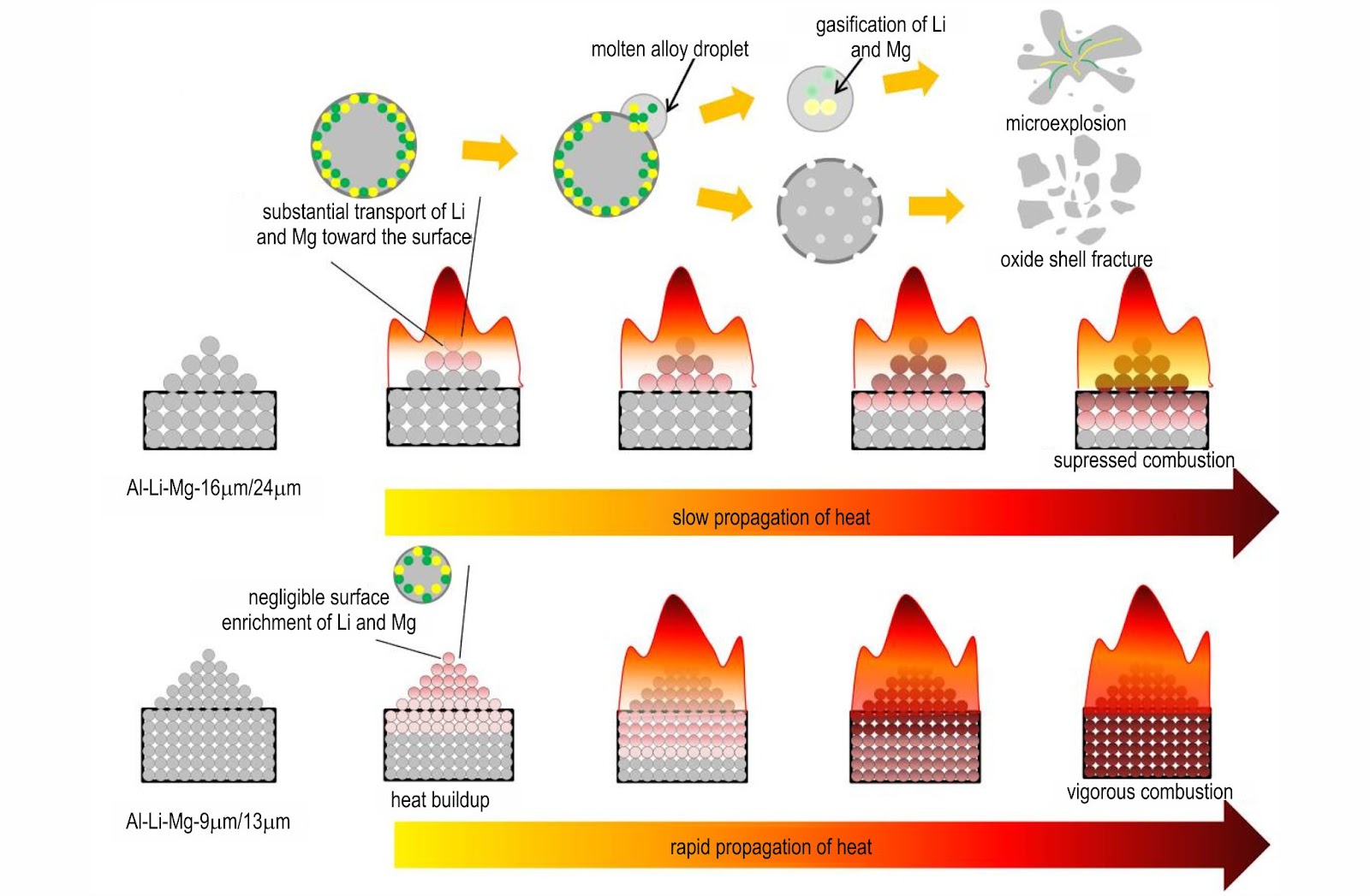
To elucidate the influence mechanism of particle size on the ignition and combustion behavior of Al-Li-Mg alloys, four alloy powders with median diameters of 9, 13, 16, and 24 μm were systematically investigated. Physicochemical properties were characterized by laser diffraction, scanning electron microscopy, X-ray diffraction, simultaneous thermal analysis, and oxygen bomb calorimetry. Ignition and combustion behaviors were assessed using a laser ignition test bench equipped with high-speed photography and fiber-optic spectrometry. Results show that with increasing particle size, ignition delay time first decreases sharply then stabilizes, dropping from 135 ms (9 μm) to 51 ms (13 μm), then to 15 ms (16 μm) and 18 ms (24 μm). Combustion intensity, indicated by maximum spectral intensity, decreases from 7300.4 (9 μm) to 1721.6 (24 μm). Combustion duration initially extends slightly then stabilizes, from 857 ms (9 μm) to 928 ms (13 μm) and approximately 920 ms for larger sizes. Notably, the 13 μm alloy achieves an optimal balance among ignition delay (51 ms), combustion duration (928 ms), and combustion intensity (6041.8). The study reveals a critical size effect: between 13 and 16 μm, ignition delay drops by 71% while combustion intensity decreases by 54%, indicating a transition from surface-diffusion-controlled to micro-explosion-dominated combustion. This mechanism arises from competition between heat conduction and elemental diffusion: larger particles restrict heat transfer, promoting Li and Mg surface enrichment and temperature gradients that induce micro-explosions, thereby shortening ignition delay but reducing combustion efficiency and intensity.
Research Progress on Dynamic Response and Energy Release Mechanisms of Reactive Damage Elements
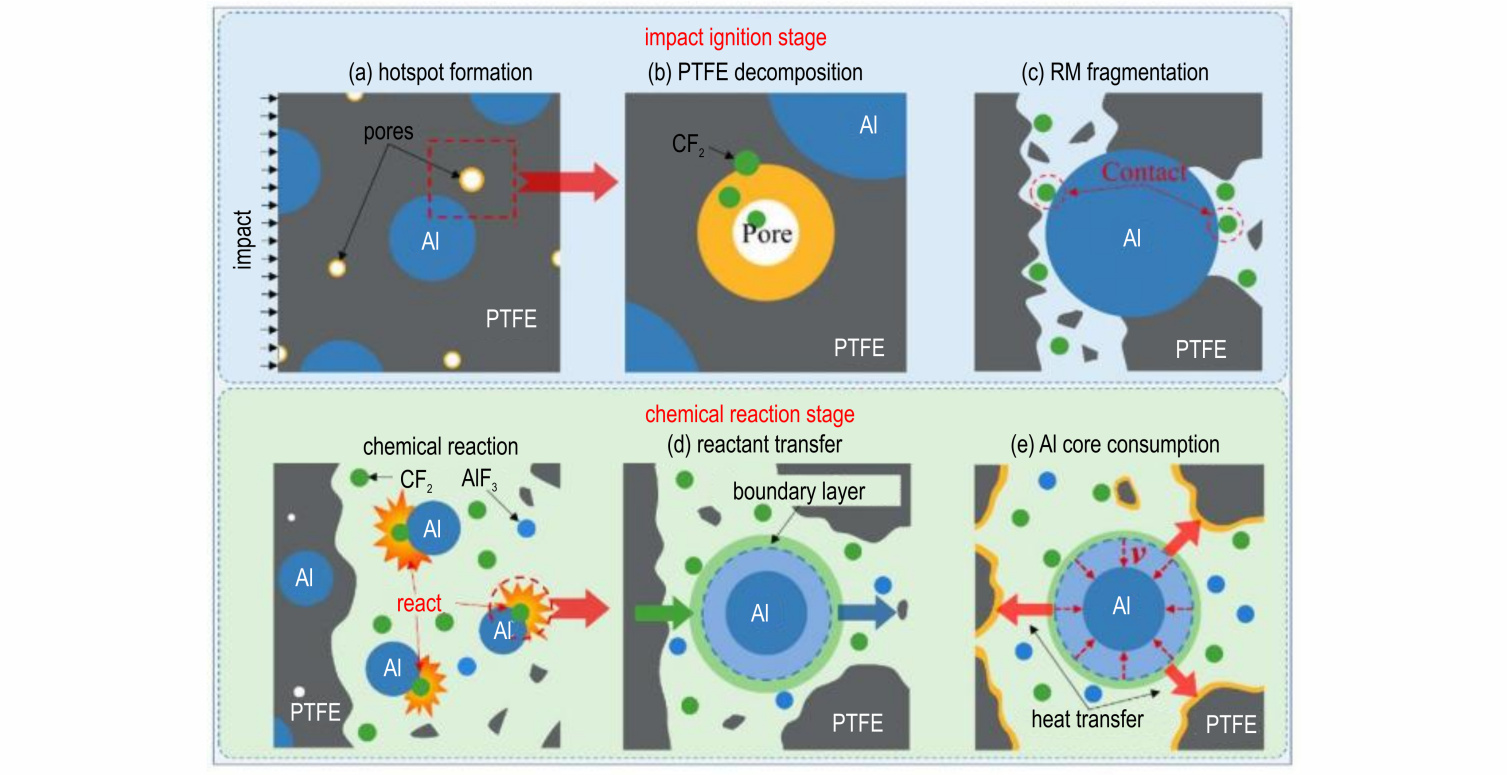
Reactive damage elements (RDEs) integrate kinetic penetration with chemical energy release, offering a dual-mode damage mechanism. This review systematically examines the state-of-the-art in RDE reaction mechanisms, penetration-reaction coupled damage models, numerical simulation methods, and dynamic loading experiments. Two-stage reaction mechanisms—shock-induced and shock-assisted—are elaborated, along with thermo-mechanical-chemical coupling theory and reaction threshold regulation. Penetration depth and hole-enlargement models, aftereffect overpressure and ignition models, fragment cloud distribution and damage radius models are summarized. Advances in reactive material equations of state, SPH-ALE multi-physics coupling algorithms, and cross-scale modeling methods are consolidated, alongside multi-physics synchronous testing and target damage assessment systems. Key findings include: Al-Ni-W systems achieve densities up to 7.8 g·cm⁻³ and tensile strengths exceeding 300 MPa, maintaining structural integrity at 2000 m·s⁻¹. PTFE/Al formulations exhibit shock-induced reactions in nanoseconds, while shock-assisted reactions occur over microseconds to milliseconds, with oxide additives like MoO₃ lowering reaction thresholds and enhancing energy release. Future directions emphasize precise reaction degree control via cross-scale models, universal damage assessment under extreme environments, and field testing using characteristic spectra and electromagnetic pulses. This review provides a comprehensive framework for advancing RDE technology in munitions and protective applications.