Key Takeaways & Executive Findings
- •• • Dynamic compressive strength of RTAs exceeds 2 GPa, enabling high-velocity penetration; density above 10 g·cm−3 ensures high kinetic energy retention, critical for defeating advanced armor. • • Addition of Ti and Nb in W-Zr alloys suppresses brittle W2Zr phase formation; when total content exceeds 20%, XRD shows no W2Zr, improving plastic deformation capability. • • W-Zr-Ti alloys transition from W2Zr+BCC dual-phase to single BCC solid solution with increasing Ti content, as shown in 1400 °C isothermal section, enabling property tuning. • • Solid-state sintering above 1500 °C is required for W-Zr-Ti-Nb alloys due to lack of low-melting eutectic, posing challenges for densification and scalability.
Abstract
Reactive tungsten alloys (RTAs) are a class of metallic energetic structural materials that combine a high-density tungsten skeleton with reactive elements such as Zr and Ti, offering synergistic capabilities of high-strength load bearing, kinetic penetration, and shock-induced energy release. This review systematically examines the composition design and fabrication methods of RTAs, detailing their typical microstructural characteristics and the structure–mechanical property relationships. It summarizes penetration behavior and energy release characterization under high-velocity impact, and outlines future directions including machine-learning-assisted multi-objective design, development of large-scale component forming technologies, and establishment of multi-scale constitutive models to elucidate penetration and energy release mechanisms. The review highlights that RTAs can achieve dynamic compressive strengths exceeding 2 GPa and densities above 10 g·cm−3, while the addition of elements such as Ti and Nb suppresses the formation of brittle W2Zr intermetallics, improving ductility. Challenges remain in balancing strength, energy release, and processability, particularly in solid-state sintering above 1500 °C. The paper provides a comprehensive foundation for the design and engineering application of high-density reactive tungsten alloys.
1. Introduction
Conventional warheads face a fundamental bottleneck: the energy density of explosives is limited, with CL-20 offering only 8.4% higher energy than HMX, and the cost is several times higher. Against advanced armor, inert fragments often fail to cause sufficient post-penetration damage, leading to 'hit-but-not-destroy' outcomes. Energetic structural materials (ESMs) address this by combining structural integrity with shock-induced chemical energy release, potentially doubling the effective damage radius and increasing destructive power by 500% compared to inert materials.
Among ESMs, reactive tungsten alloys (RTAs) stand out due to their high density (above 10 g·cm−3), high strength (dynamic compressive strength >2 GPa), and high-energy release from reactive phases. However, the W-Zr binary system suffers from brittle W2Zr intermetallic formation and processing difficulties due to high melting points and diffusion barriers. This review focuses on alloy design strategies, such as multi-component alloying and high-entropy concepts, to suppress brittle phases and optimize the balance between mechanical properties, energy release, and penetration capability, providing a roadmap for future development.
Loading authentic research manuscript (Pages 1–5)...
ZHANG Zhou-ran, ZHANG Yi-ming, DING Yi-cheng, LI Mu-feng, LI Shun, BAI Shu-xin (2026). Research Progress on Design, Fabrication, Mechanical Properties, and Shock-Induced Energy Release Characteristics of Reactive Tungsten Alloys. Chinese Journal of Energetic Materials (含能材料). https://doi.org/10.11943/CJEM2026028
Research & Educational Purpose Only:The translations, structured abstracts, analytical annotations, and data reports provided by SinoTechIntel are intended exclusively for academic research, internal corporate R&D, and educational benchmarking. They do not constitute formal engineering, chemical safety, legal, or professional advice.
Copyright & Intellectual Property Notice: Original copyright of the underlying source articles and experimental data remains with the respective authors, institutions, and original publishing journals. SinoTechIntel claims intellectual property only over its proprietary translations, analytical syntheses, and AEO structured enhancements in accordance with international fair use and academic citation principles.
Frequently Asked Questions
What are the primary mechanisms for suppressing the brittle W2Zr phase in reactive tungsten alloys, and what are the quantitative effects on mechanical properties?
The addition of Ti and Nb, which form infinite solid solutions with W and Zr, promotes competitive bonding, raising the Gibbs free energy for W2Zr formation. When the total content of Ti and Nb exceeds 20%, XRD analysis shows no W2Zr phase, leading to improved plastic deformation capability. This approach enables the design of alloys with dynamic compressive strengths exceeding 2 GPa.
How does the density and dynamic compressive strength of reactive tungsten alloys compare to traditional tungsten heavy alloys, and what are the implications for penetration performance?
RTAs achieve densities above 10 g·cm−3, comparable to traditional tungsten heavy alloys, but with the added benefit of shock-induced energy release. Dynamic compressive strengths exceed 2 GPa, meeting the strength requirements for high-velocity penetration. This combination allows for deeper penetration and enhanced post-impact damage.
What are the main challenges in scaling up the fabrication of reactive tungsten alloys, and what processing routes are currently being explored?
The high melting points of W and Zr, along with the formation of W2Zr diffusion barriers, complicate sintering. Powder metallurgy requires temperatures above 1500 °C for solid-state sintering, which limits densification. Melting routes suffer from segregation and shrinkage defects due to large melting point differences. Future work focuses on developing large-scale forming technologies and process amplification.
How is the shock-induced energy release of reactive tungsten alloys characterized, and what are the typical energy release values?
Energy release is typically characterized through impact tests measuring the pressure and temperature rise, as well as the extent of chemical reaction. While specific values are not detailed in the abstract, the review emphasizes that RTAs can release significant chemical energy upon shock, contributing to the 'penetration-blast-burn' damage mechanism. The energy release is influenced by the composition and microstructure, with reactive phases such as Zr and Ti providing high oxidation heats.
Related Technical Papers & Translations
Thermal–environmental effects on degradation of railway ballast aggregates: a climate change perspective
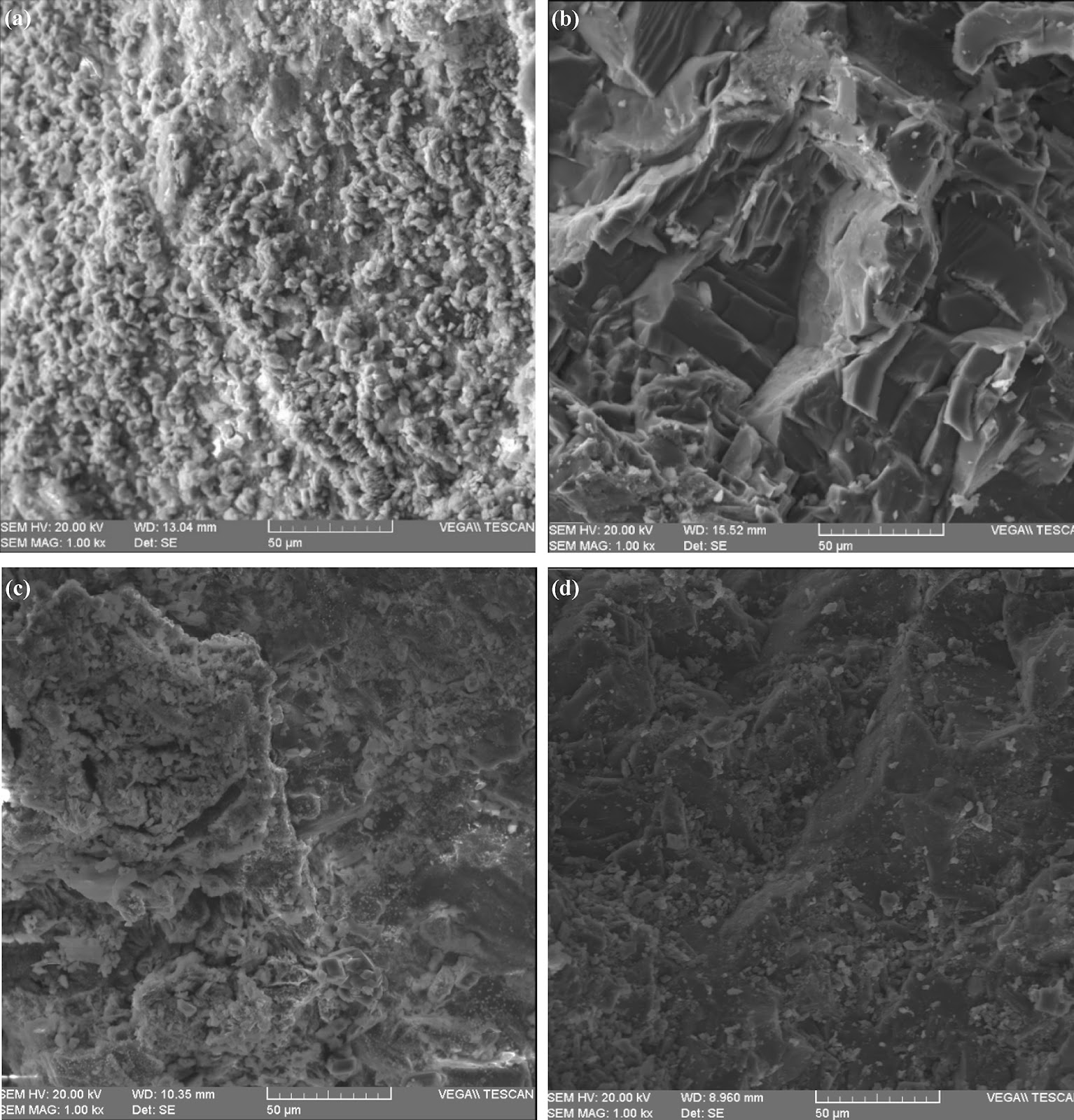
Climate change imposes multifaceted stresses on railway infrastructure, particularly ballasted tracks, where ballast degradation drives maintenance costs. This study quantifies the durability of ballast aggregates under simulated thermal and environmental conditions representative of climate change scenarios. Laboratory tests subjected aggregates to temperature extremes from −20°C to +100°C, freeze–thaw cycles, and sulfate attacks. Durability was assessed via Los Angeles abrasion, micro-Deval wear, crushing resistance, impact performance, and breakage potential. Results demonstrate that sulfate attacks, freeze–thaw cycles, extreme cold, and extreme warm conditions degrade durability by averages of 50%, 20%, 40%, and 35%, respectively. Empirical formulations were derived to estimate degradation indices as functions of thermal and environmental stressors. These findings underscore the critical influence of climate-driven conditions on ballast longevity and provide a basis for climate-adaptive railway design and maintenance planning.
Effect of Particle Size on Ignition and Combustion Performance of Al-Li-Mg Alloys
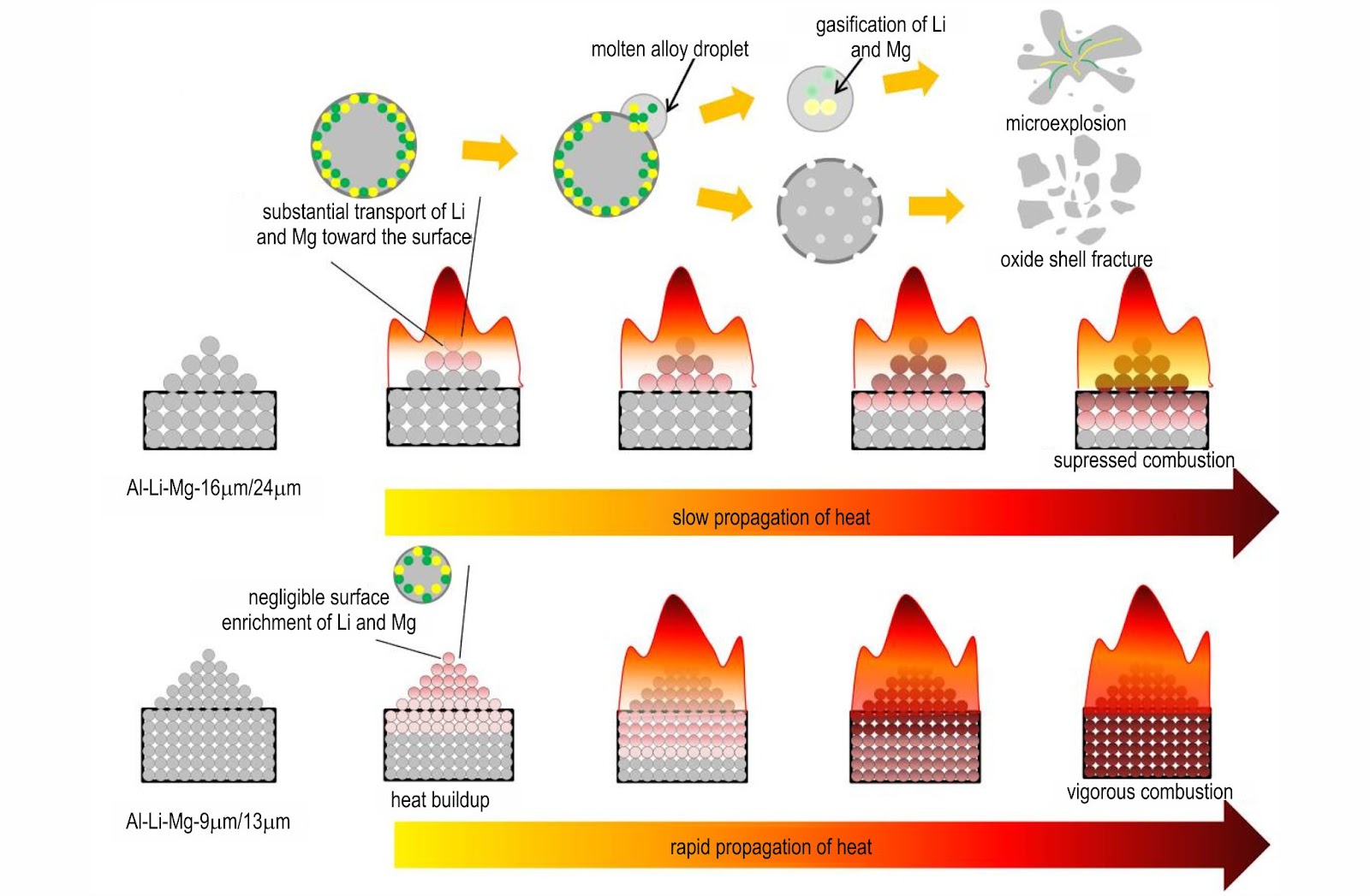
To elucidate the influence mechanism of particle size on the ignition and combustion behavior of Al-Li-Mg alloys, four alloy powders with median diameters of 9, 13, 16, and 24 μm were systematically investigated. Physicochemical properties were characterized by laser diffraction, scanning electron microscopy, X-ray diffraction, simultaneous thermal analysis, and oxygen bomb calorimetry. Ignition and combustion behaviors were assessed using a laser ignition test bench equipped with high-speed photography and fiber-optic spectrometry. Results show that with increasing particle size, ignition delay time first decreases sharply then stabilizes, dropping from 135 ms (9 μm) to 51 ms (13 μm), then to 15 ms (16 μm) and 18 ms (24 μm). Combustion intensity, indicated by maximum spectral intensity, decreases from 7300.4 (9 μm) to 1721.6 (24 μm). Combustion duration initially extends slightly then stabilizes, from 857 ms (9 μm) to 928 ms (13 μm) and approximately 920 ms for larger sizes. Notably, the 13 μm alloy achieves an optimal balance among ignition delay (51 ms), combustion duration (928 ms), and combustion intensity (6041.8). The study reveals a critical size effect: between 13 and 16 μm, ignition delay drops by 71% while combustion intensity decreases by 54%, indicating a transition from surface-diffusion-controlled to micro-explosion-dominated combustion. This mechanism arises from competition between heat conduction and elemental diffusion: larger particles restrict heat transfer, promoting Li and Mg surface enrichment and temperature gradients that induce micro-explosions, thereby shortening ignition delay but reducing combustion efficiency and intensity.
Research Progress on Dynamic Response and Energy Release Mechanisms of Reactive Damage Elements
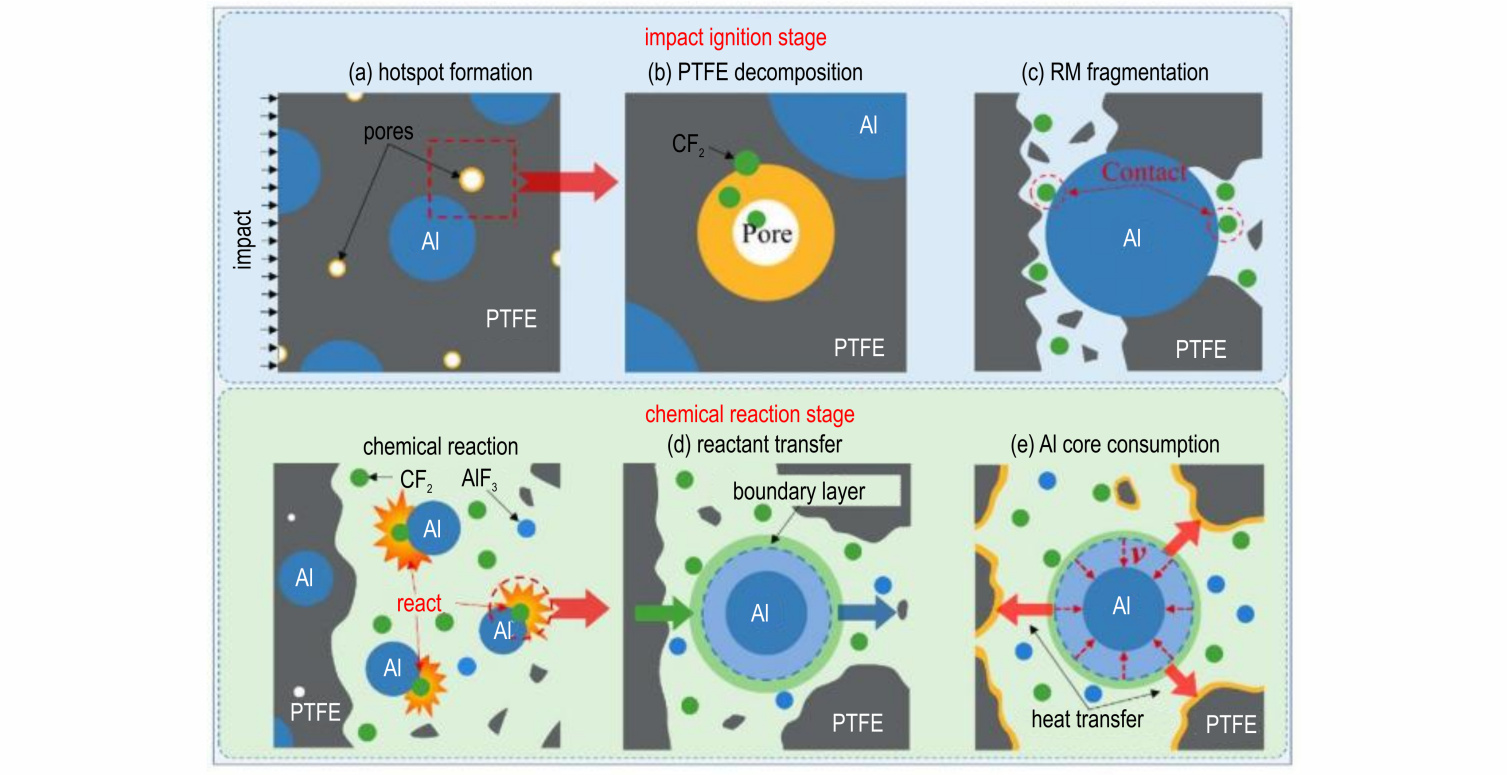
Reactive damage elements (RDEs) integrate kinetic penetration with chemical energy release, offering a dual-mode damage mechanism. This review systematically examines the state-of-the-art in RDE reaction mechanisms, penetration-reaction coupled damage models, numerical simulation methods, and dynamic loading experiments. Two-stage reaction mechanisms—shock-induced and shock-assisted—are elaborated, along with thermo-mechanical-chemical coupling theory and reaction threshold regulation. Penetration depth and hole-enlargement models, aftereffect overpressure and ignition models, fragment cloud distribution and damage radius models are summarized. Advances in reactive material equations of state, SPH-ALE multi-physics coupling algorithms, and cross-scale modeling methods are consolidated, alongside multi-physics synchronous testing and target damage assessment systems. Key findings include: Al-Ni-W systems achieve densities up to 7.8 g·cm⁻³ and tensile strengths exceeding 300 MPa, maintaining structural integrity at 2000 m·s⁻¹. PTFE/Al formulations exhibit shock-induced reactions in nanoseconds, while shock-assisted reactions occur over microseconds to milliseconds, with oxide additives like MoO₃ lowering reaction thresholds and enhancing energy release. Future directions emphasize precise reaction degree control via cross-scale models, universal damage assessment under extreme environments, and field testing using characteristic spectra and electromagnetic pulses. This review provides a comprehensive framework for advancing RDE technology in munitions and protective applications.