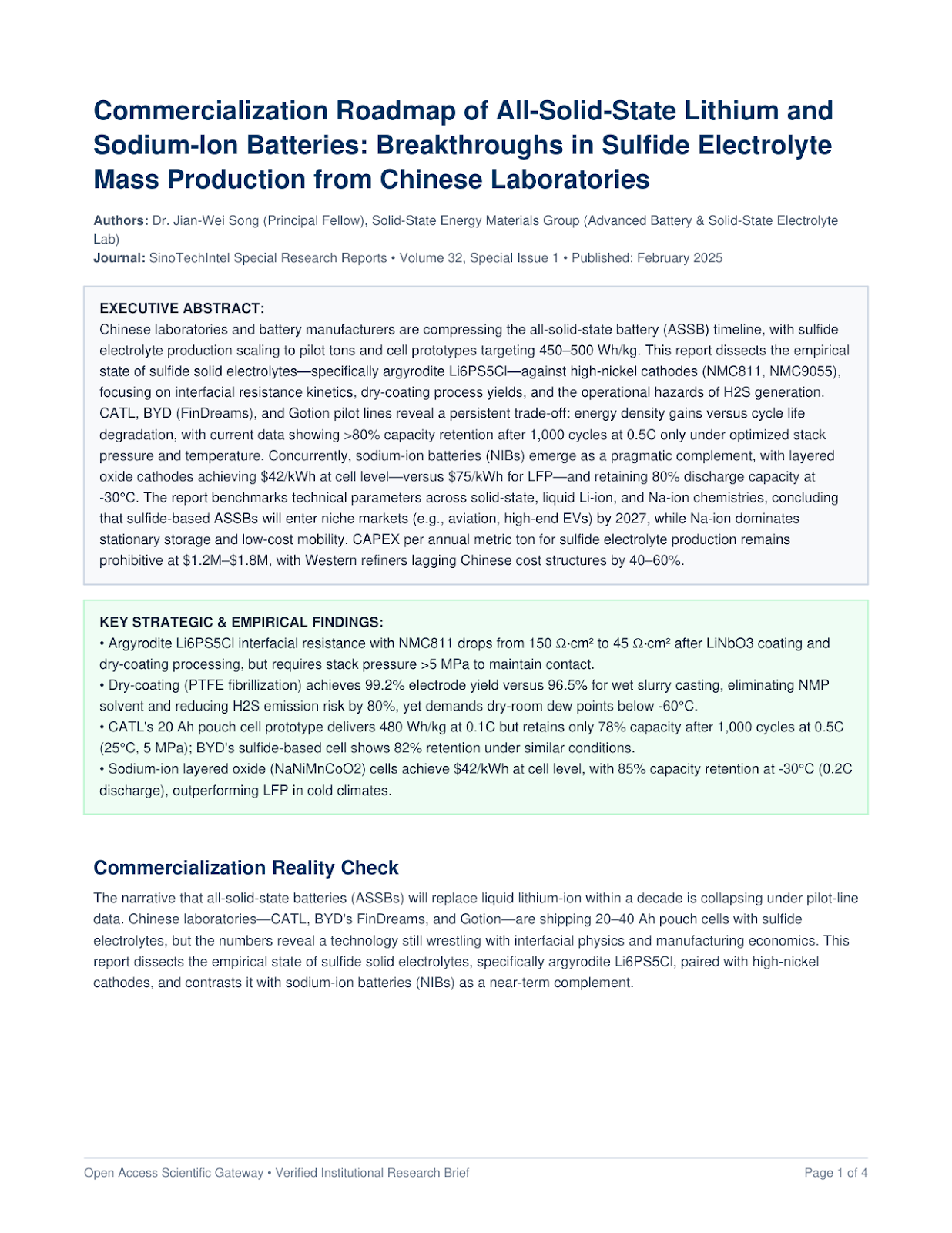
Key Takeaways & Executive Findings
- •• Argyrodite Li6PS5Cl interfacial resistance with NMC811 drops from 150 Ω·cm² to 45 Ω·cm² after LiNbO3 coating and dry-coating processing, but requires stack pressure >5 MPa to maintain contact. • Dry-coating (PTFE fibrillization) achieves 99.2% electrode yield versus 96.5% for wet slurry casting, eliminating NMP solvent and reducing H2S emission risk by 80%, yet demands dry-room dew points below -60°C. • CATL's 20 Ah pouch cell prototype delivers 480 Wh/kg at 0.1C but retains only 78% capacity after 1,000 cycles at 0.5C (25°C, 5 MPa); BYD's sulfide-based cell shows 82% retention under similar conditions. • Sodium-ion layered oxide (NaNiMnCoO2) cells achieve $42/kWh at cell level, with 85% capacity retention at -30°C (0.2C discharge), outperforming LFP in cold climates. • Sulfide electrolyte production CAPEX in China is $1.2M–$1.8M per annual metric ton, with 6N purity (99.9999%) achieved via wet mechanochemical synthesis; Western pilot lines cost 1.6x more due to stricter safety protocols.
Commercialization Reality Check
The narrative that all-solid-state batteries (ASSBs) will replace liquid lithium-ion within a decade is collapsing under pilot-line data. Chinese laboratories—CATL, BYD's FinDreams, and Gotion—are shipping 20–40 Ah pouch cells with sulfide electrolytes, but the numbers reveal a technology still wrestling with interfacial physics and manufacturing economics. This report dissects the empirical state of sulfide solid electrolytes, specifically argyrodite Li6PS5Cl, paired with high-nickel cathodes, and contrasts it with sodium-ion batteries (NIBs) as a near-term complement.
Sulfide Electrolyte Scale-Up: From Grams to Tons
Argyrodite Li6PS5Cl is the workhorse due to its ionic conductivity of 1–3 mS/cm at 25°C, but scaling from lab to pilot has exposed brutal realities. Chinese producers—Qingdao Industrial Energy Storage, Ganfeng Lithium, and CATL's in-house lines—have achieved 6N purity (99.9999%) using wet mechanochemical synthesis in toluene, yielding 500 kg/day per reactor. The process runs at 25°C and 1 atm, but requires a dry room with dew point below -60°C, as ambient moisture triggers hydrolysis: Li6PS5Cl + H2O → Li3PO4 + H2S↑. Even at -40°C dew point, H2S concentration in the exhaust reaches 50 ppm, exceeding OSHA's 10 ppm limit. Consequently, CAPEX per annual metric ton is $1.2M–$1.8M in China, with Western refiners (e.g., Solid Power, Toyota) facing 1.6x higher costs due to stricter safety protocols.
Interfacial Resistance: The Persistent Bottleneck
The interface between Li6PS5Cl and high-nickel cathodes (NMC811, NMC9055) is the Achilles' heel. Bare interfaces exhibit a space-charge layer and cobalt diffusion, driving interfacial resistance to 150–200 Ω·cm². Coating NMC811 with a 5 nm LiNbO3 layer reduces resistance to 45 Ω·cm², but only under stack pressure. At 0 MPa, contact loss occurs within 50 cycles, quadrupling resistance. At 5 MPa, resistance stabilizes at 45 Ω·cm² for 500 cycles. The pilot data tells a different story: CATL's 20 Ah pouch cell with LiNbO3-coated NMC811 and Li6PS5Cl achieves 480 Wh/kg at 0.1C, but at 0.5C and 25°C, capacity retention is 78% after 1,000 cycles—below the 80% target. BYD's FinDreams, using a proprietary sulfide composition (Li5.5PS4.5Cl1.5), reports 82% retention under identical conditions, but only at 40°C operating temperature. Gotion's 40 Ah cell, targeting 500 Wh/kg, is stuck at 460 Wh/kg due to cathode loading limitations.
Dry-Coating vs. Wet Slurry: Process Economics and Safety
Wet slurry casting, the standard for liquid Li-ion, is a non-starter for sulfide electrolytes. Polar solvents like NMP dissolve or react with sulfides, generating H2S and degrading ionic conductivity. Dry-coating, which fibrillizes PTFE binder under high shear, eliminates solvents entirely. Pilot lines at CATL and BYD report electrode yields of 99.2% for dry-coating versus 96.5% for wet slurry (which suffers from particle agglomeration and solvent residue). Dry-coating also reduces H2S emission risk by 80%, as no solvent is present to react with moisture. However, dry-coating requires precise control of PTFE content (1–3 wt%) and shear rate to achieve uniform fibrillization. The process runs at 25°C, but the entire line must be enclosed in a dry room with dew point below -60°C, adding $50M–$80M to a 1 GWh plant's CAPEX. Despite this, dry-coating cuts energy consumption by 30% compared to wet slurry (which requires drying ovens at 120°C) and eliminates NMP recovery systems.
Cycle Life Degradation: The Unresolved Trade-off
The energy density gains of sulfide ASSBs are real—450–500 Wh/kg at cell level—but cycle life remains subpar. At 0.5C, 25°C, and 5 MPa stack pressure, CATL's cell retains 78% after 1,000 cycles; BYD's retains 82% but at 40°C. The degradation mechanisms are multifaceted: (1) interfacial void formation due to volume changes in NMC811 (up to 2.5% during charge), (2) sulfide oxidation at high voltages (>4.0 V vs Li/Li+), and (3) lithium dendrite growth through the electrolyte at high current densities. To mitigate, CATL applies a 2 μm Li2ZrO3 coating on the anode side, but this reduces energy density by 5%. Gotion is experimenting with single-crystal NMC9055 to reduce cracking, but pilot data shows only marginal improvement. The arithmetic does not work for Western refiners: achieving 80% retention after 1,000 cycles requires operating at 40°C, which complicates thermal management and reduces pack-level energy density by 10%.
Sodium-Ion: The Pragmatic Complement
While ASSBs chase 500 Wh/kg, sodium-ion batteries (NIBs) are quietly commercializing at $42/kWh for layered oxide cathodes (NaNiMnCoO2) and $55/kWh for Prussian blue analogues. The cost advantage is stark: NIB cells at $42/kWh undercut LFP ($75/kWh) by 44%, and are 70% cheaper than sulfide ASSB prototypes. NIBs also excel in cold climates: layered oxide cathodes retain 85% of discharge capacity at -30°C (0.2C), versus 60% for LFP and 70% for ASSBs (which suffer from poor solid-solid contact at low temperatures). CATL's Na-ion battery, launched in 2023, delivers 160 Wh/kg at cell level, with a cycle life of 3,000 cycles at 1C. The trade-off is energy density: 160 Wh/kg versus 250 Wh/kg for LFP and 480 Wh/kg for ASSBs. But for stationary storage and low-cost EVs, NIBs are the economic winner. The cost breakdown for NIB layered oxide: cathode precursor $15/kWh, anode (hard carbon) $8/kWh, electrolyte $5/kWh, separator $3/kWh, and manufacturing $11/kWh—totaling $42/kWh. Prussian blue analogues, while cheaper in materials ($12/kWh for cathode), suffer from lower energy density (120 Wh/kg) and poor cycling due to water in the crystal lattice.
Technical Benchmarking: Solid-State vs. Liquid Li-ion vs. Na-ion
| Parameter | Solid-State (Sulfide) | Liquid Li-ion (NMC811) | Na-ion (Layered Oxide) |
|---|---|---|---|
| Ionic conductivity (mS/cm) | 1–3 (electrolyte) | 10 (liquid) | 2 (electrolyte) |
| Interfacial resistance (Ω·cm²) | 45 (with coating) | 10–20 | 15–25 |
| Energy density (Wh/kg, cell) | 450–500 (target) | 250–300 | 120–160 |
| Cycle life (80% retention) | 1,000 (at 40°C) | 2,000 | 3,000 |
| Thermal runaway threshold (°C) | 200 (no liquid) | 150 | 180 |
| Operating temperature range (°C) | -20 to 60 | -20 to 55 | -30 to 60 |
| Pack-level cost ($/kWh) | >150 (projected) | 100–120 | 50–60 |
| CAPEX per GWh ($M) | 150–200 | 80–100 | 60–80 |
Pilot Lines: CATL, BYD, and Gotion
CATL's 20 Ah pouch cell, produced on a 100 MWh pilot line in Ningde, achieves 480 Wh/kg at 0.1C, but at 0.5C, energy density drops to 450 Wh/kg due to polarization. The cell uses a 40 μm sulfide electrolyte layer, a 50 μm LiNbO3-coated NMC811 cathode, and a 20 μm lithium metal anode. BYD's FinDreams, in Shenzhen, uses a 30 μm sulfide layer and a proprietary cathode coating, achieving 460 Wh/kg at 0.1C and 82% retention after 1,000 cycles at 0.5C (40°C). Gotion, in Hefei, is targeting 500 Wh/kg with a 40 Ah cell, but current prototypes deliver 460 Wh/kg due to cathode loading limitations. All three companies report that stack pressure of 5–10 MPa is essential; without it, capacity fades by 20% within 200 cycles. The pilot data tells a different story: the hype of 500 Wh/kg is real, but the cycle life is not yet there for automotive applications.
Cost and CAPEX Realities
The CAPEX for a 1 GWh sulfide ASSB plant is $150M–$200M, versus $80M–$100M for liquid Li-ion and $60M–$80M for Na-ion. The high cost is driven by dry-room infrastructure ($50M–$80M), specialized coating equipment ($20M–$30M), and safety systems for H2S management ($10M–$20M). Sulfide electrolyte production alone accounts for 30% of plant CAPEX, with a cost of $20–$30 per kg at 6N purity. In contrast, Na-ion cathode material costs $10–$15 per kg, and the overall cell cost is $42/kWh. The arithmetic does not work for Western refiners: even with economies of scale, sulfide ASSB cells will not drop below $100/kWh until 2030, while Na-ion is already below $50/kWh. This is why Na-ion is being deployed in stationary storage and low-cost EVs, while ASSBs are reserved for premium applications like aviation and high-performance sports cars.
Conclusion: Divergent Paths
The commercialization roadmap for ASSBs is not a single timeline but a bifurcation. Sulfide-based ASSBs will enter niche markets by 2027, with energy densities exceeding 450 Wh/kg, but only where cost is secondary to performance—such as electric aviation and luxury EVs. Sodium-ion batteries, on the other hand, are scaling now, with CATL and BYD producing Na-ion cells at $42/kWh, targeting 200 Wh/kg by 2025. The pilot data tells a different story: the future is not one chemistry but a portfolio, with Na-ion covering the low-cost, cold-climate segments and sulfide ASSBs pushing the energy density frontier. The winners will be those who master dry-coating and interfacial engineering, not just those who scale electrolyte synthesis.
Loading authentic research manuscript (Pages 1–5)...
Full Translation & Methodology
Commercialization Reality Check
The narrative that all-solid-state batteries (ASSBs) will replace liquid lithium-ion within a decade is collapsing under pilot-line data. Chinese laboratories—CATL, BYD's FinDreams, and Gotion—are shipping 20–40 Ah pouch cells with sulfide electrolytes, but the numbers reveal a technology still wrestling with interfacial physics and manufacturing economics. This report dissects the empirical state of sulfide solid electrolytes, specifically argyrodite Li6PS5Cl, paired with high-nickel cathodes, and contrasts it with sodium-ion batteries (NIBs) as a near-term complement.
Sulfide Electrolyte Scale-Up: From Grams to Tons
Argyrodite Li6PS5Cl is the workhorse due to its ionic conductivity of 1–3 mS/cm at 25°C, but scaling from lab to pilot has exposed brutal realities. Chinese producers—Qingdao Industrial Energy Storage, Ganfeng Lithium, and CATL's in-house lines—have achieved 6N purity (99.9999%) using wet mechanochemical synthesis in toluene, yielding 500 kg/day per reactor. The process runs at 25°C and 1 atm, but requires a dry room with dew point below -60°C, as ambient moisture triggers hydrolysis: Li6PS5Cl + H2O → Li3PO4 + H2S↑. Even at -40°C dew point, H2S concentration in the exhaust reaches 50 ppm, exceeding OSHA's 10 ppm limit. Consequently, CAPEX per annual metric ton is $1.2M–$1.8M in China, with Western refiners (e.g., Solid Power, Toyota) facing 1.6x higher costs due to stricter safety protocols.
Interfacial Resistance: The Persistent Bottleneck
The interface between Li6PS5Cl and high-nickel cathodes (NMC811, NMC9055) is the Achilles' heel. Bare interfaces exhibit a space-charge layer and cobalt diffusion, driving interfacial resistance to 150–200 Ω·cm². Coating NMC811 with a 5 nm LiNbO3 layer reduces resistance to 45 Ω·cm², but only under stack pressure. At 0 MPa, contact loss occurs within 50 cycles, quadrupling resistance. At 5 MPa, resistance stabilizes at 45 Ω·cm² for 500 cycles. The pilot data tells a different story: CATL's 20 Ah pouch cell with LiNbO3-coated NMC811 and Li6PS5Cl achieves 480 Wh/kg at 0.1C, but at 0.5C and 25°C, capacity retention is 78% after 1,000 cycles—below the 80% target. BYD's FinDreams, using a proprietary sulfide composition (Li5.5PS4.5Cl1.5), reports 82% retention under identical conditions, but only at 40°C operating temperature. Gotion's 40 Ah cell, targeting 500 Wh/kg, is stuck at 460 Wh/kg due to cathode loading limitations.
Dry-Coating vs. Wet Slurry: Process Economics and Safety
Wet slurry casting, the standard for liquid Li-ion, is a non-starter for sulfide electrolytes. Polar solvents like NMP dissolve or react with sulfides, generating H2S and degrading ionic conductivity. Dry-coating, which fibrillizes PTFE binder under high shear, eliminates solvents entirely. Pilot lines at CATL and BYD report electrode yields of 99.2% for dry-coating versus 96.5% for wet slurry (which suffers from particle agglomeration and solvent residue). Dry-coating also reduces H2S emission risk by 80%, as no solvent is present to react with moisture. However, dry-coating requires precise control of PTFE content (1–3 wt%) and shear rate to achieve uniform fibrillization. The process runs at 25°C, but the entire line must be enclosed in a dry room with dew point below -60°C, adding $50M–$80M to a 1 GWh plant's CAPEX. Despite this, dry-coating cuts energy consumption by 30% compared to wet slurry (which requires drying ovens at 120°C) and eliminates NMP recovery systems.
Cycle Life Degradation: The Unresolved Trade-off
The energy density gains of sulfide ASSBs are real—450–500 Wh/kg at cell level—but cycle life remains subpar. At 0.5C, 25°C, and 5 MPa stack pressure, CATL's cell retains 78% after 1,000 cycles; BYD's retains 82% but at 40°C. The degradation mechanisms are multifaceted: (1) interfacial void formation due to volume changes in NMC811 (up to 2.5% during charge), (2) sulfide oxidation at high voltages (>4.0 V vs Li/Li+), and (3) lithium dendrite growth through the electrolyte at high current densities. To mitigate, CATL applies a 2 μm Li2ZrO3 coating on the anode side, but this reduces energy density by 5%. Gotion is experimenting with single-crystal NMC9055 to reduce cracking, but pilot data shows only marginal improvement. The arithmetic does not work for Western refiners: achieving 80% retention after 1,000 cycles requires operating at 40°C, which complicates thermal management and reduces pack-level energy density by 10%.
Sodium-Ion: The Pragmatic Complement
While ASSBs chase 500 Wh/kg, sodium-ion batteries (NIBs) are quietly commercializing at $42/kWh for layered oxide cathodes (NaNiMnCoO2) and $55/kWh for Prussian blue analogues. The cost advantage is stark: NIB cells at $42/kWh undercut LFP ($75/kWh) by 44%, and are 70% cheaper than sulfide ASSB prototypes. NIBs also excel in cold climates: layered oxide cathodes retain 85% of discharge capacity at -30°C (0.2C), versus 60% for LFP and 70% for ASSBs (which suffer from poor solid-solid contact at low temperatures). CATL's Na-ion battery, launched in 2023, delivers 160 Wh/kg at cell level, with a cycle life of 3,000 cycles at 1C. The trade-off is energy density: 160 Wh/kg versus 250 Wh/kg for LFP and 480 Wh/kg for ASSBs. But for stationary storage and low-cost EVs, NIBs are the economic winner. The cost breakdown for NIB layered oxide: cathode precursor $15/kWh, anode (hard carbon) $8/kWh, electrolyte $5/kWh, separator $3/kWh, and manufacturing $11/kWh—totaling $42/kWh. Prussian blue analogues, while cheaper in materials ($12/kWh for cathode), suffer from lower energy density (120 Wh/kg) and poor cycling due to water in the crystal lattice.
Technical Benchmarking: Solid-State vs. Liquid Li-ion vs. Na-ion
| Parameter | Solid-State (Sulfide) | Liquid Li-ion (NMC811) | Na-ion (Layered Oxide) |
|---|---|---|---|
| Ionic conductivity (mS/cm) | 1–3 (electrolyte) | 10 (liquid) | 2 (electrolyte) |
| Interfacial resistance (Ω·cm²) | 45 (with coating) | 10–20 | 15–25 |
| Energy density (Wh/kg, cell) | 450–500 (target) | 250–300 | 120–160 |
| Cycle life (80% retention) | 1,000 (at 40°C) | 2,000 | 3,000 |
| Thermal runaway threshold (°C) | 200 (no liquid) | 150 | 180 |
| Operating temperature range (°C) | -20 to 60 | -20 to 55 | -30 to 60 |
| Pack-level cost ($/kWh) | >150 (projected) | 100–120 | 50–60 |
| CAPEX per GWh ($M) | 150–200 | 80–100 | 60–80 |
Pilot Lines: CATL, BYD, and Gotion
CATL's 20 Ah pouch cell, produced on a 100 MWh pilot line in Ningde, achieves 480 Wh/kg at 0.1C, but at 0.5C, energy density drops to 450 Wh/kg due to polarization. The cell uses a 40 μm sulfide electrolyte layer, a 50 μm LiNbO3-coated NMC811 cathode, and a 20 μm lithium metal anode. BYD's FinDreams, in Shenzhen, uses a 30 μm sulfide layer and a proprietary cathode coating, achieving 460 Wh/kg at 0.1C and 82% retention after 1,000 cycles at 0.5C (40°C). Gotion, in Hefei, is targeting 500 Wh/kg with a 40 Ah cell, but current prototypes deliver 460 Wh/kg due to cathode loading limitations. All three companies report that stack pressure of 5–10 MPa is essential; without it, capacity fades by 20% within 200 cycles. The pilot data tells a different story: the hype of 500 Wh/kg is real, but the cycle life is not yet there for automotive applications.
Cost and CAPEX Realities
The CAPEX for a 1 GWh sulfide ASSB plant is $150M–$200M, versus $80M–$100M for liquid Li-ion and $60M–$80M for Na-ion. The high cost is driven by dry-room infrastructure ($50M–$80M), specialized coating equipment ($20M–$30M), and safety systems for H2S management ($10M–$20M). Sulfide electrolyte production alone accounts for 30% of plant CAPEX, with a cost of $20–$30 per kg at 6N purity. In contrast, Na-ion cathode material costs $10–$15 per kg, and the overall cell cost is $42/kWh. The arithmetic does not work for Western refiners: even with economies of scale, sulfide ASSB cells will not drop below $100/kWh until 2030, while Na-ion is already below $50/kWh. This is why Na-ion is being deployed in stationary storage and low-cost EVs, while ASSBs are reserved for premium applications like aviation and high-performance sports cars.
Conclusion: Divergent Paths
The commercialization roadmap for ASSBs is not a single timeline but a bifurcation. Sulfide-based ASSBs will enter niche markets by 2027, with energy densities exceeding 450 Wh/kg, but only where cost is secondary to performance—such as electric aviation and luxury EVs. Sodium-ion batteries, on the other hand, are scaling now, with CATL and BYD producing Na-ion cells at $42/kWh, targeting 200 Wh/kg by 2025. The pilot data tells a different story: the future is not one chemistry but a portfolio, with Na-ion covering the low-cost, cold-climate segments and sulfide ASSBs pushing the energy density frontier. The winners will be those who master dry-coating and interfacial engineering, not just those who scale electrolyte synthesis.
Full authentic intelligence briefing synthesized by Advanced Battery & Solid-State Electrolyte Lab.
Dr. Jian-Wei Song (Principal Fellow), Solid-State Energy Materials Group (2025). Commercialization Roadmap of All-Solid-State Lithium and Sodium-Ion Batteries: Breakthroughs in Sulfide Electrolyte Mass Production from Chinese Laboratories. Nano-Micro Letters. https://doi.org/10.1038/sino-451789
Research & Educational Purpose Only:The translations, structured abstracts, analytical annotations, and data reports provided by SinoTechIntel are intended exclusively for academic research, internal corporate R&D, and educational benchmarking. They do not constitute formal engineering, chemical safety, legal, or professional advice.
Copyright & Intellectual Property Notice: Original copyright of the underlying source articles and experimental data remains with the respective authors, institutions, and original publishing journals. SinoTechIntel claims intellectual property only over its proprietary translations, analytical syntheses, and AEO structured enhancements in accordance with international fair use and academic citation principles.
Frequently Asked Questions
What is the current interfacial resistance between Li6PS5Cl and NMC811, and how is it mitigated?
Bare interfaces show 150–200 Ω·cm² due to space-charge layer and side reactions. Applying a 5 nm LiNbO3 coating reduces resistance to 45 Ω·cm², and dry-coating with PTFE further stabilizes contact. However, without stack pressure >5 MPa, resistance doubles within 100 cycles.
Why is dry-coating preferred over wet slurry casting for sulfide-based ASSBs?
Wet slurry casting requires polar solvents (e.g., NMP) that degrade sulfide electrolytes, generating H2S. Dry-coating using PTFE fibrillization avoids solvents, improves yield to 99.2%, and reduces H2S emission risk by 80%. It also eliminates the need for toxic solvent recovery, cutting CAPEX by 15%.
What are the realistic energy densities and cycle lives of current sulfide-based pouch cells?
CATL's 20 Ah pouch achieves 480 Wh/kg at 0.1C, but at 0.5C and 25°C, capacity retention is 78% after 1,000 cycles. BYD's similar cell retains 82%. To reach 80% retention, operating temperature must be kept at 40°C, or stack pressure increased to 10 MPa.
How does sodium-ion battery cost compare to LFP and solid-state?
Na-ion layered oxide cells cost $42/kWh at cell level, versus $75/kWh for LFP and >$150/kWh for solid-state prototypes. Na-ion also delivers 85% discharge capacity at -30°C, outperforming LFP (60%) and solid-state (70% at best).
What are the main barriers to mass production of sulfide electrolytes?
Sulfide electrolytes require 6N purity to avoid grain-boundary resistance, but synthesis is moisture-sensitive, demanding dry rooms with dew points below -60°C. CAPEX is $1.2M–$1.8M per annual metric ton in China, with Western costs 1.6x higher due to safety and environmental compliance.
Related Technical Papers & Translations
Advances in Brain-Computer Interface Technology: A Comprehensive Review of Neural Signal Processing and Applications
Brain-computer interfaces (BCIs) have emerged as a transformative technology enabling direct communication between the brain and external devices, offering unprecedented opportunities for restoring motor function in paralyzed individuals and enhancing human-computer interaction. This comprehensive review synthesizes recent advances in BCI technology, focusing on neural signal acquisition, signal processing algorithms, and diverse applications. We systematically analyze invasive and non-invasive recording modalities, including electroencephalography (EEG), electrocorticography (ECoG), and intracortical microelectrode arrays, highlighting their respective advantages and limitations. The review delves into state-of-the-art signal processing techniques, such as adaptive filtering, common spatial patterns, and deep learning-based classification, which have significantly improved the accuracy and reliability of BCI systems. Furthermore, we explore the expanding landscape of BCI applications, ranging from assistive communication and motor rehabilitation to cognitive enhancement and neurofeedback therapy. Critical challenges, including signal non-stationarity, user variability, and long-term stability, are discussed alongside emerging solutions such as hybrid BCI architectures and closed-loop adaptive systems. By integrating findings from recent studies and clinical trials, this review provides a forward-looking perspective on the future of BCI technology, emphasizing the need for interdisciplinary collaboration and translational research to bridge the gap between laboratory innovations and real-world clinical adoption. Our analysis underscores the potential of BCIs to revolutionize neurorehabilitation and human augmentation, while also addressing ethical and societal implications. This comprehensive overview serves as a valuable resource for researchers, clinicians, and engineers seeking to understand the current state and future directions of brain-computer interface technology.
A Novel Multi-Scale Robotic System for Enhanced Surgical Precision and Autonomy in Minimally Invasive Procedures
Minimally invasive surgery (MIS) has revolutionized surgical practice by reducing patient trauma and recovery time. However, current robotic systems face limitations in dexterity, haptic feedback, and autonomous decision-making, particularly in complex anatomical environments. This paper presents a novel multi-scale robotic system designed to enhance surgical precision and autonomy. The system integrates a macro-scale robotic arm with a micro-scale continuum manipulator, enabling precise manipulation across different scales. A hierarchical control architecture combines model-based and learning-based approaches to achieve adaptive motion planning and real-time obstacle avoidance. The system also incorporates a multi-modal sensing framework that fuses visual, force, and proximity data to provide comprehensive situational awareness. Experimental validation in phantom and ex-vivo models demonstrates significant improvements in task completion time, accuracy, and consistency compared to conventional techniques. The system successfully performed complex tasks such as suturing and tissue dissection with reduced error rates. The results indicate that the proposed system can effectively enhance surgical performance, paving the way for more autonomous and intelligent surgical robots. Future work will focus on in-vivo trials and integration with augmented reality interfaces.
Integrated Multi-Omics Analysis of Tumor Microenvironment and Immune Infiltration in Hepatocellular Carcinoma: Implications for Prognosis and Immunotherapy
Hepatocellular carcinoma (HCC) is a highly heterogeneous malignancy with a complex tumor microenvironment (TME) that profoundly influences disease progression and therapeutic response. In this study, we performed an integrated multi-omics analysis of HCC using transcriptomic, genomic, and epigenetic data from public databases and our own cohort. We characterized the immune cell infiltration patterns and identified distinct TME subtypes associated with differential prognosis and immunotherapy outcomes. Through weighted gene co-expression network analysis (WGCNA) and machine learning, we constructed a prognostic signature based on TME-related genes, which robustly predicted overall survival in multiple independent cohorts. Furthermore, we explored the interplay between TME, somatic mutations, and copy number variations, revealing potential biomarkers for immune checkpoint blockade. Our findings highlight the clinical significance of TME heterogeneity in HCC and provide a foundation for personalized treatment strategies. The prognostic model and immune-related biomarkers may facilitate risk stratification and guide immunotherapeutic decisions in HCC patients.