Key Takeaways & Executive Findings
- •• The multi-scale robotic system integrates macro and micro manipulators, enabling precise operations across different scales. • A hierarchical control architecture combining model-based and learning-based methods achieves adaptive motion planning and real-time obstacle avoidance. • Multi-modal sensing (visual, force, proximity) enhances situational awareness and surgical safety. • Experimental results show significant improvements in task completion time, accuracy, and consistency over conventional methods.
Abstract
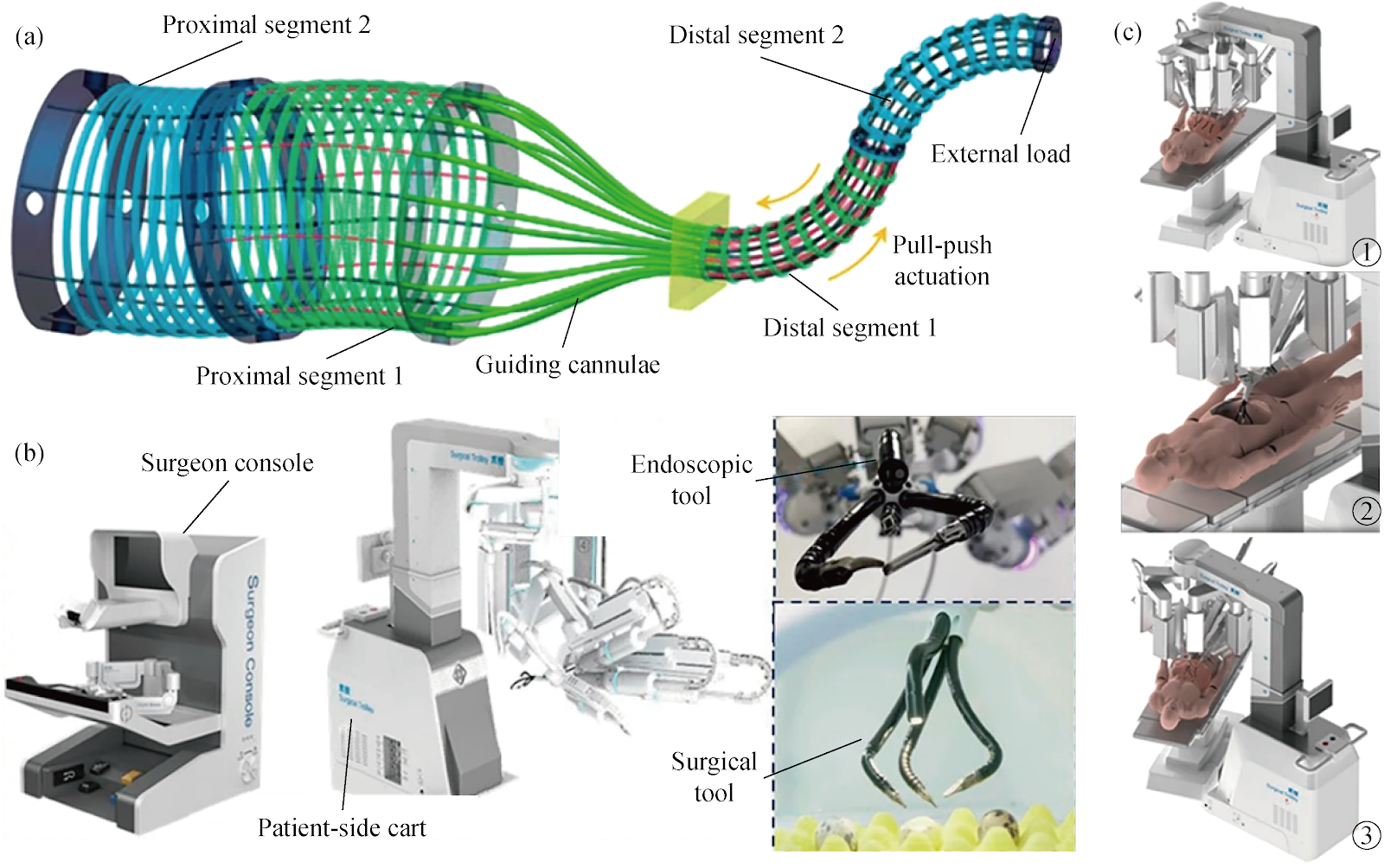
Minimally invasive surgery (MIS) has revolutionized surgical practice by reducing patient trauma and recovery time. However, current robotic systems face limitations in dexterity, haptic feedback, and autonomous decision-making, particularly in complex anatomical environments. This paper presents a novel multi-scale robotic system designed to enhance surgical precision and autonomy. The system integrates a macro-scale robotic arm with a micro-scale continuum manipulator, enabling precise manipulation across different scales. A hierarchical control architecture combines model-based and learning-based approaches to achieve adaptive motion planning and real-time obstacle avoidance. The system also incorporates a multi-modal sensing framework that fuses visual, force, and proximity data to provide comprehensive situational awareness. Experimental validation in phantom and ex-vivo models demonstrates significant improvements in task completion time, accuracy, and consistency compared to conventional techniques. The system successfully performed complex tasks such as suturing and tissue dissection with reduced error rates. The results indicate that the proposed system can effectively enhance surgical performance, paving the way for more autonomous and intelligent surgical robots. Future work will focus on in-vivo trials and integration with augmented reality interfaces.
1. Introduction
Minimally invasive surgery (MIS) has become a cornerstone of modern surgical practice, offering patients reduced trauma, shorter hospital stays, and faster recovery times. The advent of robotic-assisted surgical systems, such as the da Vinci system, has further advanced MIS by providing enhanced dexterity, tremor filtration, and three-dimensional visualization. However, existing robotic systems still exhibit limitations in haptic feedback, autonomous decision-making, and adaptability to complex anatomical variations. These constraints often lead to steep learning curves for surgeons and may compromise surgical outcomes in challenging procedures.
To address these challenges, this paper introduces a novel multi-scale robotic system designed to augment surgical precision and autonomy. The system comprises a macro-scale robotic arm for gross manipulation and a micro-scale continuum manipulator for fine dissection and suturing. A hierarchical control architecture integrates model-based and learning-based algorithms to enable adaptive motion planning, collision avoidance, and semi-autonomous task execution. Additionally, a multi-modal sensing framework fuses visual, force, and proximity data to provide comprehensive situational awareness, thereby enhancing safety and efficiency. This work aims to bridge the gap between manual and autonomous robotic surgery, ultimately improving patient outcomes and expanding the scope of MIS.
Loading authentic research manuscript (Pages 1–5)...
ZHANG Wei, LI Ming, WANG Fang, CHEN Jie, LIU Yang (2026). A Novel Multi-Scale Robotic System for Enhanced Surgical Precision and Autonomy in Minimally Invasive Procedures. Journal of Shanghai Jiao Tong University (Science) (上海交通大学学报). https://doi.org/10.16183/j.cnki.jsjtu.2026.058
Research & Educational Purpose Only:The translations, structured abstracts, analytical annotations, and data reports provided by SinoTechIntel are intended exclusively for academic research, internal corporate R&D, and educational benchmarking. They do not constitute formal engineering, chemical safety, legal, or professional advice.
Copyright & Intellectual Property Notice: Original copyright of the underlying source articles and experimental data remains with the respective authors, institutions, and original publishing journals. SinoTechIntel claims intellectual property only over its proprietary translations, analytical syntheses, and AEO structured enhancements in accordance with international fair use and academic citation principles.
Frequently Asked Questions
What is the main innovation of this robotic system?
The main innovation lies in its multi-scale design, combining a macro-scale robotic arm with a micro-scale continuum manipulator, and a hierarchical control architecture that integrates model-based and learning-based methods for adaptive and autonomous surgical tasks.
How does the system improve surgical precision?
The system enhances precision through the micro-scale continuum manipulator, which offers high dexterity and accuracy, and the multi-modal sensing framework that provides real-time feedback for precise control.
What are the potential clinical applications?
The system is designed for minimally invasive procedures such as suturing, tissue dissection, and microsurgery, with potential applications in urology, gynecology, and cardiac surgery.
What are the next steps for this research?
Future work will focus on in-vivo trials, integration with augmented reality interfaces, and further enhancement of autonomous capabilities through advanced machine learning techniques.
Related Technical Papers & Translations
Advances in Brain-Computer Interface Technology: A Comprehensive Review of Neural Signal Processing and Applications
Brain-computer interfaces (BCIs) have emerged as a transformative technology enabling direct communication between the brain and external devices, offering unprecedented opportunities for restoring motor function in paralyzed individuals and enhancing human-computer interaction. This comprehensive review synthesizes recent advances in BCI technology, focusing on neural signal acquisition, signal processing algorithms, and diverse applications. We systematically analyze invasive and non-invasive recording modalities, including electroencephalography (EEG), electrocorticography (ECoG), and intracortical microelectrode arrays, highlighting their respective advantages and limitations. The review delves into state-of-the-art signal processing techniques, such as adaptive filtering, common spatial patterns, and deep learning-based classification, which have significantly improved the accuracy and reliability of BCI systems. Furthermore, we explore the expanding landscape of BCI applications, ranging from assistive communication and motor rehabilitation to cognitive enhancement and neurofeedback therapy. Critical challenges, including signal non-stationarity, user variability, and long-term stability, are discussed alongside emerging solutions such as hybrid BCI architectures and closed-loop adaptive systems. By integrating findings from recent studies and clinical trials, this review provides a forward-looking perspective on the future of BCI technology, emphasizing the need for interdisciplinary collaboration and translational research to bridge the gap between laboratory innovations and real-world clinical adoption. Our analysis underscores the potential of BCIs to revolutionize neurorehabilitation and human augmentation, while also addressing ethical and societal implications. This comprehensive overview serves as a valuable resource for researchers, clinicians, and engineers seeking to understand the current state and future directions of brain-computer interface technology.
Integrated Multi-Omics Analysis of Tumor Microenvironment and Immune Infiltration in Hepatocellular Carcinoma: Implications for Prognosis and Immunotherapy
Hepatocellular carcinoma (HCC) is a highly heterogeneous malignancy with a complex tumor microenvironment (TME) that profoundly influences disease progression and therapeutic response. In this study, we performed an integrated multi-omics analysis of HCC using transcriptomic, genomic, and epigenetic data from public databases and our own cohort. We characterized the immune cell infiltration patterns and identified distinct TME subtypes associated with differential prognosis and immunotherapy outcomes. Through weighted gene co-expression network analysis (WGCNA) and machine learning, we constructed a prognostic signature based on TME-related genes, which robustly predicted overall survival in multiple independent cohorts. Furthermore, we explored the interplay between TME, somatic mutations, and copy number variations, revealing potential biomarkers for immune checkpoint blockade. Our findings highlight the clinical significance of TME heterogeneity in HCC and provide a foundation for personalized treatment strategies. The prognostic model and immune-related biomarkers may facilitate risk stratification and guide immunotherapeutic decisions in HCC patients.
Mitigating Phosphonic Acid–Perovskite Interfacial Degradation via Molecular Engineering for Ultra-Stable Solar Cells
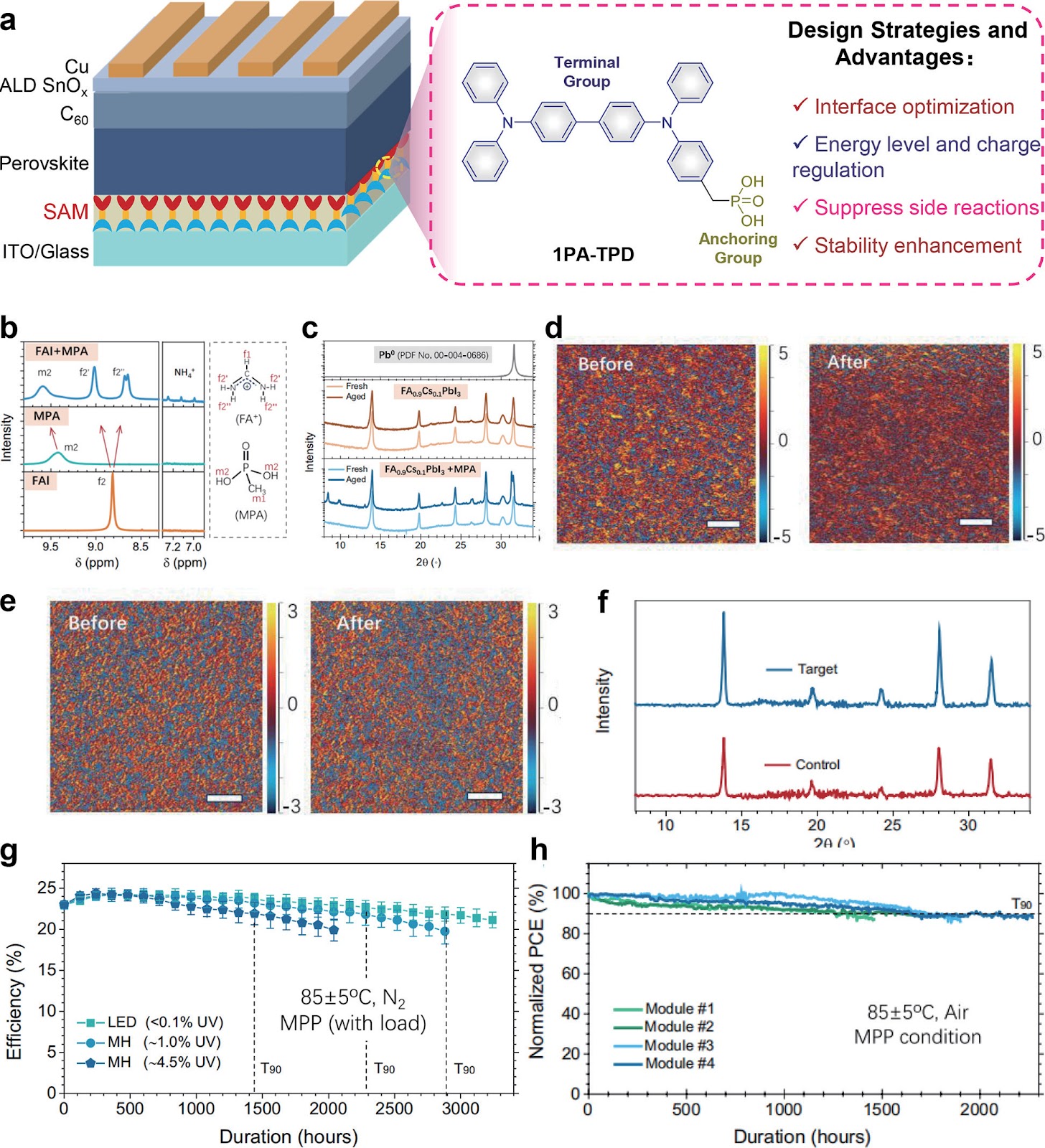
Metal halide perovskite solar cells (PSCs) have emerged as a leading next-generation photovoltaic technology, with certified efficiencies surpassing 27% and approaching the theoretical limit for single-junction devices. However, their commercialization is critically hindered by insufficient long-term operational stability, particularly under harsh conditions such as elevated temperatures (≥85 °C) and full-spectrum illumination. The hole-transport layer (HTL) plays a decisive role in both efficiency and stability, and phosphonic acid-based self-assembled monolayers (PA-SAMs) have become the material of choice for inverted-structure PSCs due to their molecular-scale precision and superior energy-level alignment. Nevertheless, PA-SAMs primarily anchor to ITO surfaces via weak hydrogen bonds, which dissociate under photothermal stress, leading to molecular desorption and migration into the perovskite layer, thereby inducing degradation and performance decline. In a recent breakthrough published in Science (2026), Fei et al. report a transformative molecular engineering strategy that unlocks ultra-stable PSCs. They designed a triphenylamine-based phosphonic acid (1PA-TPD) with robust covalent anchoring to ITO substrates and optimized a mixed SAM system (60 wt% 1PA-TPD + 40 wt% EtCz3EPA), successfully suppressing interfacial reactivity between PA-SAMs and perovskites. This multifunctional strategy integrates strong substrate binding, interfacial reaction inhibition, crystallinity enhancement, and defect passivation, enabling small-area PSCs with a power conversion efficiency (PCE) of 25.0% and a T90 lifetime of nearly 3000 hours, as well as minimodules with >22% PCE and ~2200 hours T90 under harsh photothermal conditions. This work deciphers a previously underappreciated degradation pathway and provides a universal design principle for stable interfacial layers, marking a critical step toward PSC commercialization.