SinoTechIntel Academic Portal
πŸ›οΈ Indexed Academic JournalImpact Factor: 3.8 (Q1 - Elsevier)Original: δΈ­ε›½εŒ–ε­¦ε·₯程学ζŠ₯ (θ‹±ζ–‡η‰ˆ)

Chinese Journal of Chemical Engineering

Access authentic peer-reviewed engineering methodologies, experimental datasets, and scientific literature published in this journal on SinoTechIntel.

Total Research Papers: 98
Access: 100% Free Open Access
Browse by Publication Year & VolumeReset All Filters βœ•

Published Research PapersFiltered: Year 2024 β€’ Vol. 31 β€’ Issue 12

Showing 2 of 98 peer-reviewed papers with full Graphical Abstracts.

Original ResearchVol. 31, Issue 12 β€’ pp. 635-647DOI: 10.1016/j_cjche_144878035β€’ Dec 16, 2024

Study on coal pyrolysis characteristics by combining different pyrolysis reactors

Authors: Xiaoping Su, Zhao Wang, Ning Li, Longjian Li, Ping Zhang, Ming Sun, Xiaoxun Ma

The pyrolysis process of Shendong coal (SD) was first studied by combining the characteristics of thermal gravimetric (TG), pyrolysis-gas chromatography/mass spectrometry (Py-GC/MS) and Gray-King assay (G-K). The results show that the order of coke yields is G-K (76.35% (mass))>TG (73.11% (mass))>Py (70.03% (mass)). G-K coke yield caused by condensation reaction and secondary reaction accounts for 3.08% (mass) and 3.24% (mass), respectively. Compared with slow pyrolysis, fast pyrolysis has stronger fracture ability to coal molecules and can obtain more O-compounds, mono-ring aromatics and aliphatics. Especially, the content of phenolics increases significantly from 15.49% to 35.17%, but the content of multi-ring aromatics decreases from 23.13% to 2.36%. By comparing the compositions of Py primary tar and G-K final tar, it is found that secondary reactions occurred during G-K pyrolysis process include the cleavage of alkane and esters, condensation of mono-ring aromatics with low carbon alkene, ring opening, isomerization of tri-ring aromatics, hydrogenation of aromatics and acids.
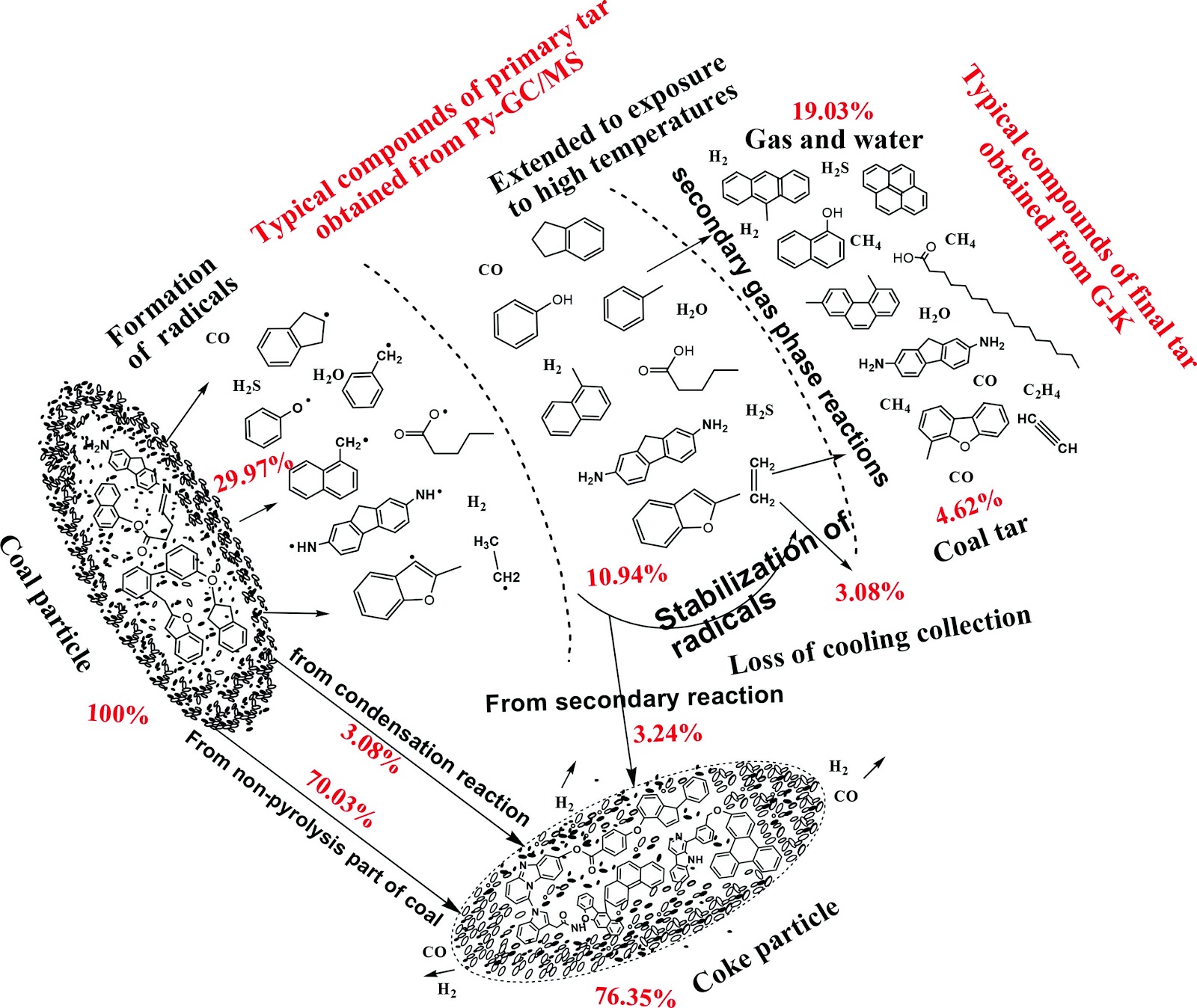
Study on coal pyrolysis characteristics by combining different pyrolysis reactors
Graphical Abstract
Original ResearchVol. 31, Issue 12 β€’ pp. 839-851DOI: 10.1016/j_cjche_144878459β€’ Dec 2, 2024

Center-concave nanosheets of core-shell WO3@Prussian blue based handheld microchip-devices for ultrasensitive lysine determination

Authors: Huaiyu Song, Meiyue Wang, Tao Liu, Zhengkun Liu, Ying Xie, Zhenyu Chu, Wanqin Jin

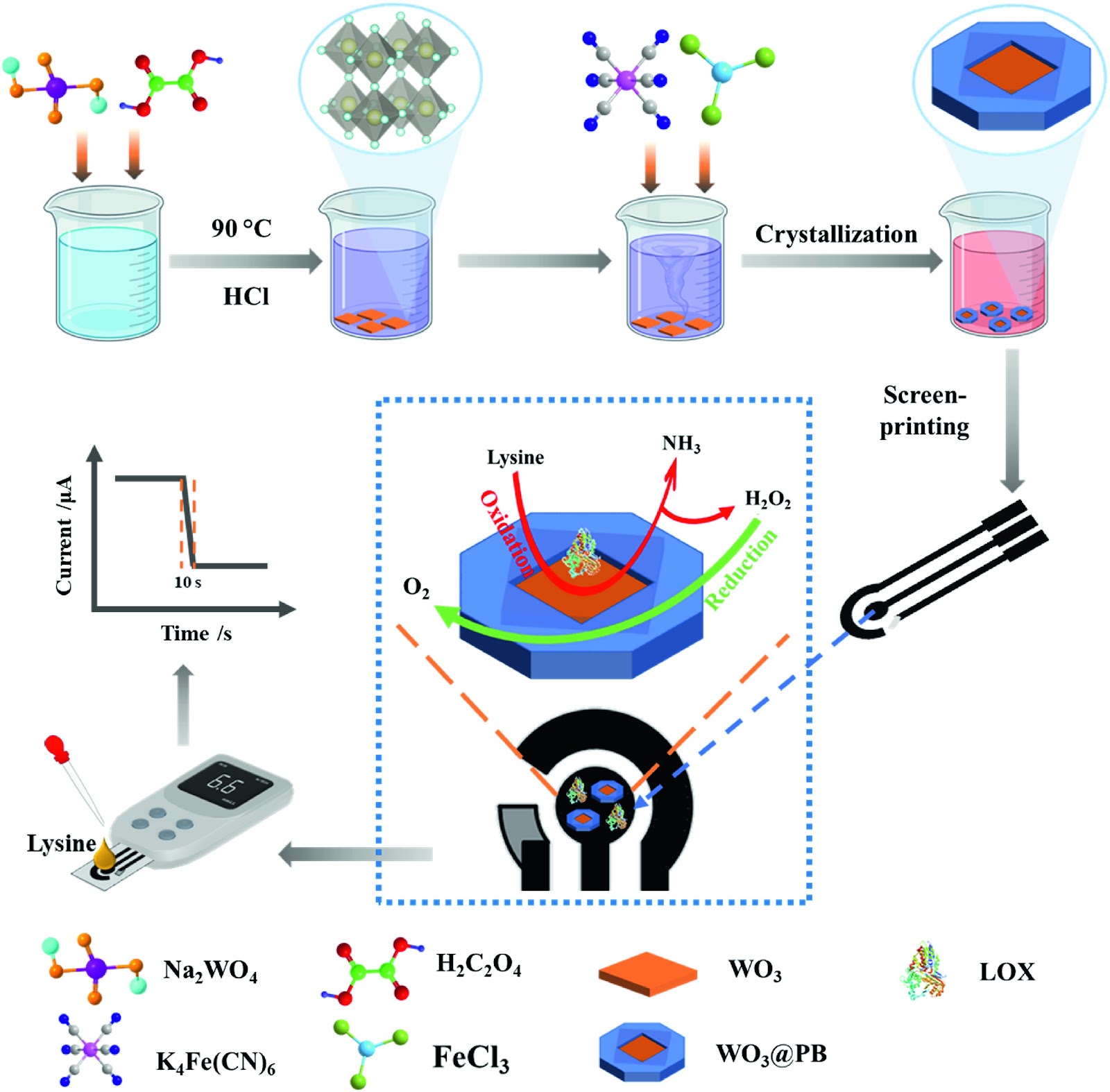
Lysine is one of the essential amino acids for human body, and its imbalance is a major cause to anemia, aging process, leukemia cell proliferation and tumor growth. Therefore, its monitoring is dominative to the prevention the disease progress and guidance to the clinical treatment. However, traditional in-hospital detection methods, such as colorimetry and fluorometric, often suffer the disadvantages of high cost and long time-consuming. These drawbacks show a difficulty in the home-in and dairy monitoring for the lysine regulation in body. In this study, we have proposed an ultrasensitive microchip-based portable device to achieve the onsite and precise determination of lysine within only 10 s. This microchip was functionalized through constructing a center-concave nanosheet of core-shell WO3@Prussian blue (WO3@PB) to remarkably strengthen the generation and transfer of the detection signal. In this special architecture, the core WO3 nanosheet can be exposed at the center region of this nanocomposite to effectively promote the enzymatic oxidation, while the PB shell enables to strongly reduce the H2O2 produced by the enzymatic reaction. Under above synergetic effects, a handheld device was designed to support the plug-and-play microchip, which performed an outstanding accuracy for the lysine detection in blood.

Center-concave nanosheets of core-shell WO3@Prussian blue based handheld microchip-devices for ultrasensitive lysine determination
Graphical Abstract