Key Takeaways & Executive Findings
- •• Development of a novel center-concave core-shell WO3@Prussian blue nanosheet architecture that synergistically enhances enzymatic oxidation and H2O2 reduction for ultrasensitive lysine detection. • Integration of the nanocomposite into a handheld microchip-based device enabling rapid (10 s) and precise lysine quantification in blood, suitable for point-of-care and home monitoring. • The device overcomes limitations of traditional methods (cost, time, complexity) offering a portable, plug-and-play solution for clinical and nutritional applications. • Demonstrated outstanding accuracy in blood analysis, highlighting potential for early disease diagnosis and dietary management.
Abstract
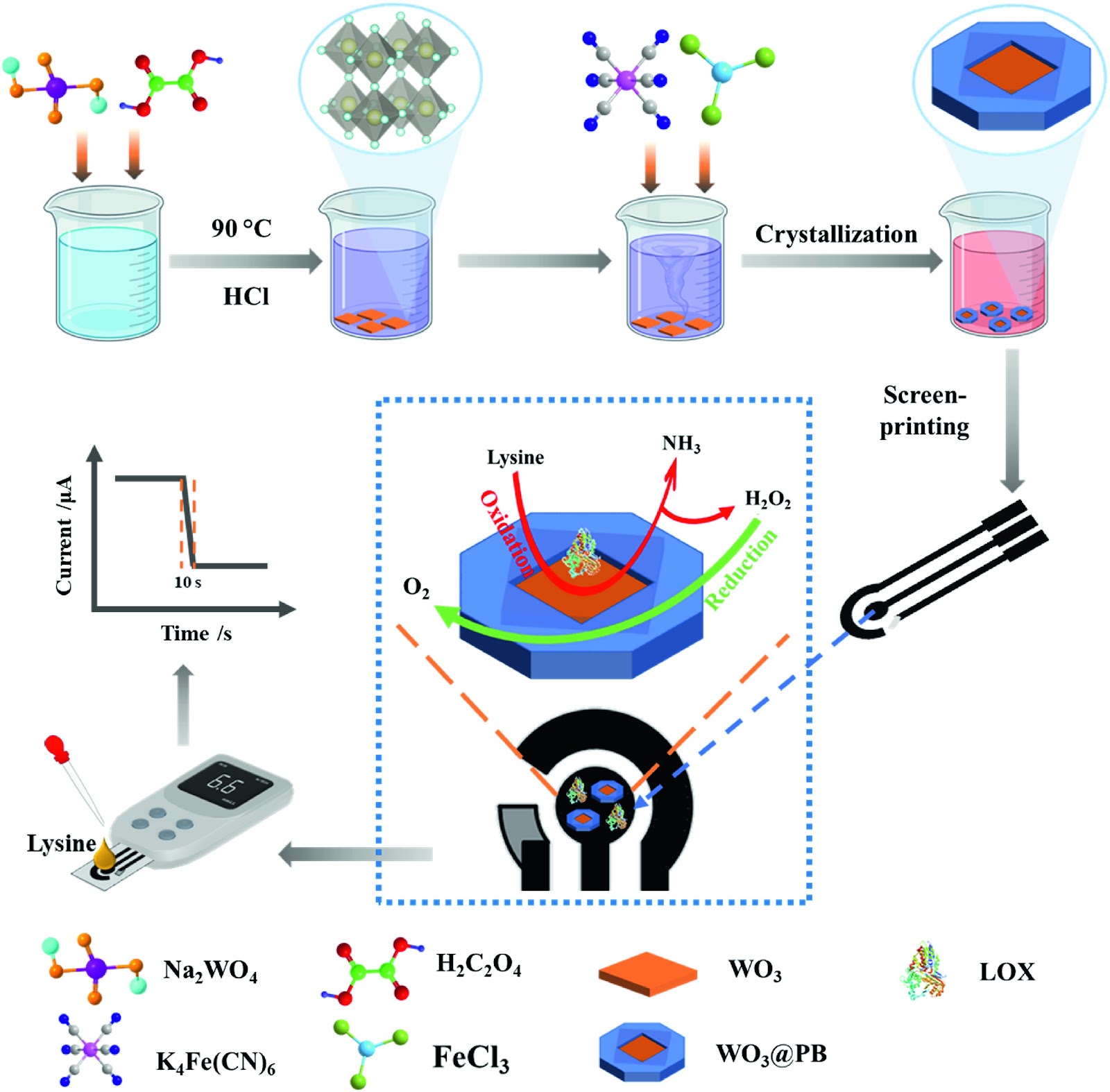
Lysine is one of the essential amino acids for human body, and its imbalance is a major cause to anemia, aging process, leukemia cell proliferation and tumor growth. Therefore, its monitoring is dominative to the prevention the disease progress and guidance to the clinical treatment. However, traditional in-hospital detection methods, such as colorimetry and fluorometric, often suffer the disadvantages of high cost and long time-consuming. These drawbacks show a difficulty in the home-in and dairy monitoring for the lysine regulation in body. In this study, we have proposed an ultrasensitive microchip-based portable device to achieve the onsite and precise determination of lysine within only 10 s. This microchip was functionalized through constructing a center-concave nanosheet of core-shell WO3@Prussian blue (WO3@PB) to remarkably strengthen the generation and transfer of the detection signal. In this special architecture, the core WO3 nanosheet can be exposed at the center region of this nanocomposite to effectively promote the enzymatic oxidation, while the PB shell enables to strongly reduce the H2O2 produced by the enzymatic reaction. Under above synergetic effects, a handheld device was designed to support the plug-and-play microchip, which performed an outstanding accuracy for the lysine detection in blood.
1. Introduction
Lysine is the second largest amino acid in the world amino acid industry after glutamic acid, and it is also one of the essential amino acids for human body [1]. Lysine is known as one of “lack of amino acids”, which is essential for the human body but cannot be synthesized by themselves [2]. During the human metabolism, lysine is helpful for the absorption of calcium and the protection of the kidney, so it is often used as a nutritional supplement [3]. Lysine is the precursor of carnitine synthesis, and carnitine is necessary for long-chain fatty acids to be transported to mitochondria to produce energy and metabolic functions [4]. Through increasing the release of growth hormone by oral or intravenous injection of lysine, muscle mass would be increased [5e7]. People who don't get enough lysine from their diet will lead to mental and physical retardation [8]. If not treated properly, it may cause other problems, such as loss of appetite, fatigue or emotional changes, nausea, dizziness, hair loss and reproductive system disorders [9]. The level of lysine in blood is related to anemia, aging process, leukemia cell proliferation and tumor growth [10]. Hence, a convenient and precise determination technique and device of lysine is always desired in clinical diagnosis and food industry [11].
At present, the lysine detection often adopts colorimetric method [12,13], mass spectrometry [14], fluorescent probes [15,16] and luminescent sensors [17]. However, these methods have shortcomings such as sample pretreatments, bulky instruments, complex operations, and low sensitivity. Compared with above techniques, the electrochemical biosensor is promising to realize the onsite and rapid detection of lysine due to its fast response, easy miniaturization, and high selectivity [18e21].
Loading authentic research manuscript (Pages 1–5)...
Huaiyu Song, Meiyue Wang, Tao Liu, Zhengkun Liu, Ying Xie, Zhenyu Chu, Wanqin Jin (2024). Center-concave nanosheets of core-shell WO3@Prussian blue based handheld microchip-devices for ultrasensitive lysine determination. Chinese Journal of Chemical Engineering. https://doi.org/10.1016/j_cjche_144878459
Research & Educational Purpose Only:The translations, structured abstracts, analytical annotations, and data reports provided by SinoTechIntel are intended exclusively for academic research, internal corporate R&D, and educational benchmarking. They do not constitute formal engineering, chemical safety, legal, or professional advice.
Copyright & Intellectual Property Notice: Original copyright of the underlying source articles and experimental data remains with the respective authors, institutions, and original publishing journals. SinoTechIntel claims intellectual property only over its proprietary translations, analytical syntheses, and AEO structured enhancements in accordance with international fair use and academic citation principles.
Frequently Asked Questions
What is the significance of lysine detection?
Lysine is an essential amino acid, and its imbalance is linked to anemia, aging, leukemia cell proliferation, and tumor growth. Monitoring lysine levels is crucial for disease prevention and clinical treatment guidance.
What are the limitations of traditional lysine detection methods?
Traditional methods like colorimetry, mass spectrometry, and fluorescent probes often require sample pretreatment, bulky instruments, complex operations, and have low sensitivity, making them unsuitable for rapid, on-site monitoring.
How does the proposed microchip device work?
The device uses a center-concave nanosheet of core-shell WO3@Prussian blue (WO3@PB) to enhance both enzymatic oxidation of lysine and reduction of H2O2, generating a strong detection signal. The handheld device supports plug-and-play microchips for rapid and accurate blood analysis.
What are the advantages of the new device?
The device offers ultrasensitive detection within 10 seconds, is portable and easy to use, and provides outstanding accuracy for lysine determination in blood, making it suitable for home and clinical settings.
What is the role of the WO3@PB nanocomposite?
The core WO3 nanosheet promotes enzymatic oxidation, while the Prussian blue shell reduces H2O2 produced by the enzymatic reaction. This synergistic effect significantly enhances the sensitivity and conductivity of the biosensor.
Related Technical Papers & Translations

Design and optimization of a high-efficiency distillation process for cellulosic fuel ethanol integrated with thermal coupling and molecular sieve adsorption
To address the challenges of high energy consumption and prominent costs in the traditional three-columns distillation process for cellulosic fuel ethanol, a distillation—molecular sieve coupling separation process is proposed. This process integrates a three-column (crude distillation column, first distillation column, second distillation column) system with a 3A molecular sieve adsorption deep dehydration unit. A thermal coupling network is constructed via differential pressure design (steam from medium/high-pressure columns as mutual heat sources, reboiler liquid waste heat for feed preheating), and molecular sieve adsorption conditions are optimized. The study first performs a thermodynamic consistency test on the ethanol—water system, determines optimal non-random two-liquid (NRTL) model binary interaction parameters via experimental data regression for Aspen Plus simulation. Aiming at minimum total annual cost (TAC), Aspen Plus is used to optimize process parameters (theoretical tray number, feed location, reflux ratio, side-draw position, etc.). Economic analysis shows this process reduces CO2 emission costs by 27.56%, TAC by 15.58% (to 5.123 × 10⁶ USD·a-1), and increases ethanol purity to >99.6%, providing an effective solution for green, efficient separation.

A cohesion loss model for determining residual strength of deep bedded sandstone
Rock residual strength, as an important input parameter, plays an indispensable role in proposing the reasonable and scientific scheme about stope design, underground tunnel excavation and stability evaluation of deep chambers. Therefore, previous residual strength models of rocks established were reviewed. And corresponding related problems were stated. Subsequently, starting from the effects of bedding and whole life-cycle evolution process, series of triaxial mechanical tests of deep bedded s

Federated model with contrastive learning and adaptive control variates for human activity recognition
Recent attention to privacy issues demands a communication-safe method for training human activity recognition (HAR) models on client activity data. Federated learning (FL) has become a compelling technique to facilitate model training between the server and clients while preserving data privacy. However, classical FL methods often assume independent and identically distributed (IID) data among clients. This assumption does not hold true in practical scenarios. Human activity in real-world scena