Key Takeaways & Executive Findings
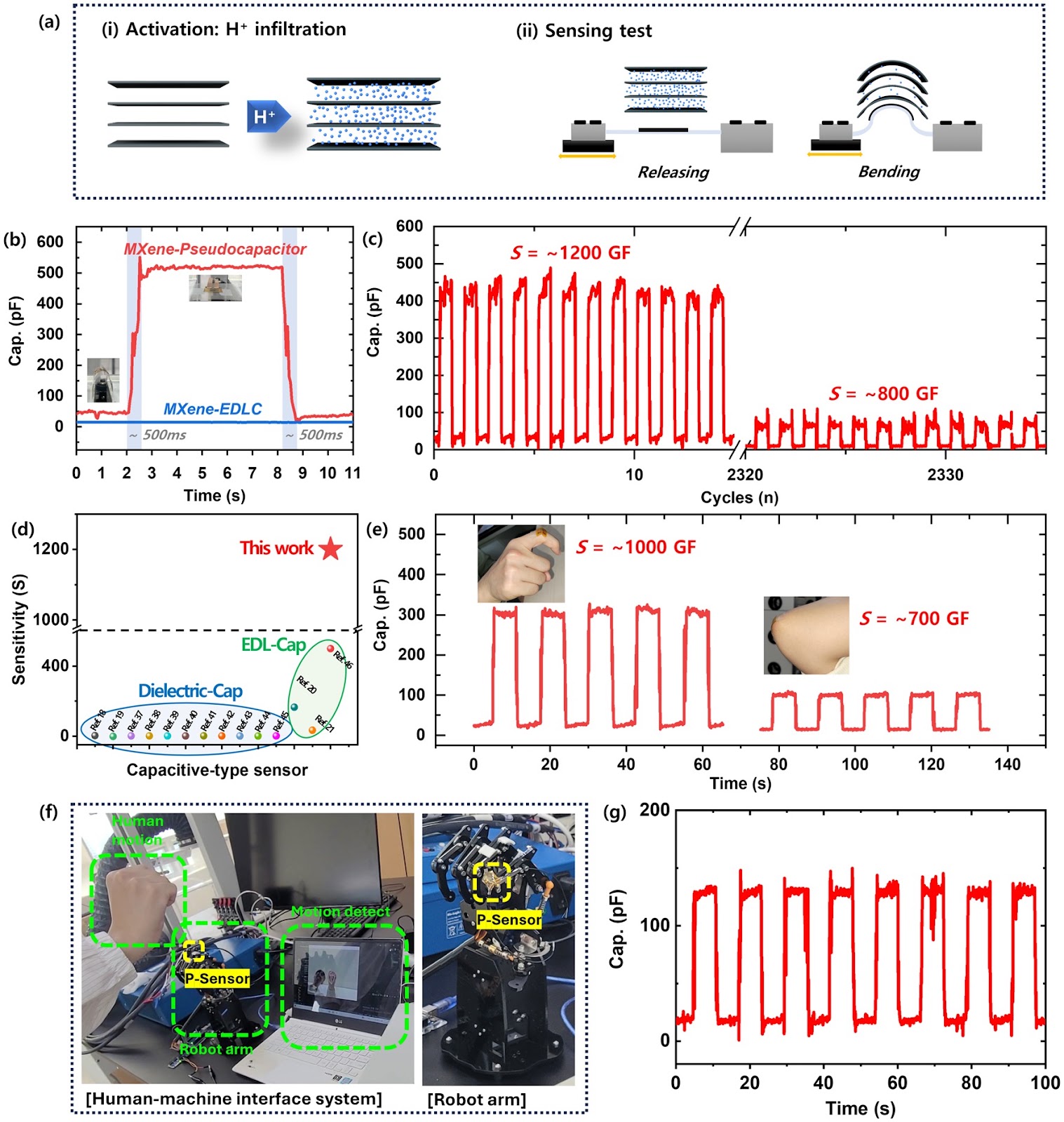
- •• Discovery of a novel phenomenon where pseudocapacitance of flexible MXene supercapacitors changes sensitively in response to bending, leading to the development of Pseudocapacitive Sensors. • Pseudocapacitive Sensors repurpose supercapacitors as strain sensors, detecting capacitance changes from shifts between pseudocapacitance and electrical double layer capacitor, achieving a gauge factor of about 1200. • The sensing mechanism relies on local pH changes induced by bending, which switch energy storage kinetics from Faradaic protonation to non-Faradaic adsorption. • This work expands the application of pseudocapacitance from energy storage to multifunctional electronics, with potential in robotics, biomedical devices, and health monitoring.
Abstract
Extensively explored for their distinctive pseudocapacitance characteristics, MXenes, a distinguished group of 2D materials, have led to remarkable achievements, particularly in the realm of energy storage devices. This work presents an innovative Pseudocapacitive Sensor. The key lies in switching the energy storage kinetics from pseudocapacitor to electrical double layer capacitor by employing the change of local pH (-log[H+]) in MXene-based flexible supercapacitors during bending. Pseudocapacitive sensing is observed in acidic electrolyte but absent in neutral electrolyte. Applied shearing during bending causes liquid-crystalline MXene sheets to increase in their degree of anisotropic alignment. With blocking of H+ mobility due to the higher diffusion barrier, local pH increases. The electrochemical energy storage kinetics transits from Faradaic chemical protonation (intercalation) to non-Faradaic physical adsorption. We utilize the phenomenon of capacitance change due to shifting energy storage kinetics for strain sensing purposes. The developed highly sensitive Pseudocapacitive Sensors feature a remarkable gauge factor (GF) of approximately 1200, far surpassing conventional strain sensors (GF: ~1 for dielectric-cap sensor). The introduction of the Pseudocapacitive Sensor represents a paradigm shift, expanding the application of pseudocapacitance from being solely confined to energy devices to the realm of multifunctional electronics. This technological leap enriches our understanding of the pseudocapacitance mechanism of MXenes, and will drive innovation in cutting-edge technology areas, including advanced robotics, implantable biomedical devices, and health monitoring systems.
1. Introduction
MXenes, owing to their unique pseudocapacitance traits, have been extensively researched in the field of energy storage devices, particularly in supercapacitors and microsupercapacitors (MSCs) [1–7]. Ti3C2Tx MXenes, renowned for their remarkable pseudocapacitive properties, exhibit this phenomenon within supercapacitors due to redox reactions at the electrode–electrolyte interface [8–13]. Specifically, these reactions involve the transfer of charge, resulting in the alteration of the titanium oxidation state, and are accompanied by protonation of oxygen functional groups [14–17]. This phenomenon is compared with that of an electrical double layer capacitor (EDLC), which operates through non-faradaic physisorption without involving any redox chemical reaction.
The potential applications of this distinctive feature extend across diverse fields, specifically in energy storage and power supply systems, eliciting substantial interest. MXene has inherent anisotropic mechanical properties. MXene-hydrogel, containing negatively charged unilamellar nanosheets, aligns under mechanical shearing of Ti3C2Tx liquid–crystal phase.
Meanwhile, in the field of mechanical strain sensor, there are still challenges in practical use for motion sensing as human–machine interfaces: sensitivity, responsivity, hysteresis characteristics (response/recovery), linearity (sensitivity to strain). Among these, the most critical limitation is low sensitivity, where gauge factor (GF) is theoretically 1 [18–20]. Xu et al. improved sensor sensitivity by using ionically cross-linked polymer-alginate and covalently cross-linked polymer-polyacrylamide, achieving a gauge factor (GF) of approximately 165 [21]. Rao et al. fabricated a highly sensitive capacitive strain sensor comprising a self-healing polydiacetylene-polyacrylic acid- Cr3+ hydrogel, which exhibits a GF of up to 160 [22]. However, these
Loading authentic research manuscript (Pages 1–5)...
Eunji Kim, Seongbeen Kim, Hyeong Min Jin, Gyungtae Kim, Hwi-Heon Ha, Yunhui Choi, Kyoungha Min, Su-Ho Cho, Hee Han, Chi Won Ahn, Jaewoo Roh, Il-Kwon Oh, Jinwoo Lee, Yonghee Lee (2024). Unlocking Novel Functionality: Pseudocapacitive Sensing in MXene-Based Flexible Supercapacitors. Nano-Micro Letters. https://doi.org/10.1007/s40820-024-01567-2
Research & Educational Purpose Only:The translations, structured abstracts, analytical annotations, and data reports provided by SinoTechIntel are intended exclusively for academic research, internal corporate R&D, and educational benchmarking. They do not constitute formal engineering, chemical safety, legal, or professional advice.
Copyright & Intellectual Property Notice: Original copyright of the underlying source articles and experimental data remains with the respective authors, institutions, and original publishing journals. SinoTechIntel claims intellectual property only over its proprietary translations, analytical syntheses, and AEO structured enhancements in accordance with international fair use and academic citation principles.
Frequently Asked Questions
What is a Pseudocapacitive Sensor?
A Pseudocapacitive Sensor is a novel device that repurposes MXene-based flexible supercapacitors as strain sensors. It detects capacitance changes resulting from the shift between pseudocapacitance and electrical double layer capacitance, which is induced by bending and local pH changes.
How does the Pseudocapacitive Sensor achieve such a high gauge factor?
The sensor achieves a gauge factor of approximately 1200, far exceeding conventional strain sensors (GF ~1), by exploiting the sensitive dependence of pseudocapacitance on bending-induced local pH changes, which alter the energy storage kinetics from Faradaic to non-Faradaic processes.
What is the underlying mechanism of pseudocapacitive sensing?
The mechanism involves bending-induced shearing that aligns MXene sheets, increasing the diffusion barrier for H+ ions and raising local pH. This blocks protonation (Faradaic) and shifts to physical adsorption (non-Faradaic), causing a measurable capacitance change.
In which electrolyte is pseudocapacitive sensing observed?
Pseudocapacitive sensing is observed in acidic electrolytes, but it is absent in neutral electrolytes, indicating the critical role of H+ ions in the sensing mechanism.
What are potential applications of Pseudocapacitive Sensors?
Potential applications include advanced robotics, implantable biomedical devices, and health monitoring systems, where high sensitivity and flexibility are required.
Related Technical Papers & Translations
Direct Repair of the Crystal Structure and Coating Surface of Spent LiFePO4 Materials Enables Superfast Li-Ion Migration
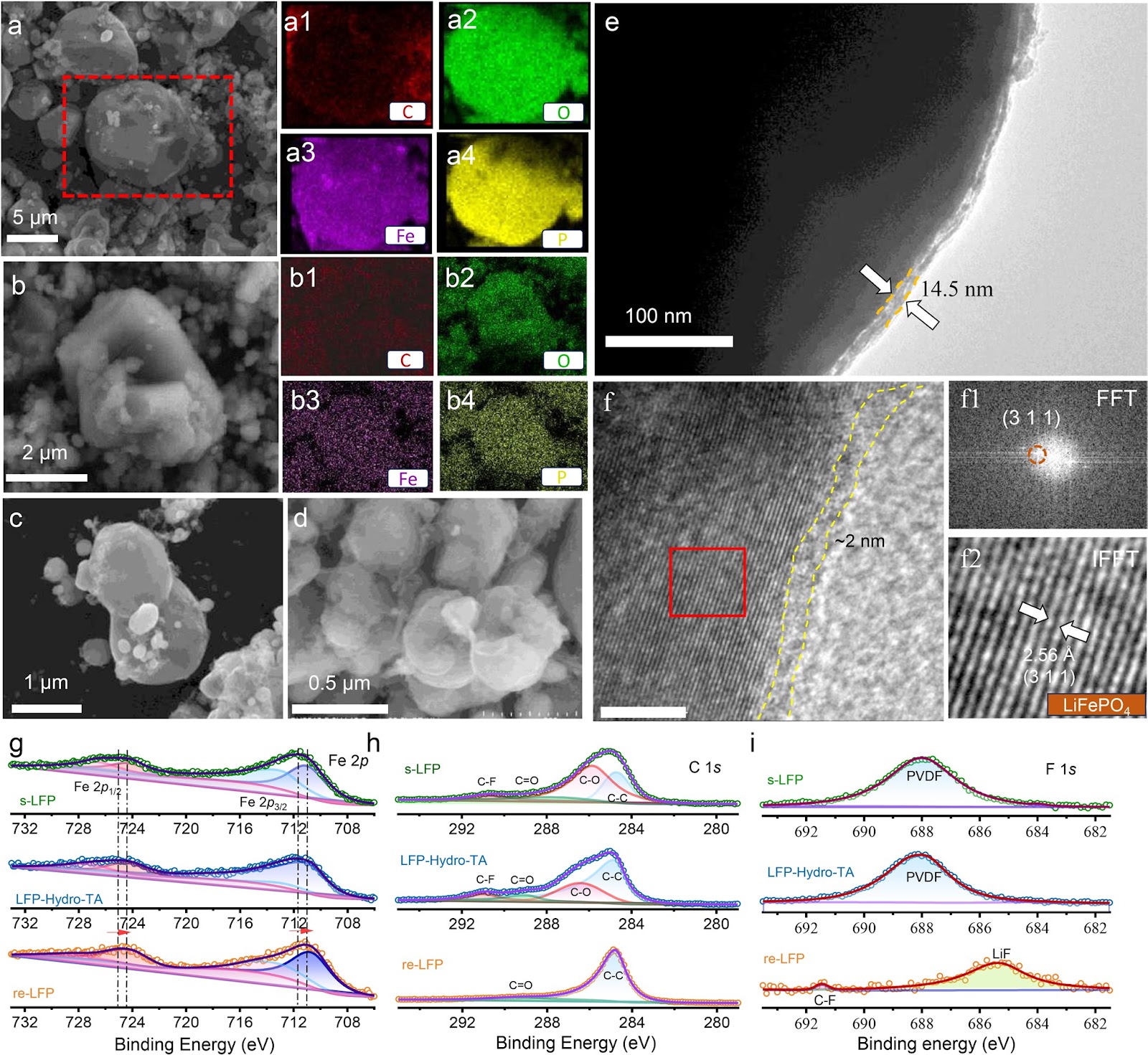
The rapid accumulation of spent LiFePO4 (LFP) cathodes from retired lithium-ion batteries necessitates the development of effective and environmental-friendly recycling strategies. In this context, direct regeneration has emerged as a promising approach for reclaiming LFP cathode materials, offering a streamlined pathway to restore their electrochemical functionality. We report an integrated regeneration protocol that simultaneously repairs the degraded crystal structure and reconstructs the damaged carbon coating in spent LFP. The regenerated cathode material had superfast lithium-ion diffusion kinetics and a stable cathode–electrolyte interface, giving a remarkable rate capability with specific capacities of 122 mAh g−1 at 5C and 106 mAh g−1 at 10C (1C = 170 mA g−1). It also maintained capacities of 110.7 mAh g−1 (5C) and 84.1 mAh g−1 (10C) after 400 cycles. It could be used in harsh environments and could be stably cycled at subzero temperatures (−10 and −20 °C) and in solid-state electrolyte batteries. Life cycle assessment combined with economic evaluation using the EverBatt model reveals that this direct regeneration approach has high economic and environmental benefits.
Oxide Semiconductor for Advanced Memory Architectures: Atomic Layer Deposition, Key Requirement and Challenges
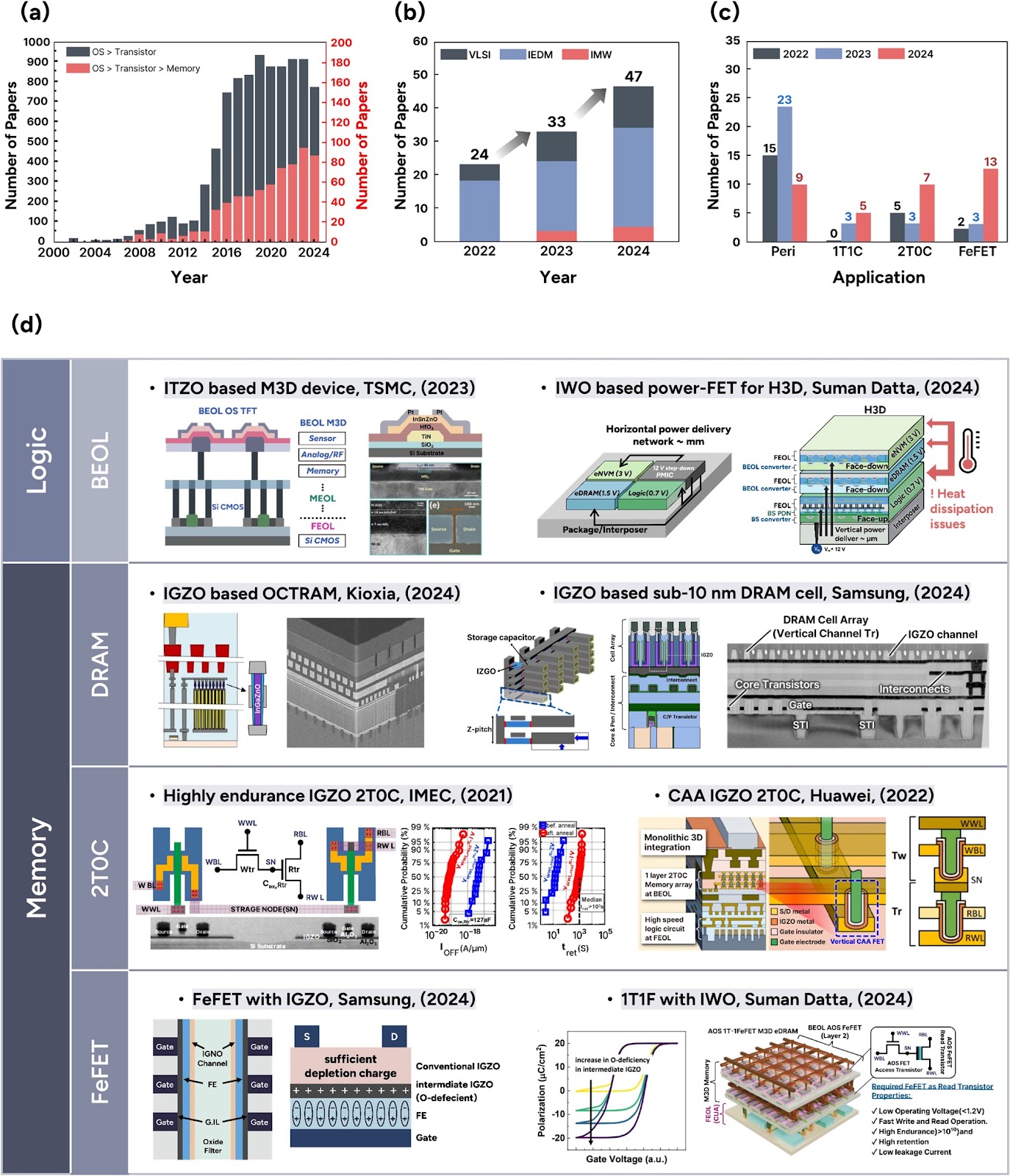
Oxide semiconductors (OSs), introduced by the Hosono group in the early 2000s, have evolved from display backplane materials to promising candidates for advanced memory and logic devices. The exceptionally low leakage current of OSs and compatibility with three-dimensional (3D) architectures have recently sparked renewed interest in their use in semiconductor applications. This review begins by exploring the unique material properties of OSs, which fundamentally originate from their distinct electronic band structure. Subsequently, we focus on atomic layer deposition (ALD), a core technique for growing excellent OS films, covering both basic and advanced processes compatible with 3D scaling. The basic surface reaction mechanisms—adsorption and reaction—and their roles in film growth are introduced. Furthermore, material design strategies, such as cation selection, crystallinity control, anion doping, and heterostructure engineering, are discussed. We also highlight challenges in memory applications, including contact resistance, hydrogen instability, and lack of p-type materials, and discuss the feasibility of ALD-grown OSs as potential solutions. Lastly, we provide an outlook on the role of ALD-grown OSs in memory technologies. This review bridges material fundamentals and device-level requirements, offering a comprehensive perspective on the potential of ALD-driven OSs for next-generation semiconductor memory devices.
Laser powder bed fusion of biodegradable Zn-4Cu alloy: Processing, microstructure and properties
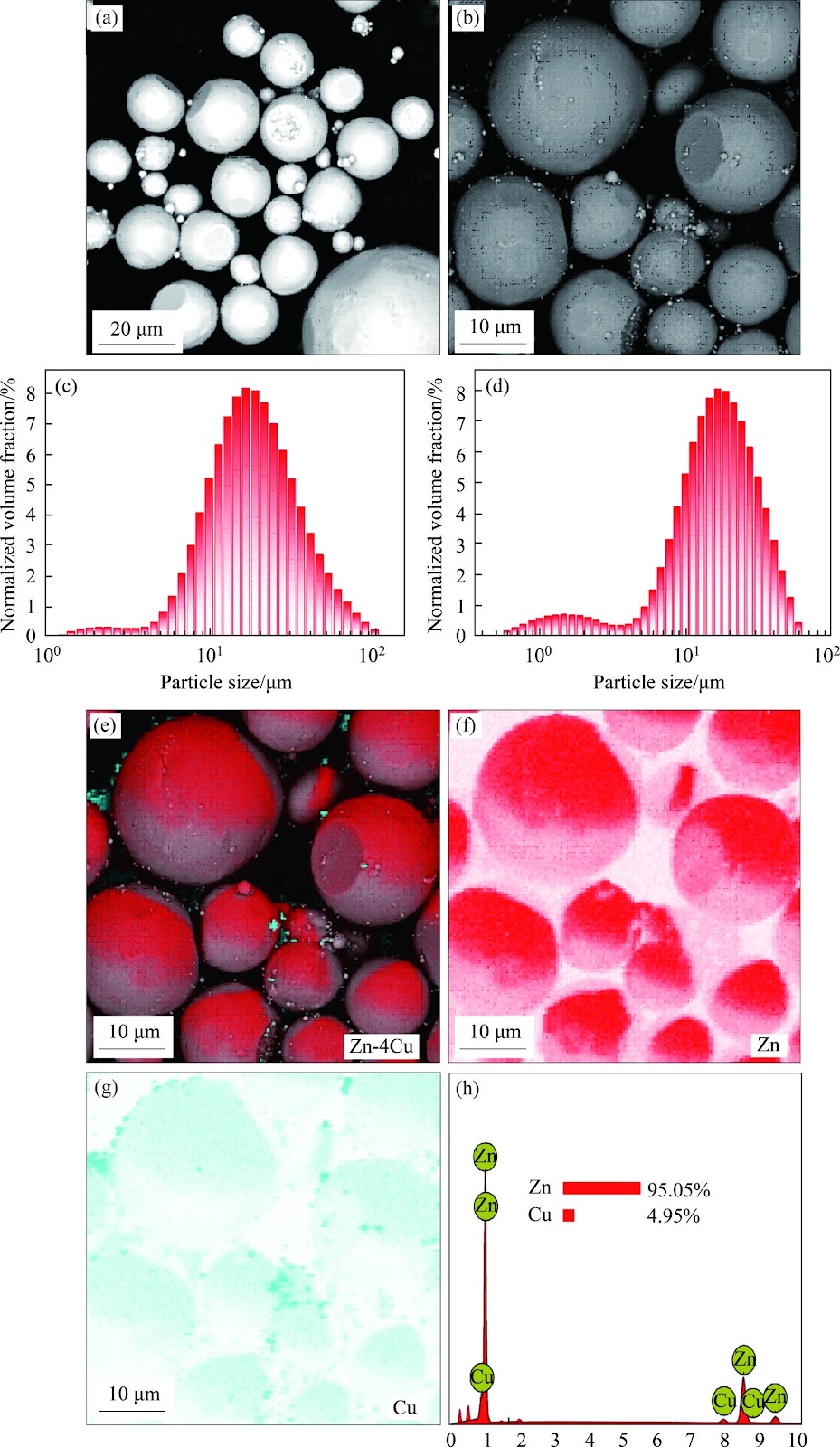
Zn's natural degradability and biocompatibility make it a promising candidate for implants, however, its mechanical properties remain insufficient for bone applications. In this study, the performance of Zn was enhanced by developing Zn-Cu alloys via laser powder bed fusion (LPBF). Optimal LPBF parameters for forming stable tracks were achieved by adjusting laser power and scanning speed. Under optimized conditions of 100 W and 100 mm/s, high-density (99.58%) Zn-Cu alloys with improved hardness (68.2HV) and yield strength (160 MPa) were achieved. These improvements are attributed to solid solution strengthening, segregation strengthening, and grain refinement. The Zn-Cu alloys also demonstrated favorable degradation behavior, with a rate of 0.16 mm/year. This degradation is primarily driven by micro-galvanic corrosion between the CuZn5 phase and Zn matrix, along with refined grains and increased grain boundary density. This work demonstrates a viable strategy for fabricating Zn-based implants with enhanced structural integrity and mechanical performance via LPBF.