Key Takeaways & Executive Findings
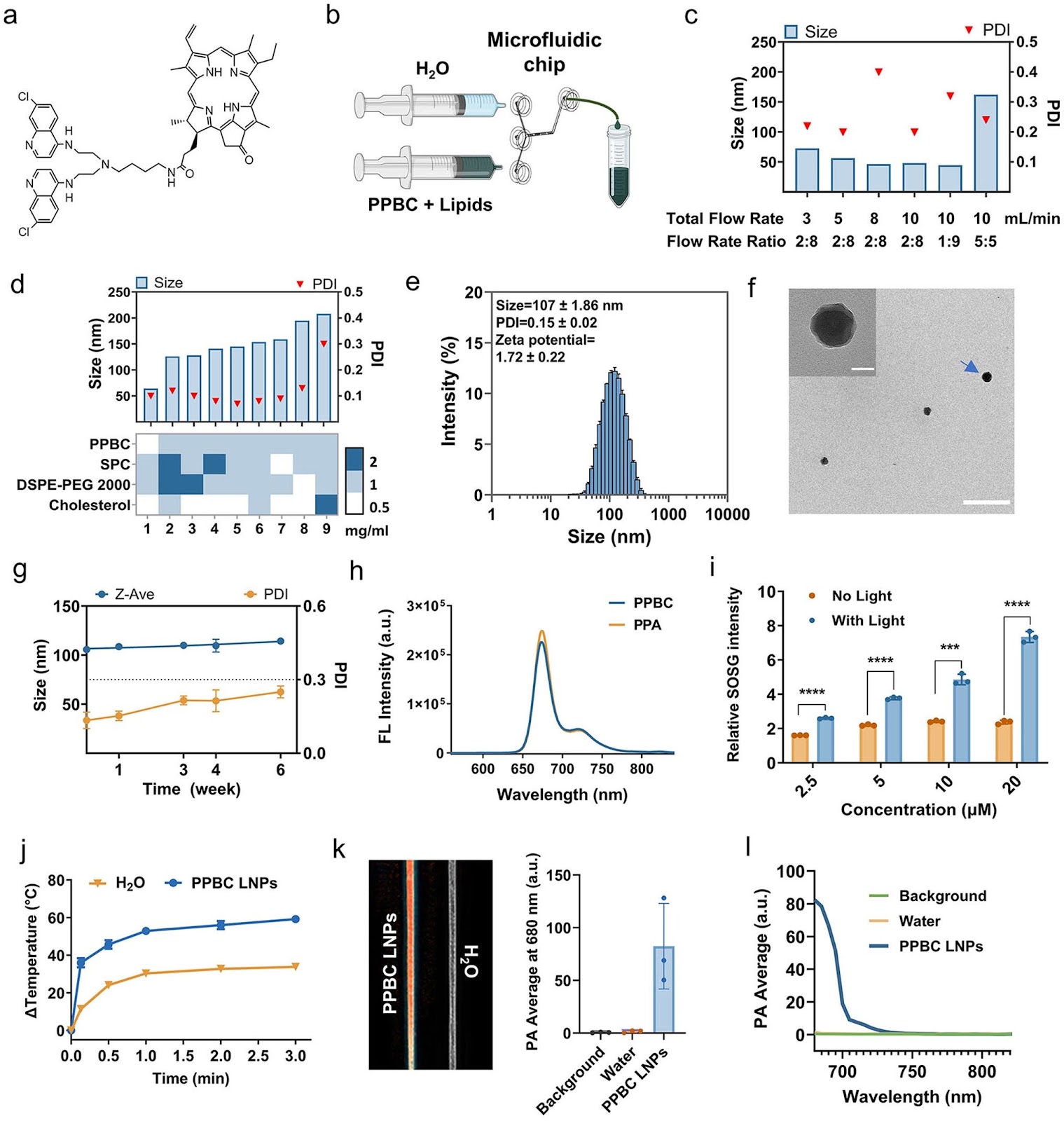
- •• PPBC LNPs integrate photodynamic and photothermal therapy with autophagy blockage, effectively inducing bladder cancer cell death. • The nanoparticles enable bimodal photoacoustic and fluorescence imaging, allowing high-resolution, deep-tissue tracking of drug biodistribution and therapeutic response. • Two doses of PPBC LNPs combined with laser treatment led to complete ablation of several bladder tumors, demonstrating potent antitumor efficacy. • Formulated with lipid excipients via microfluidics, PPBC LNPs exhibit excellent biocompatibility, stability, and scalability, supporting clinical translation.
Abstract
Rational design of multifunctional nanoplatforms capable of combining therapeutic effects with real-time monitoring of drug distribution and tumor status is emerging as a promising approach in cancer nanomedicine. Here, we introduce pyropheophorbide a–bisaminoquinoline conjugate lipid nanoparticles (PPBC LNPs) as a bimodal system for image-guided phototherapy in bladder cancer treatment. PPBC LNPs not only demonstrate both powerful photodynamic and photothermal effects upon light activation, but also exhibit potent autophagy blockage, effectively inducing bladder cancer cell death. Furthermore, PPBC LNPs possess remarkable photoacoustic (PA) and fluorescence (FL) imaging capabilities, enabling imaging with high-resolution, deep tissue penetration and high sensitivity for tracking drug biodistribution and phototherapy efficacy. Specifically, PA imaging confirms the efficient accumulation of PPBC LNPs within tumor and predicts therapeutic outcomes of photodynamic therapy, while FL imaging confirms their prolonged retention at the tumor site for up to 6 days. PPBC LNPs significantly suppress bladder tumor growth, with several tumors completely ablated following just two doses of the nanoparticles and laser treatment. Additionally, PPBC LNPs were formulated with lipid-based excipients and assembled using microfluidic technology to enhance biocompatibility, stability, and scalability, showing potential for clinical translation. This versatile nanoparticle represents a promising candidate for further development in bladder cancer therapy.
1. Introduction
Bladder cancer is a prevalent urological malignancy, with 614,298 new cases and 220,596 deaths reported globally in 2022 [1, 2]. Standard treatments include transurethral resection of bladder tumor (TURBT), intravesical chemotherapy, and immunotherapy for non-muscle invasive bladder cancer (NMIBC), as well as radical cystectomy with chemotherapy for muscle invasive bladder cancer [3, 4]. Despite these interventions, up to 30%–80% of patients experience tumor recurrence within 5 years [5, 6]. Current therapies face several challenges: TURBT or cystectomy alone is usually insufficient to prevent recurrence, while intravesical treatments suffer from poor drug retention, systemic toxicity, and limited penetration into bladder tissue [7, 8]. Chemotherapeutic agents like mitomycin C and Bacillus Calmette–Guérin immunotherapy, although effective, can cause significant side effects and may lead to drug resistance [9].
Photodynamic therapy (PDT) offers a minimally invasive option for bladder cancer treatment [10, 11]. The bladder’s accessibility and the feasibility of delivering light through optical fibers make it suitable for PDT. PDT was clinically approved for bladder cancer treatment in 1993 with the photosensitizer Photofrin® [12]. More recently, TLD-1433, a polypyridyl Ru (II) complex, has entered clinical trials for NMIBC treatment [13, 14]. However, PDT suffers from intrinsic limitations, including oxygen dependence, poor selectivity, limited bioavailability, and poor pharmacokinetic properties, all of which constrain its clinical efficacy [10, 15]. Photothermal therapy (PTT) has emerged as an alternative for treating advanced tumors [16, 17]. PTT employs photosensitizers (PSs) to convert laser energy into heat, inducing hyperthermia-mediated cell death. This oxygen-independent mechanism may overcome the hypoxia-related limitations of PDT. Therefore, there is growing interest in developing dual-modal PSs that can elicit both PDT and PTT effects for bladder cancer treatment [18].
Loading authentic research manuscript (Pages 1–5)...
Menghuan Tang, Sohaib Mahri, Ya-Ping Shiau, Tasneem Mukarrama, Rodolfo Villa, Qiufang Zong, Kelsey Jane Racacho, Yangxiong Li, Yunyoung Lee, Yanyu Huang, Zhaoqing Cong, Jinhwan Kim, Yuanpei Li, Tzu-Yin Lin (2025). Multifunctional and Scalable Nanoparticles for Bimodal Image-Guided Phototherapy in Bladder Cancer Treatment. Nano-Micro Letters. https://doi.org/10.1007/s40820-025-01717-0
Research & Educational Purpose Only:The translations, structured abstracts, analytical annotations, and data reports provided by SinoTechIntel are intended exclusively for academic research, internal corporate R&D, and educational benchmarking. They do not constitute formal engineering, chemical safety, legal, or professional advice.
Copyright & Intellectual Property Notice: Original copyright of the underlying source articles and experimental data remains with the respective authors, institutions, and original publishing journals. SinoTechIntel claims intellectual property only over its proprietary translations, analytical syntheses, and AEO structured enhancements in accordance with international fair use and academic citation principles.
Frequently Asked Questions
What are PPBC LNPs and how are they used in bladder cancer treatment?
PPBC LNPs are pyropheophorbide a–bisaminoquinoline conjugate lipid nanoparticles that combine photodynamic and photothermal therapy with autophagy blockage. They are designed for image-guided phototherapy, enabling bimodal photoacoustic and fluorescence imaging to track drug distribution and therapeutic efficacy in bladder cancer.
How do PPBC LNPs enhance imaging and therapy?
PPBC LNPs exhibit strong photoacoustic and fluorescence signals, allowing high-resolution, deep-tissue imaging. They also generate both reactive oxygen species (PDT) and heat (PTT) upon light activation, leading to effective cancer cell death. Their autophagy-blocking property further enhances their antitumor activity.
What is the significance of using microfluidics for PPBC LNP production?
Microfluidics enables scalable and reproducible assembly of PPBC LNPs with lipid-based excipients, ensuring excellent biocompatibility, stability, and uniformity. This manufacturing approach supports clinical translation by facilitating large-scale production.
What were the key results of the study?
The study demonstrated that PPBC LNPs significantly suppressed bladder tumor growth in vivo, with several tumors completely ablated after just two doses combined with laser treatment. The nanoparticles also showed prolonged retention at the tumor site for up to 6 days, as confirmed by fluorescence imaging.
What are the potential clinical applications of PPBC LNPs?
PPBC LNPs hold promise for clinical translation in bladder cancer therapy, offering a multifunctional platform for image-guided phototherapy. Their ability to combine therapeutic and imaging functions could improve treatment precision and monitoring, potentially reducing recurrence rates.
Related Technical Papers & Translations
Direct Repair of the Crystal Structure and Coating Surface of Spent LiFePO4 Materials Enables Superfast Li-Ion Migration
The rapid accumulation of spent LiFePO4 (LFP) cathodes from retired lithium-ion batteries necessitates the development of effective and environmental-friendly recycling strategies. In this context, direct regeneration has emerged as a promising approach for reclaiming LFP cathode materials, offering a streamlined pathway to restore their electrochemical functionality. We report an integrated regeneration protocol that simultaneously repairs the degraded crystal structure and reconstructs the damaged carbon coating in spent LFP. The regenerated cathode material had superfast lithium-ion diffusion kinetics and a stable cathode–electrolyte interface, giving a remarkable rate capability with specific capacities of 122 mAh g−1 at 5C and 106 mAh g−1 at 10C (1C = 170 mA g−1). It also maintained capacities of 110.7 mAh g−1 (5C) and 84.1 mAh g−1 (10C) after 400 cycles. It could be used in harsh environments and could be stably cycled at subzero temperatures (−10 and −20 °C) and in solid-state electrolyte batteries. Life cycle assessment combined with economic evaluation using the EverBatt model reveals that this direct regeneration approach has high economic and environmental benefits.
Oxide Semiconductor for Advanced Memory Architectures: Atomic Layer Deposition, Key Requirement and Challenges
Oxide semiconductors (OSs), introduced by the Hosono group in the early 2000s, have evolved from display backplane materials to promising candidates for advanced memory and logic devices. The exceptionally low leakage current of OSs and compatibility with three-dimensional (3D) architectures have recently sparked renewed interest in their use in semiconductor applications. This review begins by exploring the unique material properties of OSs, which fundamentally originate from their distinct electronic band structure. Subsequently, we focus on atomic layer deposition (ALD), a core technique for growing excellent OS films, covering both basic and advanced processes compatible with 3D scaling. The basic surface reaction mechanisms—adsorption and reaction—and their roles in film growth are introduced. Furthermore, material design strategies, such as cation selection, crystallinity control, anion doping, and heterostructure engineering, are discussed. We also highlight challenges in memory applications, including contact resistance, hydrogen instability, and lack of p-type materials, and discuss the feasibility of ALD-grown OSs as potential solutions. Lastly, we provide an outlook on the role of ALD-grown OSs in memory technologies. This review bridges material fundamentals and device-level requirements, offering a comprehensive perspective on the potential of ALD-driven OSs for next-generation semiconductor memory devices.
Laser powder bed fusion of biodegradable Zn-4Cu alloy: Processing, microstructure and properties
Zn's natural degradability and biocompatibility make it a promising candidate for implants, however, its mechanical properties remain insufficient for bone applications. In this study, the performance of Zn was enhanced by developing Zn-Cu alloys via laser powder bed fusion (LPBF). Optimal LPBF parameters for forming stable tracks were achieved by adjusting laser power and scanning speed. Under optimized conditions of 100 W and 100 mm/s, high-density (99.58%) Zn-Cu alloys with improved hardness (68.2HV) and yield strength (160 MPa) were achieved. These improvements are attributed to solid solution strengthening, segregation strengthening, and grain refinement. The Zn-Cu alloys also demonstrated favorable degradation behavior, with a rate of 0.16 mm/year. This degradation is primarily driven by micro-galvanic corrosion between the CuZn5 phase and Zn matrix, along with refined grains and increased grain boundary density. This work demonstrates a viable strategy for fabricating Zn-based implants with enhanced structural integrity and mechanical performance via LPBF.