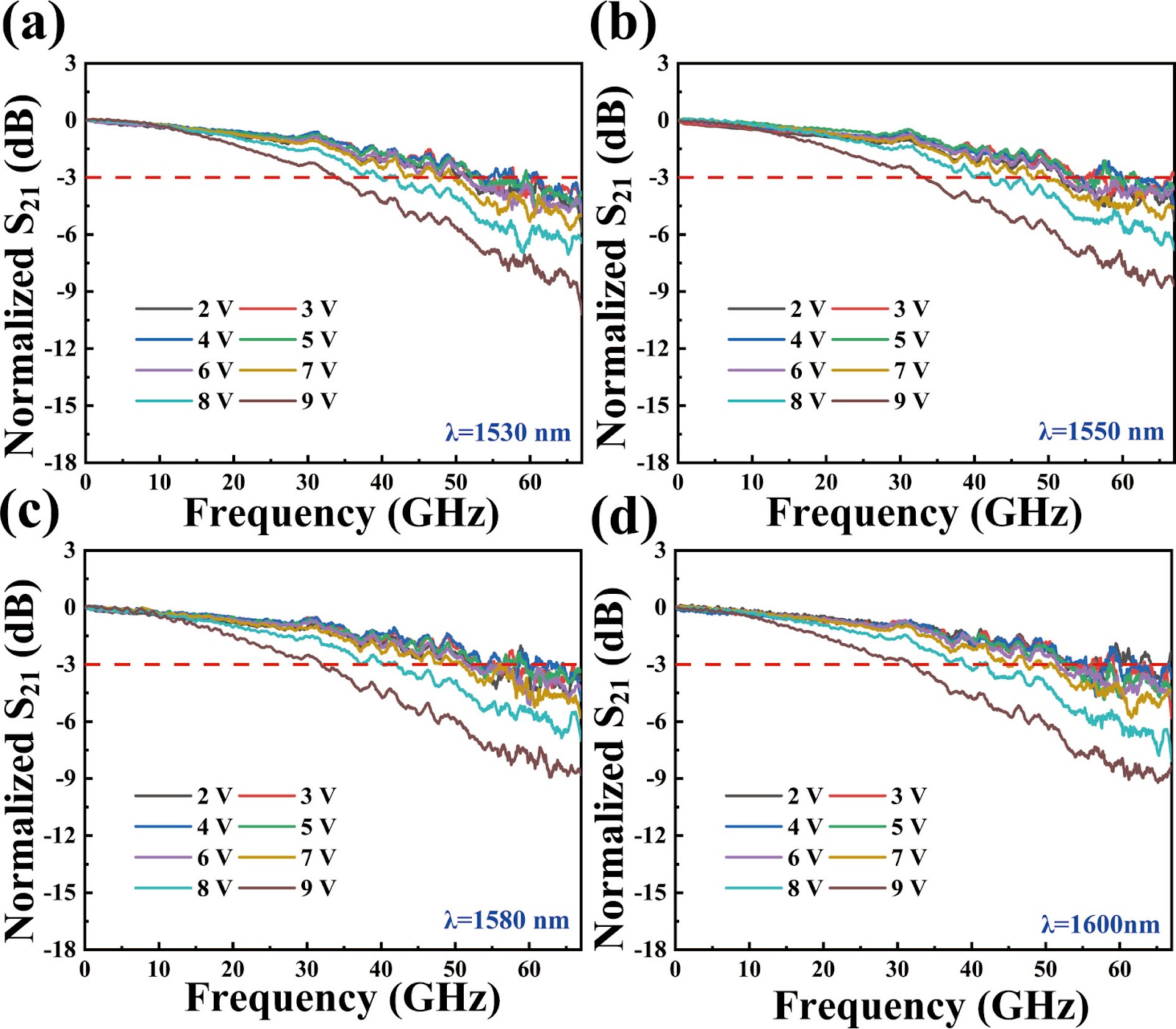
Key Takeaways & Executive Findings
- •• A novel asymmetric PIN structure in a Ge photodetector improves electric field distribution and reduces depletion width, enhancing speed. • The device achieves high responsivity of 1.49 A/W at 1550 nm and 1.16 A/W at 1600 nm under weak avalanche at -7 V. • Bandwidths of 47.1 GHz and 44.5 GHz are obtained at 1550 nm and 1600 nm, respectively, enabling high-speed operation. • The fabrication process is simplified using a commercial 140 nm SiPH platform, making it CMOS-compatible and cost-effective.
Abstract
A silicon-based germanium (Ge) photodetector operating in the C and L bands is proposed. The device features a novel asymmetric PIN structure that optimizes the electric field distribution in Ge and reduces the effective width of the depleted region. The optical structure is carefully designed to enhance responsivity over a broad wavelength range. Under a bias of -7 V, where a weak avalanche process occurs, the device achieves responsivities of 1.49 A/W at 1550 nm and 1.16 A/W at 1600 nm, with corresponding bandwidths of 47.1 GHz and 44.5 GHz, respectively. These results demonstrate significant potential for applications in high-speed optical communication systems.
1. Introduction
The rapid advancement of data-driven technologies, such as 5G networks, artificial intelligence (AI), and the internet of things (IoT), has dramatically increased the demand for high-speed, high-capacity optical communication systems. Traditional single-wavelength transmission methods are increasingly constrained by bandwidth limitations, signal-to-noise ratio degradation, and rising power consumption. To address these challenges, wavelength-division multiplexing (WDM) technology has emerged as a cornerstone of modern optical networks. By enabling the simultaneous transmission of multiple wavelengths through a single optical fiber, WDM significantly enhances spectral efficiency and supports high-speed, long-distance communication.
Among the conventional communication bands, the C-band (1530–1565 nm) has been the industry standard due to its low transmission loss and compatibility with erbium-doped fiber amplifier (EDFA) technology. However, the exponential growth in global data traffic has necessitated exploration beyond the C-band. The L-band (1565–1625 nm) offers an attractive solution for expanding network capacity while maintaining low-loss transmission characteristics. The combined use of the C and L bands further optimizes spectral efficiency, paving the way for scalable, future-proof optical communication systems.
Loading authentic research manuscript (Pages 1–5)...
Yiling Hu, Zhipeng Liu, Zhi Liu, Yupeng Zhu, Tao Men, Guangze Zhang, Jun Zheng, Yuhua Zuo, Buwen Cheng (2025). High-Responsivity and High-Speed Germanium Photodetector for C + L Band Applications. Journal of Semiconductors (半导体学报 - 中国科学院半导体研究所). https://doi.org/10.1088/1674-4926/25030017
Research & Educational Purpose Only:The translations, structured abstracts, analytical annotations, and data reports provided by SinoTechIntel are intended exclusively for academic research, internal corporate R&D, and educational benchmarking. They do not constitute formal engineering, chemical safety, legal, or professional advice.
Copyright & Intellectual Property Notice: Original copyright of the underlying source articles and experimental data remains with the respective authors, institutions, and original publishing journals. SinoTechIntel claims intellectual property only over its proprietary translations, analytical syntheses, and AEO structured enhancements in accordance with international fair use and academic citation principles.
Frequently Asked Questions
What is the operating wavelength range of the proposed germanium photodetector?
The photodetector is designed for the C and L bands, covering 1530–1625 nm, with specific performance demonstrated at 1550 nm and 1600 nm.
How does the asymmetric PIN structure improve device performance?
The asymmetric PIN structure optimizes the electric field distribution in the germanium absorption region and reduces the effective width of the depleted region, thereby decreasing carrier transit time and enhancing speed.
What are the key performance metrics at -7 V bias?
At -7 V, the device achieves responsivities of 1.49 A/W at 1550 nm and 1.16 A/W at 1600 nm, with bandwidths of 47.1 GHz and 44.5 GHz, respectively.
What is the significance of the weak avalanche effect in this device?
The weak avalanche effect provides moderate internal gain to enhance responsivity while maintaining low excess noise, making the device suitable for high-sensitivity optical receivers.
Is the fabrication process CMOS-compatible?
Yes, the device is fabricated on a SOI substrate using a commercial 140 nm SiPH platform with a simple CMOS-compatible process, ensuring cost-effectiveness and scalability.
Related Technical Papers & Translations
Advances in Brain-Computer Interface Technology: A Comprehensive Review of Neural Signal Processing and Applications
Brain-computer interfaces (BCIs) have emerged as a transformative technology enabling direct communication between the brain and external devices, offering unprecedented opportunities for restoring motor function in paralyzed individuals and enhancing human-computer interaction. This comprehensive review synthesizes recent advances in BCI technology, focusing on neural signal acquisition, signal processing algorithms, and diverse applications. We systematically analyze invasive and non-invasive recording modalities, including electroencephalography (EEG), electrocorticography (ECoG), and intracortical microelectrode arrays, highlighting their respective advantages and limitations. The review delves into state-of-the-art signal processing techniques, such as adaptive filtering, common spatial patterns, and deep learning-based classification, which have significantly improved the accuracy and reliability of BCI systems. Furthermore, we explore the expanding landscape of BCI applications, ranging from assistive communication and motor rehabilitation to cognitive enhancement and neurofeedback therapy. Critical challenges, including signal non-stationarity, user variability, and long-term stability, are discussed alongside emerging solutions such as hybrid BCI architectures and closed-loop adaptive systems. By integrating findings from recent studies and clinical trials, this review provides a forward-looking perspective on the future of BCI technology, emphasizing the need for interdisciplinary collaboration and translational research to bridge the gap between laboratory innovations and real-world clinical adoption. Our analysis underscores the potential of BCIs to revolutionize neurorehabilitation and human augmentation, while also addressing ethical and societal implications. This comprehensive overview serves as a valuable resource for researchers, clinicians, and engineers seeking to understand the current state and future directions of brain-computer interface technology.
A Novel Multi-Scale Robotic System for Enhanced Surgical Precision and Autonomy in Minimally Invasive Procedures
Minimally invasive surgery (MIS) has revolutionized surgical practice by reducing patient trauma and recovery time. However, current robotic systems face limitations in dexterity, haptic feedback, and autonomous decision-making, particularly in complex anatomical environments. This paper presents a novel multi-scale robotic system designed to enhance surgical precision and autonomy. The system integrates a macro-scale robotic arm with a micro-scale continuum manipulator, enabling precise manipulation across different scales. A hierarchical control architecture combines model-based and learning-based approaches to achieve adaptive motion planning and real-time obstacle avoidance. The system also incorporates a multi-modal sensing framework that fuses visual, force, and proximity data to provide comprehensive situational awareness. Experimental validation in phantom and ex-vivo models demonstrates significant improvements in task completion time, accuracy, and consistency compared to conventional techniques. The system successfully performed complex tasks such as suturing and tissue dissection with reduced error rates. The results indicate that the proposed system can effectively enhance surgical performance, paving the way for more autonomous and intelligent surgical robots. Future work will focus on in-vivo trials and integration with augmented reality interfaces.
Integrated Multi-Omics Analysis of Tumor Microenvironment and Immune Infiltration in Hepatocellular Carcinoma: Implications for Prognosis and Immunotherapy
Hepatocellular carcinoma (HCC) is a highly heterogeneous malignancy with a complex tumor microenvironment (TME) that profoundly influences disease progression and therapeutic response. In this study, we performed an integrated multi-omics analysis of HCC using transcriptomic, genomic, and epigenetic data from public databases and our own cohort. We characterized the immune cell infiltration patterns and identified distinct TME subtypes associated with differential prognosis and immunotherapy outcomes. Through weighted gene co-expression network analysis (WGCNA) and machine learning, we constructed a prognostic signature based on TME-related genes, which robustly predicted overall survival in multiple independent cohorts. Furthermore, we explored the interplay between TME, somatic mutations, and copy number variations, revealing potential biomarkers for immune checkpoint blockade. Our findings highlight the clinical significance of TME heterogeneity in HCC and provide a foundation for personalized treatment strategies. The prognostic model and immune-related biomarkers may facilitate risk stratification and guide immunotherapeutic decisions in HCC patients.