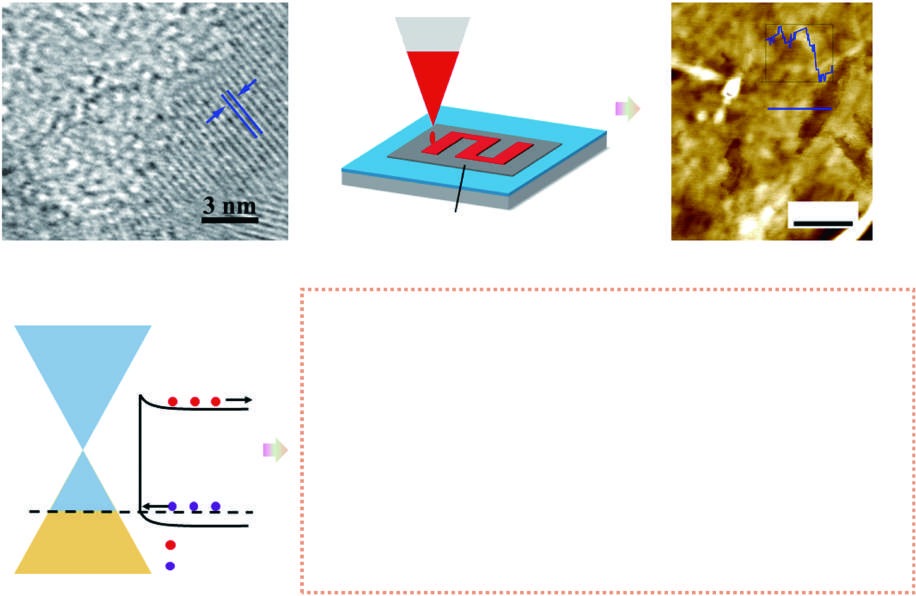
Key Takeaways & Executive Findings
- •• Graphene/MoX2 van der Waals heterostructures combine high carrier mobility of graphene with high absorption coefficient of MoX2, effectively reducing dark current and enhancing photodetector performance. • The review systematically covers working principles, performance metrics, and device architectures, providing a comprehensive framework for designing high-performance photodetectors. • Various preparation methods and performance enhancement strategies are summarized, offering practical guidance for fabricating graphene/MoX2 vdWH photodetectors. • Current challenges and future research directions are identified, highlighting the potential for further optimization and practical applications in optoelectronics.
Abstract
Graphene is widely used in photodetection because of its high carrier mobility and wide spectral absorption range. However, its high dark current caused by its low light absorption severely limits its performance. Molybdenum dihalide (MoX2, X=S, Se and Te) has a high absorption coefficient, which can compensate for the high dark current in graphene-based photodetectors and result in outstanding photoelectronic properties of those based on a graphene/MoX2 van der Waals heterostructure (vdWH). In this review, we firstly review working principles, performance indicators, and structures of photodetectors. After that, the significance of graphene/MoX2 vdWH photodetectors is highlighted from the fundamental perspective. Preparation methodologies and performance enhancement strategies of graphene/MoX2 vdWH photodetectors are correspondingly summarized. In the end, we highlight the current challenges and future directions of the graphene/MoX2 vdWH photodetectors. This review will guide the design of high-performance vdWH photodetectors.
1. Introduction
Photodetectors can convert the absorbed optical signal into electrical signal[1], which are widely used in military reconnaissance[2], medical imaging[3], astronomy[4], optical communication[5], fire warning[6], temperature detection[7], etc. Based on the working mechanism, photodetectors can be categorized into photon detectors[8] and thermal detectors[9]. The thermal detectors can convert the infrared radiation energy induced by temperature change into electricity, which includes pneumatic detector[10], thermocouple[11], thermistor[12] and pyroelectric detector[13,14]. Thermal detectors can be used in fire alarming[15], temperature detection[16], rocket engine[17], thermal imaging[18], etc. However, their application is limited by temperature fluctuation noise arising from the radiating background. This drawback can be overcome by photon detectors[19]. Photon detectors are radiation detectors based on either external[2,20] or internal photoelectric effects[21,22](Fig. 1). Modern photodetectors are mostly based on the internal photoelectric effect, which are solid state electronic devices made of semiconductor materials and also known as semiconductor photodetectors[23]. In semiconductor photodetectors, two-dimensional (2D) material-based photodetectors[23] have attracted extensive interest because of their ultra-wide spectral response range from ultraviolet to terahertz, ultra-speedy photoresponsivity, and high spatial resolution for imaging[24].
The signal conversion process from optical signal to electrical signal in 2D material-based photodetectors can be separated into in 3 steps. (1) When the incident photons are absorbed by the photosensitive materials after the light trapping process, the photoexcited electrons transit from the valence band (VB) to the conduction band (CB) of the photosensitive materials and left holes in the VB. In this step, materials with high absorption coefficient and wide spectrum absorption range play important roles in improving the performance of 2D material-based photodetectors. (2) Under the applied external electric field or the internal electric field formed at the heterostructure interface, the photoinduced electron-hole pairs can be separated, and different carriers move to the corresponding electrodes along the conduction path. In this step, high carrier mobility (μ) of the material can contribute to high photoelectronic performance. (3) After the charge carriers arrive at the electrodes, in accordance with configurations of different electrodes, charge carriers can be extracted and conducted to the external circuit and generate the photocurrent[25]. Therefore, it can be seen that high-performance photodetectors require materials with high μ, high absorption coefficient, and wide spectrum absorption range[26].
Graphene, as one of the most important 2D layered materials, is a honeycomb crystal with a closed-packed hexagonal structure of single carbon atom[29–31]. Graphene has a Dirac coni...
Loading authentic research manuscript (Pages 1–5)...
ZHANG Xin-hua, LIU Wei-di, GONG You-pin, LIU Qing-feng, CHEN Zhi-gang (2024). Advances in graphene/molybdenum dichalcogenide-based van der Waals heterostructure photodetectors. New Carbon Materials. https://doi.org/10.1016/S1872-5805_N
Research & Educational Purpose Only:The translations, structured abstracts, analytical annotations, and data reports provided by SinoTechIntel are intended exclusively for academic research, internal corporate R&D, and educational benchmarking. They do not constitute formal engineering, chemical safety, legal, or professional advice.
Copyright & Intellectual Property Notice: Original copyright of the underlying source articles and experimental data remains with the respective authors, institutions, and original publishing journals. SinoTechIntel claims intellectual property only over its proprietary translations, analytical syntheses, and AEO structured enhancements in accordance with international fair use and academic citation principles.
Frequently Asked Questions
What are the advantages of graphene/MoX2 van der Waals heterostructures for photodetectors?
Graphene/MoX2 vdWHs combine graphene's high carrier mobility and wide spectral absorption with MoX2's high absorption coefficient, effectively reducing dark current and enhancing photoresponsivity, making them promising for high-performance photodetectors.
What are the main challenges in graphene/MoX2 photodetectors?
Challenges include achieving large-area uniform growth, controlling interface quality, reducing dark current further, and improving response speed and stability. Future directions involve optimizing device architectures and exploring new MoX2 materials.
How are graphene/MoX2 heterostructures typically fabricated?
Common methods include mechanical exfoliation and transfer, chemical vapor deposition (CVD), and van der Waals epitaxy. These techniques allow precise stacking of layers to form high-quality heterostructures.
What performance metrics are used to evaluate photodetectors?
Key metrics include responsivity, specific detectivity, response time, quantum efficiency, and dark current. These parameters determine the sensitivity, speed, and overall performance of the photodetector.
What are the potential applications of graphene/MoX2 photodetectors?
They can be used in optical communication, imaging, environmental monitoring, and medical diagnostics, leveraging their broad spectral response and high sensitivity.
Related Technical Papers & Translations

Design and optimization of a high-efficiency distillation process for cellulosic fuel ethanol integrated with thermal coupling and molecular sieve adsorption
To address the challenges of high energy consumption and prominent costs in the traditional three-columns distillation process for cellulosic fuel ethanol, a distillation—molecular sieve coupling separation process is proposed. This process integrates a three-column (crude distillation column, first distillation column, second distillation column) system with a 3A molecular sieve adsorption deep dehydration unit. A thermal coupling network is constructed via differential pressure design (steam from medium/high-pressure columns as mutual heat sources, reboiler liquid waste heat for feed preheating), and molecular sieve adsorption conditions are optimized. The study first performs a thermodynamic consistency test on the ethanol—water system, determines optimal non-random two-liquid (NRTL) model binary interaction parameters via experimental data regression for Aspen Plus simulation. Aiming at minimum total annual cost (TAC), Aspen Plus is used to optimize process parameters (theoretical tray number, feed location, reflux ratio, side-draw position, etc.). Economic analysis shows this process reduces CO2 emission costs by 27.56%, TAC by 15.58% (to 5.123 × 10⁶ USD·a-1), and increases ethanol purity to >99.6%, providing an effective solution for green, efficient separation.

A cohesion loss model for determining residual strength of deep bedded sandstone
Rock residual strength, as an important input parameter, plays an indispensable role in proposing the reasonable and scientific scheme about stope design, underground tunnel excavation and stability evaluation of deep chambers. Therefore, previous residual strength models of rocks established were reviewed. And corresponding related problems were stated. Subsequently, starting from the effects of bedding and whole life-cycle evolution process, series of triaxial mechanical tests of deep bedded s

Federated model with contrastive learning and adaptive control variates for human activity recognition
Recent attention to privacy issues demands a communication-safe method for training human activity recognition (HAR) models on client activity data. Federated learning (FL) has become a compelling technique to facilitate model training between the server and clients while preserving data privacy. However, classical FL methods often assume independent and identically distributed (IID) data among clients. This assumption does not hold true in practical scenarios. Human activity in real-world scena