SinoTechIntel Academic Portal
🏛️ Indexed Academic JournalImpact Factor: 3.7 (Q2 - Elsevier)Original: 新型炭材料

New Carbon Materials

3.7 (Q2 - Elsevier)

Total Research Papers: 47
Access: 100% Free Open Access
Browse by Publication Year & VolumeReset All Filters ✕

Published Research PapersFiltered: Year 2024 • Vol. 39 • No. 3

Showing 3 of 47 peer-reviewed papers with full Graphical Abstracts.

Original ResearchVol. 39, No. 3 • pp. 526-537DOI: 10.1016/S1872-5805_NJan 15, 2024

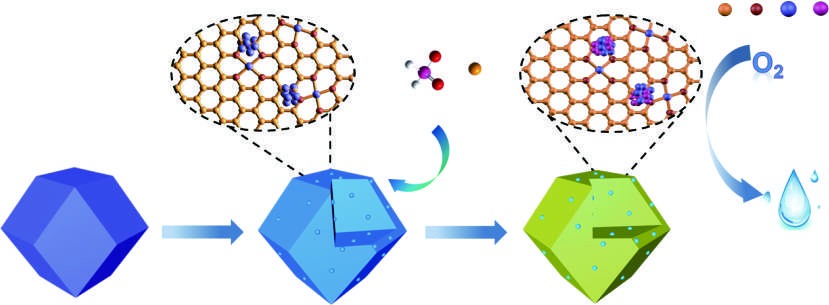
Controllable construction of CoP nanoparticles anchored on a nitrogen-doped porous carbon as an electrocatalyst for highly efficient oxygen reduction in Zn-air batteries

Authors: YAN Xiao-li, WANG Kui, HAO Shu-wei, ZHOU Guang-da, YANG Hao-wei, ZHANG Hua, GUO Jun-jie

Exploring cost-efficient and highly-efficient noble metal-free catalysts for the oxygen reduction reactions (ORRs) involved in sustainable energy devices remains a great challenge. Transition-metal phosphides supported on heteroatom-doped carbons have shown potential as alternative candidates for precious metals because of their tunable electronic structures and higher catalytic performance. Phosphating was used to construct CoP nanoparticles (NPs) anchored on a nitrogen-doped porous carbon framework (CoP@NC) from Co NPs loaded on NC, using PH3 gas released from NaH2PO2 during heat treatment. The dodecahedral structure of Co NPs was retained in their transformation to CoP NPs. The CoP@NC electrocatalyst shows a remarkable ORR activity with a half-wave potential up to 0.92 V under alkaline conditions, which is attributed to the combined coupling between the well dispersed CoP nanoparticles on the nitrogen-doped carbon and the efficient mass transport in the porous structure. Zinc-air batteries assembled with the CoP@NC electrocatalyst as a cathode have a high open-circuit voltage of 1.51 V and power density of 210.1 mW cm−2. This work provides a novel strategy to develop low-cost catalysts with an excellent ORR performance to promote their practical use in metal-air batteries.
Controllable construction of CoP nanoparticles anchored on a nitrogen-doped porous carbon as an electrocatalyst for highly efficient oxygen reduction in Zn-air batteries
Graphical Abstract
Original ResearchVol. 39, No. 3 • pp. 100-112DOI: 10.1016/S1872-5805_NJan 15, 2024

Boron and nitrogen co-doped sodium alginate-based porous carbons for durable and fast Zn-ion hybrid capacitors

Authors: LU Ya-ping, WANG Hong-xing, LIU Lan-tao, PANG Wei-wei, CHEN Xiao-hong

In recent years, zinc-ion hybrid capacitors (ZIHCs) have attracted increasing attention due to their environmental friendliness and excellent electrochemical properties. However, their performance is mainly limited by the electrochemical performance of the cathode, so it is necessary to develop an advanced cathode material. N, B co-doped sodium alginate-based porous carbon (NBSPC) was prepared by one-step co-carbonization using sodium alginate as the matrix and NH4B5O8 as the N and B source. This N, B co-doping strategy improves the pore structure of the carbon materials and increases the number of surface functional groups, greatly improving the capacitive behavior of the raw materials and thus improving their electrochemical performance. When used as the cathode in ZIHCs, the NBSPC had an excellent rate performance (85.4 mA h g−1 even at ultra-high current density of 40 A g−1) and good cycling stability (15 000 cycles at 20 A g−1 with a capacity retention rate of 94.5%).

Boron and nitrogen co-doped sodium alginate-based porous carbons for durable and fast Zn-ion hybrid capacitors
Graphical Abstract
Original ResearchVol. 39, No. 3 • pp. 515-525DOI: 10.1016/S1872-5805_NJan 15, 2024

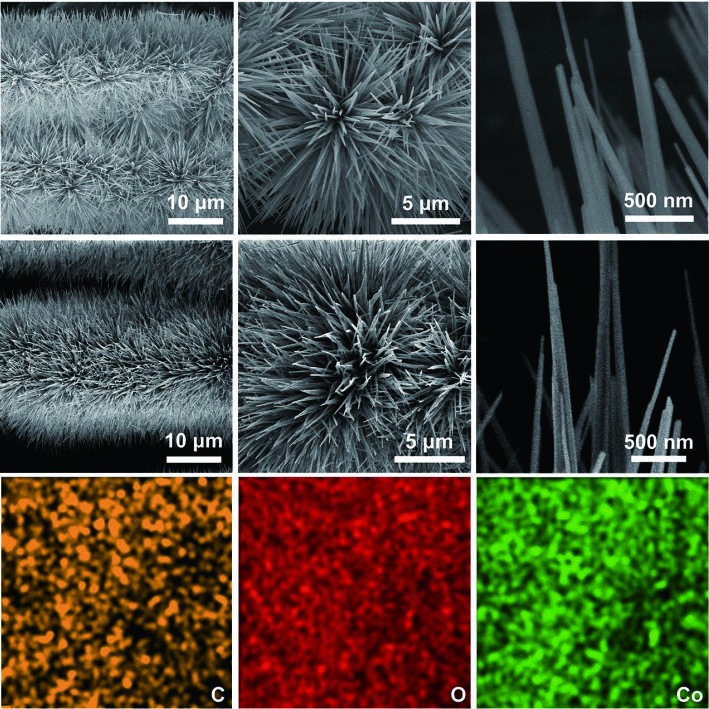
Controlled growth of a graphdiyne/cobalt hydroxide heterointerface for efficient chlorine production

Authors: LIU Hui-min, LUAN Xiao-yu, YAN Jia-yu, BU Fan-le, XUE Yu-rui, LI Yu-liang

The chlor-alkali process plays a key and irreplaceable role in the chemical industry because of its use in various industrial processes. However, the low selectivity and efficiency of the reported chlorine evolution reaction (CER) electrocatalysts obviously hinder its practical use. We report a simple method for the controlled growth of high-performance CER electrocatalysts by first growing cobalt hydroxide on the surface of carbon cloth, followed by the in-situ growth of graphdiyne (GDY/Co(OH)2). As expected, the as-synthesized catalyst has a small overpotential of only 83 mV at 10 mA cm−2, a maximum Faradaic Efficiency (FE) of 91.54%, and a high chlorine yield of 157.11 mg h−1 cm−2 in acidic simulated seawater. Experimental results demonstrate that the in-situ growth of GDY on the Co(OH)2 surface leads to the formation of heterointerfaces with strong electron transfer between GDY and Co atoms, resulting in a higher conductivity, larger active specific surface area and more active sites, thereby improving the overall electrocatalytic selectivity and efficiency.

Controlled growth of a graphdiyne/cobalt hydroxide heterointerface for efficient chlorine production
Graphical Abstract