SinoTechIntel Academic Portal
πŸ›οΈ Indexed Academic JournalImpact Factor: 3.7 (Q2 - Elsevier)Original: ζ–°εž‹η‚­ζζ–™

New Carbon Materials

3.7 (Q2 - Elsevier)

Total Research Papers: 47
Access: 100% Free Open Access
Browse by Publication Year & VolumeReset All Filters βœ•

Published Research PapersFiltered: Year 2024 β€’ Vol. 39 β€’ No. 1

Showing 2 of 47 peer-reviewed papers with full Graphical Abstracts.

Original ResearchVol. 39, No. 1 β€’ pp. 164-172DOI: 10.1016/S1872-5805_Nβ€’ Jan 15, 2024

Ir nanoclusters on ZIF-8-derived nitrogen-doped carbon frameworks to give a highly efficient hydrogen evolution reaction

Authors: WANG Xi-ao, GONG Yan-shang, LIU Zhi-kun, WU Pei-shan, ZHANG Li-xue, SUN Jian-kun

The precise change of the electronic structure of active metals using low-active supports is an effective way of developing high-performance electrocatalysts. The electronic interaction of the metal and support provides a flexible way of optimizing the catalytic performance. We have fabricated an efficient hydrogen evolution reaction (HER) electrocatalyst, in which Ir nanoclusters are uniformly loaded on a nitrogen-doped carbon framework (Ir@NC). The synthesis process entails immersing an annealed zeolitic imidazolate framework-8 (ZIF-8), prepared at 900 Β°C as a carbon source, into an IrCl3 solution, followed by a calcination-reduction treatment at 400 Β°C under a H2/Ar atmosphere. The three-dimensional porous structure of the nitrogen-doped carbon framework exposes more active metal sites, and the combined effect of the Ir clusters and the N-doped carbon support efficiently changes the electronic structure of Ir, optimizing the HER process. In acidic media, Ir@NC has a remarkable HER electrocatalytic activity, with an overpotential of only 23 mV at 10 mA cmβˆ’2, an ultra-low Tafel slope (25.8 mV decβˆ’1) and good stability for over 24 h at 10 mA cmβˆ’2. The high activity of the electrocatalyst with a simple and scalable synthesis method makes it a highly promising candidate for the industrial production of hydrogen by splitting acidic water.
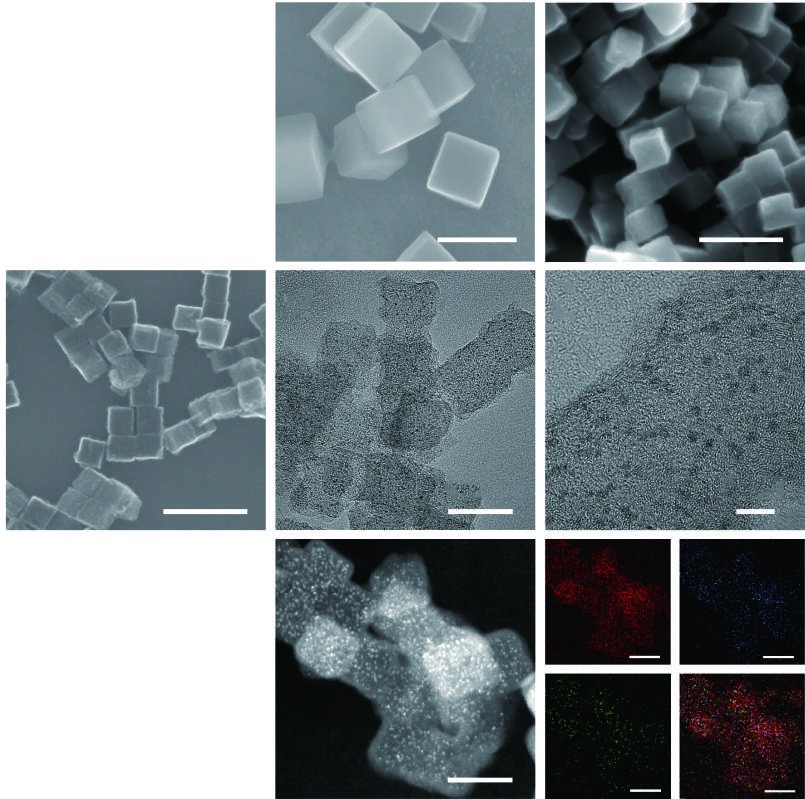
Ir nanoclusters on ZIF-8-derived nitrogen-doped carbon frameworks to give a highly efficient hydrogen evolution reaction
Graphical Abstract
Original ResearchVol. 39, No. 1 β€’ pp. 42-63DOI: 10.1016/S1872-5805_Nβ€’ Jan 15, 2024

Carbon-based metal-free nanomaterials for the electrosynthesis of small-molecule chemicals: A review

Authors: SHI Lei, LI Yan-zhe, YIN Hua-jie, ZHAO Shen-long

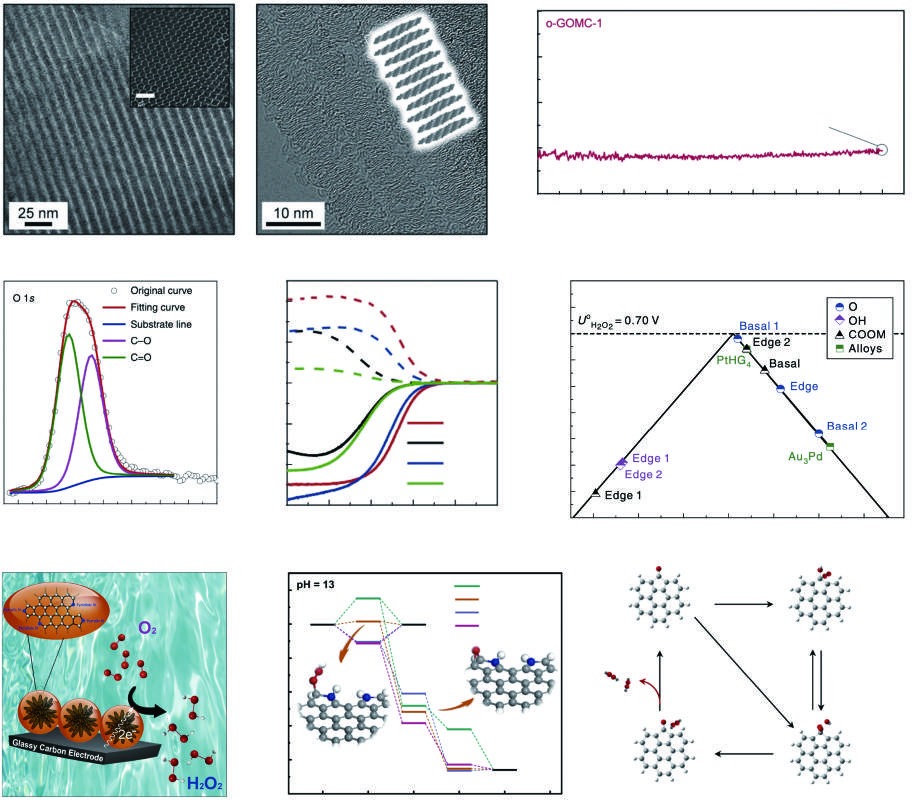
Electrocatalysis is a key component of many clean energy technologies that has the potential to store renewable electricity in chemical form. Currently, noble metal-based catalysts are most widely used for improving the conversion efficiency of reactants during the electrocatalytic process. However, drawbacks such as high cost and poor stability seriously hinder their large-scale use in this process and in sustainable energy devices. Carbon-based metal-free catalysts (CMFCs) have received growing attention due to their enormous potential for improving the catalytic performance. This review gives a concise comprehensive overview of recent developments in CMFCs for electrosynthesis. First, the fundamental catalytic mechanisms and design strategies of CMFCs are presented and discussed. Then, a brief overview of various electrosynthesis processes, including the synthesis of hydrogen peroxide, ammonia, chlorine, as well as various carbon- and nitrogen-based compounds is given. Finally, current challenges and prospects for CMFCs are highlighted.

Carbon-based metal-free nanomaterials for the electrosynthesis of small-molecule chemicals: A review
Graphical Abstract