Key Takeaways & Executive Findings
- •• Ir nanoclusters supported on nitrogen-doped carbon frameworks (Ir@NC) exhibit exceptional HER activity with an overpotential of only 23 mV at 10 mA cm−2 in acidic media. • The strong electronic interaction between Ir clusters and the N-doped carbon support optimizes the electronic structure of Ir, enhancing catalytic performance. • The three-dimensional porous structure of the ZIF-8-derived carbon framework exposes abundant active sites, contributing to high efficiency. • The simple, scalable synthesis method and excellent stability (over 24 h) make Ir@NC a promising candidate for industrial acidic water electrolysis.
Abstract
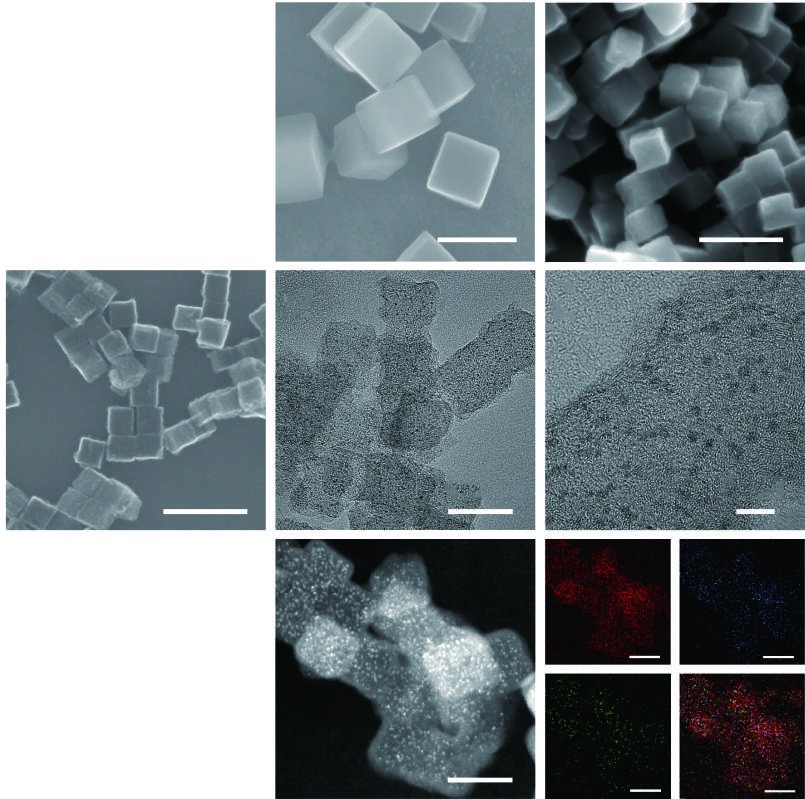
The precise change of the electronic structure of active metals using low-active supports is an effective way of developing high-performance electrocatalysts. The electronic interaction of the metal and support provides a flexible way of optimizing the catalytic performance. We have fabricated an efficient hydrogen evolution reaction (HER) electrocatalyst, in which Ir nanoclusters are uniformly loaded on a nitrogen-doped carbon framework (Ir@NC). The synthesis process entails immersing an annealed zeolitic imidazolate framework-8 (ZIF-8), prepared at 900 °C as a carbon source, into an IrCl3 solution, followed by a calcination-reduction treatment at 400 °C under a H2/Ar atmosphere. The three-dimensional porous structure of the nitrogen-doped carbon framework exposes more active metal sites, and the combined effect of the Ir clusters and the N-doped carbon support efficiently changes the electronic structure of Ir, optimizing the HER process. In acidic media, Ir@NC has a remarkable HER electrocatalytic activity, with an overpotential of only 23 mV at 10 mA cm−2, an ultra-low Tafel slope (25.8 mV dec−1) and good stability for over 24 h at 10 mA cm−2. The high activity of the electrocatalyst with a simple and scalable synthesis method makes it a highly promising candidate for the industrial production of hydrogen by splitting acidic water.
1. Introduction
Hydrogen energy with high energy density is a clean and sustainable energy resource which can be easily transported and stored, allowing for flexibility in energy distribution[1–3]. Additionally, hydrogen fuel cells have high energy conversion efficiency and produce only water as a byproduct, minimizing environmental impact[4–5]. However, obtaining green hydrogen via water electrolysis is largely hindered by its low energy efficiency. Recently, acidic electrolyzers, generally operate at lower voltages and have higher energy efficiency than alkaline counterparts, have become interesting alternatives[6–8]. Furthermore, acidic electrolyzers also exhibit faster reaction kinetics, enabling higher current densities and overall improved performance[9]. However, one major challenge in acidic catalytic systems is the stability of the catalysts. Most of the catalysts that can be utilized in alkaline conditions, especially the non-noble metal catalysts, are severely degraded in acidic electrolytes[10–12]. This instability can lead to decreased catalytic activity and shortened catalyst lifespan[13–14]. Addressing catalyst stability is crucial for the development and commercialization of efficient and durable electrocatalytic hydrogen production in acidic conditions[15].
Despite the low abundance and high cost, precious metals like Pt, Ir and Ru are still the main electrocatalysts that are extensively utilized in acidic electrolytes[16–17]. For instance, You et al. reported Ir nanoparticles anchored cucurbit [6] uril, which exhibited slightly worse HER performance (η10 = 54 mV) than Pt/C in 0.5 mol L−1 H2SO4[18]. Song et al. reported that a material with Ru dispersed on CoP nanoparticles exhibits superior HER catalytic activity, with a low overpotential of 49 mV to achieve 10 mA cm−2 in 0.5 mol L−1 H2SO4 solution, by lowering the energy barrier of proton-coupled electron transfer[19]. Drouet et al. reported a porous Ru nanomaterial, which needed an overpotential of 83 mV to deliver 10 mA cm−2 in 0.5 mol L−1 H2SO4 solution, owing to the porous structure of the material[20]. Although great progress has been made in this direction, methods for regulating the electronic structure while simultaneously increasing the utilization efficiency of precious metal atoms is still challenging[21].
Nanoscaling of material dimensions plays a critical role in enhancing the specific surface area of catalysts to provide more active sites[22]. The nano-catalysts often exhibit distinct and impressive properties compared to bulk materials. In particular, the metal nanoclusters with extremely high specific surface area and a lower surface metal-metal coordination number, improve the surface-t...
Loading authentic research manuscript (Pages 1–5)...
WANG Xi-ao, GONG Yan-shang, LIU Zhi-kun, WU Pei-shan, ZHANG Li-xue, SUN Jian-kun (2024). Ir nanoclusters on ZIF-8-derived nitrogen-doped carbon frameworks to give a highly efficient hydrogen evolution reaction. New Carbon Materials. https://doi.org/10.1016/S1872-5805_N
Research & Educational Purpose Only:The translations, structured abstracts, analytical annotations, and data reports provided by SinoTechIntel are intended exclusively for academic research, internal corporate R&D, and educational benchmarking. They do not constitute formal engineering, chemical safety, legal, or professional advice.
Copyright & Intellectual Property Notice: Original copyright of the underlying source articles and experimental data remains with the respective authors, institutions, and original publishing journals. SinoTechIntel claims intellectual property only over its proprietary translations, analytical syntheses, and AEO structured enhancements in accordance with international fair use and academic citation principles.
Frequently Asked Questions
What is the main achievement of this research?
The research developed an efficient hydrogen evolution reaction (HER) electrocatalyst (Ir@NC) with an overpotential of only 23 mV at 10 mA cm−2 in acidic media, an ultra-low Tafel slope of 25.8 mV dec−1, and good stability for over 24 hours, making it a promising candidate for industrial hydrogen production.
How is the Ir@NC catalyst synthesized?
The synthesis involves annealing ZIF-8 at 900°C to obtain a nitrogen-doped carbon framework, then immersing it in an IrCl3 solution, followed by calcination-reduction at 400°C under a H2/Ar atmosphere to form uniformly loaded Ir nanoclusters.
Why is the electronic interaction between Ir and the support important?
The electronic interaction between Ir nanoclusters and the nitrogen-doped carbon support optimizes the electronic structure of Ir, which enhances the catalytic activity for the hydrogen evolution reaction by improving reaction kinetics and stability.
What are the advantages of using ZIF-8-derived carbon frameworks?
ZIF-8-derived carbon frameworks provide a three-dimensional porous structure with high surface area, which exposes more active metal sites and facilitates mass transport, contributing to the high performance of the electrocatalyst.
What is the significance of this work for industrial applications?
The simple and scalable synthesis method, combined with high activity and stability in acidic conditions, makes Ir@NC a highly promising candidate for industrial-scale hydrogen production via acidic water electrolysis.
Related Technical Papers & Translations

Design and optimization of a high-efficiency distillation process for cellulosic fuel ethanol integrated with thermal coupling and molecular sieve adsorption
To address the challenges of high energy consumption and prominent costs in the traditional three-columns distillation process for cellulosic fuel ethanol, a distillation—molecular sieve coupling separation process is proposed. This process integrates a three-column (crude distillation column, first distillation column, second distillation column) system with a 3A molecular sieve adsorption deep dehydration unit. A thermal coupling network is constructed via differential pressure design (steam from medium/high-pressure columns as mutual heat sources, reboiler liquid waste heat for feed preheating), and molecular sieve adsorption conditions are optimized. The study first performs a thermodynamic consistency test on the ethanol—water system, determines optimal non-random two-liquid (NRTL) model binary interaction parameters via experimental data regression for Aspen Plus simulation. Aiming at minimum total annual cost (TAC), Aspen Plus is used to optimize process parameters (theoretical tray number, feed location, reflux ratio, side-draw position, etc.). Economic analysis shows this process reduces CO2 emission costs by 27.56%, TAC by 15.58% (to 5.123 × 10⁶ USD·a-1), and increases ethanol purity to >99.6%, providing an effective solution for green, efficient separation.

A cohesion loss model for determining residual strength of deep bedded sandstone
Rock residual strength, as an important input parameter, plays an indispensable role in proposing the reasonable and scientific scheme about stope design, underground tunnel excavation and stability evaluation of deep chambers. Therefore, previous residual strength models of rocks established were reviewed. And corresponding related problems were stated. Subsequently, starting from the effects of bedding and whole life-cycle evolution process, series of triaxial mechanical tests of deep bedded s

Federated model with contrastive learning and adaptive control variates for human activity recognition
Recent attention to privacy issues demands a communication-safe method for training human activity recognition (HAR) models on client activity data. Federated learning (FL) has become a compelling technique to facilitate model training between the server and clients while preserving data privacy. However, classical FL methods often assume independent and identically distributed (IID) data among clients. This assumption does not hold true in practical scenarios. Human activity in real-world scena