Ultrafast Sulfur Redox Dynamics Enabled by a PPy@N-TiO2 Z-Scheme Heterojunction Photoelectrode for Photo-Assisted Lithium–Sulfur Batteries
Authors: Fei Zhao, Yibo He, Xuhong Li, Ke Yang, Shuo Chen, Yuanzhi Jiang, Xue-Sen Wang, Chunyuan Song, Xuqing Liu
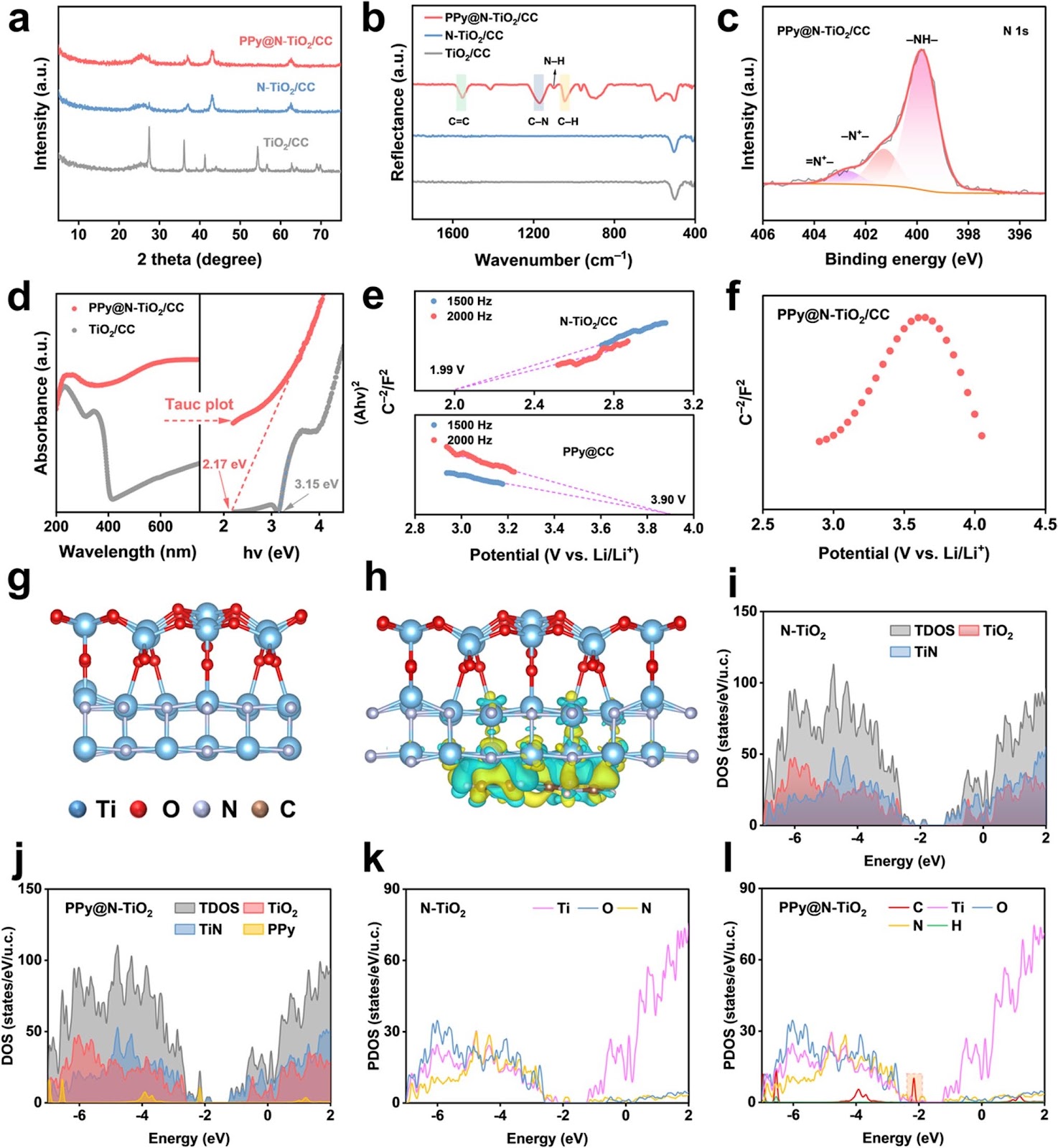
Photo-assisted lithium–sulfur batteries (PALSBs) offer an eco-friendly solution to address the issue of sluggish reaction kinetics of conventional LSBs. However, designing an efficient photoelectrode for practical implementation remains a significant challenge. Herein, we construct a free-standing polymer–inorganic hybrid photoelectrode with a direct Z-scheme heterostructure to develop high-efficiency PALSBs. Specifically, polypyrrole (PPy) is in situ vapor-phase polymerized on the surface of N-doped TiO2 nanorods supported on carbon cloth (N-TiO2/CC), thereby forming a well-defined p–n heterojunction. This architecture efficiently facilitates the carrier separation of photo-generated electron–hole pairs and significantly enhances carrier transport by creating a built-in electric field. Thus, the PPy@N-TiO2/CC can simultaneously act as a photocatalyst and an electrocatalyst to accelerate the reduction and evolution of sulfur, enabling ultrafast sulfur redox dynamics, as convincingly validated by both theoretical simulations and experimental results. Consequently, the PPy@N-TiO2/CC PALSB achieves a high discharge capacity of 1653 mAh g−1, reaching 98.7% of the theoretical value. Furthermore, 5 h of photo-charging without external voltage enables the PALSB to deliver a discharge capacity of 333 mAh g−1, achieving dual-mode energy harvesting capabilities. This work successfully integrates solar energy conversion and storage within a rechargeable battery system, providing a promising strategy for sustainable energy storage technologies.