Achieving Wide-Temperature-Range Physical and Chemical Hydrogen Sorption in a Structural Optimized Mg/N-Doped Porous Carbon Nanocomposite
Authors: Yinghui Li, Li Ren, Zi Li, Yingying Yao, Xi Lin, Wenjiang Ding, Andrea C. Ferrari, Jianxin Zou
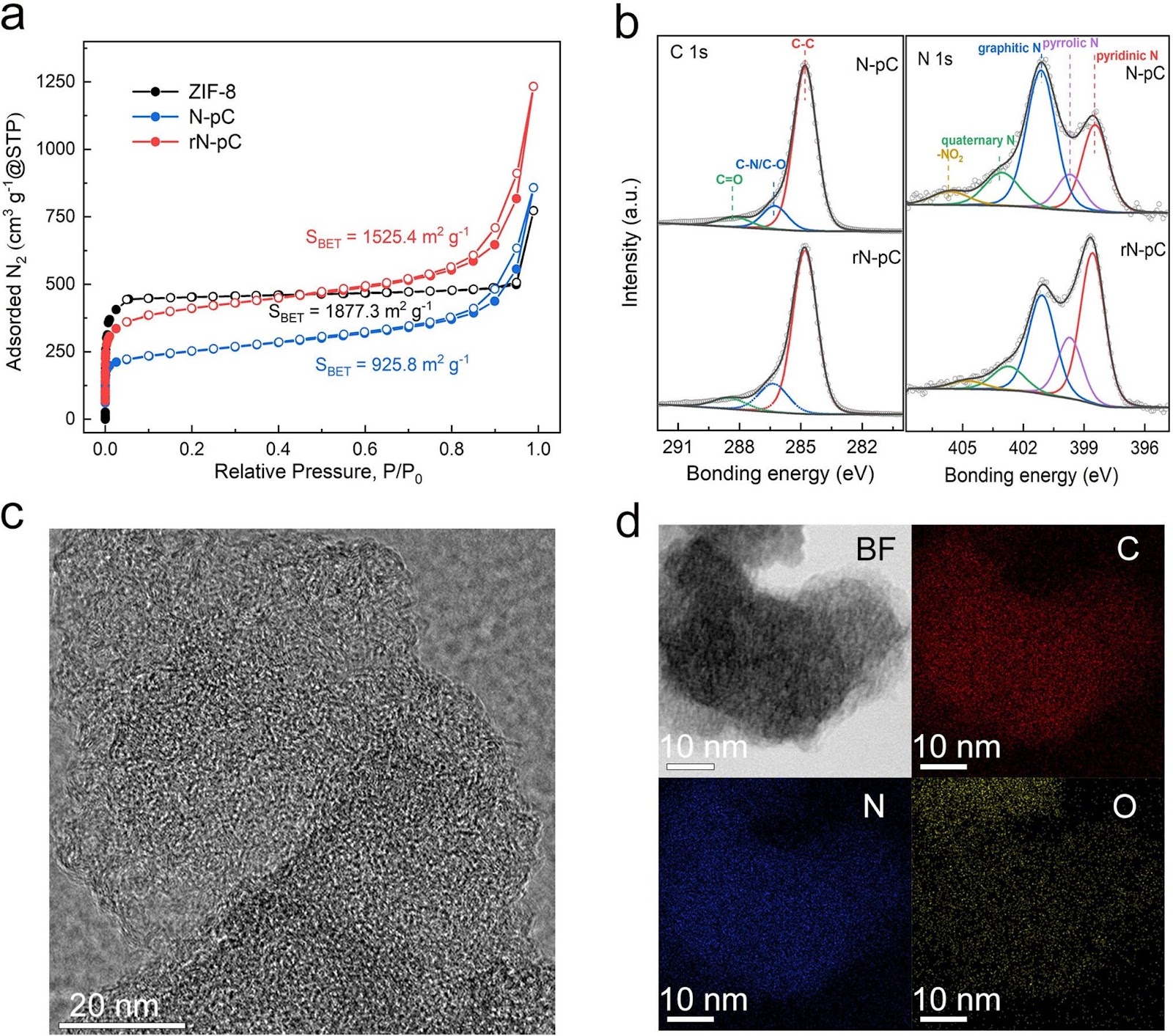
Nanoconfinement is a promising approach to simultaneously enhance the thermodynamics, kinetics, and cycling stability of hydrogen storage materials. The introduction of supporting scaffolds usually causes a reduction in the total hydrogen storage capacity due to “dead weight.” Here, we synthesize an optimized N-doped porous carbon (rN-pC) without heavy metal as supporting scaffold to confine Mg/MgH2 nanoparticles (Mg/MgH2@rN-pC). rN-pC with 60 wt% loading capacity of Mg (denoted as 60 Mg@rN-pC) can adsorb and desorb 0.62 wt% H2 on the rN-pC scaffold. The nanoconfined MgH2 can be chemically dehydrided at 175 °C, providing ~3.59 wt% H2 with fast kinetics (fully dehydrogenated at 300 °C within 15 min). This study presents the first realization of nanoconfined Mg-based system with adsorption-active scaffolds. Besides, the nanoconfined MgH2 formation enthalpy is reduced to ~68 kJ mol−1 H2 from ~75 kJ mol−1 H2 for pure MgH2. The composite can be also compressed to nanostructured pellets, with volumetric H2 density reaching 33.4 g L−1 after 500 MPa compression pressure, which surpasses the 24 g L−1 volumetric capacity of 350 bar compressed H2. Our approach can be implemented to the design of hybrid H2 storage materials with enhanced capacity and desorption rate.