Efficient Thermally Evaporated Near-Infrared Perovskite Light-Emitting Diodes via Phase Regulation
Authors: Siwei He, Lanxin Qin, Zhengzheng Liu, Jae-Wook Kang, Jiajun Luo, Juan Du
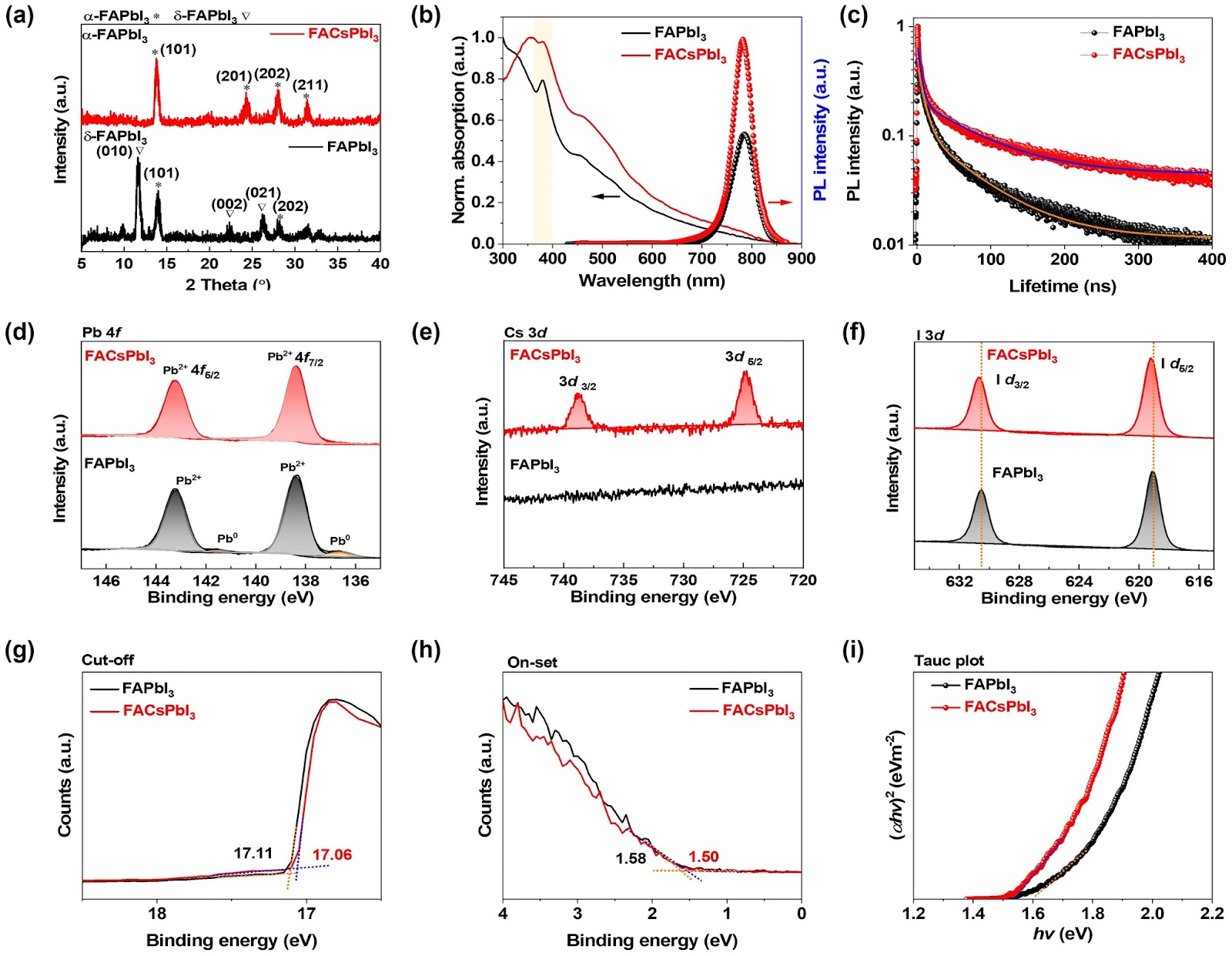
α-phase formamidinium lead triiodide (FAPbI3) has demonstrated extraordinary properties for near-infrared perovskite light-emitting diodes (NIR-PeLEDs). The vacuum processing technique has recently received increasing attention from industry and academia due to its solvent-free feature and compatibility with large-scale production. Nevertheless, vacuum-deposited NIR-PeLEDs have been less studied, and their efficiencies lag far behind those of solution-based PeLEDs as it is still challenging to prepare pure α-FAPbI3 by the thermal evaporation. Herein, we report a Cs-containing triple-source co-evaporation approach to develop the perovskite films. The addition of thermally stable Cs cation fills in the perovskite crystal lattice and eliminates the formation of metallic Pb caused by the degradation of FA cation during the evaporation process. The tri-source co-evaporation strategy significantly promotes the phase transition from yellow δ-phase FAPbI3 to black α-phase FACsPbI3, fostering smooth, uniform, and pinhole-free perovskite films with higher crystallinity and fewer defects. On this basis, the resulting NIR-PeLED based on FACsPbI3 yields a maximum EQE of 10.25%, which is around sixfold higher than that of FAPbI3-based PeLEDs. Our work demonstrates a reliable and effective strategy to achieve α-FAPbI3 via thermal evaporation and paves the pathway toward highly efficient perovskite optoelectronic devices for future commercialization.