Cellulose Elementary Fibrils as Deagglomerated Binder for High-Mass-Loading Lithium Battery Electrodes
Authors: Young-Kuk Hong, Jung-Hui Kim, Nag-Young Kim, Kyeong-Seok Oh, Hong-I Kim, Seokhyeon Ryu, Yumi Ko, Ji-Young Kim, Kwon-Hyung Lee, Sang-Young Lee
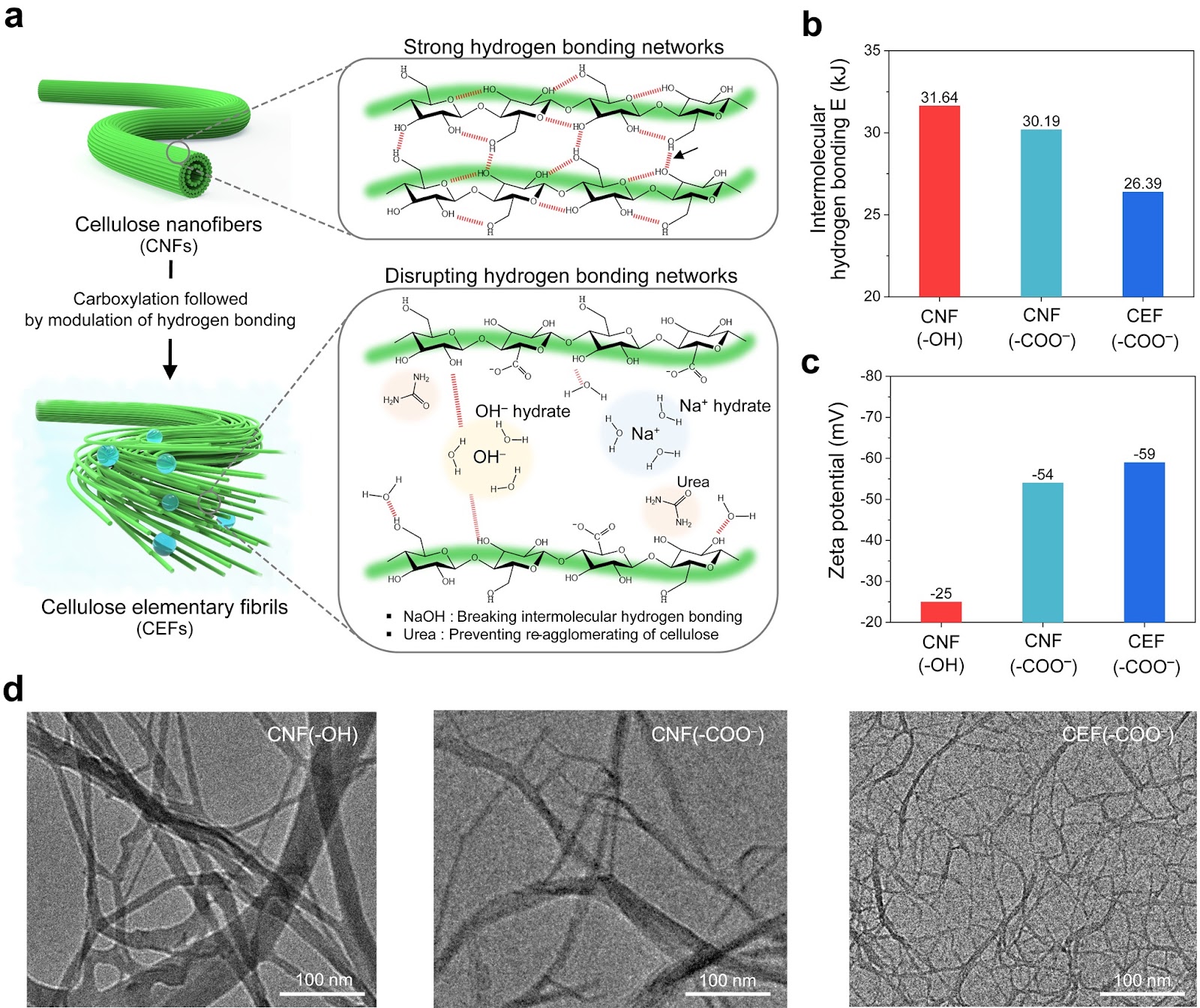
Amidst the ever-growing interest in high-mass-loading Li battery electrodes, a persistent challenge has been the insufficient continuity of their ion/electron conduction pathways. Here, we propose cellulose elementary fibrils (CEFs) as a class of deagglomerated binder for high-mass-loading electrodes. Derived from natural wood, CEF represents the most fundamental unit of cellulose with nanoscale diameter. The preparation of the CEFs involves the modulation of intermolecular hydrogen bonding by the treatment with a proton acceptor and a hydrotropic agent. This elementary deagglomeration of the cellulose fibers increases surface area and anionic charge density, thus promoting uniform dispersion with carbon conductive additives and suppressing interfacial side reactions at electrodes. Consequently, a homogeneous redox reaction is achieved throughout the electrodes. The resulting CEF-based cathode (overlithiated layered oxide (OLO) is chosen as a benchmark electrode active material) exhibits a high areal-mass-loading (50 mg cm–2, equivalent to an areal capacity of 12.5 mAh cm–2) and a high specific energy density (445.4 Wh kg–1) of a cell, which far exceeds those of previously reported OLO cathodes. This study highlights the viability of the deagglomerated binder in enabling sustainable high-mass-loading electrodes that are difficult to achieve with conventional synthetic polymer binders.