SinoTechIntel Academic Portal
🏛️ Indexed Academic JournalImpact Factor: 3.8

Journal of Semiconductors (半导体学报 - 中国科学院半导体研究所)

Authoritative peer-reviewed journal in materials science, metallurgy, chemistry and engineering technologies: Journal of Semiconductors (半导体学报 - Viện Bán dẫn CAS)

Total Research Papers: 115
Access: 100% Free Open Access
Browse by Publication Year & VolumeReset All Filters ✕

Published Research PapersFiltered: Year 2026 • Vol. 32 • 1

Showing 3 of 115 peer-reviewed papers with full Graphical Abstracts.

Original ResearchVol. 32, Issue 1 • pp. 100-112DOI: 10.1088/1674-4926/26010031Jan 15, 2026

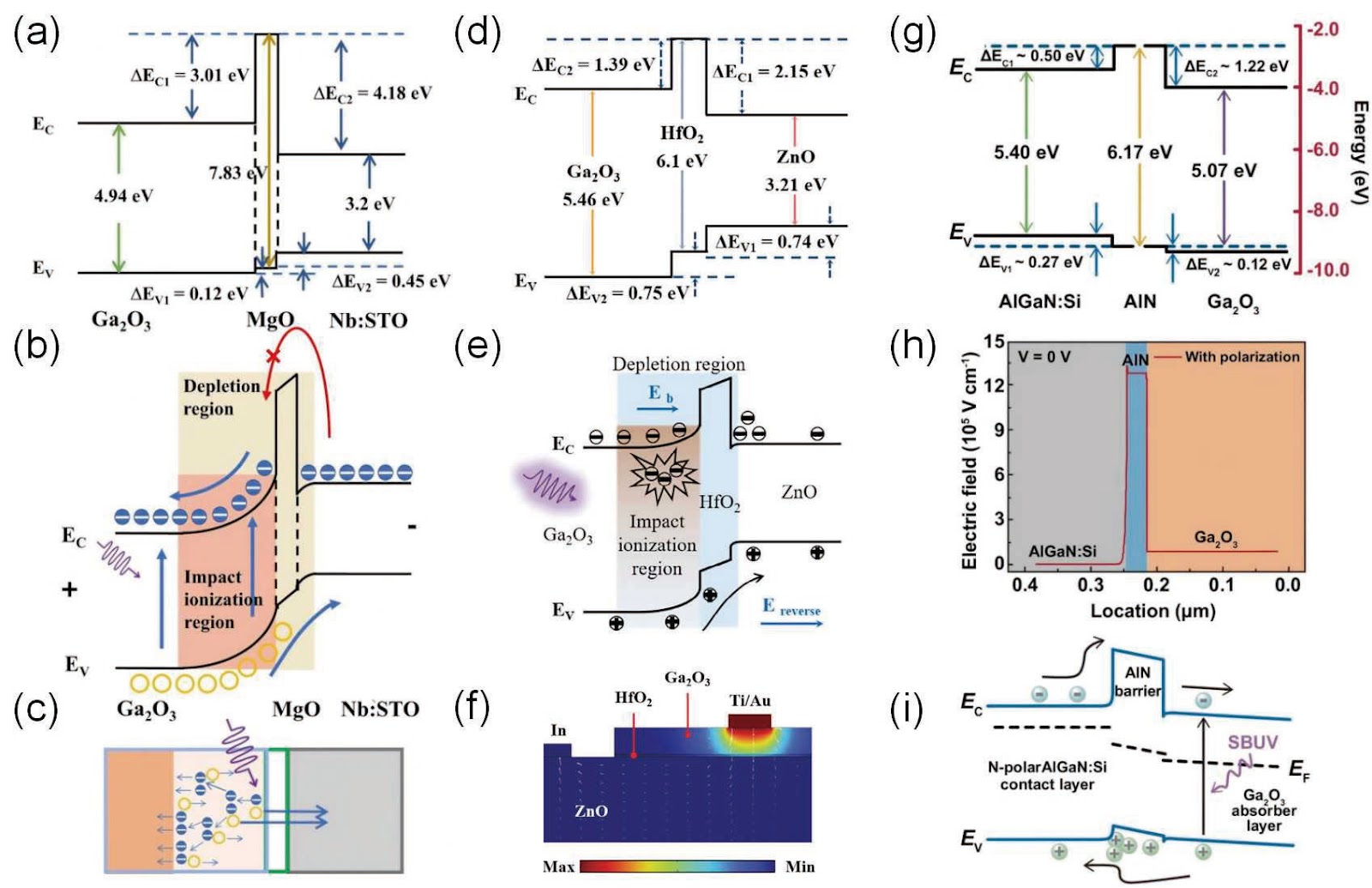
Band Engineering Solar-Blind Ultraviolet Photodetectors: Breaking the Sensitivity-Speed Trade-off

Authors: HONG Bin Wang, PENG Li, JIANGANG Ma

Solar-blind ultraviolet (UV) photodetectors are crucial for applications requiring high signal-to-noise ratio and immunity to solar background noise. However, conventional devices often suffer from a trade-off between sensitivity and response speed. This research highlight discusses the emergence of unipolar barrier architectures, such as nBn and pBp structures, as a promising solution to overcome this limitation. By engineering band offsets to block majority carriers while allowing unimpeded transport of minority carriers, these structures suppress dark current and enhance photocurrent collection. Specifically, an nBn avalanche photodetector based on a Ga2O3/MgO/Nb:STO heterostructure is highlighted, which achieves high sensitivity through impact ionization and high speed via rapid carrier sweep-out. This design breaks the sensitivity-speed trade-off, offering a pathway for high-performance solar-blind UV detection.
Band Engineering Solar-Blind Ultraviolet Photodetectors: Breaking the Sensitivity-Speed Trade-off
Graphical Abstract
Original ResearchVol. 32, Issue 1 • pp. 100-112DOI: 10.1088/1674-4926/26010049Jan 15, 2026

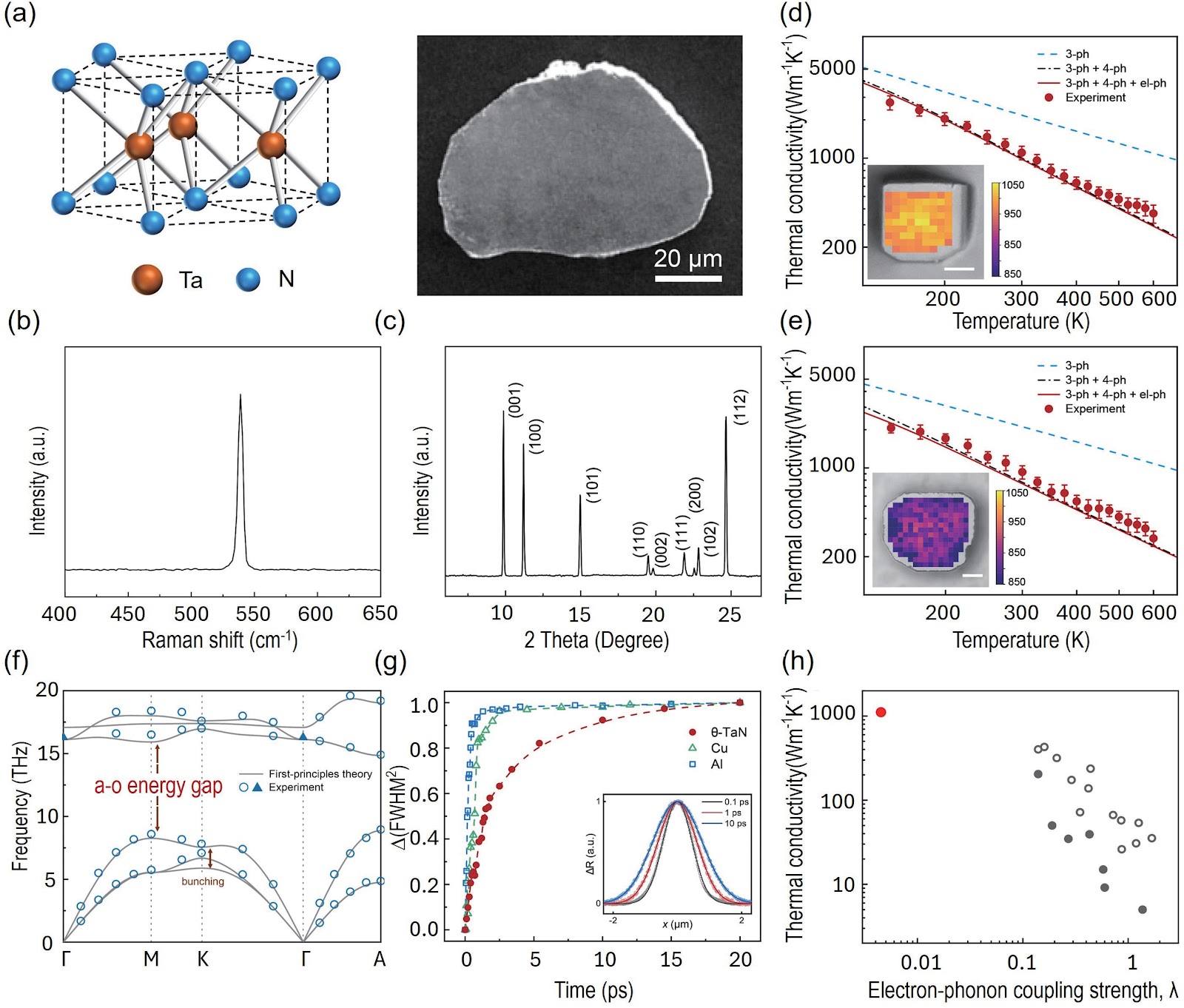
θ-TaN: Redefining the Thermal Conductivity Limit of Metallic Materials

Authors: Miao-Ling Lin, Ping-Heng Tan

Thermal management has become a critical bottleneck for the performance and reliability of modern electronics. For over a century, the thermal conductivity (κ) of metallic materials was believed to have an inherent upper limit of approximately 400 W·m⁻¹·K⁻¹, constrained by strong electron-phonon coupling and lattice anharmonicity. However, a groundbreaking study by Li et al. (Science, 2026) experimentally realized single-crystalline θ-phase tantalum nitride (θ-TaN), a metastable transition metal nitride with a room-temperature thermal conductivity of ~1100 W·m⁻¹·K⁻¹ along the a-axis and ~928 W·m⁻¹·K⁻¹ along the c-axis, nearly three times that of copper. This work shatters the long-standing thermal conductivity limit for metals and validates theoretical predictions. The exceptional performance of θ-TaN arises from its unique hexagonal crystal structure (space group P6m2), featuring a large acoustic-optical phonon gap (~8 THz) and acoustic phonon bunching, which suppress phonon-phonon scattering. Additionally, weak electron-phonon coupling and minimal isotope scattering contribute to phonon-dominated heat transport. The authors synthesized high-quality single crystals via a flux-assisted metathesis reaction, overcoming challenges of conventional high-pressure routes. Using time-domain thermoreflectance and inelastic X-ray scattering, they confirmed the intrinsic ultrahigh thermal conductivity and mapped the phonon band structure. This discovery introduces a new class of high-thermal-conductivity metals, opening transformative opportunities for thermal management in electronics, aerospace, and energy systems.

θ-TaN: Redefining the Thermal Conductivity Limit of Metallic Materials
Graphical Abstract
Original ResearchVol. 32, Issue 1 • pp. 100-112DOI: 10.1088/1674-4926/26010050Jan 15, 2026

Bonding at the Atomic Limit: Redefining Contacts in Two-Dimensional Semiconductors

Authors: Bei Zhao, Xidong Duan

Two-dimensional transition metal dichalcogenides (TMDs) hold promise for next-generation electronics, but their industrial adoption is hindered by van der Waals (vdW) contacts, which exhibit weak interfacial coupling and high contact resistance (RC). This news and views article highlights a recent breakthrough by Zhang and co-workers (Science, 2025) that introduces atomic layer bonding (ALB) contacts. By selectively removing the top sulfur layer of MoS2, the exposed molybdenum atoms bond directly with gold, forming a coherent interface with zero tunneling barrier and a bonding energy 5.4 times higher than vdW contacts. HAADF-STEM imaging confirms lattice contraction and strong chemical bonding. Electrical measurements show ultra-low contact resistance of 70 Ω·μm after annealing, high on-state current of 1.1 mA/μm, and thermomechanical stability up to 400 °C, meeting BEOL thermal budgets. ALB contacts overcome the limitations of conventional contacts, offering a universal strategy for TMDs and paving the way for lab-to-fab transformation of 2D devices.

Bonding at the Atomic Limit: Redefining Contacts in Two-Dimensional Semiconductors
Graphical Abstract