SinoTechIntel Academic Portal
πŸ›οΈ Indexed Academic JournalImpact Factor: 3.8 (Q1 - Elsevier)Original: δΈ­ε›½εŒ–ε­¦ε·₯程学ζŠ₯ (θ‹±ζ–‡η‰ˆ)

Chinese Journal of Chemical Engineering

Access authentic peer-reviewed engineering methodologies, experimental datasets, and scientific literature published in this journal on SinoTechIntel.

Total Research Papers: 98
Access: 100% Free Open Access
Browse by Publication Year & VolumeReset All Filters βœ•

Published Research PapersFiltered: Year 2024 β€’ 67

Showing 2 of 98 peer-reviewed papers with full Graphical Abstracts.

Original ResearchVol. 67, Issue 1 β€’ pp. 89-96DOI: 10.1016/j_cjche_1448β€’ Jan 15, 2024

Enhanced corrosion resistance of epoxy resin coating via addition of CeO2 and benzotriazole

Authors: Xu Han, Ruijie Guo, Baolong Niu, Hong Yan

The use of fillers to enhance the corrosion protection of epoxy resins has been widely applied. In this work, cerium dioxide (CeO2) and benzotriazole (BTA) were introduced into an epoxy resin to enhance the corrosion resistance of Q235 carbon steel. Scanning electron microscopy results indicated that the CeO2 grains were rod-like and ellipsoidal in shape, and the distribution pattern of BTA was analyzed by energy dispersive spectroscope. The dynamic potential polarization curve proved the excellent corrosion resistance of the composite epoxy resin with CeO2 and BTA co-addition, and electrochemical impedance spectroscopy test analysis indicated the significantly enhanced long-term corrosion protection performance of the composite coating. And the optimal protective performance was provided by the coating containing 0.3% (mass) CeO2 and 20% (mass) BTA, which was attributed to the barrier performance of CeO2 particles and the chemical barrier effect of BTA. The formation of corrosion products was analyzed using X-ray diffraction. In addition, the corrosion resistance mechanism of the coating was also discussed in detail.
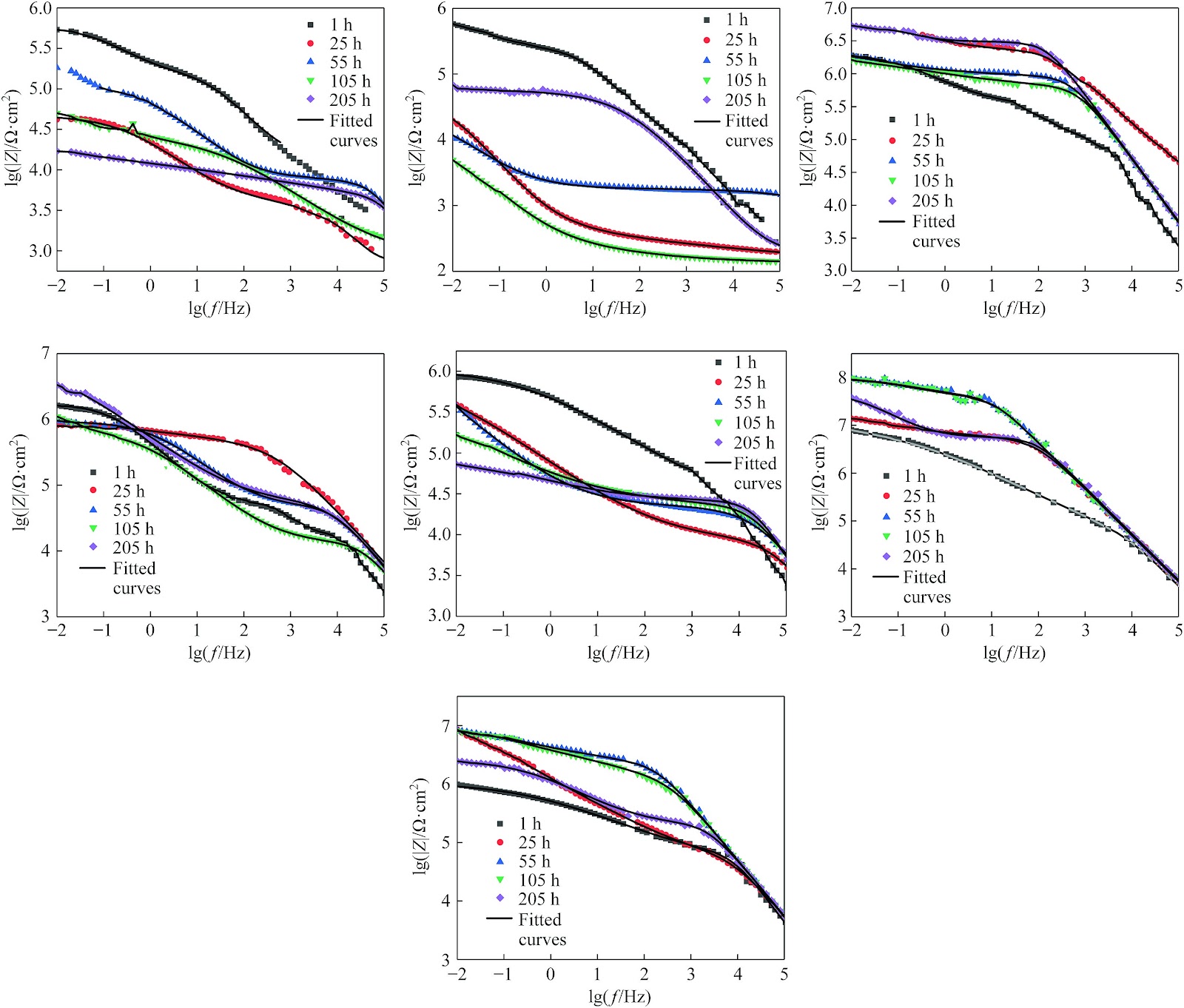
Enhanced corrosion resistance of epoxy resin coating via addition of CeO2 and benzotriazole
Graphical Abstract
Original ResearchVol. 67, Issue 1 β€’ pp. 68-77DOI: 10.1016/j_cjche_1448β€’ Dec 15, 2023

Amino-functionalized UiO-66-doped mixed matrix membranes with high permeation performance and fouling resistance

Authors: Yi Zhang, Di Liu, Zhaoli Wang, Junjian Yu, Yanyin Cheng, Wenjing Li, Zhe Wang, Hongzhe Ni, Yuchao Wang

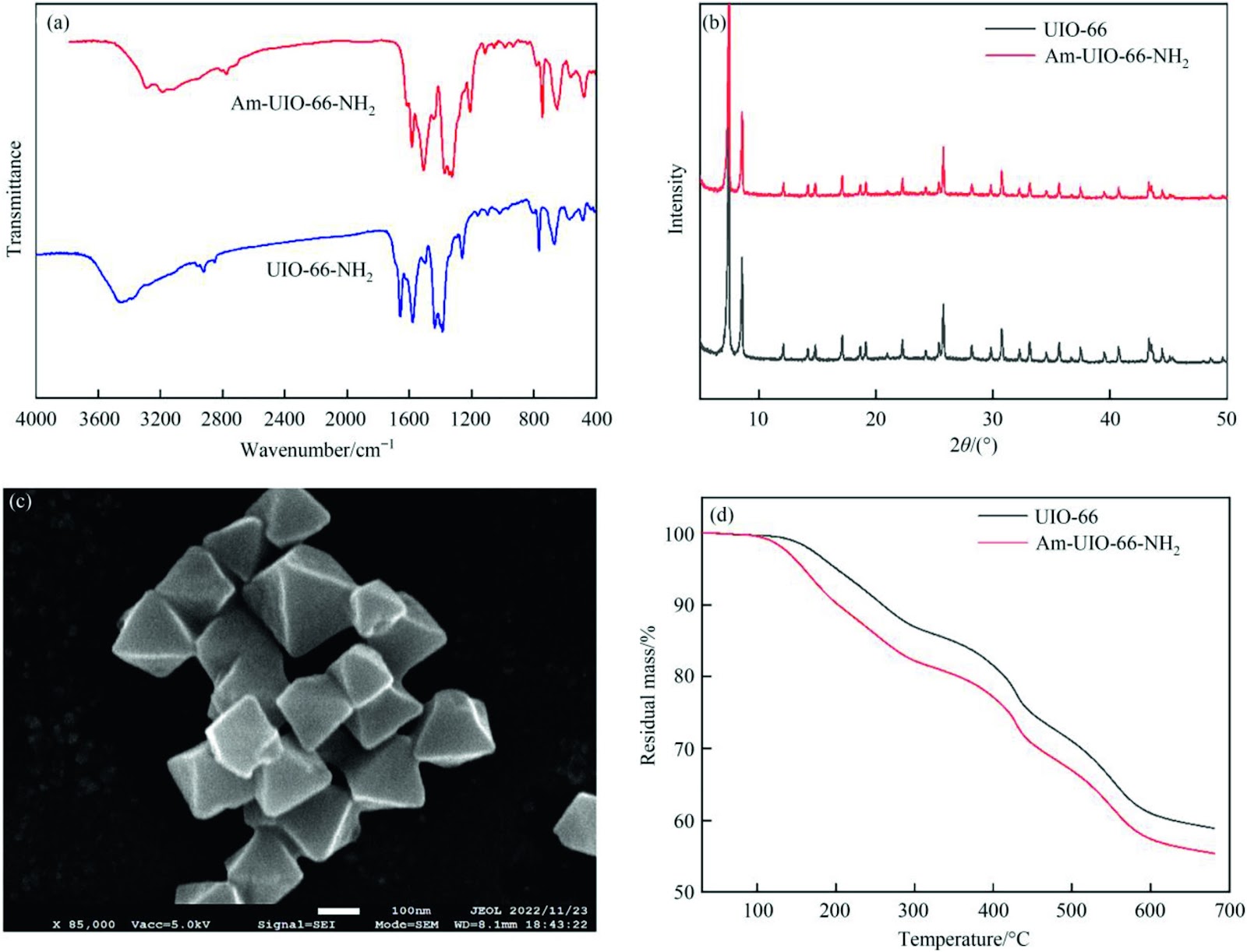
For the reduction of bovine serum proteins from wastewater, a novel mixed matrix membrane was prepared by functionalizing the substrate material polyaryletherketone (PAEK), followed by carboxyl groups (C-SPAEKS), and then adding amino-functionalized UiO-66-NH2 (Am-UiO-66-NH2). Amino-functionalization of UiO-66 was accomplished by melamine, followed by an amidation reaction to immobilize Am-UiO-66-NH2, which was immobilized on the surface of the membrane as well as in the pore channels, which enhanced the hydrophilicity of the membrane surface while increasing the negative potential of the membrane surface. This nanoparticle-loaded ultrafiltration membrane has good permeation performance, with a pure water flux of up to 482.3 LΒ·mβˆ’2Β·hβˆ’1 for C-SPAEKS/Am-UiO-66-NH2 and a retention rate of up to 98.7% for bovine serum albumin (BSA)-contaminated solutions. Meanwhile, after several hydrophilic modifications, the flux recovery of BSA contaminants by this series of membranes increased from 56.2% to 80.55% of pure membranes. The results of ultrafiltration flux time tests performed at room temperature showed that the series of ultrafiltration membranes remained relatively stable over a test time of 300 min. Thus, the newly developed mixed matrix membrane showed potential for high efficiency and stability in wastewater treatment containing bovine serum proteins.

Amino-functionalized UiO-66-doped mixed matrix membranes with high permeation performance and fouling resistance
Graphical Abstract