Key Takeaways & Executive Findings
- •• Novel mixed matrix membranes (MMMs) were fabricated by incorporating amino-functionalized UiO-66-NH2 into carboxylated polyaryletherketone (C-SPAEKS), significantly enhancing hydrophilicity and negative surface charge. • The optimized C-SPAEKS/Am-UiO-66-NH2 membrane achieved a high pure water flux of 482.3 L·m−2·h−1 and a bovine serum albumin (BSA) rejection rate of 98.7%, demonstrating excellent permeation and separation performance. • Flux recovery ratio increased from 56.2% to 80.55% after hydrophilic modification, indicating improved fouling resistance and reusability for protein-containing wastewater treatment. • The membranes exhibited stable ultrafiltration performance over 300 minutes of operation, highlighting their potential for long-term applications in wastewater treatment.
Abstract
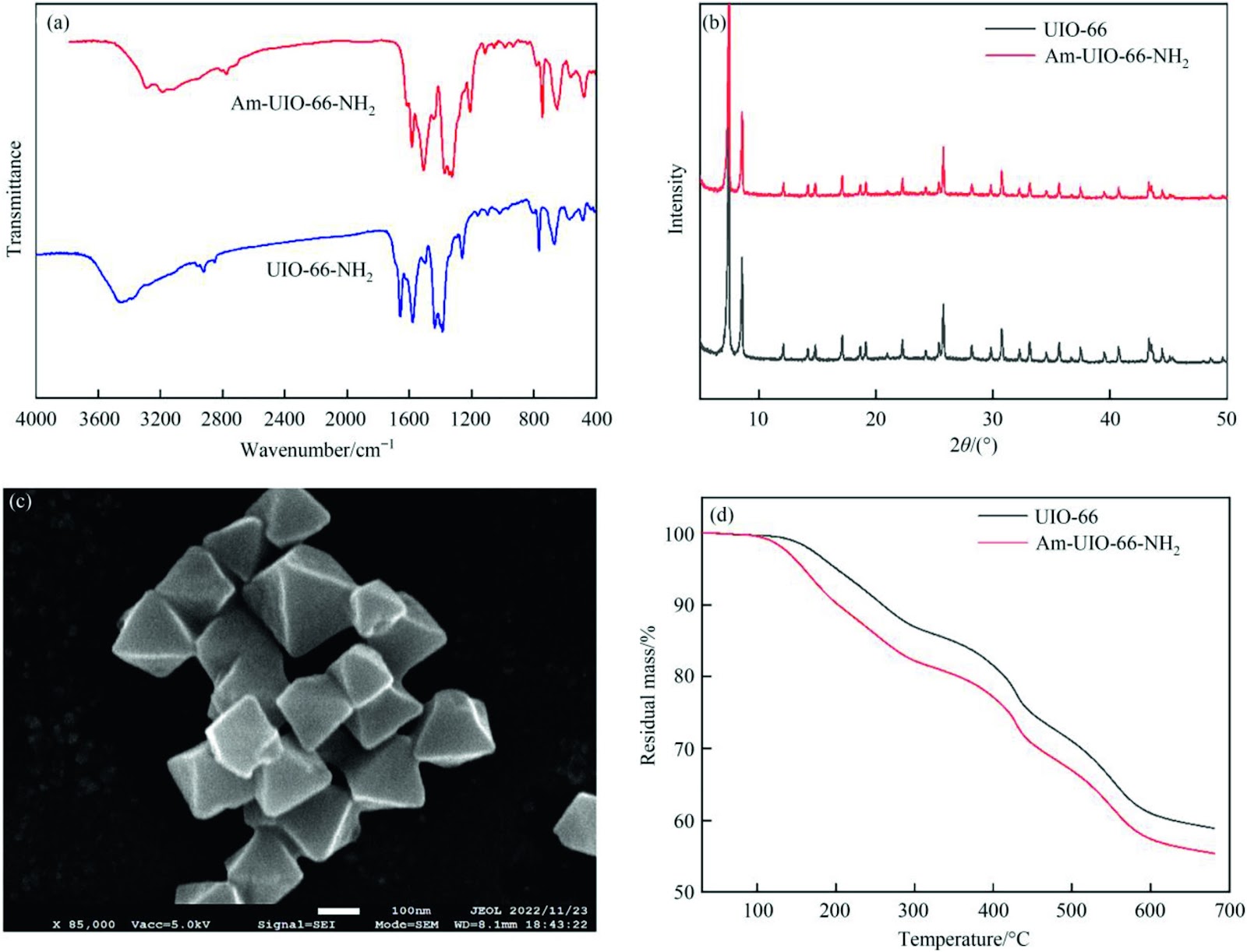
For the reduction of bovine serum proteins from wastewater, a novel mixed matrix membrane was prepared by functionalizing the substrate material polyaryletherketone (PAEK), followed by carboxyl groups (C-SPAEKS), and then adding amino-functionalized UiO-66-NH2 (Am-UiO-66-NH2). Amino-functionalization of UiO-66 was accomplished by melamine, followed by an amidation reaction to immobilize Am-UiO-66-NH2, which was immobilized on the surface of the membrane as well as in the pore channels, which enhanced the hydrophilicity of the membrane surface while increasing the negative potential of the membrane surface. This nanoparticle-loaded ultrafiltration membrane has good permeation performance, with a pure water flux of up to 482.3 L·m−2·h−1 for C-SPAEKS/Am-UiO-66-NH2 and a retention rate of up to 98.7% for bovine serum albumin (BSA)-contaminated solutions. Meanwhile, after several hydrophilic modifications, the flux recovery of BSA contaminants by this series of membranes increased from 56.2% to 80.55% of pure membranes. The results of ultrafiltration flux time tests performed at room temperature showed that the series of ultrafiltration membranes remained relatively stable over a test time of 300 min. Thus, the newly developed mixed matrix membrane showed potential for high efficiency and stability in wastewater treatment containing bovine serum proteins.
1. Introduction
Carbon reduction policies and energy-saving targets have become the consensus of most countries [1], and how to obtain clean, fresh water by using energy-saving methods has become one of the challenges faced by most countries in the world [2]. Traditional water treatment methods include coagulation, adsorption, biological treatment, and filtration, but none of them can meet the requirements of people living and drinking. The ultrafiltration direction in membrane separation technology is considered one of the potential approaches to solve this problem [3e5]. Whether in general wastewater purification [6], seawater desalination, or in new fields such as drug purification and nanoparticle separation, ultrafiltration membrane technology is gradually replacing other outdated separation technologies. The characteristic pore sizes of ultrafiltration membranes are 2e100 nm. Under the effect of osmotic pressure, macromolecules such as viruses, proteins, bacteria, and colloids are blocked on the surface of the membrane, enabling the separation and treatment of wastewater.
Common substrate materials for ultrafiltration membranes are polyetherketone (PEK) [7,8], poly sulfone (PSF) [9,10], and poly vinylidene fluoride (PVDF) [11]. In comparison to other substrates, polyaryletherketone (PAEK) is an amorphous, high-temperature-resistant resin with superior mechanical properties. The benzene rings on the main chain of the polyaryletherketone molecule provide the molecular chain with rigidity, which gives PAEK good mechanical strength. Besides, the large number of ether bonds makes the molecular chain flexible, which in turn gives PAEK good toughness. Currently, PAEK faces problems of low permeability and serious membrane contamination in practical applications of ultrafiltration membranes because of their hydrophobic properties [12]. To overcome these limitations, researchers have gradually started to use polymer membranes as matrix materials and organic/inorganic fillers to control the separation effect, thus creating improved mixed matrix membranes (MMMs) [13e15]. MMMs are using doped nanoparticles to improve the hydrophobicity, contamination resistance, surface charge or pore size, and porosity of ultrafiltration membranes. This is considered one of the most promising directions for ultrafiltration membranes because of their simplicity of operation and significantly improved performance. However, the modification of matrix materials has been faced with a trade-off between performance and stability. The introduction of nanoparticles [16] (e.g., carb...
Loading authentic research manuscript (Pages 1–5)...
Yi Zhang, Di Liu, Zhaoli Wang, Junjian Yu, Yanyin Cheng, Wenjing Li, Zhe Wang, Hongzhe Ni, Yuchao Wang (2023). Amino-functionalized UiO-66-doped mixed matrix membranes with high permeation performance and fouling resistance. Chinese Journal of Chemical Engineering. https://doi.org/10.1016/j_cjche_1448
Research & Educational Purpose Only:The translations, structured abstracts, analytical annotations, and data reports provided by SinoTechIntel are intended exclusively for academic research, internal corporate R&D, and educational benchmarking. They do not constitute formal engineering, chemical safety, legal, or professional advice.
Copyright & Intellectual Property Notice: Original copyright of the underlying source articles and experimental data remains with the respective authors, institutions, and original publishing journals. SinoTechIntel claims intellectual property only over its proprietary translations, analytical syntheses, and AEO structured enhancements in accordance with international fair use and academic citation principles.
Frequently Asked Questions
What is the main objective of this study?
The study aims to develop a novel mixed matrix membrane (MMM) with high permeation performance and fouling resistance for the reduction of bovine serum proteins from wastewater, by incorporating amino-functionalized UiO-66-NH2 into carboxylated polyaryletherketone (C-SPAEKS).
How was the amino-functionalized UiO-66-NH2 prepared?
Amino-functionalization of UiO-66 was accomplished by using melamine, followed by an amidation reaction to immobilize Am-UiO-66-NH2 on the membrane surface and within pore channels.
What were the key performance metrics of the developed membrane?
The C-SPAEKS/Am-UiO-66-NH2 membrane exhibited a pure water flux of up to 482.3 L·m−2·h−1 and a bovine serum albumin (BSA) retention rate of up to 98.7%.
How did the membrane perform in terms of fouling resistance?
The flux recovery ratio increased from 56.2% to 80.55% after hydrophilic modifications, indicating improved fouling resistance and reusability.
What is the significance of this research?
The newly developed mixed matrix membrane shows potential for high efficiency and stability in wastewater treatment containing bovine serum proteins, offering a promising solution for clean water production.
Related Technical Papers & Translations

Design and optimization of a high-efficiency distillation process for cellulosic fuel ethanol integrated with thermal coupling and molecular sieve adsorption
To address the challenges of high energy consumption and prominent costs in the traditional three-columns distillation process for cellulosic fuel ethanol, a distillation—molecular sieve coupling separation process is proposed. This process integrates a three-column (crude distillation column, first distillation column, second distillation column) system with a 3A molecular sieve adsorption deep dehydration unit. A thermal coupling network is constructed via differential pressure design (steam from medium/high-pressure columns as mutual heat sources, reboiler liquid waste heat for feed preheating), and molecular sieve adsorption conditions are optimized. The study first performs a thermodynamic consistency test on the ethanol—water system, determines optimal non-random two-liquid (NRTL) model binary interaction parameters via experimental data regression for Aspen Plus simulation. Aiming at minimum total annual cost (TAC), Aspen Plus is used to optimize process parameters (theoretical tray number, feed location, reflux ratio, side-draw position, etc.). Economic analysis shows this process reduces CO2 emission costs by 27.56%, TAC by 15.58% (to 5.123 × 10⁶ USD·a-1), and increases ethanol purity to >99.6%, providing an effective solution for green, efficient separation.

A cohesion loss model for determining residual strength of deep bedded sandstone
Rock residual strength, as an important input parameter, plays an indispensable role in proposing the reasonable and scientific scheme about stope design, underground tunnel excavation and stability evaluation of deep chambers. Therefore, previous residual strength models of rocks established were reviewed. And corresponding related problems were stated. Subsequently, starting from the effects of bedding and whole life-cycle evolution process, series of triaxial mechanical tests of deep bedded s

Federated model with contrastive learning and adaptive control variates for human activity recognition
Recent attention to privacy issues demands a communication-safe method for training human activity recognition (HAR) models on client activity data. Federated learning (FL) has become a compelling technique to facilitate model training between the server and clients while preserving data privacy. However, classical FL methods often assume independent and identically distributed (IID) data among clients. This assumption does not hold true in practical scenarios. Human activity in real-world scena