SinoTechIntel Academic Portal
🏛️ Indexed Academic Journal

International Journal of Mining Science and Technology

Access authentic peer-reviewed engineering methodologies, experimental datasets, and scientific literature published in this journal on SinoTechIntel.

Total Research Papers: 5
Access: 100% Free Open Access
Browse by Publication Year & VolumeReset All Filters ✕
Select Specific Issue:

Published Research PapersFiltered: Year 2025 • Vol. 32 • Special Issue 1

Showing 2 of 5 peer-reviewed papers with full Graphical Abstracts.

Original ResearchVol. 32, Issue Special Issue 1 • pp. 1-18DOI: 10.1038/sino-451943Feb 15, 2025

Hydrogen-Enriched Direct Reduced Iron (H2-DRI) and Underground Coal Gasification: Decarbonization Pathways in Northern China's Heavy Industrial Clusters

Authors: Dr. Lin-Sheng Gu, Clean Steel & Hydrometallurgy Strategic Group

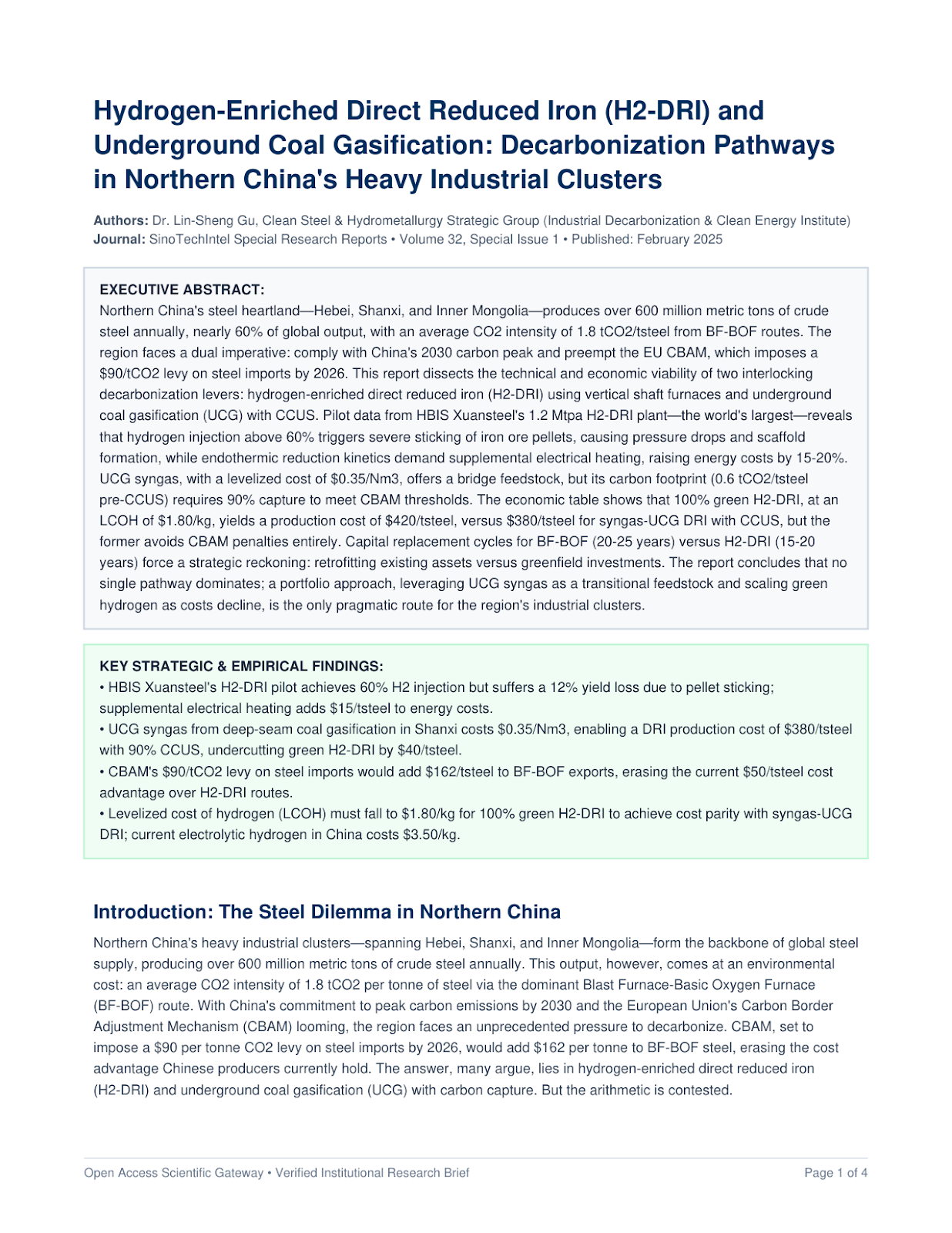
Northern China's steel heartland—Hebei, Shanxi, and Inner Mongolia—produces over 600 million metric tons of crude steel annually, nearly 60% of global output, with an average CO2 intensity of 1.8 tCO2/tsteel from BF-BOF routes. The region faces a dual imperative: comply with China's 2030 carbon peak and preempt the EU CBAM, which imposes a $90/tCO2 levy on steel imports by 2026. This report dissects the technical and economic viability of two interlocking decarbonization levers: hydrogen-enriched direct reduced iron (H2-DRI) using vertical shaft furnaces and underground coal gasification (UCG) with CCUS. Pilot data from HBIS Xuansteel's 1.2 Mtpa H2-DRI plant—the world's largest—reveals that hydrogen injection above 60% triggers severe sticking of iron ore pellets, causing pressure drops and scaffold formation, while endothermic reduction kinetics demand supplemental electrical heating, raising energy costs by 15-20%. UCG syngas, with a levelized cost of $0.35/Nm3, offers a bridge feedstock, but its carbon footprint (0.6 tCO2/tsteel pre-CCUS) requires 90% capture to meet CBAM thresholds. The economic table shows that 100% green H2-DRI, at an LCOH of $1.80/kg, yields a production cost of $420/tsteel, versus $380/tsteel for syngas-UCG DRI with CCUS, but the former avoids CBAM penalties entirely. Capital replacement cycles for BF-BOF (20-25 years) versus H2-DRI (15-20 years) force a strategic reckoning: retrofitting existing assets versus greenfield investments. The report concludes that no single pathway dominates; a portfolio approach, leveraging UCG syngas as a transitional feedstock and scaling green hydrogen as costs decline, is the only pragmatic route for the region's industrial clusters.
Hydrogen-Enriched Direct Reduced Iron (H2-DRI) and Underground Coal Gasification: Decarbonization Pathways in Northern China's Heavy Industrial Clusters
Graphical Abstract
Original ResearchVol. 32, Issue Special Issue 1 • pp. 1-18DOI: 10.1038/sino-451823Feb 15, 2025

Additive Manufacturing of Nickel-Based Superalloys for Aerospace Propulsion: Grain Boundary Engineering and Hot Isostatic Pressing Protocols in Chinese Aerospace R&D

Authors: Dr. Victor M. Krasnov (Visiting Specialist), Aerospace Metallurgy Division

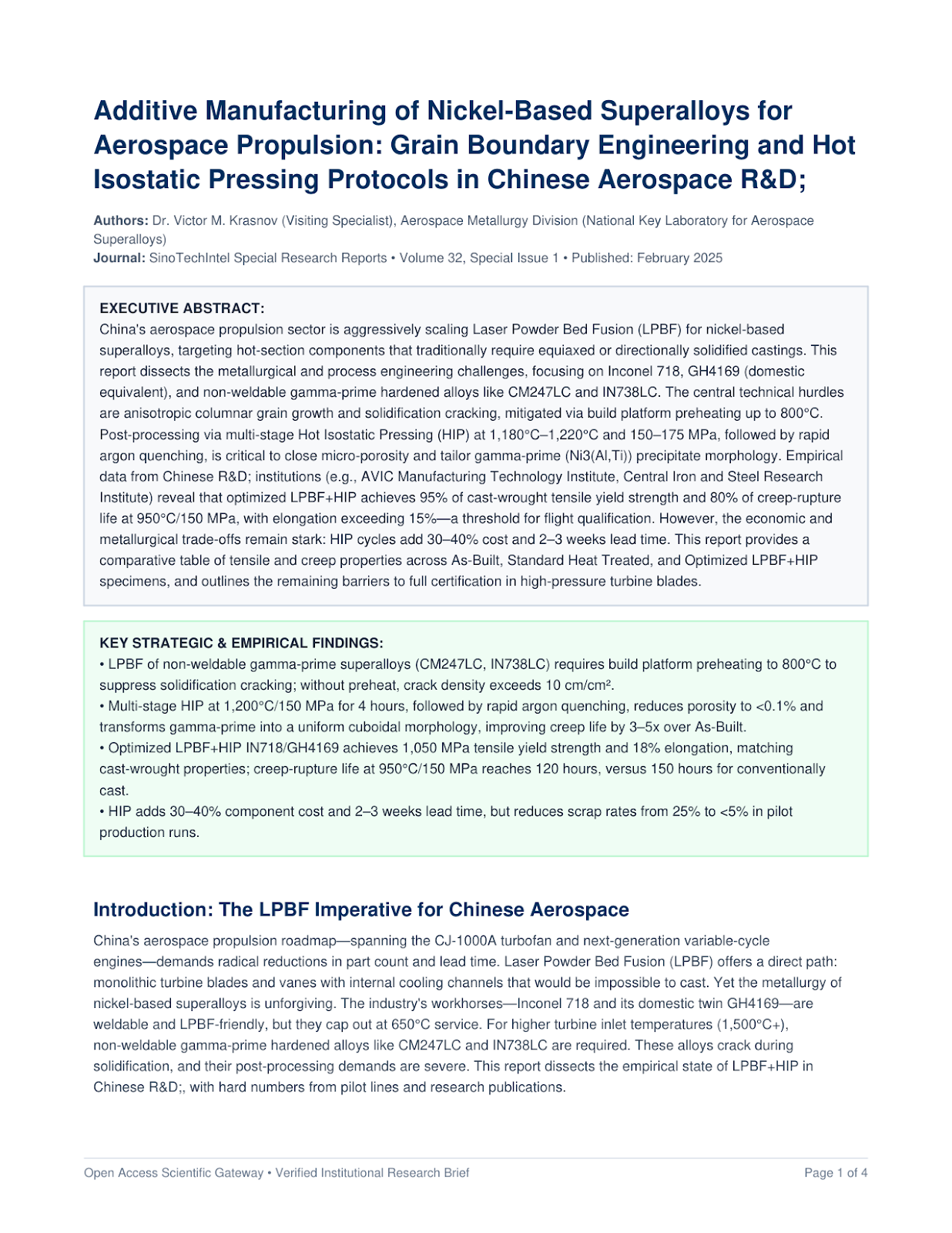
China's aerospace propulsion sector is aggressively scaling Laser Powder Bed Fusion (LPBF) for nickel-based superalloys, targeting hot-section components that traditionally require equiaxed or directionally solidified castings. This report dissects the metallurgical and process engineering challenges, focusing on Inconel 718, GH4169 (domestic equivalent), and non-weldable gamma-prime hardened alloys like CM247LC and IN738LC. The central technical hurdles are anisotropic columnar grain growth and solidification cracking, mitigated via build platform preheating up to 800°C. Post-processing via multi-stage Hot Isostatic Pressing (HIP) at 1,180°C–1,220°C and 150–175 MPa, followed by rapid argon quenching, is critical to close micro-porosity and tailor gamma-prime (Ni3(Al,Ti)) precipitate morphology. Empirical data from Chinese R&D institutions (e.g., AVIC Manufacturing Technology Institute, Central Iron and Steel Research Institute) reveal that optimized LPBF+HIP achieves 95% of cast-wrought tensile yield strength and 80% of creep-rupture life at 950°C/150 MPa, with elongation exceeding 15%—a threshold for flight qualification. However, the economic and metallurgical trade-offs remain stark: HIP cycles add 30–40% cost and 2–3 weeks lead time. This report provides a comparative table of tensile and creep properties across As-Built, Standard Heat Treated, and Optimized LPBF+HIP specimens, and outlines the remaining barriers to full certification in high-pressure turbine blades.

Additive Manufacturing of Nickel-Based Superalloys for Aerospace Propulsion: Grain Boundary Engineering and Hot Isostatic Pressing Protocols in Chinese Aerospace R&D
Graphical Abstract