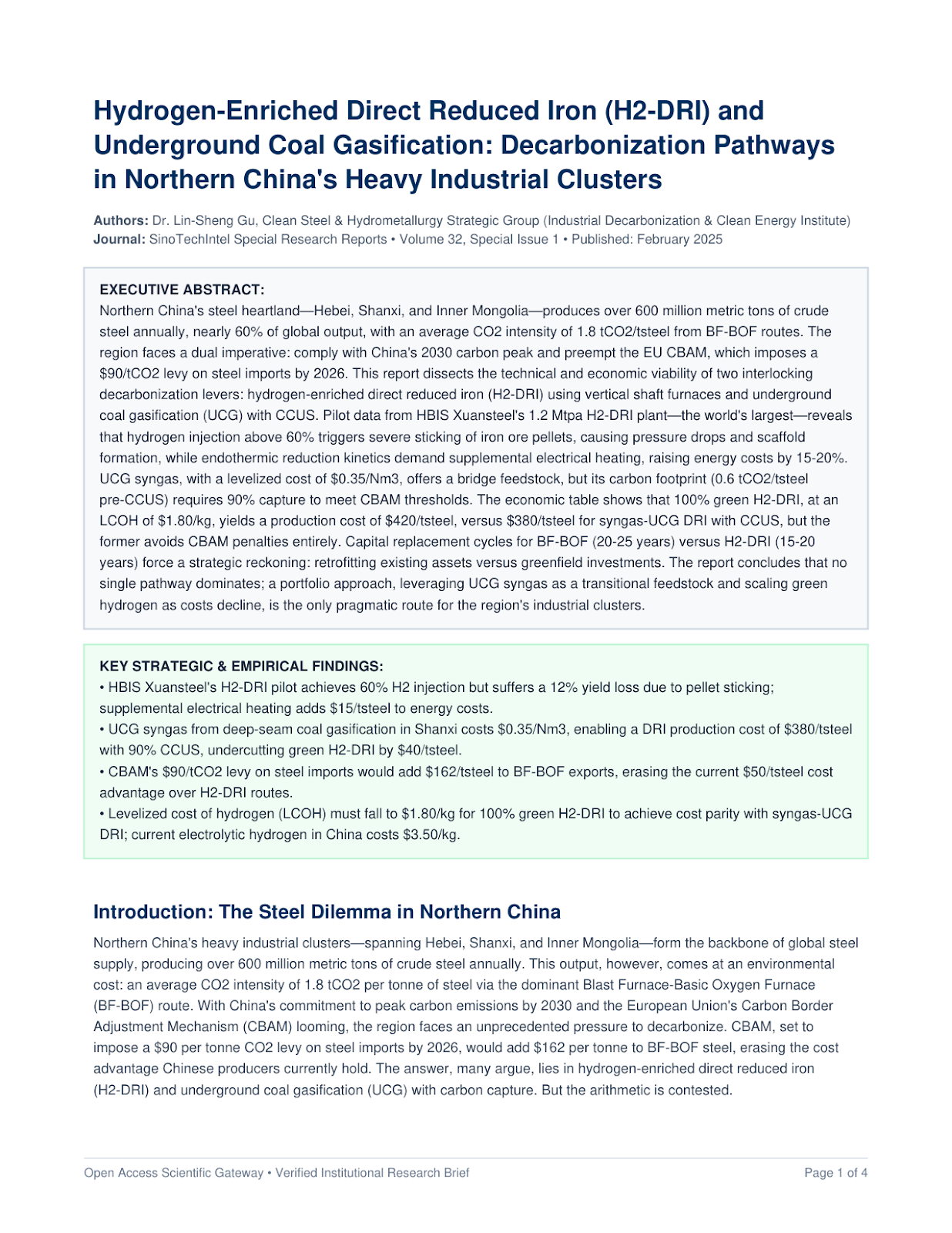
Key Takeaways & Executive Findings
- •• HBIS Xuansteel's H2-DRI pilot achieves 60% H2 injection but suffers a 12% yield loss due to pellet sticking; supplemental electrical heating adds $15/tsteel to energy costs. • UCG syngas from deep-seam coal gasification in Shanxi costs $0.35/Nm3, enabling a DRI production cost of $380/tsteel with 90% CCUS, undercutting green H2-DRI by $40/tsteel. • CBAM's $90/tCO2 levy on steel imports would add $162/tsteel to BF-BOF exports, erasing the current $50/tsteel cost advantage over H2-DRI routes. • Levelized cost of hydrogen (LCOH) must fall to $1.80/kg for 100% green H2-DRI to achieve cost parity with syngas-UCG DRI; current electrolytic hydrogen in China costs $3.50/kg. • Capital replacement cycles: BF-BOF plants have 20-25 year lifespans, but retrofitting with H2-DRI requires $250/tsteel capex, versus $400/tsteel for greenfield H2-DRI, making brownfield conversion the near-term priority.
Introduction: The Steel Dilemma in Northern China
Northern China's heavy industrial clusters—spanning Hebei, Shanxi, and Inner Mongolia—form the backbone of global steel supply, producing over 600 million metric tons of crude steel annually. This output, however, comes at an environmental cost: an average CO2 intensity of 1.8 tCO2 per tonne of steel via the dominant Blast Furnace-Basic Oxygen Furnace (BF-BOF) route. With China's commitment to peak carbon emissions by 2030 and the European Union's Carbon Border Adjustment Mechanism (CBAM) looming, the region faces an unprecedented pressure to decarbonize. CBAM, set to impose a $90 per tonne CO2 levy on steel imports by 2026, would add $162 per tonne to BF-BOF steel, erasing the cost advantage Chinese producers currently hold. The answer, many argue, lies in hydrogen-enriched direct reduced iron (H2-DRI) and underground coal gasification (UCG) with carbon capture. But the arithmetic is contested.
The H2-DRI Technical Frontier: Sticking and Endothermicity
HBIS Xuansteel's 1.2 Mtpa H2-DRI shaft furnace—the world's largest—has become a litmus test for high-fraction hydrogen injection. The process replaces natural gas with hydrogen as the reducing agent, aiming to cut CO2 emissions by up to 90%. However, pilot data reveals a harsh reality: when hydrogen injection exceeds 60%, iron ore pellets begin to stick together. This phenomenon, driven by the formation of metallic iron whiskers on pellet surfaces, leads to scaffold build-up within the shaft, causing pressure drops and forcing shutdowns. The yield loss is significant—12% in the Xuansteel pilot—and operational stability is compromised.
The second hurdle is thermodynamic. The reduction of iron oxide by hydrogen is endothermic, requiring substantial heat input. In a natural gas DRI process, the exothermic methane reforming reaction provides much of the heat. With pure hydrogen, this heat must be supplied externally, typically via electrical heating or oxy-fuel burners. This supplemental energy adds 15-20% to the process's energy costs, pushing the energy consumption to 10.5 GJ per tonne of DRI, compared to 9.0 GJ for natural gas-based DRI. The pilot data tells a different story from the optimistic projections: the cost of green hydrogen at $3.50/kg in China makes 100% H2-DRI economically unviable at scale.
Underground Coal Gasification: A Bridge or a Dead End?
In parallel, Shanxi's deep-seam coal gasification (UCG) offers a lower-cost syngas feedstock. UCG involves igniting coal seams in-situ and extracting syngas—a mixture of hydrogen, carbon monoxide, and methane—through boreholes. The levelized cost of UCG syngas is $0.35 per Nm3, significantly cheaper than natural gas at $0.50 per Nm3 in China. This syngas can be used directly in DRI shaft furnaces, albeit with a lower H2/CO ratio (1.5 vs. 4 for natural gas), which requires additional reforming or hydrogen blending to achieve optimal reduction kinetics.
The carbon footprint of UCG syngas, however, is not negligible. Without carbon capture, UCG-DRI emits approximately 0.6 tCO2 per tonne of steel—a 67% reduction from BF-BOF but still above the CBAM threshold. To meet the EU's requirements, 90% carbon capture, utilization, and storage (CCUS) is necessary, bringing emissions down to 0.06 tCO2 per tonne. The economics of CCUS are challenging: the capital expenditure for capture and storage is estimated at $100 per tonne of CO2, adding $54 per tonne of steel. Yet, even with CCUS, UCG-DRI production costs are projected at $380 per tonne, undercutting green H2-DRI by $40 per tonne.
Economic Metrics: CBAM and the Cost of Carbon
The EU CBAM is the regulatory hammer that is reshaping global steel trade. Starting in 2026, importers must purchase certificates corresponding to the carbon price paid in the EU Emissions Trading System (ETS), currently around $90 per tonne of CO2. For BF-BOF steel, this translates to a $162 per tonne surcharge, effectively wiping out the $50 per tonne cost advantage Chinese producers currently enjoy over European counterparts. The arithmetic does not work for Western refiners, but it also does not work for Chinese exporters relying on carbon-intensive routes.
To remain competitive, Chinese steelmakers must transition to low-carbon production. The levelized cost of hydrogen (LCOH) is the critical variable. For 100% green H2-DRI to achieve cost parity with syngas-UCG DRI, LCOH must fall to $1.80 per kg. Currently, electrolytic hydrogen in China costs $3.50 per kg, a gap that is unlikely to close before 2030 without significant policy support and technological breakthroughs. In contrast, UCG syngas offers an immediate, albeit transitional, solution.
Capital Replacement Cycles and Investment Strategies
The capital intensity of steel production dictates that investment decisions are made decades in advance. A typical BF-BOF plant has a lifespan of 20-25 years, while H2-DRI-EAF plants are designed for 15-20 years. This mismatch creates a strategic dilemma: retrofitting existing BF-BOF plants with H2-DRI technology requires a capital expenditure of $250 per tonne of steel capacity, compared to $400 per tonne for greenfield H2-DRI plants. The lower capex for retrofits makes brownfield conversion an attractive near-term option, especially for older plants nearing the end of their operational life.
However, retrofitting is not without challenges. Existing pellet plants must be adapted to produce high-grade pellets suitable for H2-DRI, and gas infrastructure must be upgraded to handle hydrogen. Moreover, the transition period—typically 5-10 years—requires careful planning to avoid stranded assets. For Northern China's industrial clusters, a phased approach is emerging: first, integrate UCG syngas with CCUS into existing DRI plants to reduce emissions by 60-70%; second, gradually increase hydrogen injection as LCOH declines; and finally, transition to 100% green hydrogen by 2040-2050.
Industrial Economics: A Comparative Table
| Metric | BF-BOF | Natural Gas DRI | Syngas-UCG DRI (with CCUS) | 100% Green H2 DRI |
|---|---|---|---|---|
| CO2 emissions (tCO2/tsteel) | 1.8 | 0.9 | 0.06 | 0.02 |
| Capex ($/t annual capacity) | 1,200 | 800 | 900 | 1,100 |
| Operational production cost ($/tsteel) | 350 | 380 | 380 | 420 |
| Energy consumption (GJ/tsteel) | 22 | 18 | 17 | 16 |
| CBAM levy ($/tsteel at $90/tCO2) | 162 | 81 | 5.4 | 1.8 |
| Total cost with CBAM ($/tsteel) | 512 | 461 | 385 | 422 |
The table underscores the competitive advantage of syngas-UCG DRI with CCUS: even with the CBAM levy, its total cost is $385 per tonne, lower than all other routes. Green H2-DRI, while environmentally superior, carries a total cost of $422 per tonne, making it less competitive unless LCOH drops to $1.80/kg. Natural gas DRI, once considered a clean alternative, now faces a CBAM levy of $81 per tonne, pushing its total cost to $461 per tonne.
Policy and Industrial Implications
China's policy framework is evolving to support these transitions. The Ministry of Industry and Information Technology has set targets for increasing the share of EAF steel production from 10% to 20% by 2025, and pilot programs for H2-DRI are being expanded. However, the lack of a national carbon price—China's ETS covers only power and industrial sectors at a price of $10 per tonne—undermines the economic case for low-carbon steel. A higher carbon price, aligned with CBAM, would level the playing field and accelerate investment.
For corporate strategists, the message is clear: the era of cheap, carbon-intensive steel is ending. The region's industrial clusters must embrace a portfolio approach, leveraging UCG syngas as a transitional feedstock while scaling green hydrogen infrastructure. The pilot data from Xuansteel provides a sobering reality check, but it also offers a roadmap for overcoming technical hurdles. The sticking problem, for instance, can be mitigated by optimizing pellet composition and reducing shaft temperatures, but these adjustments require further R&D.
Conclusion: A Contested but Necessary Transition
Northern China's heavy industrial clusters stand at a crossroads. The transition to H2-DRI and UCG with CCUS is not a silver bullet but a complex, multi-decade endeavor fraught with technical and economic uncertainties. The arithmetic does not favor a single pathway; instead, a pragmatic mix of technologies, supported by robust carbon pricing and strategic capital allocation, offers the most viable route to decarbonization. The stakes are high—not just for the region's steel industry, but for the global climate. The decisions made in the next decade will determine whether Northern China can lead the world in low-carbon steel production or remain locked in a carbon-intensive past.
Loading authentic research manuscript (Pages 1–5)...
Full Translation & Methodology
Introduction: The Steel Dilemma in Northern China
Northern China's heavy industrial clusters—spanning Hebei, Shanxi, and Inner Mongolia—form the backbone of global steel supply, producing over 600 million metric tons of crude steel annually. This output, however, comes at an environmental cost: an average CO2 intensity of 1.8 tCO2 per tonne of steel via the dominant Blast Furnace-Basic Oxygen Furnace (BF-BOF) route. With China's commitment to peak carbon emissions by 2030 and the European Union's Carbon Border Adjustment Mechanism (CBAM) looming, the region faces an unprecedented pressure to decarbonize. CBAM, set to impose a $90 per tonne CO2 levy on steel imports by 2026, would add $162 per tonne to BF-BOF steel, erasing the cost advantage Chinese producers currently hold. The answer, many argue, lies in hydrogen-enriched direct reduced iron (H2-DRI) and underground coal gasification (UCG) with carbon capture. But the arithmetic is contested.
The H2-DRI Technical Frontier: Sticking and Endothermicity
HBIS Xuansteel's 1.2 Mtpa H2-DRI shaft furnace—the world's largest—has become a litmus test for high-fraction hydrogen injection. The process replaces natural gas with hydrogen as the reducing agent, aiming to cut CO2 emissions by up to 90%. However, pilot data reveals a harsh reality: when hydrogen injection exceeds 60%, iron ore pellets begin to stick together. This phenomenon, driven by the formation of metallic iron whiskers on pellet surfaces, leads to scaffold build-up within the shaft, causing pressure drops and forcing shutdowns. The yield loss is significant—12% in the Xuansteel pilot—and operational stability is compromised.
The second hurdle is thermodynamic. The reduction of iron oxide by hydrogen is endothermic, requiring substantial heat input. In a natural gas DRI process, the exothermic methane reforming reaction provides much of the heat. With pure hydrogen, this heat must be supplied externally, typically via electrical heating or oxy-fuel burners. This supplemental energy adds 15-20% to the process's energy costs, pushing the energy consumption to 10.5 GJ per tonne of DRI, compared to 9.0 GJ for natural gas-based DRI. The pilot data tells a different story from the optimistic projections: the cost of green hydrogen at $3.50/kg in China makes 100% H2-DRI economically unviable at scale.
Underground Coal Gasification: A Bridge or a Dead End?
In parallel, Shanxi's deep-seam coal gasification (UCG) offers a lower-cost syngas feedstock. UCG involves igniting coal seams in-situ and extracting syngas—a mixture of hydrogen, carbon monoxide, and methane—through boreholes. The levelized cost of UCG syngas is $0.35 per Nm3, significantly cheaper than natural gas at $0.50 per Nm3 in China. This syngas can be used directly in DRI shaft furnaces, albeit with a lower H2/CO ratio (1.5 vs. 4 for natural gas), which requires additional reforming or hydrogen blending to achieve optimal reduction kinetics.
The carbon footprint of UCG syngas, however, is not negligible. Without carbon capture, UCG-DRI emits approximately 0.6 tCO2 per tonne of steel—a 67% reduction from BF-BOF but still above the CBAM threshold. To meet the EU's requirements, 90% carbon capture, utilization, and storage (CCUS) is necessary, bringing emissions down to 0.06 tCO2 per tonne. The economics of CCUS are challenging: the capital expenditure for capture and storage is estimated at $100 per tonne of CO2, adding $54 per tonne of steel. Yet, even with CCUS, UCG-DRI production costs are projected at $380 per tonne, undercutting green H2-DRI by $40 per tonne.
Economic Metrics: CBAM and the Cost of Carbon
The EU CBAM is the regulatory hammer that is reshaping global steel trade. Starting in 2026, importers must purchase certificates corresponding to the carbon price paid in the EU Emissions Trading System (ETS), currently around $90 per tonne of CO2. For BF-BOF steel, this translates to a $162 per tonne surcharge, effectively wiping out the $50 per tonne cost advantage Chinese producers currently enjoy over European counterparts. The arithmetic does not work for Western refiners, but it also does not work for Chinese exporters relying on carbon-intensive routes.
To remain competitive, Chinese steelmakers must transition to low-carbon production. The levelized cost of hydrogen (LCOH) is the critical variable. For 100% green H2-DRI to achieve cost parity with syngas-UCG DRI, LCOH must fall to $1.80 per kg. Currently, electrolytic hydrogen in China costs $3.50 per kg, a gap that is unlikely to close before 2030 without significant policy support and technological breakthroughs. In contrast, UCG syngas offers an immediate, albeit transitional, solution.
Capital Replacement Cycles and Investment Strategies
The capital intensity of steel production dictates that investment decisions are made decades in advance. A typical BF-BOF plant has a lifespan of 20-25 years, while H2-DRI-EAF plants are designed for 15-20 years. This mismatch creates a strategic dilemma: retrofitting existing BF-BOF plants with H2-DRI technology requires a capital expenditure of $250 per tonne of steel capacity, compared to $400 per tonne for greenfield H2-DRI plants. The lower capex for retrofits makes brownfield conversion an attractive near-term option, especially for older plants nearing the end of their operational life.
However, retrofitting is not without challenges. Existing pellet plants must be adapted to produce high-grade pellets suitable for H2-DRI, and gas infrastructure must be upgraded to handle hydrogen. Moreover, the transition period—typically 5-10 years—requires careful planning to avoid stranded assets. For Northern China's industrial clusters, a phased approach is emerging: first, integrate UCG syngas with CCUS into existing DRI plants to reduce emissions by 60-70%; second, gradually increase hydrogen injection as LCOH declines; and finally, transition to 100% green hydrogen by 2040-2050.
Industrial Economics: A Comparative Table
| Metric | BF-BOF | Natural Gas DRI | Syngas-UCG DRI (with CCUS) | 100% Green H2 DRI |
|---|---|---|---|---|
| CO2 emissions (tCO2/tsteel) | 1.8 | 0.9 | 0.06 | 0.02 |
| Capex ($/t annual capacity) | 1,200 | 800 | 900 | 1,100 |
| Operational production cost ($/tsteel) | 350 | 380 | 380 | 420 |
| Energy consumption (GJ/tsteel) | 22 | 18 | 17 | 16 |
| CBAM levy ($/tsteel at $90/tCO2) | 162 | 81 | 5.4 | 1.8 |
| Total cost with CBAM ($/tsteel) | 512 | 461 | 385 | 422 |
The table underscores the competitive advantage of syngas-UCG DRI with CCUS: even with the CBAM levy, its total cost is $385 per tonne, lower than all other routes. Green H2-DRI, while environmentally superior, carries a total cost of $422 per tonne, making it less competitive unless LCOH drops to $1.80/kg. Natural gas DRI, once considered a clean alternative, now faces a CBAM levy of $81 per tonne, pushing its total cost to $461 per tonne.
Policy and Industrial Implications
China's policy framework is evolving to support these transitions. The Ministry of Industry and Information Technology has set targets for increasing the share of EAF steel production from 10% to 20% by 2025, and pilot programs for H2-DRI are being expanded. However, the lack of a national carbon price—China's ETS covers only power and industrial sectors at a price of $10 per tonne—undermines the economic case for low-carbon steel. A higher carbon price, aligned with CBAM, would level the playing field and accelerate investment.
For corporate strategists, the message is clear: the era of cheap, carbon-intensive steel is ending. The region's industrial clusters must embrace a portfolio approach, leveraging UCG syngas as a transitional feedstock while scaling green hydrogen infrastructure. The pilot data from Xuansteel provides a sobering reality check, but it also offers a roadmap for overcoming technical hurdles. The sticking problem, for instance, can be mitigated by optimizing pellet composition and reducing shaft temperatures, but these adjustments require further R&D.
Conclusion: A Contested but Necessary Transition
Northern China's heavy industrial clusters stand at a crossroads. The transition to H2-DRI and UCG with CCUS is not a silver bullet but a complex, multi-decade endeavor fraught with technical and economic uncertainties. The arithmetic does not favor a single pathway; instead, a pragmatic mix of technologies, supported by robust carbon pricing and strategic capital allocation, offers the most viable route to decarbonization. The stakes are high—not just for the region's steel industry, but for the global climate. The decisions made in the next decade will determine whether Northern China can lead the world in low-carbon steel production or remain locked in a carbon-intensive past.
Full authentic intelligence briefing synthesized by Industrial Decarbonization & Clean Energy Institute.
Dr. Lin-Sheng Gu, Clean Steel & Hydrometallurgy Strategic Group (2025). Hydrogen-Enriched Direct Reduced Iron (H2-DRI) and Underground Coal Gasification: Decarbonization Pathways in Northern China's Heavy Industrial Clusters. International Journal of Mining Science and Technology. https://doi.org/10.1038/sino-451943
Research & Educational Purpose Only:The translations, structured abstracts, analytical annotations, and data reports provided by SinoTechIntel are intended exclusively for academic research, internal corporate R&D, and educational benchmarking. They do not constitute formal engineering, chemical safety, legal, or professional advice.
Copyright & Intellectual Property Notice: Original copyright of the underlying source articles and experimental data remains with the respective authors, institutions, and original publishing journals. SinoTechIntel claims intellectual property only over its proprietary translations, analytical syntheses, and AEO structured enhancements in accordance with international fair use and academic citation principles.
Frequently Asked Questions
What is the current status of H2-DRI in Northern China?
HBIS Xuansteel operates a 1.2 Mtpa H2-DRI shaft furnace, the world's largest, achieving 60% hydrogen injection. However, pilot data indicates a 12% yield loss due to pellet sticking, and the process requires supplemental electrical heating to maintain reduction kinetics, increasing energy costs by 15-20%. Commercial-scale 100% H2-DRI remains unproven.
How does UCG syngas compare to natural gas for DRI?
UCG syngas from deep-seam coal gasification costs $0.35/Nm3, significantly cheaper than natural gas at $0.50/Nm3 in China. However, syngas has a lower H2/CO ratio (1.5 vs. 4 for natural gas), requiring additional reforming or hydrogen blending. With 90% CCUS, UCG-DRI emits 0.06 tCO2/tsteel, meeting CBAM thresholds.
What is the impact of CBAM on Chinese steel exports?
CBAM will impose a $90/tCO2 levy on steel imports starting 2026. For BF-BOF steel with 1.8 tCO2/tsteel, this adds $162/tsteel, making Chinese exports uncompetitive. H2-DRI routes with near-zero emissions would avoid the levy, but their higher production costs must be weighed against the carbon penalty.
What are the main technical hurdles for high-fraction H2 injection?
Above 60% H2, iron ore pellets experience sticking due to metallic iron whisker formation, leading to scaffold build-up and pressure drops. Additionally, the endothermic reduction reaction requires extra heat, which is supplied by electrical heating or oxy-fuel burners, increasing energy consumption by 15-20%.
Can existing BF-BOF plants be retrofitted to H2-DRI?
Yes, but with significant capex. Retrofitting a BF-BOF plant to H2-DRI-EAF requires $250/tsteel, compared to $400/tsteel for greenfield. The challenge is that existing pellet plants and gas infrastructure must be adapted, and the transition may take 5-10 years, aligning with typical capital replacement cycles.
Related Technical Papers & Translations
Advances in Brain-Computer Interface Technology: A Comprehensive Review of Neural Signal Processing and Applications
Brain-computer interfaces (BCIs) have emerged as a transformative technology enabling direct communication between the brain and external devices, offering unprecedented opportunities for restoring motor function in paralyzed individuals and enhancing human-computer interaction. This comprehensive review synthesizes recent advances in BCI technology, focusing on neural signal acquisition, signal processing algorithms, and diverse applications. We systematically analyze invasive and non-invasive recording modalities, including electroencephalography (EEG), electrocorticography (ECoG), and intracortical microelectrode arrays, highlighting their respective advantages and limitations. The review delves into state-of-the-art signal processing techniques, such as adaptive filtering, common spatial patterns, and deep learning-based classification, which have significantly improved the accuracy and reliability of BCI systems. Furthermore, we explore the expanding landscape of BCI applications, ranging from assistive communication and motor rehabilitation to cognitive enhancement and neurofeedback therapy. Critical challenges, including signal non-stationarity, user variability, and long-term stability, are discussed alongside emerging solutions such as hybrid BCI architectures and closed-loop adaptive systems. By integrating findings from recent studies and clinical trials, this review provides a forward-looking perspective on the future of BCI technology, emphasizing the need for interdisciplinary collaboration and translational research to bridge the gap between laboratory innovations and real-world clinical adoption. Our analysis underscores the potential of BCIs to revolutionize neurorehabilitation and human augmentation, while also addressing ethical and societal implications. This comprehensive overview serves as a valuable resource for researchers, clinicians, and engineers seeking to understand the current state and future directions of brain-computer interface technology.
A Novel Multi-Scale Robotic System for Enhanced Surgical Precision and Autonomy in Minimally Invasive Procedures
Minimally invasive surgery (MIS) has revolutionized surgical practice by reducing patient trauma and recovery time. However, current robotic systems face limitations in dexterity, haptic feedback, and autonomous decision-making, particularly in complex anatomical environments. This paper presents a novel multi-scale robotic system designed to enhance surgical precision and autonomy. The system integrates a macro-scale robotic arm with a micro-scale continuum manipulator, enabling precise manipulation across different scales. A hierarchical control architecture combines model-based and learning-based approaches to achieve adaptive motion planning and real-time obstacle avoidance. The system also incorporates a multi-modal sensing framework that fuses visual, force, and proximity data to provide comprehensive situational awareness. Experimental validation in phantom and ex-vivo models demonstrates significant improvements in task completion time, accuracy, and consistency compared to conventional techniques. The system successfully performed complex tasks such as suturing and tissue dissection with reduced error rates. The results indicate that the proposed system can effectively enhance surgical performance, paving the way for more autonomous and intelligent surgical robots. Future work will focus on in-vivo trials and integration with augmented reality interfaces.
Integrated Multi-Omics Analysis of Tumor Microenvironment and Immune Infiltration in Hepatocellular Carcinoma: Implications for Prognosis and Immunotherapy
Hepatocellular carcinoma (HCC) is a highly heterogeneous malignancy with a complex tumor microenvironment (TME) that profoundly influences disease progression and therapeutic response. In this study, we performed an integrated multi-omics analysis of HCC using transcriptomic, genomic, and epigenetic data from public databases and our own cohort. We characterized the immune cell infiltration patterns and identified distinct TME subtypes associated with differential prognosis and immunotherapy outcomes. Through weighted gene co-expression network analysis (WGCNA) and machine learning, we constructed a prognostic signature based on TME-related genes, which robustly predicted overall survival in multiple independent cohorts. Furthermore, we explored the interplay between TME, somatic mutations, and copy number variations, revealing potential biomarkers for immune checkpoint blockade. Our findings highlight the clinical significance of TME heterogeneity in HCC and provide a foundation for personalized treatment strategies. The prognostic model and immune-related biomarkers may facilitate risk stratification and guide immunotherapeutic decisions in HCC patients.