Humification of organic matter and passivation of heavy metals during the hydrothermal carbonization of swine manure
Authors: Jiangbo Xiong, Chunfei Zhou, Qingwen Zhang, Huiwen Gu, Yujuan Huang, Pin Zhang, Min Jiang, Faying Lai, Xiaoping Liu, Huajun Huang
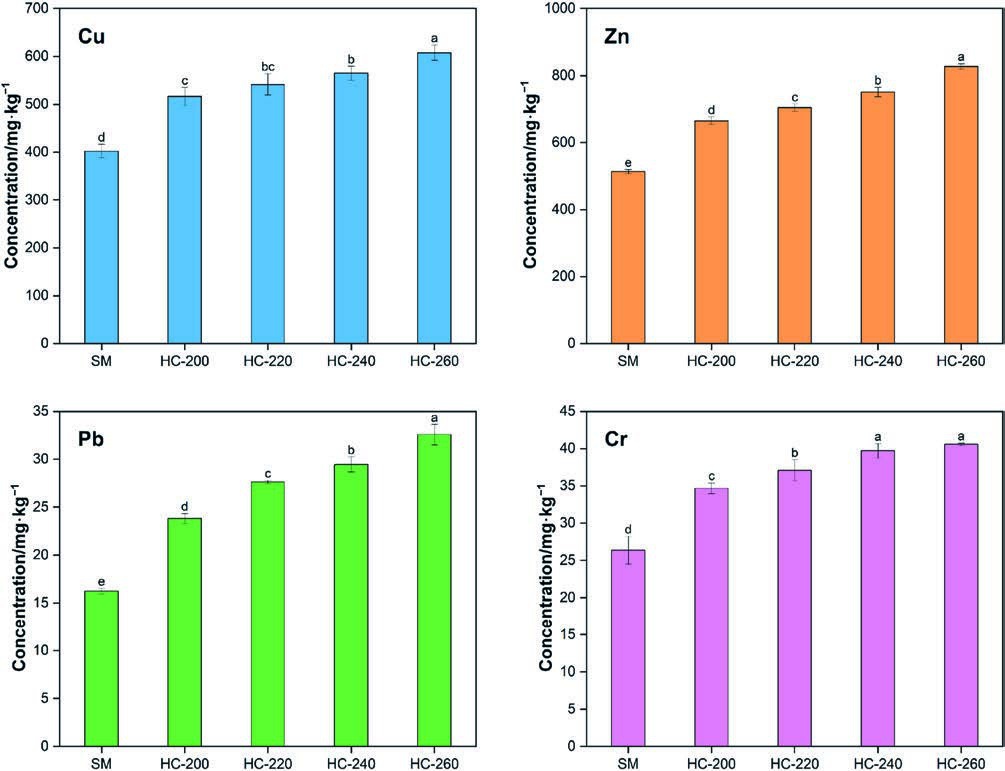
Hydrothermal carbonization (HTC) is a promising technology for the coversion of swine manure (SM) for hydrochars (HCs). Currently, information on the humifica cation of organic matter is limited during the HTC of SM, and its potential correlation with the passivation of heavy metals (HMs) remains unclear, which is crucial referece for the land application of SM-derived HCs. This study systematically inves-tigated the humifica cation of organic matter and the passivation of HMs during the HTC of SM and then explored their intrinsic connection. The HTC treatment can enhance the humifica cation of organic matter, and the HCs obtained at 240 ◦C had the best humifica cation effect, with the highest content of humus (83.84 mg·g−1 versus 41.97 mg·g−1 in SM) and humifica cation rate (28.89% versus 15.73% in SM). Dissolved organic carbons (DOC) and readily oxidized organic carbons (ROC) were more easily degraded in the HTC of SM, and part was further converted into inactive organic carbon. HMs (Cu, Zn, Pb, and Cr) were enriched in HCs, but all HMs were largely passivated. The ecological risk of multi-HMs was reduced from moderate risk in SM to low risk in HCs. The percentages of HMs in exchangeable/acid-soluble forms were positively correlated with the contents of DOC and negatively correlated with the ratio of humic acids to fulvic acids (P < 0.05). It was inferred that the humifica cation of organic matter promoted the passivation of HMs in the HTC of SM. This study provided deeper insights into the humifica cation of organic matter and it's intrinsic correlation with HMs-passivation during the HTC of SM.