Key Takeaways & Executive Findings
- •• HTC enhances humification of organic matter in swine manure, with optimal effect at 240°C, increasing humus content from 41.97 to 83.84 mg·g−1 and humification rate from 15.73% to 28.89%. • Heavy metals (Cu, Zn, Pb, Cr) are enriched in hydrochars but significantly passivated, reducing ecological risk from moderate to low. • The passivation of heavy metals is positively correlated with dissolved organic carbon content and negatively correlated with the humic acid to fulvic acid ratio, indicating that humification promotes metal passivation. • HTC is a promising technology for safe land application of swine manure-derived hydrochars, mitigating environmental risks from heavy metals.
Abstract
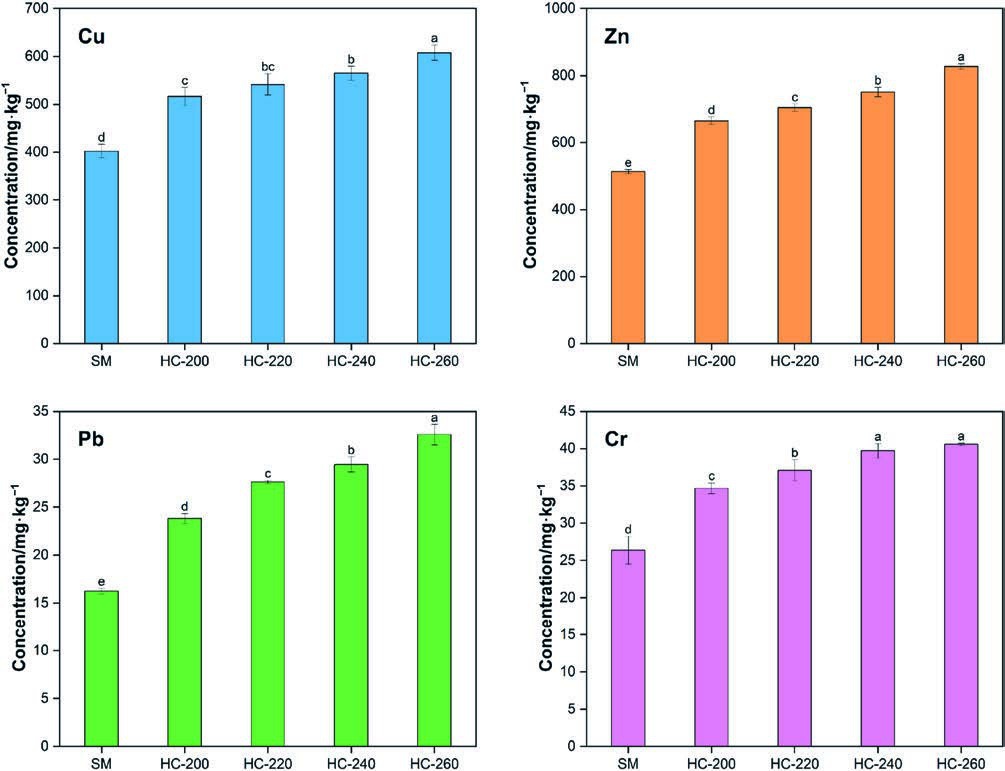
Hydrothermal carbonization (HTC) is a promising technology for the coversion of swine manure (SM) for hydrochars (HCs). Currently, information on the humifica cation of organic matter is limited during the HTC of SM, and its potential correlation with the passivation of heavy metals (HMs) remains unclear, which is crucial referece for the land application of SM-derived HCs. This study systematically inves-tigated the humifica cation of organic matter and the passivation of HMs during the HTC of SM and then explored their intrinsic connection. The HTC treatment can enhance the humifica cation of organic matter, and the HCs obtained at 240 ◦C had the best humifica cation effect, with the highest content of humus (83.84 mg·g−1 versus 41.97 mg·g−1 in SM) and humifica cation rate (28.89% versus 15.73% in SM). Dissolved organic carbons (DOC) and readily oxidized organic carbons (ROC) were more easily degraded in the HTC of SM, and part was further converted into inactive organic carbon. HMs (Cu, Zn, Pb, and Cr) were enriched in HCs, but all HMs were largely passivated. The ecological risk of multi-HMs was reduced from moderate risk in SM to low risk in HCs. The percentages of HMs in exchangeable/acid-soluble forms were positively correlated with the contents of DOC and negatively correlated with the ratio of humic acids to fulvic acids (P < 0.05). It was inferred that the humifica cation of organic matter promoted the passivation of HMs in the HTC of SM. This study provided deeper insights into the humifica cation of organic matter and it's intrinsic correlation with HMs-passivation during the HTC of SM.
1. Introduction
With the rapid development of intensive livestock farming, a substantial amount of livestock manure has been generated in the world. For example, in 2023, the production of swine manure (SM) in China reached 80 million tons [1]. SM has long been used as an organic fertilizer due to its rich content of organic matter and nutrients, making it highly suitable for use as farmland fertilizer [2]. However, excessive and improper application of SM has led to serious environmental problems, such as soil, groundwater, and surface water pollution [3]. A recent study revealed that the content of total phosphorus in the largest freshwater lake in China (Poyang Lake) increased by 3.15 times over the past 70 years. One of the important pollution sources is the livestock manure [4]. At present, most industrial breeding systems lack suffici cient land to accommodate the livestock manure produced, resulting in signif-icant loss of nutrients and eutrophication of water bodies. Moreover, intensive animal feeding systems extensively utilize feed additives with heavy metals (HMs), resulting in the incorporation of approximately 1.0−1.5 million tons of HMs-containing additives annually [5]. Due to their non-biodegradability and poor metabolic characteristics, the HMs are mostly excreted in animal manure [6]. Consequently, proper disposal and management of SM have become an urgent and challenging issue.
For centuries, animal manure has been directly utilized as organic fertilizer for agricultural applications. The presence of hazardous substances (such as HMs and antibiotics) and the loss of nutrients have become two major environmental risks during the land application of livestock manure [7]. More recently, biological treatments, including aerobic composting and anaerobic digestion, are predominant manure disposal technologies [8]. However, the poor passivation of HMs hindered the development of biological treatment technologies [8—10]. Therefore, the development of new technologies that can mitigate the potential environment risk of HMs in livestock manure is urgently needed.
Recently, there has been renewed interest in the thermal treatments for reducing the HMs' mobility in livestock manure. Among these, hydrothermal carbonization (HTC) has attracted much attention because it can directly transform high moisture waste into value-added products (such as hydrochars (HCs)) [11]. The HCs derived from livestock manure have been proven to be suitable soil conditioners, which could improve soil quality and crop yield [12]. Without dewatering before treatment, HTC offers a sustainable and efficient approach for manure management.
Loading authentic research manuscript (Pages 1–5)...
Jiangbo Xiong, Chunfei Zhou, Qingwen Zhang, Huiwen Gu, Yujuan Huang, Pin Zhang, Min Jiang, Faying Lai, Xiaoping Liu, Huajun Huang (2025). Humification of organic matter and passivation of heavy metals during the hydrothermal carbonization of swine manure. Chinese Journal of Chemical Engineering. https://doi.org/10.1016/j_cjche_1496
Research & Educational Purpose Only:The translations, structured abstracts, analytical annotations, and data reports provided by SinoTechIntel are intended exclusively for academic research, internal corporate R&D, and educational benchmarking. They do not constitute formal engineering, chemical safety, legal, or professional advice.
Copyright & Intellectual Property Notice: Original copyright of the underlying source articles and experimental data remains with the respective authors, institutions, and original publishing journals. SinoTechIntel claims intellectual property only over its proprietary translations, analytical syntheses, and AEO structured enhancements in accordance with international fair use and academic citation principles.
Frequently Asked Questions
What is hydrothermal carbonization (HTC) and how does it apply to swine manure?
HTC is a thermal treatment that converts high-moisture waste like swine manure into value-added hydrochars under elevated temperature and pressure. It enhances humification of organic matter and passivates heavy metals, making the hydrochars safer for land application.
How does HTC affect the humification of organic matter in swine manure?
HTC significantly enhances humification, with the best effect at 240°C, increasing humus content from 41.97 mg·g−1 in raw manure to 83.84 mg·g−1 in hydrochars, and the humification rate from 15.73% to 28.89%.
What happens to heavy metals during hydrothermal carbonization of swine manure?
Heavy metals such as Cu, Zn, Pb, and Cr are enriched in the hydrochars but are largely passivated, meaning their mobility and bioavailability are reduced. The ecological risk of multiple heavy metals decreases from moderate to low risk.
What is the correlation between humification and heavy metal passivation in HTC?
The study found that the percentages of heavy metals in exchangeable/acid-soluble forms are positively correlated with dissolved organic carbon content and negatively correlated with the humic acid to fulvic acid ratio, indicating that humification promotes the passivation of heavy metals.
Why is this research important for sustainable agriculture?
This research provides a sustainable solution for managing swine manure by converting it into safe soil conditioners, reducing environmental pollution from heavy metals and nutrients, and contributing to circular economy in agriculture.
Related Technical Papers & Translations

Design and optimization of a high-efficiency distillation process for cellulosic fuel ethanol integrated with thermal coupling and molecular sieve adsorption
To address the challenges of high energy consumption and prominent costs in the traditional three-columns distillation process for cellulosic fuel ethanol, a distillation—molecular sieve coupling separation process is proposed. This process integrates a three-column (crude distillation column, first distillation column, second distillation column) system with a 3A molecular sieve adsorption deep dehydration unit. A thermal coupling network is constructed via differential pressure design (steam from medium/high-pressure columns as mutual heat sources, reboiler liquid waste heat for feed preheating), and molecular sieve adsorption conditions are optimized. The study first performs a thermodynamic consistency test on the ethanol—water system, determines optimal non-random two-liquid (NRTL) model binary interaction parameters via experimental data regression for Aspen Plus simulation. Aiming at minimum total annual cost (TAC), Aspen Plus is used to optimize process parameters (theoretical tray number, feed location, reflux ratio, side-draw position, etc.). Economic analysis shows this process reduces CO2 emission costs by 27.56%, TAC by 15.58% (to 5.123 × 10⁶ USD·a-1), and increases ethanol purity to >99.6%, providing an effective solution for green, efficient separation.

A cohesion loss model for determining residual strength of deep bedded sandstone
Rock residual strength, as an important input parameter, plays an indispensable role in proposing the reasonable and scientific scheme about stope design, underground tunnel excavation and stability evaluation of deep chambers. Therefore, previous residual strength models of rocks established were reviewed. And corresponding related problems were stated. Subsequently, starting from the effects of bedding and whole life-cycle evolution process, series of triaxial mechanical tests of deep bedded s

Federated model with contrastive learning and adaptive control variates for human activity recognition
Recent attention to privacy issues demands a communication-safe method for training human activity recognition (HAR) models on client activity data. Federated learning (FL) has become a compelling technique to facilitate model training between the server and clients while preserving data privacy. However, classical FL methods often assume independent and identically distributed (IID) data among clients. This assumption does not hold true in practical scenarios. Human activity in real-world scena