Key Takeaways & Executive Findings
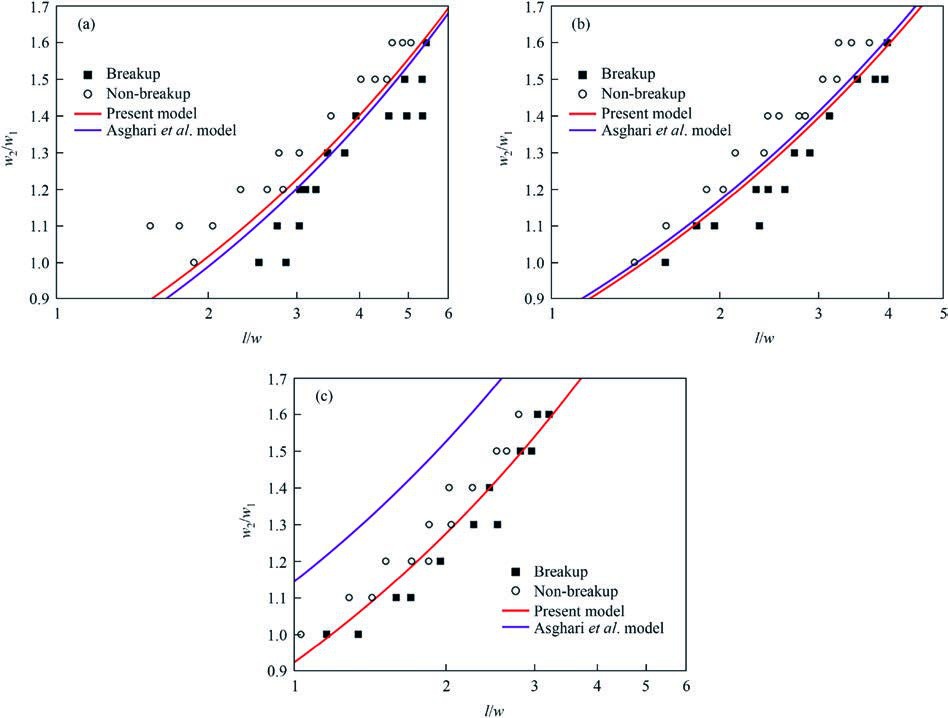
- •• A theoretical model based on force balance accurately predicts the critical Capillary number for droplet breakup in T-junction microchannels. • Increasing sidearm length ratio inhibits droplet breakup and induces asymmetric breakup regimes. • Increasing outlet-to-inlet width ratio reduces the likelihood of droplet breakup. • The model provides a predictive framework for controlling droplet dynamics in lab-on-a-chip applications.
Abstract
Understanding and predicting droplet breakup is essential in droplet-based microfluidic systems, as it enables precise control over droplet manipulation for various applications. In this study, droplet breakup behavior in a T-junction microchannel is investigated under the influence of microchannel geometry using three-dimensional numerical simulations. A theoretical model is developed based on the balance between surface tension and viscous drag forces acting on the droplet, incorporating the effects of geometric parameters on droplet length. This model predicts the critical Capillary number required for breakup to occur. The theoretical predictions are validated using both previous research data and the present numerical simulations. The results show that the model accurately predicts the transition between breakup and non-breakup regimes. Specifically, an increase in sidearm length ratio inhibits droplet breakup and leads to an asymmetric breakup regime. Furthermore, increasing the outlet-to-inlet width ratio also reduces the likelihood of droplet breakup. These findings provide a predictive framework for understanding and controlling droplet dynamics in microfluidic T-junctions, with potential applications in lab-on-a-chip technologies.
1. Introduction
In recent decades, droplet-based microfluidics has gained a lot of attention because of its numerous uses in the food, chemical, medicinal, and environmental sectors [1,2]. Rapid analysis times, accurate control over small droplet volumes, and dependable manipulation of individual droplets are only a few of the benefits that have driven its broad usage [3]. For droplet formation [4], mixing [5], merging [6], and breakdown [7], T-junction microchannels are essential parts of droplet-based microfluidic systems.
The study of droplet breakup in T-junctions is particularly important for applications requiring the mass production of microdroplets through sequential T-junctions [8]. This behavior was first investigated by Link et al. [8], followed by Jullien et al. [9], who identified three distinct breakup regimes: non-breakup (NB), breakup with tunnels (TB), and breakup with permanent obstruction (POB). In the TB regime, the droplet splits while leaving a gap or 'tunnel' between itself and the microchannel walls, allowing continuous flow of the outer fluid. This tunnel may exist either from the start or form gradually before breakup. In contrast, the POB regime involves the droplet fully blocking the channel branches throughout the breakup process, with no tunnel formation. Breakup in this case occurs through necking in the central region. Further exploration of these behaviors has been conducted, such as Chen and Deng [10] study on droplet non-breakup through hydrodynamics and shear stress, and Sun et al. [11] in-depth examination of the tunnel breakup regime. The permanent obstruction breakup mode has been studied by Leshansky et al. [12] and Hoang et al. [13].
Loading authentic research manuscript (Pages 1–5)...
Thanh Tung Nguyen, Van Thanh Hoang (2025). Effect of geometry ratios on droplet breakup in a T-junction microchannel: A theoretical predictive model. Chinese Journal of Chemical Engineering. https://doi.org/10.1016/j_cjche_1496
Research & Educational Purpose Only:The translations, structured abstracts, analytical annotations, and data reports provided by SinoTechIntel are intended exclusively for academic research, internal corporate R&D, and educational benchmarking. They do not constitute formal engineering, chemical safety, legal, or professional advice.
Copyright & Intellectual Property Notice: Original copyright of the underlying source articles and experimental data remains with the respective authors, institutions, and original publishing journals. SinoTechIntel claims intellectual property only over its proprietary translations, analytical syntheses, and AEO structured enhancements in accordance with international fair use and academic citation principles.
Frequently Asked Questions
What is the main contribution of this paper?
The paper develops a theoretical predictive model for droplet breakup in T-junction microchannels, incorporating geometric parameters, and validates it with numerical simulations and previous data.
How do geometry ratios affect droplet breakup?
Increasing sidearm length ratio inhibits droplet breakup and leads to asymmetric breakup, while increasing outlet-to-inlet width ratio also reduces the likelihood of breakup.
What is the critical Capillary number?
The critical Capillary number is the threshold value above which droplet breakup occurs, predicted by the theoretical model based on force balance.
What are the potential applications of this research?
The findings provide a predictive framework for controlling droplet dynamics in microfluidic T-junctions, with applications in lab-on-a-chip technologies for precise droplet manipulation.
What methods were used in this study?
The study used three-dimensional numerical simulations and developed a theoretical model based on the balance between surface tension and viscous drag forces.
Related Technical Papers & Translations

Design and optimization of a high-efficiency distillation process for cellulosic fuel ethanol integrated with thermal coupling and molecular sieve adsorption
To address the challenges of high energy consumption and prominent costs in the traditional three-columns distillation process for cellulosic fuel ethanol, a distillation—molecular sieve coupling separation process is proposed. This process integrates a three-column (crude distillation column, first distillation column, second distillation column) system with a 3A molecular sieve adsorption deep dehydration unit. A thermal coupling network is constructed via differential pressure design (steam from medium/high-pressure columns as mutual heat sources, reboiler liquid waste heat for feed preheating), and molecular sieve adsorption conditions are optimized. The study first performs a thermodynamic consistency test on the ethanol—water system, determines optimal non-random two-liquid (NRTL) model binary interaction parameters via experimental data regression for Aspen Plus simulation. Aiming at minimum total annual cost (TAC), Aspen Plus is used to optimize process parameters (theoretical tray number, feed location, reflux ratio, side-draw position, etc.). Economic analysis shows this process reduces CO2 emission costs by 27.56%, TAC by 15.58% (to 5.123 × 10⁶ USD·a-1), and increases ethanol purity to >99.6%, providing an effective solution for green, efficient separation.

A cohesion loss model for determining residual strength of deep bedded sandstone
Rock residual strength, as an important input parameter, plays an indispensable role in proposing the reasonable and scientific scheme about stope design, underground tunnel excavation and stability evaluation of deep chambers. Therefore, previous residual strength models of rocks established were reviewed. And corresponding related problems were stated. Subsequently, starting from the effects of bedding and whole life-cycle evolution process, series of triaxial mechanical tests of deep bedded s

Federated model with contrastive learning and adaptive control variates for human activity recognition
Recent attention to privacy issues demands a communication-safe method for training human activity recognition (HAR) models on client activity data. Federated learning (FL) has become a compelling technique to facilitate model training between the server and clients while preserving data privacy. However, classical FL methods often assume independent and identically distributed (IID) data among clients. This assumption does not hold true in practical scenarios. Human activity in real-world scena