SinoTechIntel Academic Portal
🏛️ Indexed Academic Journal

China Foundry

Access authentic peer-reviewed engineering methodologies, experimental datasets, and scientific literature published in this journal on SinoTechIntel.

Total Research Papers: 75
Access: 100% Free Open Access
Browse by Publication Year & VolumeReset All Filters ✕

Published Research PapersFiltered: Year 2026 • Vol. 23 • No. 2

Showing 2 of 75 peer-reviewed papers with full Graphical Abstracts.

Original ResearchVol. 23, No. 2 • pp. 245-253DOI: 10.1007/s41230-026-5016-6Jan 15, 2026

Titanium alloy with synergistic enhancement of strength and toughness based on molybdenum equivalent design: Microstructure evolution and strengthening-toughening mechanism

Authors: Yi-li Li, Hong-ze Fang, Rui-run Chen, Jia-qi Hao, Bao-hui Zhu, Jing-jie Guo

The traditional "trial and error" microstructural control method, with high cost and low efficiency, has become a key issue restricting the development of ultra-high strength and toughness titanium alloys. This study adopts the molybdenum equivalent (Mo[eq]) method to rapidly design Ti-xMo-4Al-4Zr-3Nb-2Cr-1Fe alloys (x=5-9). The as-cast alloys with different Mo[eq] exhibit a single peak of the β phase in XRD. The β grains of 5Mo alloy (the lowest Mo[eq]) exhibit elongated columnar grain characteristics. As the Mo[eq] increases, the β grains transition towards a more equiaxed form, resulting in a decrease in aspect ratio and a reduction in grain size. As the Mo[eq] increases, the α phase content gradually decreases and the α phase is almost unobservable in 9Mo alloy (the highest Mo[eq]). The α phase in 5Mo alloy exhibits short rod-shaped shapes with an average length of about 2.4 μm, while the α phase in 6Mo alloy shows an equiaxed and short rod shapes with the smallest size. The strength, plasticity, and toughness are the lowest in 5Mo alloy, with values of 867 MPa, 7.3%, and 56 MPa·m1/2, respectively. However, it reaches its maximum in 6Mo alloy, where the strength, plasticity, and toughness increase to 984 MPa, 12.8%, and 74 MPa·m1/2, respectively. The mechanical properties of Ti-xMo-4Al-4Zr-3Nb-2Cr-1Fe alloys are affected mainly by solid-solution strengthening of Mo element, refinement of β grain, and changes in α/β phase content. This study lays a certain theoretical foundation for the theoretical research and composition development of new ultra-high strength and toughness titanium alloys.
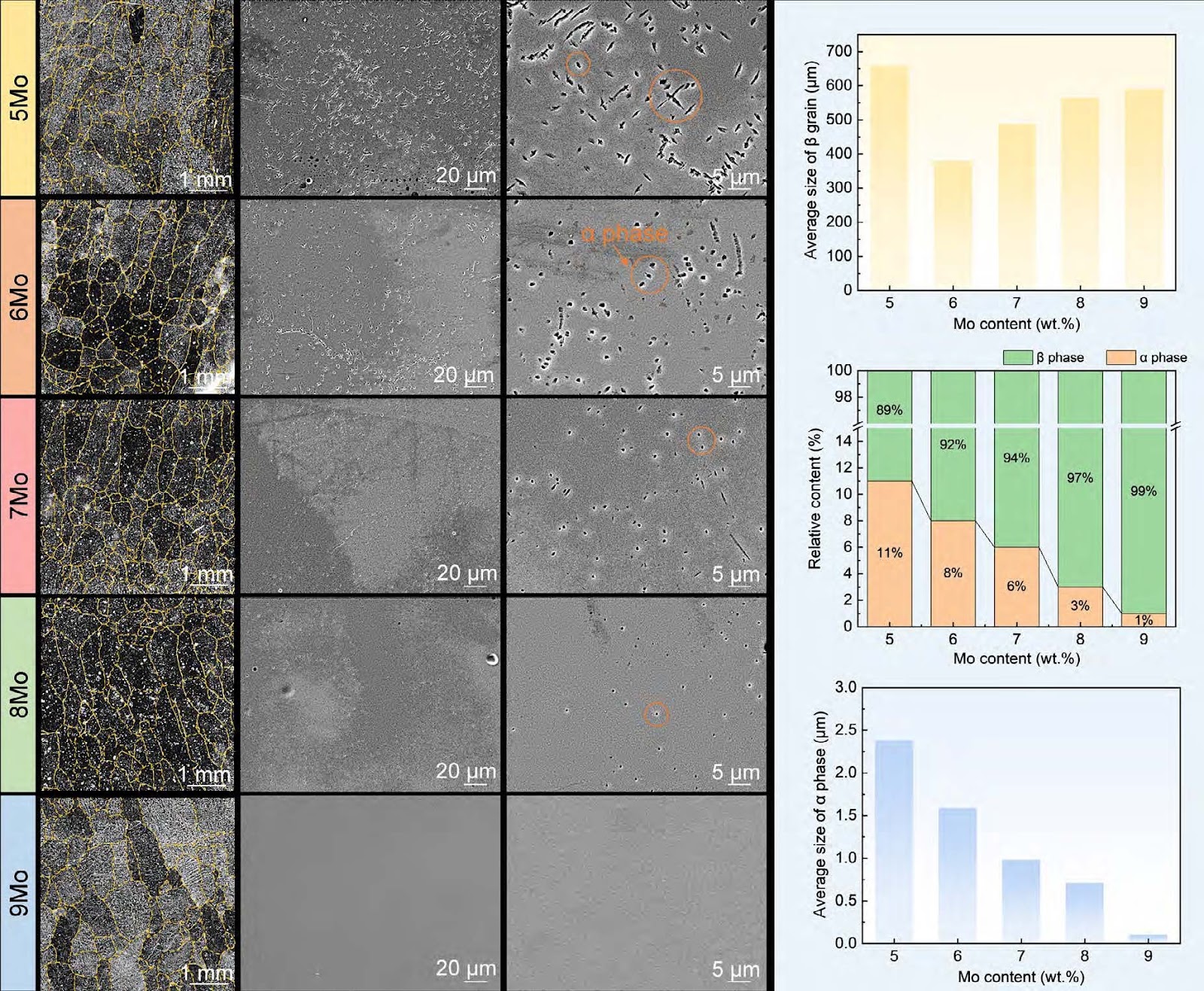
Titanium alloy with synergistic enhancement of strength and toughness based on molybdenum equivalent design: Microstructure evolution and strengthening-toughening mechanism
Graphical Abstract
Original ResearchVol. 23, No. 2 • pp. 274-282DOI: 10.1007/s41230-026-5097-2Jan 15, 2026

Creep behavior and fracture mechanism of high Al/Nb-containing TiAl alloy

Authors: Yan Wang, Qi Wang, Rui-run Chen, Yan-qing Su, Heng-zhi Fu

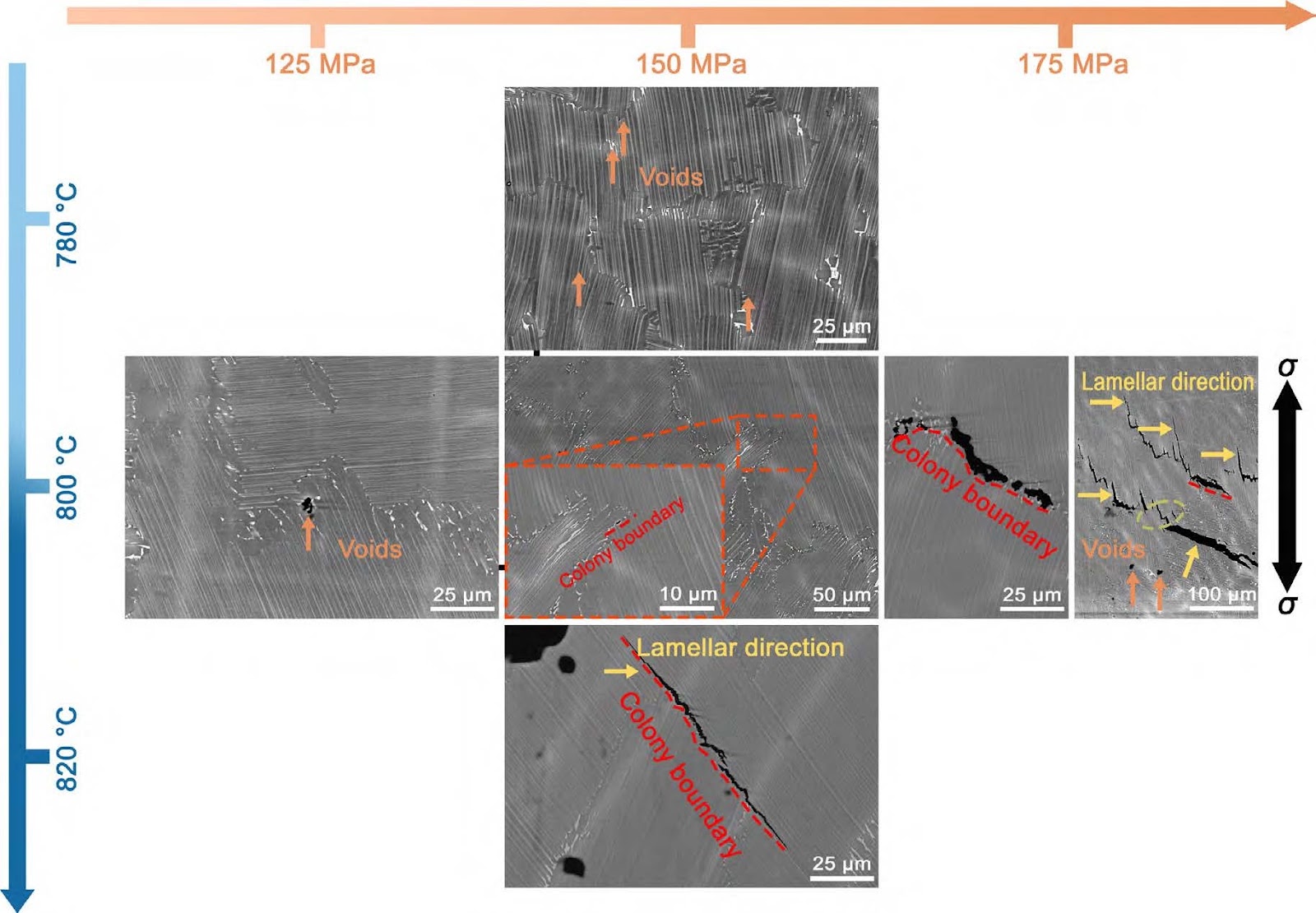
High Al content inhibits the formation of B2 phase, which improves creep resistance in high Al/Nb-containing TiAl alloys. In this work, the microstructure evolution and creep behavior of TiAl based alloy Ti-46Al-8Nb (at.%) with a high Al/Nb content, produced by the vacuum consumable electrode melting technology and the electromagnetic cold crucible melting technology, were studied. The microstructure of the Ti-46Al-8Nb alloy is composed of α2/γ phases arranged in layers with different orientations, which possesses smooth grain boundaries due to small-blocky segregation and irregular serrated grain boundaries caused by large-blocky segregation. Under conditions of 780-820 °C and 125-175 MPa for 200 h, it exhibits typical power-law creep characteristics. The apparent activation energy of creep (Q) and apparent stress exponent (n) of the Ti-46Al-8Nb alloy are Q=274 kJ·mol-1 and n=1.97, respectively. The creep deformation mechanism is grain boundary sliding. Cracks easily form at the smooth boundary. The irregular serrated boundaries with small specific surface area hinder the dislocation movement, thereby improving the boundary creep resistance. When the stress concentration reaches a certain degree, the cracks will initiate between the lamellar structures within the grain. The crack usually propagates along the boundary perpendicular to or at an angle of 45° with the stress axis until creep failure occurs.

Creep behavior and fracture mechanism of high Al/Nb-containing TiAl alloy
Graphical Abstract