Towards sustainable lunar habitats with ISRU in Chang’E mission: Mechanical–energy evolution and damage mechanisms of LPBF-printed lunar regolith simulate
Authors: Sheng Li, Xinyi Li, Yuyue Gao, Bo Zhou, Yan Zhou, Jian Song, Cheng Zhou, Wei Yao, Lieyun Ding
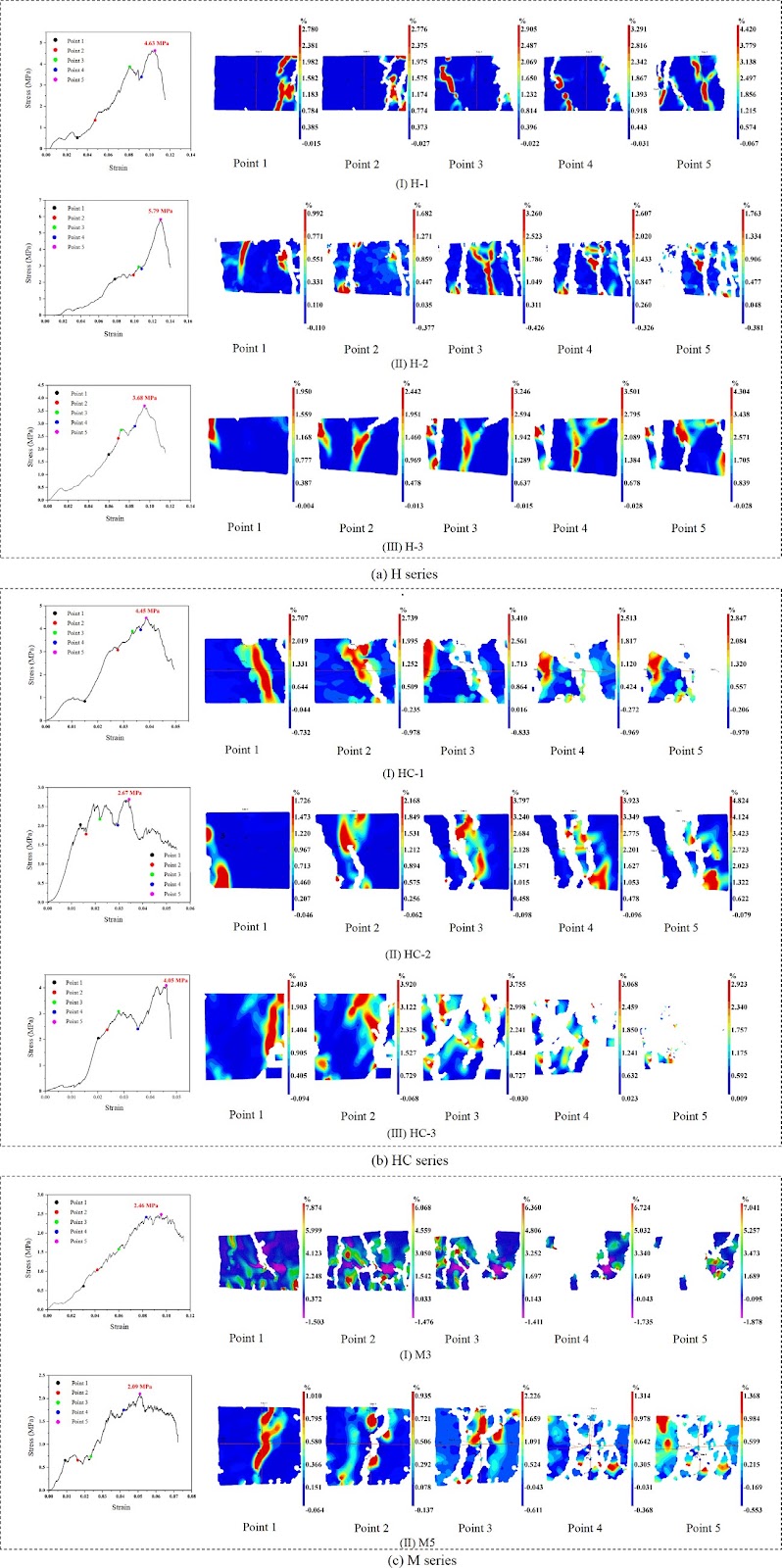
Targeting Chang’E-8 mission’ in-situ resource utilization (ISRU) for sustainable lunar habitats, laser powder bed fusion (LPBF) provides a viable pathway for in-situ additive manufacturing of lunar regolith. To elucidate mission relevant mechanical behavior and failure mechanisms of LPBF fabricated lunar regolith simulants, mare type and highland type simulant specimens were produced. Microstructural characterization, mechanical test coupled with three-dimensional digital image correlation (3D-DIC), and an energy-dissipation framework were employed for comprehensive analysis. The pristine highland specimens achieved 5.79 MPa and a peak strain of 0.13 (50 mm × 50 mm × 30 mm), significantly outperforming their mare counterparts. Wire-cutting to 20 mm × 20 mm × 20 mm lowered strength by ∼ 20% and peak strain to 0.04, indicating cutting-induced defects reduce ductility. All specimens displayed multi-peaked stress–strain curves. 3D-DIC revealed band-type strain localization in pristine highland samples, diffuse strain patterns in cut highland samples, and highly tortuous, network-type bands in mare samples; the anisotropy index was also quantified. Fragmented particles exhibited fractal dimensions ranging from 1.6 to 2.0 (size 1.25–9 mm). Energy evolution progressed through three distinct stages: elastic energy storage, progressive energy dissipation delaying crack propagation, and final unstable collapse. An energy-based damage model was established and validated. The data and methods developed support Chang’E-8 missions’ ISRU demonstrations and establish a transferable framework toward sustainable lunar habitats.