SinoTechIntel Academic Portal
πŸ›οΈ Indexed Academic JournalImpact Factor: 3.8 (Q1 - Elsevier)Original: δΈ­ε›½εŒ–ε­¦ε·₯程学ζŠ₯ (θ‹±ζ–‡η‰ˆ)

Chinese Journal of Chemical Engineering

Access authentic peer-reviewed engineering methodologies, experimental datasets, and scientific literature published in this journal on SinoTechIntel.

Total Research Papers: 98
Access: 100% Free Open Access
Browse by Publication Year & VolumeReset All Filters βœ•

Published Research PapersFiltered: Year 2023 β€’ Vol. 32 β€’ Issue 7

Showing 2 of 98 peer-reviewed papers with full Graphical Abstracts.

Original ResearchVol. 32, Issue 7 β€’ pp. 346-358DOI: 10.1016/j_cjche_144875280β€’ Jul 15, 2023

Investigation of oxy-fuel combustion for methane and acid gas in a diffusion flame

Authors: Songling Guo, Xun Tao, Fan Zhou, Mengyan Yu, Yufan Wu, Yunfei Gao, Lu Ding, Fuchen Wang

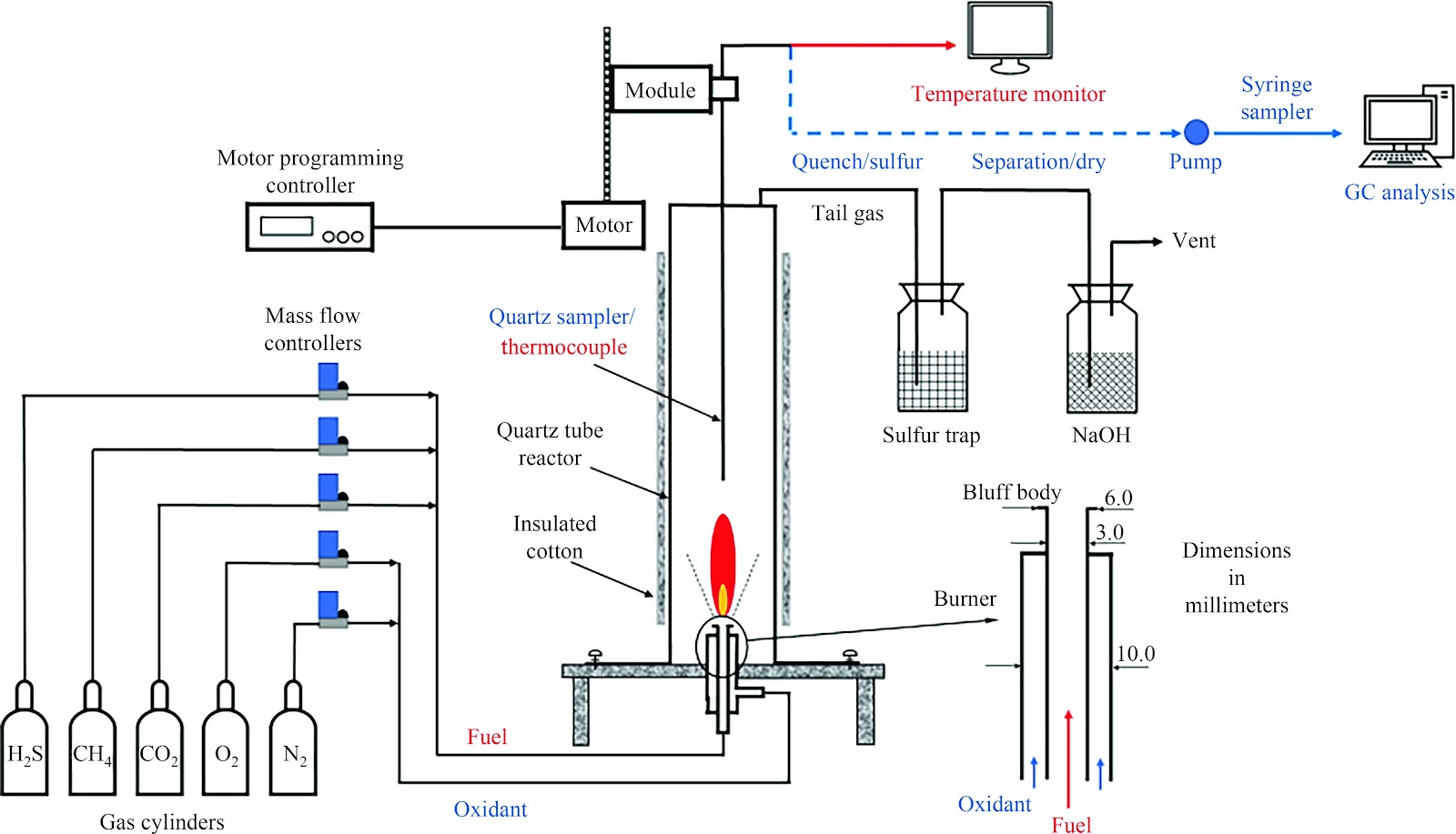
Co-combustion of methane (CH4) and acid gas (AG) is required to sustain the temperature in Claus reaction furnace. In this study, oxy-fuel combustion of methane and acid gas has been experimentally studied in a diffusion flame. Three equivalence ratios (ER = 1.0, 1.5, 2.0) and CH4-addition ratios (CH4/AG = 0.3, 0.5, 0.7) were examined and the flame was interpreted by analyzing the distributions of the temperature and species concentration along central axial. CH4-AG diffusion flame could be classified into three sections namely initial reaction, oxidation and complex reaction sections. Competitive oxidation of CH4 and H2S was noted in the first section wherein H2S was preferred and both were mainly proceeding decomposition and partial oxidation. SO2 was formed at oxidation section together with obvious presence of H2 and CO. However, H2 and CO were inclined to be sustained under fuel rich condition in the complex reaction section. Reducing ER and increasing CH4/AG contributed to higher temperature, H2S and CH4 oxidation and CO2 reactivity. Hence a growing trend for CH4 and AG to convert into H2, CO and SO2 could be witnessed. And this factor enhanced the generation of CS2 and COS in the flame inner core by interactions of CH4 and CO2 with sulfur species. COS was formed through the interactions of CO and CO2 with sulfur species. The CS2 production directly relied on reaction of CH4 with sulfur species. The concentration of COS was greater than CS2 since CS2 was probably inhibited due to the presence of H2. COS and CS2 could be consumed by further oxidation or other complex reactions.
Investigation of oxy-fuel combustion for methane and acid gas in a diffusion flame
Graphical Abstract
Original ResearchVol. 32, Issue 7 β€’ pp. 550-562DOI: 10.1016/j_cjche_144877639β€’ Jul 1, 2023

Active MoS2-based electrode for green ammonia synthesis

Authors: Xin Liu, Lei Yang, Tao Wei, Shanping Liu, Beibei Xiao

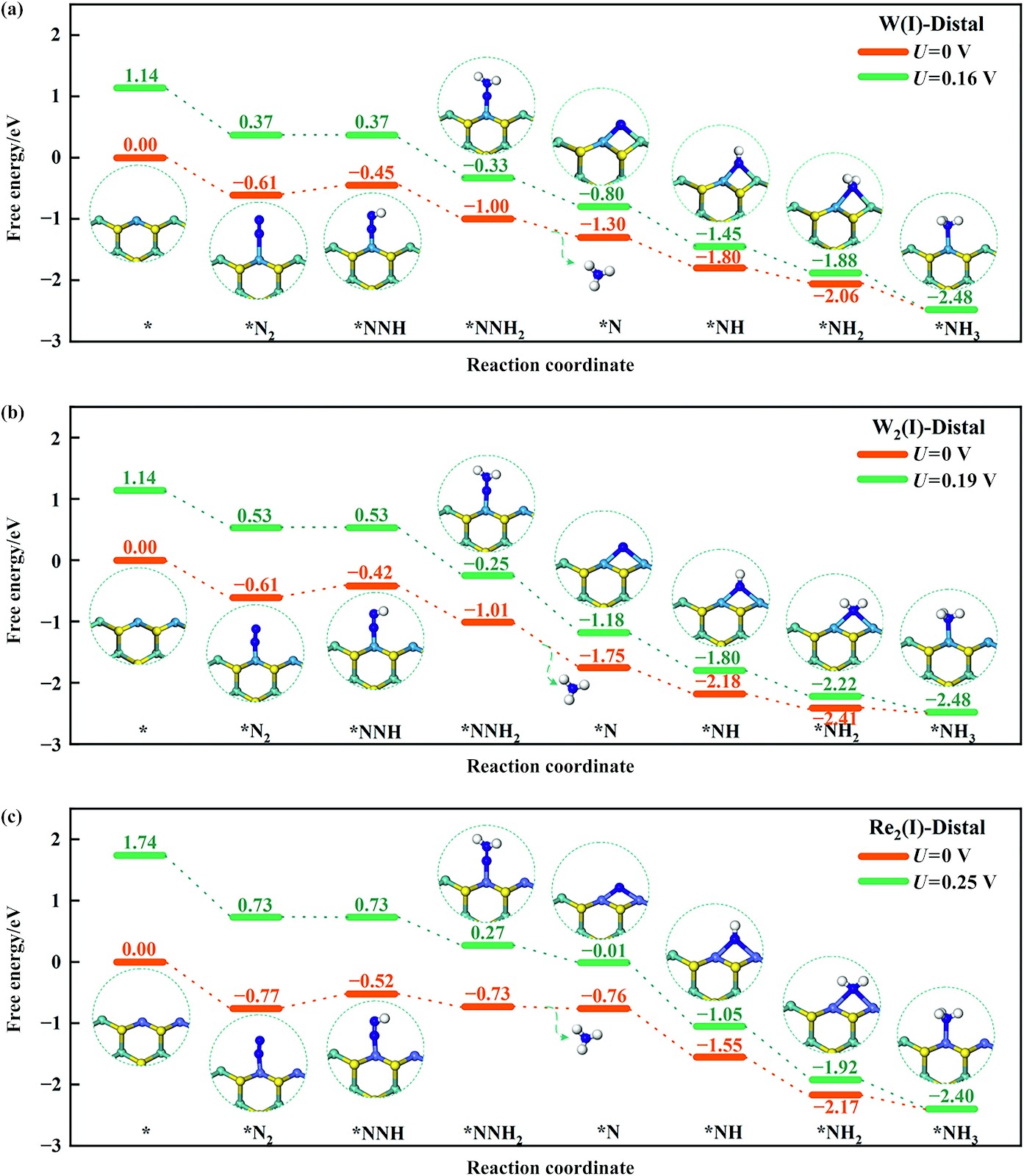
Nitrogen electro-reduction under mild conditions is one promising alternative approach of the energy-consuming Haber-Bosch process for the artificial ammonia synthesis. One critical aspect to unlocking this technology is to discover the catalysts with high selectivity and efficiency. In this work, the N2-to-NH3 conversion on the functional MoS2 is fully investigated by density functional theory calculations since the layered MoS2 provides the ideal platform for the elaborating copies of the nitrogenase found in nature, wherein the functionalization is achieved via basal-adsorption, basal-substitution or edge-substitution of transition metal elements. Our results reveal that the edge-functionalization is a feasible strategy for the activity promotion; however, the basal-adsorption and basal-substitution separately suffer from the electrochemical instability and the NRR inefficiency. Specifically, MoS2 functionalized via edge W-substitution exhibits an exceptional activity. The energetically favored reaction pathway is through the distal pathway and a limiting potential is less than 0.20 V. Overall, this work escalates the rational design of the high-effective catalysts for nitrogen fixation and provides the explanation why the predicated catalyst have a good performance, paving the guidance for the experiments.

Active MoS2-based electrode for green ammonia synthesis
Graphical Abstract