Key Takeaways & Executive Findings
- •• Edge-functionalization of MoS2 with transition metals, particularly W-substitution, significantly enhances nitrogen reduction reaction (NRR) activity, achieving a limiting potential below 0.20 V. • Basal-adsorption and basal-substitution strategies are less effective due to electrochemical instability and poor NRR efficiency, respectively. • Density functional theory (DFT) calculations reveal that the distal pathway is energetically favored for N2-to-NH3 conversion on the edge-functionalized MoS2. • The findings provide a rational design strategy for high-performance MoS2-based electrocatalysts for green ammonia synthesis, offering guidance for experimental validation.
Abstract
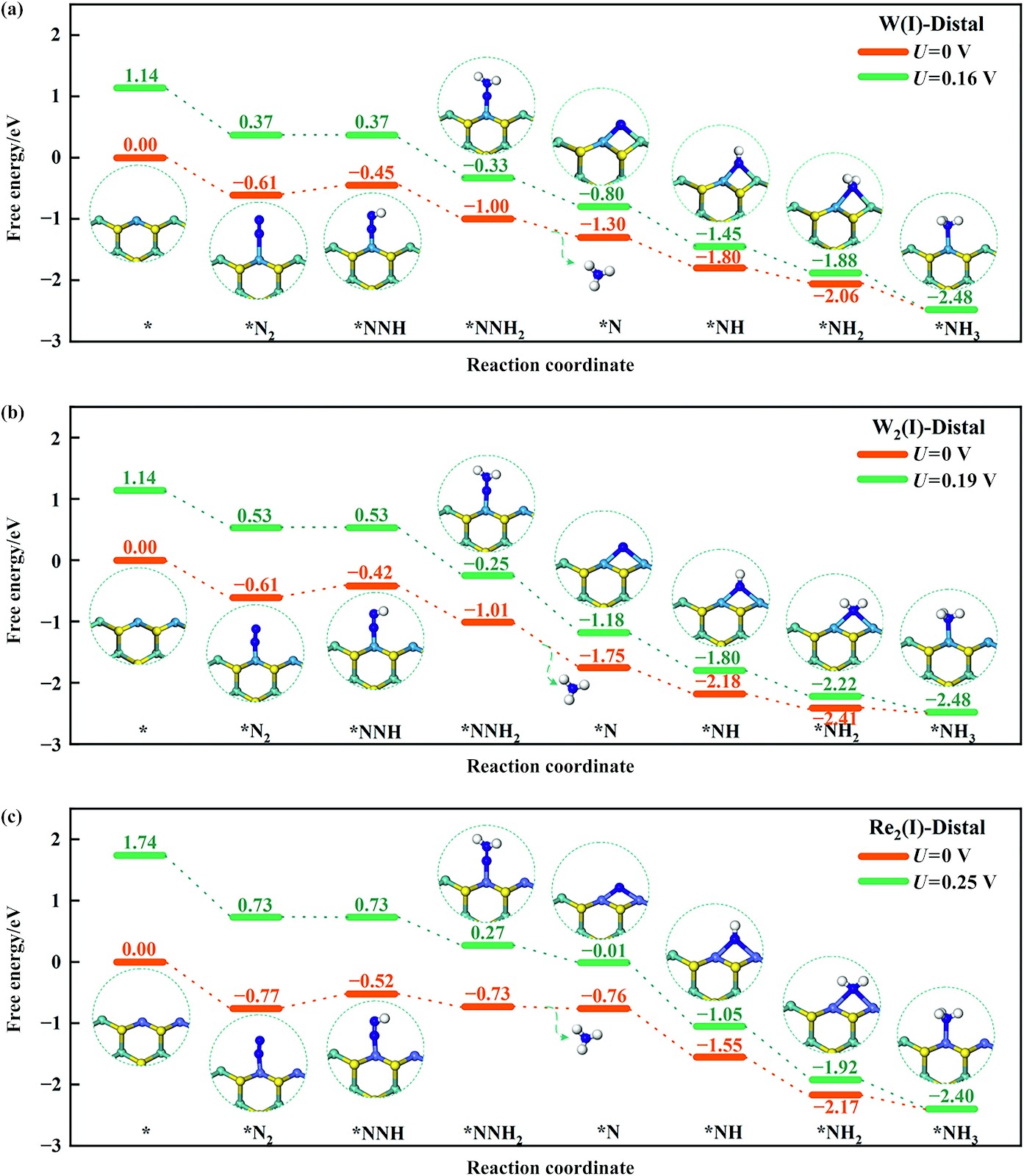
Nitrogen electro-reduction under mild conditions is one promising alternative approach of the energy-consuming Haber-Bosch process for the artificial ammonia synthesis. One critical aspect to unlocking this technology is to discover the catalysts with high selectivity and efficiency. In this work, the N2-to-NH3 conversion on the functional MoS2 is fully investigated by density functional theory calculations since the layered MoS2 provides the ideal platform for the elaborating copies of the nitrogenase found in nature, wherein the functionalization is achieved via basal-adsorption, basal-substitution or edge-substitution of transition metal elements. Our results reveal that the edge-functionalization is a feasible strategy for the activity promotion; however, the basal-adsorption and basal-substitution separately suffer from the electrochemical instability and the NRR inefficiency. Specifically, MoS2 functionalized via edge W-substitution exhibits an exceptional activity. The energetically favored reaction pathway is through the distal pathway and a limiting potential is less than 0.20 V. Overall, this work escalates the rational design of the high-effective catalysts for nitrogen fixation and provides the explanation why the predicated catalyst have a good performance, paving the guidance for the experiments.
1. Introduction
Artificial ammonia synthesis is of pressing concern for fertilizer production and hydrogen storage [1e4]. In industry, the N2-to-NH3 conversion is achieved through the Haber-Bosch reaction, which is highly energy consumption due to the inert N≡N triple bond (941 kJ mol−1) [5e9]. Such conventional method cannot satisfy the pursuit of energy sustainability. Thus, developing a green and clean technology to boost the nitrogen reduction reaction (NRR) is of paramount importance. In the direction, the ammonia synthesis via electrocatalysis under the mild conditions has triggered enormous investigations, wherein one critical hotpot is to discover the catalysts with high efficiency [10e15].
The marvelous nature provides an easy way to achieve the nitrogen fixation. For instance, Azotobacter endowed with nitrogenase enzymes enables the conversion from the atmospheric nitrogen to ammonia. As discovered, the nitrogenase is a two-component system composed of the FeMo protein and the electron-transfer Fe protein. The FeMo protein contains the FeMo cofactor which provides the active site for the binding of reactant and reduction reactions [16]. Inspired by the nature, counterfeiting well-designed nitrogenase structure with inorganic structures made of similar elements and analogous configurations is an innovative method to design the catalysts for nitrogen fixations. Amongst varied materials, molybdenum dichalcogenide MoS2 with layered configuration provides ideal platform for the elaborating copies of active site of natural nitrogenase [17e19]. Therefore, there are great enthusiasms focused on MoS2 in the application of NRR electrocatalysis.
Loading authentic research manuscript (Pages 1–5)...
Xin Liu, Lei Yang, Tao Wei, Shanping Liu, Beibei Xiao (2023). Active MoS2-based electrode for green ammonia synthesis. Chinese Journal of Chemical Engineering. https://doi.org/10.1016/j_cjche_144877639
Research & Educational Purpose Only:The translations, structured abstracts, analytical annotations, and data reports provided by SinoTechIntel are intended exclusively for academic research, internal corporate R&D, and educational benchmarking. They do not constitute formal engineering, chemical safety, legal, or professional advice.
Copyright & Intellectual Property Notice: Original copyright of the underlying source articles and experimental data remains with the respective authors, institutions, and original publishing journals. SinoTechIntel claims intellectual property only over its proprietary translations, analytical syntheses, and AEO structured enhancements in accordance with international fair use and academic citation principles.
Frequently Asked Questions
What is the main objective of this study?
The main objective is to systematically investigate the N2-to-NH3 conversion on functionalized MoS2 using density functional theory calculations, aiming to discover high-performance catalysts for green ammonia synthesis.
Which functionalization strategy shows the best performance for NRR on MoS2?
Edge-functionalization, specifically edge W-substitution, exhibits exceptional activity with a limiting potential of less than 0.20 V, outperforming basal-adsorption and basal-substitution strategies.
What is the significance of the limiting potential in this context?
The limiting potential is a key descriptor for electrocatalytic activity; a lower value indicates higher efficiency and lower energy input required for the nitrogen reduction reaction.
How does this research contribute to sustainable ammonia production?
By identifying a promising MoS2-based electrocatalyst, this research provides a pathway for green ammonia synthesis under mild conditions, offering an alternative to the energy-intensive Haber-Bosch process.
What computational methods were employed in this study?
The study employed density functional theory (DFT) calculations to evaluate the thermodynamic and kinetic aspects of the nitrogen reduction reaction on functionalized MoS2 models.
Related Technical Papers & Translations

Design and optimization of a high-efficiency distillation process for cellulosic fuel ethanol integrated with thermal coupling and molecular sieve adsorption
To address the challenges of high energy consumption and prominent costs in the traditional three-columns distillation process for cellulosic fuel ethanol, a distillation—molecular sieve coupling separation process is proposed. This process integrates a three-column (crude distillation column, first distillation column, second distillation column) system with a 3A molecular sieve adsorption deep dehydration unit. A thermal coupling network is constructed via differential pressure design (steam from medium/high-pressure columns as mutual heat sources, reboiler liquid waste heat for feed preheating), and molecular sieve adsorption conditions are optimized. The study first performs a thermodynamic consistency test on the ethanol—water system, determines optimal non-random two-liquid (NRTL) model binary interaction parameters via experimental data regression for Aspen Plus simulation. Aiming at minimum total annual cost (TAC), Aspen Plus is used to optimize process parameters (theoretical tray number, feed location, reflux ratio, side-draw position, etc.). Economic analysis shows this process reduces CO2 emission costs by 27.56%, TAC by 15.58% (to 5.123 × 10⁶ USD·a-1), and increases ethanol purity to >99.6%, providing an effective solution for green, efficient separation.

A cohesion loss model for determining residual strength of deep bedded sandstone
Rock residual strength, as an important input parameter, plays an indispensable role in proposing the reasonable and scientific scheme about stope design, underground tunnel excavation and stability evaluation of deep chambers. Therefore, previous residual strength models of rocks established were reviewed. And corresponding related problems were stated. Subsequently, starting from the effects of bedding and whole life-cycle evolution process, series of triaxial mechanical tests of deep bedded s

Federated model with contrastive learning and adaptive control variates for human activity recognition
Recent attention to privacy issues demands a communication-safe method for training human activity recognition (HAR) models on client activity data. Federated learning (FL) has become a compelling technique to facilitate model training between the server and clients while preserving data privacy. However, classical FL methods often assume independent and identically distributed (IID) data among clients. This assumption does not hold true in practical scenarios. Human activity in real-world scena