Key Takeaways & Executive Findings
- •• Proposed a new paradigm for nanoantenna design using coupled-mode theory, enabling precise control of light–matter interactions. • Designed an OC-Hμ resonator with ultra-sensitive (7.25% nm−1) and ultra-broadband (3–10 μm) sensing performance, immune to asymmetric Fano lineshapes. • Demonstrated machine learning-assisted mixture classification, concentration prediction, and spectral reconstruction with up to 100% accuracy. • Showcased potential for SARS-CoV-2 detection, advancing SEIRA technology for biomolecule recognition and trace detection.
Abstract
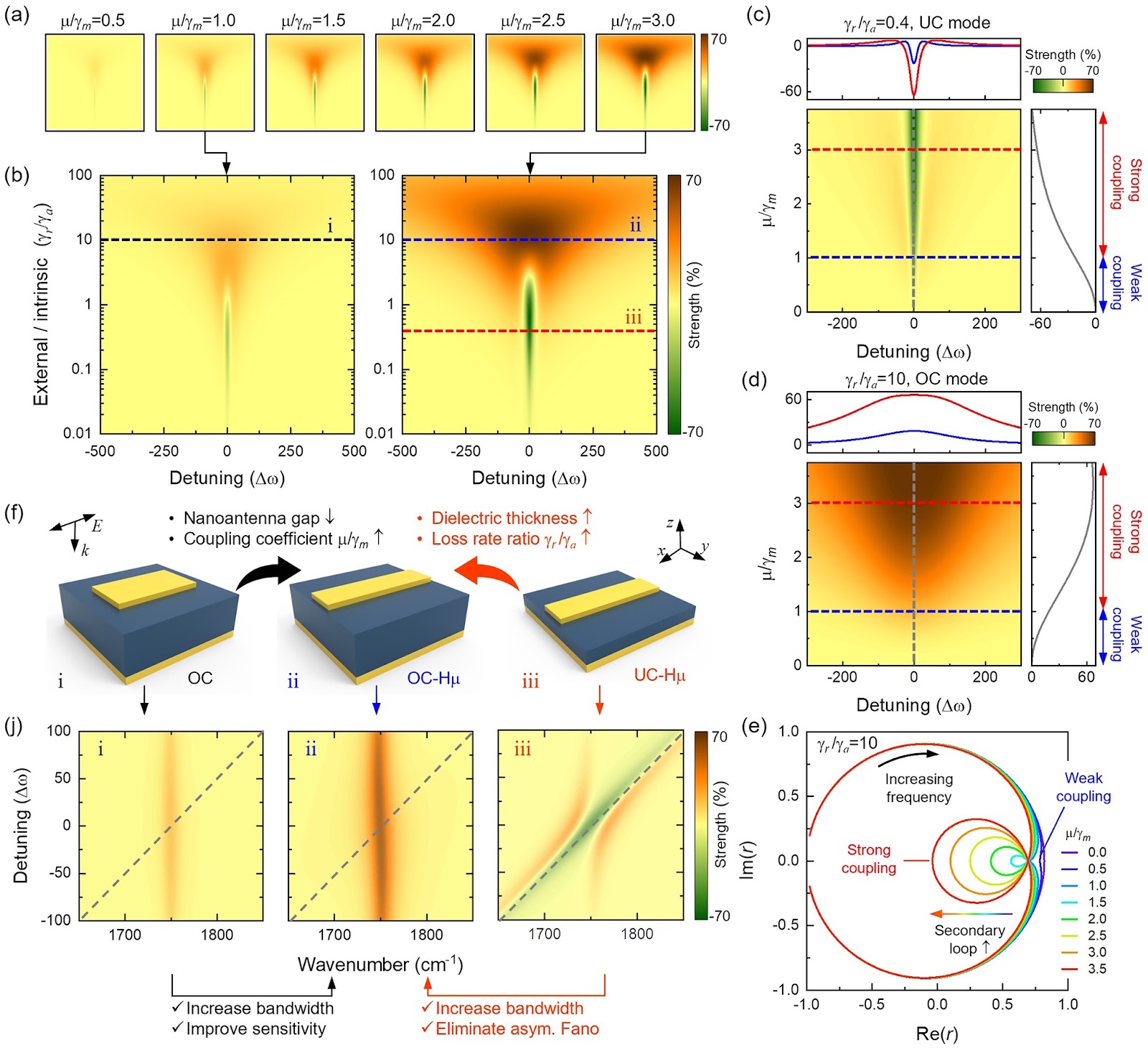
Plasmonic nanoantennas provide unique opportunities for precise control of light–matter coupling in surface-enhanced infrared absorption (SEIRA) spectroscopy, but most of the resonant systems realized so far suffer from the obstacles of low sensitivity, narrow bandwidth, and asymmetric Fano resonance perturbations. Here, we demonstrated an overcoupled resonator with a high plasmon-molecule coupling coefficient (μ) (OC-Hμ resonator) by precisely controlling the radiation loss channel, the resonator-oscillator coupling channel, and the frequency detuning channel. We observed a strong dependence of the sensing performance on the coupling state, and demonstrated that OC-Hμ resonator has excellent sensing properties of ultra-sensitive (7.25% nm−1), ultra-broadband (3–10 μm), and immune asymmetric Fano lineshapes. These characteristics represent a breakthrough in SEIRA technology and lay the foundation for specific recognition of biomolecules, trace detection, and protein secondary structure analysis using a single array (array size is 100×100 µm2). In addition, with the assistance of machine learning, mixture classification, concentration prediction and spectral reconstruction were achieved with the highest accuracy of 100%. Finally, we demonstrated the potential of OC-Hμ resonator for SARS-CoV-2 detection. These findings will promote the wider application of SEIRA technology, while providing new ideas for other enhanced spectroscopy technologies, quantum photonics and studying light–matter interactions.
1. Introduction
Maximizing tailored light–matter interactions in nanoscale materials is a central goal of nanophotonics [1]. Resonant nanosystems have been demonstrated for the confinement and control of electromagnetic energy in subwavelength volumes, providing unique opportunities for enhanced light–matter interactions [2]. Based on this property of nanophotonics, many applications have been demonstrated, including enhanced spectroscopy [3–5], nonlinear optics [6], plasmon catalysis [7], quantum optics [8] and nanolasers [9]. Among them, surface-enhanced infrared absorption (SEIRA) spectroscopy is more attractive [10, 11]. This is because the mid-infrared spectrum contains infrared vibrational fingerprints of various biochemical molecules, which are related to molecular composition, chemical bonds, and inherent configurations. The emergence of nanophotonics has solved the limitation of low sensitivity of infrared in detecting trace molecules or ultra-thin film systems [12–15]. SEIRA spectroscopy has made significant progress recently and has achieved molecular dynamic monitoring [16–19], hyperspectral imaging [20–24], and biochemical molecule detection [25–27], showing a wide range of application potential. Despite significant progress in controlling the spectral composition of light–matter interactions, several thorny issues have hindered widespread application of this technology.
Low sensitivity, narrow bandwidth, and asymmetric Fano resonance are the three main obstacles restricting the wide application of SEIRA [28–31]. Among them, low sensitivity leads to unsound value of the limit of detection (LOD). Narrow bandwidth affects the versatility of individual devices [31]. The asymmetric Fano resonance hinders the direct acquisition of molecular fingerprint vibration information [30]. Huge efforts have been made to solve the above problems. First, a series of strategies, such as utilizing nanogaps [28, 32, 33], molecular enrichment [27, 34], and bound states in the continuum (BIC) [20], have been proposed to improve the sensitivity of SEIRA. Second, methods such as multiresonance [17, 35, 36], supercell [31], array [20], modulation [25, 37] and gradient metasurfaces [38, 39] were used to collect broadband spectral data. In terms of weakening asymmetric Fano resonance, methods such as broadband [31], envelope [20, 40–42] or secondary calibration [43] have been proposed to restore the natural absorption fingerprint of molecules. While the above approaches all address one or two of the obstacles to some extent, simultaneously addressing all three of the above obstacles using a single array device remains a huge challenge. Solving these three challenges simultaneously on a single array device facilitates smaller device size, higher integration, and broader applicability.
Recently, there has been widespread interest in exploring nanoantennas driven by physics to achieve exceptional sensing capabilities. This pursuit has led to the emergence of various novel resonance modes with high-performance sensing characteristics, such as Fano-resonant [26], BIC [20], exceptional points [44], a
Loading authentic research manuscript (Pages 1–5)...
Dongxiao Li, Hong Zhou, Zhihao Ren, Cheng Xu, Chengkuo Lee (2024). Tailoring Light–Matter Interactions in Overcoupled Resonator for Biomolecule Recognition and Detection. Nano-Micro Letters. https://doi.org/10.1007/s40820-024-01520-3
Research & Educational Purpose Only:The translations, structured abstracts, analytical annotations, and data reports provided by SinoTechIntel are intended exclusively for academic research, internal corporate R&D, and educational benchmarking. They do not constitute formal engineering, chemical safety, legal, or professional advice.
Copyright & Intellectual Property Notice: Original copyright of the underlying source articles and experimental data remains with the respective authors, institutions, and original publishing journals. SinoTechIntel claims intellectual property only over its proprietary translations, analytical syntheses, and AEO structured enhancements in accordance with international fair use and academic citation principles.
Frequently Asked Questions
What is the main innovation of this paper?
The paper proposes a new paradigm for nanoantenna design using coupled-mode theory, leading to an overcoupled resonator (OC-Hμ) that simultaneously achieves ultra-sensitivity, ultra-broadband operation, and immunity to asymmetric Fano resonance, addressing key limitations of SEIRA spectroscopy.
How does the OC-Hμ resonator improve sensing performance?
By precisely controlling radiation loss, resonator-oscillator coupling, and frequency detuning, the OC-Hμ resonator achieves a high plasmon-molecule coupling coefficient, resulting in ultra-sensitive (7.25% nm−1) and ultra-broadband (3–10 μm) detection with symmetric lineshapes.
What role does machine learning play in this study?
Machine learning is used to analyze spectral data from the OC-Hμ resonator, enabling mixture classification, concentration prediction, and spectral reconstruction with up to 100% accuracy, enhancing the practical utility of the sensor.
What are the potential applications of this technology?
The technology can be applied for specific biomolecule recognition, trace detection, protein secondary structure analysis, and even SARS-CoV-2 detection, with implications for enhanced spectroscopy, quantum photonics, and light-matter interaction studies.
Related Technical Papers & Translations
Direct Repair of the Crystal Structure and Coating Surface of Spent LiFePO4 Materials Enables Superfast Li-Ion Migration
The rapid accumulation of spent LiFePO4 (LFP) cathodes from retired lithium-ion batteries necessitates the development of effective and environmental-friendly recycling strategies. In this context, direct regeneration has emerged as a promising approach for reclaiming LFP cathode materials, offering a streamlined pathway to restore their electrochemical functionality. We report an integrated regeneration protocol that simultaneously repairs the degraded crystal structure and reconstructs the damaged carbon coating in spent LFP. The regenerated cathode material had superfast lithium-ion diffusion kinetics and a stable cathode–electrolyte interface, giving a remarkable rate capability with specific capacities of 122 mAh g−1 at 5C and 106 mAh g−1 at 10C (1C = 170 mA g−1). It also maintained capacities of 110.7 mAh g−1 (5C) and 84.1 mAh g−1 (10C) after 400 cycles. It could be used in harsh environments and could be stably cycled at subzero temperatures (−10 and −20 °C) and in solid-state electrolyte batteries. Life cycle assessment combined with economic evaluation using the EverBatt model reveals that this direct regeneration approach has high economic and environmental benefits.
Oxide Semiconductor for Advanced Memory Architectures: Atomic Layer Deposition, Key Requirement and Challenges
Oxide semiconductors (OSs), introduced by the Hosono group in the early 2000s, have evolved from display backplane materials to promising candidates for advanced memory and logic devices. The exceptionally low leakage current of OSs and compatibility with three-dimensional (3D) architectures have recently sparked renewed interest in their use in semiconductor applications. This review begins by exploring the unique material properties of OSs, which fundamentally originate from their distinct electronic band structure. Subsequently, we focus on atomic layer deposition (ALD), a core technique for growing excellent OS films, covering both basic and advanced processes compatible with 3D scaling. The basic surface reaction mechanisms—adsorption and reaction—and their roles in film growth are introduced. Furthermore, material design strategies, such as cation selection, crystallinity control, anion doping, and heterostructure engineering, are discussed. We also highlight challenges in memory applications, including contact resistance, hydrogen instability, and lack of p-type materials, and discuss the feasibility of ALD-grown OSs as potential solutions. Lastly, we provide an outlook on the role of ALD-grown OSs in memory technologies. This review bridges material fundamentals and device-level requirements, offering a comprehensive perspective on the potential of ALD-driven OSs for next-generation semiconductor memory devices.
Laser powder bed fusion of biodegradable Zn-4Cu alloy: Processing, microstructure and properties
Zn's natural degradability and biocompatibility make it a promising candidate for implants, however, its mechanical properties remain insufficient for bone applications. In this study, the performance of Zn was enhanced by developing Zn-Cu alloys via laser powder bed fusion (LPBF). Optimal LPBF parameters for forming stable tracks were achieved by adjusting laser power and scanning speed. Under optimized conditions of 100 W and 100 mm/s, high-density (99.58%) Zn-Cu alloys with improved hardness (68.2HV) and yield strength (160 MPa) were achieved. These improvements are attributed to solid solution strengthening, segregation strengthening, and grain refinement. The Zn-Cu alloys also demonstrated favorable degradation behavior, with a rate of 0.16 mm/year. This degradation is primarily driven by micro-galvanic corrosion between the CuZn5 phase and Zn matrix, along with refined grains and increased grain boundary density. This work demonstrates a viable strategy for fabricating Zn-based implants with enhanced structural integrity and mechanical performance via LPBF.