Key Takeaways & Executive Findings
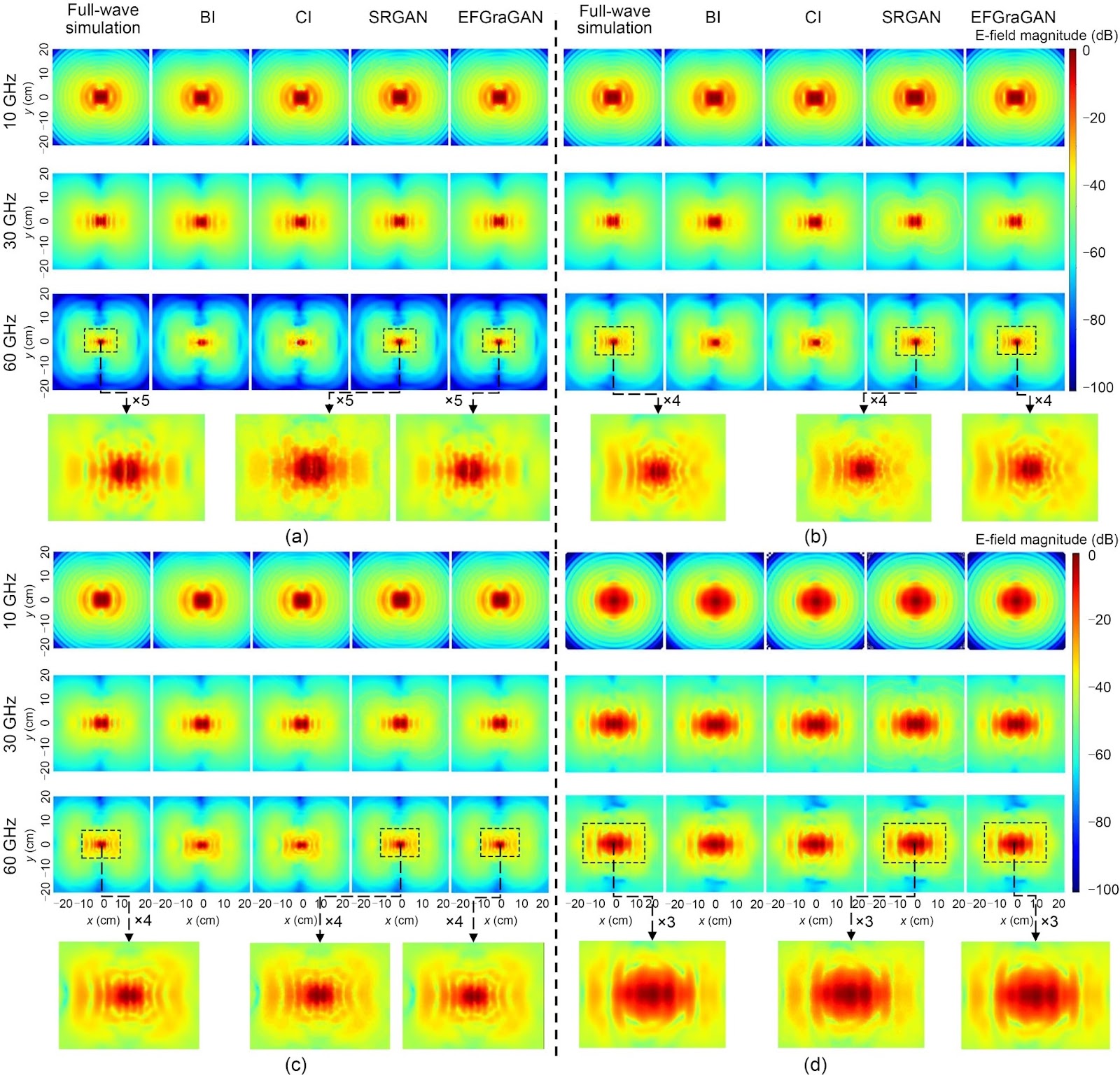
- •• EFGraGAN integrates field gradient loss to reconstruct high-resolution mmWave E-fields, preserving both local magnitude and spatial structure. • Training with plane-wave integral representation (PWIR) and randomized incidence significantly improves generalization across antenna types. • Achieves maximum mean relative error below 9% up to 60 GHz in a 4×4 dipole array, satisfying IEC/IEEE 63195-2 standards for exposure assessment. • Demonstrates robustness to noise, enabling existing measurement systems to perform accurate and efficient mmWave exposure assessment.
Abstract
Accurate assessment of human exposure to millimeter-wave (mmWave) electric fields (E-fields) has recently become critical for public health and safety. High-spatial-resolution E-field distribution is required for assessment of mmWave electromagnetic exposure according to the International Electrotechnical Commission (IEC) and the Institute of Electrical and Electronics Engineers (IEEE) (IEC/IEEE 63195-2 standard). This study proposes a generative adversarial network (GAN) integrated with field gradient loss, termed EFGraGAN, for superresolution reconstruction of mmWave E-fields. The incorporation of E-field gradient loss enables the network to learn both local field magnitudes and spatial structures, thereby enhancing the accuracy and fine structural details of reconstructed E-field maps. To improve generalization across antenna types, the training dataset is generated using plane-wave integral representation (PWIR) and randomized parametric incidence, simulating diverse field distributions. Combined with bilinear interpolation, the method achieves high-resolution reconstruction at 30 GHz and 60 GHz, meeting the requirements of the IEC/IEEE 63195-2 standard for exposure assessment. Numerical simulations show that EFGraGAN reconstructs E-field distributions in a skin phantom with a maximum mean relative error (MRE) of <9% up to 60 GHz in a 4×4 dipole array scenario, outperforming conventional interpolation and traditional GAN methods. The approach also demonstrates strong robustness to noise, enabling current measurement systems to achieve accurate and efficient evaluation of mmWave exposure.
1. Introduction
With the rapid application of millimeter-wave (mmWave) technology, public concerns regarding the potential adverse health effects of excessive exposure to electromagnetic (EM) fields have increased (Lin, 2016; Yang et al., 2021). Accurate evaluation of mmWave exposure has become an increasingly significant issue. At frequencies >6 GHz, the specific absorption rate (SAR) becomes less relevant for exposure assessment due to the extremely shallow penetration depth of millimeter waves. Instead, the incident power density (IPD) is adopted as the primary compliance metric, particularly for measurement (Wu et al., 2013; IEC/IEEE, 2022a). IPD refers to the power per unit area of EM radiation incident on a surface in free space and can be assessed at distances close to the radiating source.
As IPD can be derived from the electric field (E-field) (Wu et al., 2024), measurement systems equipped with either a single probe or probe arrays are commonly used to determine the values at discrete sampling points. In such kinds of systems, the spacing between these sampling points drastically influences the precision of assessment. Denser sampling can reduce the uncertainty in E-field distributions. However, it will introduce pronounced coupling effects (Qamar et al., 2016) and lead to measurement errors. Currently, the minimal spacing of probes has not been standardized, while the interval for the current measurement system is claimed to be around 7–8 mm (Liu et al., 2020). Meanwhile, sampling resolution and spatial gradients are critical for the accurate localization and assessment of the maximum exposure value (IEC/IEEE, 2020, 2022a). Specifically, when assessing mmWave exposure, for evaluating the peak spatial-average IPD, the value is calculated with a step size of 1 mm or λ/10, whichever is less (IEC/IEEE, 2022a, 2022b). In such a case, there is an urgent need to reconstruct the E-field at much higher resolution, for instance, from the spatial interval of 8 mm to 1 mm (e.g., 10 GHz) and even to 0.5 mm (up to 60 GHz). Traditional interpolation methods often fail to provide sufficient details and accuracy (Wang X et al., 2023), necessitating the development of advanced reconstruction techniques. Otherwise, the current measurement systems, which are of high cost, would become obsolete.
In recent years, generative adversarial networks (GANs) have emerged as a powerful tool for image reconstruction. Conditional GAN (CGAN) introduces conditional information to enable the generator to produce specific types of data on demand (Mirza and Osindero, 2014). Notably, superresolution GAN (SRGAN) (Ledig et al., 2017) uses adversarial training combined with perceptual loss to g
Loading authentic research manuscript (Pages 1–5)...
Shiwei YI, Congsheng LI, Tongning WU (2025). Superresolution reconstruction of E-field for assessing millimeter-wave exposure based on gradient-informed generative adversarial networks with plane-wave integral representation. Engineering Information Technology & Electronic Engineering. https://doi.org/10.1631/ENG_ITEE_2025_0021
Research & Educational Purpose Only:The translations, structured abstracts, analytical annotations, and data reports provided by SinoTechIntel are intended exclusively for academic research, internal corporate R&D, and educational benchmarking. They do not constitute formal engineering, chemical safety, legal, or professional advice.
Copyright & Intellectual Property Notice: Original copyright of the underlying source articles and experimental data remains with the respective authors, institutions, and original publishing journals. SinoTechIntel claims intellectual property only over its proprietary translations, analytical syntheses, and AEO structured enhancements in accordance with international fair use and academic citation principles.
Frequently Asked Questions
What is EFGraGAN?
EFGraGAN is a generative adversarial network that integrates field gradient loss for superresolution reconstruction of millimeter-wave electric fields. It learns both local field magnitudes and spatial structures to produce high-resolution E-field maps.
How does EFGraGAN improve E-field reconstruction compared to traditional methods?
EFGraGAN outperforms conventional interpolation and traditional GAN methods by incorporating field gradient loss, which enhances accuracy and fine structural details. It achieves a maximum mean relative error of less than 9% up to 60 GHz in a 4×4 dipole array scenario.
What is the role of plane-wave integral representation (PWIR) in training?
PWIR is used to generate a training dataset with randomized parametric incidence, simulating diverse field distributions. This improves the network's generalization across different antenna types.
Does EFGraGAN meet international standards for mmWave exposure assessment?
Yes, EFGraGAN meets the requirements of the IEC/IEEE 63195-2 standard for exposure assessment, achieving high-resolution reconstruction at 30 GHz and 60 GHz with a step size as low as 0.5 mm.
How robust is EFGraGAN to measurement noise?
EFGraGAN demonstrates strong robustness to noise, enabling current measurement systems to achieve accurate and efficient evaluation of mmWave exposure without significant degradation in performance.
Related Technical Papers & Translations
Design and optimization of a high-efficiency distillation process for cellulosic fuel ethanol integrated with thermal coupling and molecular sieve adsorption
To address the challenges of high energy consumption and prominent costs in the traditional three-columns distillation process for cellulosic fuel ethanol, a distillation—molecular sieve coupling separation process is proposed. This process integrates a three-column (crude distillation column, first distillation column, second distillation column) system with a 3A molecular sieve adsorption deep dehydration unit. A thermal coupling network is constructed via differential pressure design (steam from medium/high-pressure columns as mutual heat sources, reboiler liquid waste heat for feed preheating), and molecular sieve adsorption conditions are optimized. The study first performs a thermodynamic consistency test on the ethanol—water system, determines optimal non-random two-liquid (NRTL) model binary interaction parameters via experimental data regression for Aspen Plus simulation. Aiming at minimum total annual cost (TAC), Aspen Plus is used to optimize process parameters (theoretical tray number, feed location, reflux ratio, side-draw position, etc.). Economic analysis shows this process reduces CO2 emission costs by 27.56%, TAC by 15.58% (to 5.123 × 10⁶ USD·a-1), and increases ethanol purity to >99.6%, providing an effective solution for green, efficient separation.
A cohesion loss model for determining residual strength of deep bedded sandstone
Rock residual strength, as an important input parameter, plays an indispensable role in proposing the reasonable and scientific scheme about stope design, underground tunnel excavation and stability evaluation of deep chambers. Therefore, previous residual strength models of rocks established were reviewed. And corresponding related problems were stated. Subsequently, starting from the effects of bedding and whole life-cycle evolution process, series of triaxial mechanical tests of deep bedded s
Federated model with contrastive learning and adaptive control variates for human activity recognition
Recent attention to privacy issues demands a communication-safe method for training human activity recognition (HAR) models on client activity data. Federated learning (FL) has become a compelling technique to facilitate model training between the server and clients while preserving data privacy. However, classical FL methods often assume independent and identically distributed (IID) data among clients. This assumption does not hold true in practical scenarios. Human activity in real-world scena