Key Takeaways & Executive Findings
- •• Increasing normal load (Fs) or normal stiffness (K) reduces initial shear slip and significantly enhances peak shear load and shear modulus, with increases up to 210.32% and 177.06%, respectively. • Higher shear rate (v) amplifies initial shear slip but reduces peak shear load by 38.57% and shear modulus by 37.03%, indicating rate-dependent mechanical weakening. • Under increasing Fs and K or decreasing v, the debonding failure surface shifts from the resin-rock interface to the resin-bolt interface, with failure mode transitioning from tensile rupture of resin to shear-off at the resin surface. • Initial shear dilation marks the onset of shear failure surface formation along anisotropic interfaces, which is critical for predicting debonding initiation and designing more reliable anchorage systems.
Abstract
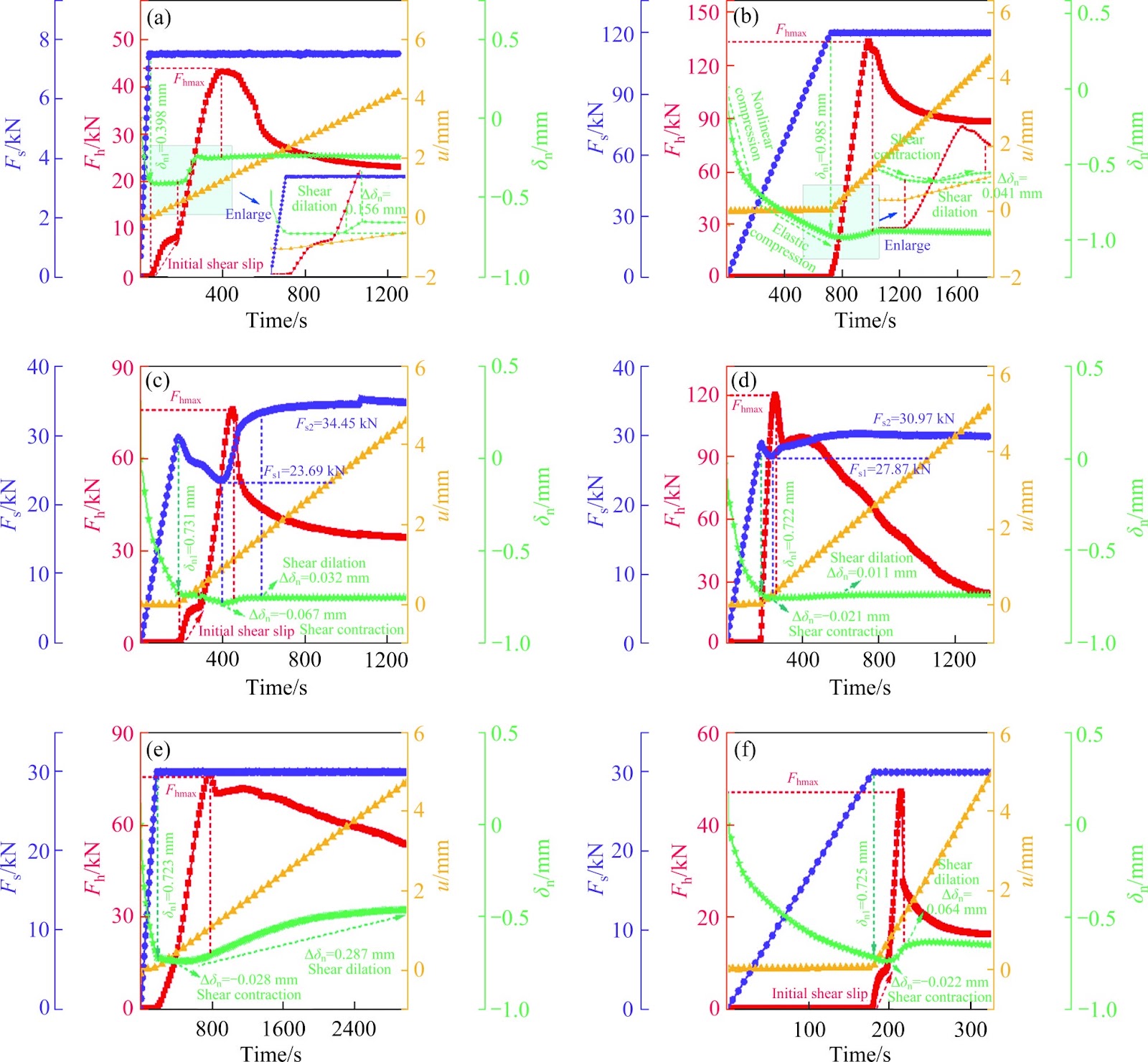
This study investigates the shear mechanical responses and debonding failure mechanisms of anchoring systems comprising three anisotropic media and two anisotropic interfaces under controlled boundary conditions of constant normal load (Fs), constant normal stiffness (K), and shear rate (v). A systematic analysis of shear mechanical properties, the evolution of maximum principal strain field, and damage characteristics along shear failure surface is presented. Results from direct shear tests demonstrate that initial shear slip diminishes with increasing Fs and K, attributed to the normal constraint strengthening effect, while an increase in v enhances initial shear slip due to attenuated deformation coordination and stress transfer. As Fs increases from 7.5 to 120 kN, K from 0 to 12 MPa/mm, and v from 0.1 to 2 mm/min, the peak shear load increases by 210.32% and 80.16% with rising Fs and K, respectively, while decreases by 38.57% with increasing v. Correspondingly, the shear modulus exhibits, respectively, a 135.29% and 177.06% increase with rising Fs and K, and a 37.03% decrease with larger v. Initial shear dilation is identified as marking the formation of shear failure surface along anisotropic interfaces, resulting from the combined shear actions at the resin-bolt interface, where resin undergoes shear by bolt surface protrusions, and the resin-rock interface, where mutual shear occurs between resin and rock. With increasing Fs and K and decreasing v, the location of the shear failure surface shifts from the resin-rock interface to the resin-bolt interface, accompanied by a transition in failure mode from tensile rupture of resin to shear off at the resin surface.
1. Introduction
Anchorage support technology has gained prominence due to its superior support strength, convenient installation process, high adaptability, and significant economic benefits, leading to widespread application in geotechnical engineering fields such as mining, tunneling, and slope stabilization [1 −4], as depicted in Figure 1. The load-bearing capacity and long-term stability of anchorage systems during service are outcomes of multiple interacting factors, which primarily include the strength of materials (anchor bolts, bonding agents, and surrounding rock masses), boundary conditions (such as constant normal load, constant normal stiffness, disturbance intensity, and load type), anchorage parameters (including anchorage length, spacing, angle, and preload), and the shear mechanical characteristics and debonding failure mechanisms between anisotropic media [6−10].
The support resistance provided by anchorage systems primarily depends on the shear strength and friction at anisotropic interfaces, with the cumulative progression of damage and degradation potentially leading to system failure [11, 12].
Loading authentic research manuscript (Pages 1–5)...
NIE Xin-xin, YIN Qian, TAO Zhi-gang, GUO Long-ji, RIABOKON Evgenii, ZHU De-fu, XIE Liang-fu, ZHA Wen-hua, WANG Lin-feng, REN Ya-jun (2025). Shear mechanical properties and debonding failure mechanisms of bolt-resin-rock anchoring system with anisotropic interfaces. Journal of Central South University. https://doi.org/10.1007/s11771-025-6009-0
Research & Educational Purpose Only:The translations, structured abstracts, analytical annotations, and data reports provided by SinoTechIntel are intended exclusively for academic research, internal corporate R&D, and educational benchmarking. They do not constitute formal engineering, chemical safety, legal, or professional advice.
Copyright & Intellectual Property Notice: Original copyright of the underlying source articles and experimental data remains with the respective authors, institutions, and original publishing journals. SinoTechIntel claims intellectual property only over its proprietary translations, analytical syntheses, and AEO structured enhancements in accordance with international fair use and academic citation principles.
Frequently Asked Questions
What does this study investigate?
This study investigates the shear mechanical responses and debonding failure mechanisms of bolt-resin-rock anchoring systems with anisotropic interfaces under controlled constant normal load, constant normal stiffness, and shear rate conditions.
How do normal load and normal stiffness affect the shear performance of anchoring systems?
Increasing normal load (Fs) and normal stiffness (K) reduces initial shear slip and significantly enhances peak shear load and shear modulus, with increases up to 210.32% and 177.06%, respectively, due to the normal constraint strengthening effect.
What is the effect of shear rate on anchoring system behavior?
Higher shear rate (v) increases initial shear slip due to attenuated deformation coordination and stress transfer, while decreasing the peak shear load by 38.57% and shear modulus by 37.03%.
How does the debonding failure surface change under different boundary conditions?
With increasing normal load and normal stiffness, and decreasing shear rate, the debonding failure surface shifts from the resin-rock interface to the resin-bolt interface, and the failure mode transitions from tensile rupture of resin to shear off at the resin surface.
Why is initial shear dilation important?
Initial shear dilation marks the formation of the shear failure surface along anisotropic interfaces, which is critical for identifying the onset of debonding and understanding the combined shear actions at the resin-bolt and resin-rock interfaces.
Related Technical Papers & Translations

Design and optimization of a high-efficiency distillation process for cellulosic fuel ethanol integrated with thermal coupling and molecular sieve adsorption
To address the challenges of high energy consumption and prominent costs in the traditional three-columns distillation process for cellulosic fuel ethanol, a distillation—molecular sieve coupling separation process is proposed. This process integrates a three-column (crude distillation column, first distillation column, second distillation column) system with a 3A molecular sieve adsorption deep dehydration unit. A thermal coupling network is constructed via differential pressure design (steam from medium/high-pressure columns as mutual heat sources, reboiler liquid waste heat for feed preheating), and molecular sieve adsorption conditions are optimized. The study first performs a thermodynamic consistency test on the ethanol—water system, determines optimal non-random two-liquid (NRTL) model binary interaction parameters via experimental data regression for Aspen Plus simulation. Aiming at minimum total annual cost (TAC), Aspen Plus is used to optimize process parameters (theoretical tray number, feed location, reflux ratio, side-draw position, etc.). Economic analysis shows this process reduces CO2 emission costs by 27.56%, TAC by 15.58% (to 5.123 × 10⁶ USD·a-1), and increases ethanol purity to >99.6%, providing an effective solution for green, efficient separation.

A cohesion loss model for determining residual strength of deep bedded sandstone
Rock residual strength, as an important input parameter, plays an indispensable role in proposing the reasonable and scientific scheme about stope design, underground tunnel excavation and stability evaluation of deep chambers. Therefore, previous residual strength models of rocks established were reviewed. And corresponding related problems were stated. Subsequently, starting from the effects of bedding and whole life-cycle evolution process, series of triaxial mechanical tests of deep bedded s

Federated model with contrastive learning and adaptive control variates for human activity recognition
Recent attention to privacy issues demands a communication-safe method for training human activity recognition (HAR) models on client activity data. Federated learning (FL) has become a compelling technique to facilitate model training between the server and clients while preserving data privacy. However, classical FL methods often assume independent and identically distributed (IID) data among clients. This assumption does not hold true in practical scenarios. Human activity in real-world scena