Key Takeaways & Executive Findings
- •• Semi-quantitative Raman and FTIR analysis reveals structural evolution of mesophase pitch-based carbon foams at each preparation stage. • Ball milling pretreatment yields uniform pore distribution and good properties in carbon foams. • Liquid phase extraction produces carbon foams with highest graphitization, best compression resistance (2.47 MPa), highest thermal conductivity (64.47 W/(m·K)), and lowest electrical resistance (13.02 μΩ·m). • Combined spectroscopic and microscopic characterization enables controlled preparation of high-performance carbon foams.
Abstract
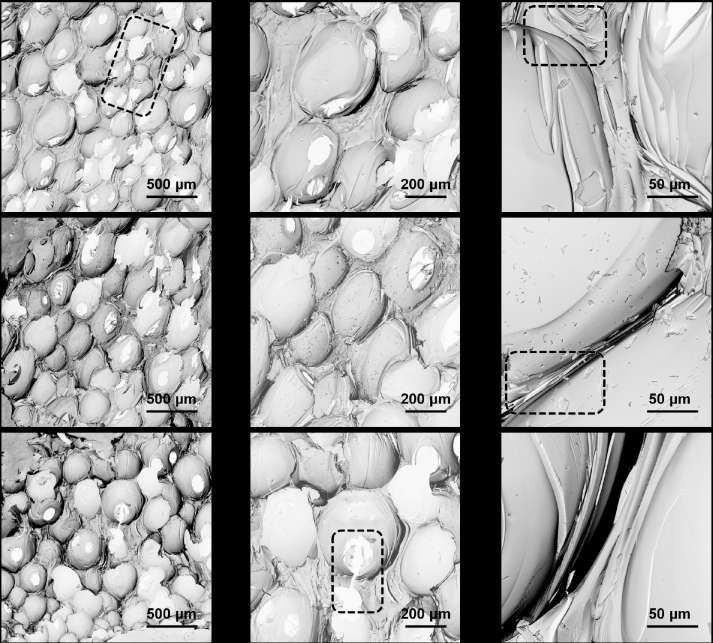
Graphitized carbon foams (GFms) were prepared using mesophase pitch (MP) as a raw material by foaming (450 °C), pre-oxidation (320 °C), carbonization (1 000 °C) and graphitization (2 800 °C). The differences in structure and properties of GFms prepared from different MP precursors pretreated by ball milling or liquid phase extraction were investigated and compared, and semi-quantitative calculations were conducted on the Raman and FTIR spectra of samples at each preparation stage. Semi-quantitative spectroscopic analysis provided detailed information on the structure and chemical composition changes of the MP and GFm derived from it. Combined with microscopic observations, the change from precursor to GFm was analyzed. The results showed that ball milling concentrated the distribution of aromatic molecules in the pitch, which contributed to uniform foaming to give a GFm with a uniform pore distribution and good properties. Liquid phase extraction helped remove light components while retaining large aromatics to form graphitic planes with the largest average size during post-treatment to produce a GFm with the highest degree of graphitization and the fewest open pores, giving the best compression resistance (2.47 MPa), the highest thermal conductivity (64.47 W/(m·K)) and the lowest electrical resistance (13.02 μΩ·m). Characterization combining semi-quantitative spectroscopic analysis with microscopic observations allowed us to control the preparation of the MP-derived GFms.
1. Introduction
Carbon foam, a light carbon material characterized by its sponge-like interconnected porous structure, exhibits remarkable properties including low density, high thermal stability and impact resistance. Furthermore, its customizable thermal and electrical conductivity holds great potential for applications in structural materials, thermal management, electrochemistry and energy storage, catalyst supports, etc.[1–4] Carbon foam can be synthesized from different carbonaceous precursors, polymers such as phenolic resin and polyurethane, various pitches including coal tar pitch, petroleum pitch and naphthalene pitch, as well as biomass materials[5]. Among them, pitch-based carbon foam can form a highly ordered graphite structure after graphitization, exhibiting excellent properties, which has received extensive attention from academia and industry[5].
The unique thermal, electrical and mechanical properties of carbon foams are mainly attributed to the highly aligned or oriented graphitic structure along the pore walls[6]. The pore structure and graphite crystallite size are greatly influenced by the process control, thus investigating the evolution of foam carbon in the whole preparation process is curical. In previous studies, researchers mainly applied electron microscopy and polarized optical microscopy to visually illustrate the evolution of pore structure and graphite orientation[2,7,8], or qualitative Raman and FTIR spectroscopic analysis to indirectly infer changes in fine structure and chemical composition. Nevertheless, it is challenging to provide effective guidance for the controllable synthesis of carbon foam solely through this qualitative characterization. In this study, we conducted further semi-quantitative spectral analysis through peak fitting and calculation of specific aromatic parameters. This approach allowed us to obtain key information about the content and size of polycyclic aromatic hydrocarbons and aliphatic hydrocarbon side chains, thereby simplifying the characterization and analysis of carbon foam through microscopic verification.
Plastic properties have an important impact on the foaming behavior of pitch precursors, and normally, high dilatation and fluidity could induce low-density foams[9]. Therefore, different precursor pretreatments were often applied, such as ball milling and liquid phase extraction. The purpose of ball milling is to achieve uniform particle size for uniform softening. Additionally, the high-energy mechanochemical facilitate the conversion of carbonaceous molecules, thereby adjusting pitch fluidity[10]. In liquid phase extraction, the light components that are rich in transferable hydrogen can be removed by solvent dissolution and volatilization, to stabilize free radicals generated by pyrolysis, and fluidity can be decreased due to larger condensed aromatic molecules extracted[9].
Loading authentic research manuscript (Pages 1–5)...
LIU Yue, CHANG Sheng-kai, SU Zhan-peng, HUANG Zu-jian, QIN Ji, YANG Jian-xiao (2024). Semi-quantitative analysis of the structural evolution of mesophase pitch-based carbon foams by Raman and FTIR spectroscopy. New Carbon Materials. https://doi.org/10.1016/S1872-5805_N
Research & Educational Purpose Only:The translations, structured abstracts, analytical annotations, and data reports provided by SinoTechIntel are intended exclusively for academic research, internal corporate R&D, and educational benchmarking. They do not constitute formal engineering, chemical safety, legal, or professional advice.
Copyright & Intellectual Property Notice: Original copyright of the underlying source articles and experimental data remains with the respective authors, institutions, and original publishing journals. SinoTechIntel claims intellectual property only over its proprietary translations, analytical syntheses, and AEO structured enhancements in accordance with international fair use and academic citation principles.
Frequently Asked Questions
What is the main objective of this study?
The study aims to analyze the structural evolution of mesophase pitch-based carbon foams using semi-quantitative Raman and FTIR spectroscopy, and to compare the effects of different precursor pretreatments (ball milling and liquid phase extraction) on the final properties of the carbon foams.
How were the carbon foams prepared?
Carbon foams were prepared from mesophase pitch via foaming at 450 °C, pre-oxidation at 320 °C, carbonization at 1000 °C, and graphitization at 2800 °C.
What are the key findings regarding ball milling pretreatment?
Ball milling concentrated the distribution of aromatic molecules in the pitch, leading to uniform foaming and resulting in carbon foams with uniform pore distribution and good properties.
What are the key findings regarding liquid phase extraction pretreatment?
Liquid phase extraction removed light components while retaining large aromatics, which formed larger graphitic planes during post-treatment. This produced carbon foams with the highest degree of graphitization, fewest open pores, best compression resistance (2.47 MPa), highest thermal conductivity (64.47 W/(m·K)), and lowest electrical resistance (13.02 μΩ·m).
Why is semi-quantitative spectroscopic analysis important?
Semi-quantitative spectroscopic analysis provides detailed information on the content and size of polycyclic aromatic hydrocarbons and aliphatic side chains, enabling better understanding and control of the preparation process compared to purely qualitative methods.
Related Technical Papers & Translations

Design and optimization of a high-efficiency distillation process for cellulosic fuel ethanol integrated with thermal coupling and molecular sieve adsorption
To address the challenges of high energy consumption and prominent costs in the traditional three-columns distillation process for cellulosic fuel ethanol, a distillation—molecular sieve coupling separation process is proposed. This process integrates a three-column (crude distillation column, first distillation column, second distillation column) system with a 3A molecular sieve adsorption deep dehydration unit. A thermal coupling network is constructed via differential pressure design (steam from medium/high-pressure columns as mutual heat sources, reboiler liquid waste heat for feed preheating), and molecular sieve adsorption conditions are optimized. The study first performs a thermodynamic consistency test on the ethanol—water system, determines optimal non-random two-liquid (NRTL) model binary interaction parameters via experimental data regression for Aspen Plus simulation. Aiming at minimum total annual cost (TAC), Aspen Plus is used to optimize process parameters (theoretical tray number, feed location, reflux ratio, side-draw position, etc.). Economic analysis shows this process reduces CO2 emission costs by 27.56%, TAC by 15.58% (to 5.123 × 10⁶ USD·a-1), and increases ethanol purity to >99.6%, providing an effective solution for green, efficient separation.

A cohesion loss model for determining residual strength of deep bedded sandstone
Rock residual strength, as an important input parameter, plays an indispensable role in proposing the reasonable and scientific scheme about stope design, underground tunnel excavation and stability evaluation of deep chambers. Therefore, previous residual strength models of rocks established were reviewed. And corresponding related problems were stated. Subsequently, starting from the effects of bedding and whole life-cycle evolution process, series of triaxial mechanical tests of deep bedded s

Federated model with contrastive learning and adaptive control variates for human activity recognition
Recent attention to privacy issues demands a communication-safe method for training human activity recognition (HAR) models on client activity data. Federated learning (FL) has become a compelling technique to facilitate model training between the server and clients while preserving data privacy. However, classical FL methods often assume independent and identically distributed (IID) data among clients. This assumption does not hold true in practical scenarios. Human activity in real-world scena