Key Takeaways & Executive Findings
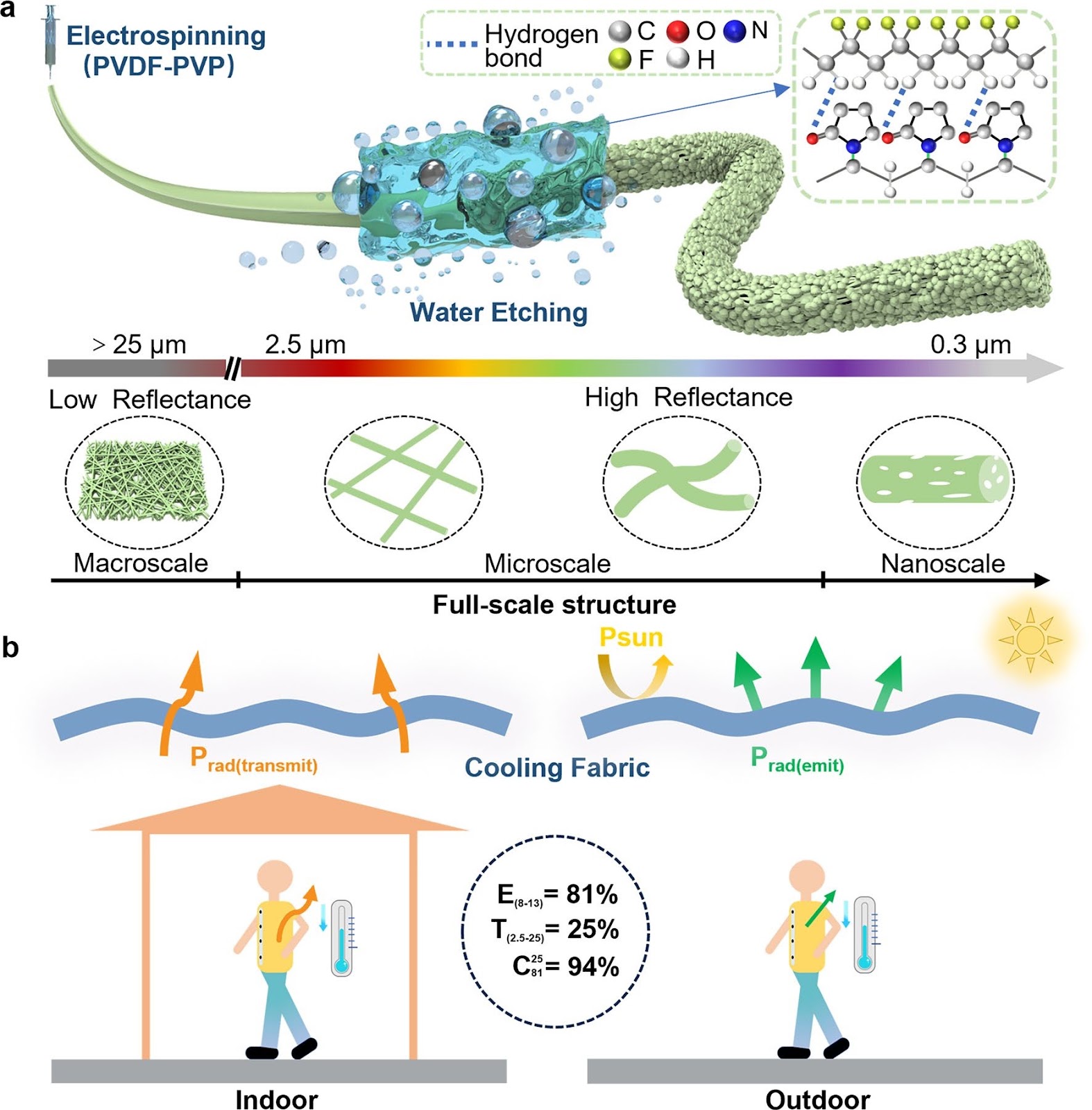
- •• The full-scale structure fabric achieves 94% sunlight reflectance and only 6% mid-infrared reflectance, minimizing heat absorption and radiation obstruction. • It exhibits 81% radiative emission in the atmospheric window (8–13 µm) and 25% transmission in the mid-infrared (2.5–25 µm), enabling efficient thermal radiation release. • The fabric provides net cooling powers of 60 W m−2 outdoors and 26 W m−2 indoors, demonstrating effective dual-environment cooling. • In practical tests, the fabric lowers human body temperature by 1.4–5.5 °C compared to typical polydimethylsiloxane film, highlighting its potential for sustainable personal thermal management.
Abstract
Radiative cooling fabric creates a thermally comfortable environment without energy input, providing a sustainable approach to personal thermal management. However, most currently reported fabrics mainly focus on outdoor cooling, ignoring to achieve simultaneous cooling both indoors and outdoors, thereby weakening the overall cooling performance. Herein, a full-scale structure fabric with selective emission properties is constructed for simultaneous indoor and outdoor cooling. The fabric achieves 94% reflectance performance in the sunlight band (0.3–2.5 µm) and 6% in the mid-infrared band (2.5–25 µm), effectively minimizing heat absorption and radiation release obstruction. It also demonstrates 81% radiative emission performance in the atmospheric window band (8–13 µm) and 25% radiative transmission performance in the mid-infrared band (2.5–25 μm), providing 60 and 26 W m−2 net cooling power outdoors and indoors. In practical applications, the fabric achieves excellent indoor and outdoor human cooling, with temperatures 1.4–5.5 °C lower than typical polydimethylsiloxane film. This work proposes a novel design for the advanced radiative cooling fabric, offering significant potential to realize sustainable personal thermal management.
1. Introduction
The greenhouse effect has significantly contributed to the increased frequency and intensity of extreme weather events [1–3]. Statistics indicate that people have endured 86 days of high-temperature weather annually over the past three years [4]. Energy-intensive refrigeration systems like air conditioners and fans are widely used to lower indoor temperatures, while they also further exacerbate the greenhouse effect [5–7]. In contrast, personal thermal management (PTM) technology has gained significant attention for its superior energy efficiency, providing localized cooling to enhance personal comfort while reducing energy consumption [8–11]. Passive radiative cooling (PRC) shows outstanding application potential in PTM because it allows 40%–60% of the body heat to be released through radiation [12–14].
Although various radiative cooling materials for the human body have been developed, most of them focus primarily on outdoor cooling, ignoring the important contribution of indoor cooling to personal comfort [15, 16]. Some studies have shown great potential for indoor cooling, while thorough study remain unexplored [17, 18]. Although previous work has achieved both indoor and outdoor cooling, it has not considered the impact of material structure on improving radiation release in the mid-infrared (MIR) band [19].
The challenge in achieving both indoor and outdoor cooling lies in ensuring excellent sunlight reflection while endowing materials with emission and transmission radiation capabilities. High sunlight reflection performance can be accomplished through multilayer structures [20, 21], porous structures [22, 23] and composite structures [24, 25]. These structures, however, concentrate on the reflection in sunlight band (0.3–2.5 µm) and ignore the reflection in the MIR band (2.5–25 μm) will impede the release of thermal radiation from the human body. To address this limitation, the introduction of a full-scale structure design offers a promising solution. This design features a microscale distribution that is concentrated in the 0.3–2.5 μm band while being nearly negligible in the 2.5–25 μm band. Such a structure effect can be utilized to enhance reflectance within the sunlight band, while simultaneously suppressing reflectance in the MIR band.
It is essential to analyze the mechanisms of thermal radiation release, considering the two modes of thermal radiation from an object (transmission and emission) [26]. PRC materials can be categorized into radiation transmission and radiation emission types [13, 27]. For instance, common radiation transmission material polyethylene (PE) has been confirmed to allow human thermal radiation to transmit through, enabling heat to be directly dissipated into the external environment [28–30]. However, the thickness of PE materials must be restricted to less than 150 µm, which reduces their reflectance of sunlight, making PE more suitable for indoor cooling [31]. Radiation emission materials like polyvinylidene fluoride hexafluoropropylene (PVDF-HFP) contain abundant C–F bonds, which are effective emitters in the atmospheric window.
Loading authentic research manuscript (Pages 1–5)...
Haijiao Yu, Jiqing Lu, Jie Yan, Tian Bai, Zhaoxuan Niu, Bin Ye, Wanli Cheng, Dong Wang, Siqi Huan, Guangping Han (2025). Selective Emission Fabric for Indoor and Outdoor Passive Radiative Cooling in Personal Thermal Management. Nano-Micro Letters. https://doi.org/10.1007/s40820-025-01713-4
Research & Educational Purpose Only:The translations, structured abstracts, analytical annotations, and data reports provided by SinoTechIntel are intended exclusively for academic research, internal corporate R&D, and educational benchmarking. They do not constitute formal engineering, chemical safety, legal, or professional advice.
Copyright & Intellectual Property Notice: Original copyright of the underlying source articles and experimental data remains with the respective authors, institutions, and original publishing journals. SinoTechIntel claims intellectual property only over its proprietary translations, analytical syntheses, and AEO structured enhancements in accordance with international fair use and academic citation principles.
Frequently Asked Questions
What is the main innovation of this fabric?
The fabric features a full-scale structure that achieves high sunlight reflectance (94%) and low mid-infrared reflectance (6%), while also providing high emission (81%) in the atmospheric window and transmission (25%) in the mid-infrared band, enabling simultaneous indoor and outdoor cooling.
How does the fabric achieve both indoor and outdoor cooling?
It combines high solar reflection to minimize heat gain outdoors, with high thermal radiation emission and transmission to release body heat effectively, resulting in net cooling powers of 60 W/m² outdoors and 26 W/m² indoors.
What are the practical cooling performance results?
In real-world tests, the fabric lowered human body temperature by 1.4–5.5 °C compared to typical polydimethylsiloxane film, demonstrating effective cooling in both indoor and outdoor settings.
What is the significance of the full-scale structure design?
The design optimizes the distribution of structural features to enhance reflectance in the sunlight band while suppressing reflectance in the mid-infrared band, which is crucial for unobstructed thermal radiation release.
How does this fabric contribute to sustainable personal thermal management?
By providing passive radiative cooling without energy input, the fabric reduces reliance on energy-intensive air conditioning, thereby lowering energy consumption and mitigating greenhouse gas emissions.
Related Technical Papers & Translations
Direct Repair of the Crystal Structure and Coating Surface of Spent LiFePO4 Materials Enables Superfast Li-Ion Migration
The rapid accumulation of spent LiFePO4 (LFP) cathodes from retired lithium-ion batteries necessitates the development of effective and environmental-friendly recycling strategies. In this context, direct regeneration has emerged as a promising approach for reclaiming LFP cathode materials, offering a streamlined pathway to restore their electrochemical functionality. We report an integrated regeneration protocol that simultaneously repairs the degraded crystal structure and reconstructs the damaged carbon coating in spent LFP. The regenerated cathode material had superfast lithium-ion diffusion kinetics and a stable cathode–electrolyte interface, giving a remarkable rate capability with specific capacities of 122 mAh g−1 at 5C and 106 mAh g−1 at 10C (1C = 170 mA g−1). It also maintained capacities of 110.7 mAh g−1 (5C) and 84.1 mAh g−1 (10C) after 400 cycles. It could be used in harsh environments and could be stably cycled at subzero temperatures (−10 and −20 °C) and in solid-state electrolyte batteries. Life cycle assessment combined with economic evaluation using the EverBatt model reveals that this direct regeneration approach has high economic and environmental benefits.
Oxide Semiconductor for Advanced Memory Architectures: Atomic Layer Deposition, Key Requirement and Challenges
Oxide semiconductors (OSs), introduced by the Hosono group in the early 2000s, have evolved from display backplane materials to promising candidates for advanced memory and logic devices. The exceptionally low leakage current of OSs and compatibility with three-dimensional (3D) architectures have recently sparked renewed interest in their use in semiconductor applications. This review begins by exploring the unique material properties of OSs, which fundamentally originate from their distinct electronic band structure. Subsequently, we focus on atomic layer deposition (ALD), a core technique for growing excellent OS films, covering both basic and advanced processes compatible with 3D scaling. The basic surface reaction mechanisms—adsorption and reaction—and their roles in film growth are introduced. Furthermore, material design strategies, such as cation selection, crystallinity control, anion doping, and heterostructure engineering, are discussed. We also highlight challenges in memory applications, including contact resistance, hydrogen instability, and lack of p-type materials, and discuss the feasibility of ALD-grown OSs as potential solutions. Lastly, we provide an outlook on the role of ALD-grown OSs in memory technologies. This review bridges material fundamentals and device-level requirements, offering a comprehensive perspective on the potential of ALD-driven OSs for next-generation semiconductor memory devices.
Laser powder bed fusion of biodegradable Zn-4Cu alloy: Processing, microstructure and properties
Zn's natural degradability and biocompatibility make it a promising candidate for implants, however, its mechanical properties remain insufficient for bone applications. In this study, the performance of Zn was enhanced by developing Zn-Cu alloys via laser powder bed fusion (LPBF). Optimal LPBF parameters for forming stable tracks were achieved by adjusting laser power and scanning speed. Under optimized conditions of 100 W and 100 mm/s, high-density (99.58%) Zn-Cu alloys with improved hardness (68.2HV) and yield strength (160 MPa) were achieved. These improvements are attributed to solid solution strengthening, segregation strengthening, and grain refinement. The Zn-Cu alloys also demonstrated favorable degradation behavior, with a rate of 0.16 mm/year. This degradation is primarily driven by micro-galvanic corrosion between the CuZn5 phase and Zn matrix, along with refined grains and increased grain boundary density. This work demonstrates a viable strategy for fabricating Zn-based implants with enhanced structural integrity and mechanical performance via LPBF.