Key Takeaways & Executive Findings
- •• PVAc selectively flocculates ultrafine talc from chalcopyrite, enabling efficient reverse flotation separation at a dosage of 40 mg/L. • Hydrogen bonding between PVAc ester groups and talc surface hydroxyls drives selective flocculation, while chalcopyrite lacks binding sites. • PVAc adsorption enhances talc hydrophobicity and promotes bubble-particle attachment by shifting interaction energy from repulsive to attractive. • This study provides mechanistic insights into floc-flotation coupling and expands the use of ester-based polymers for ultrafine mineral recovery.
Abstract
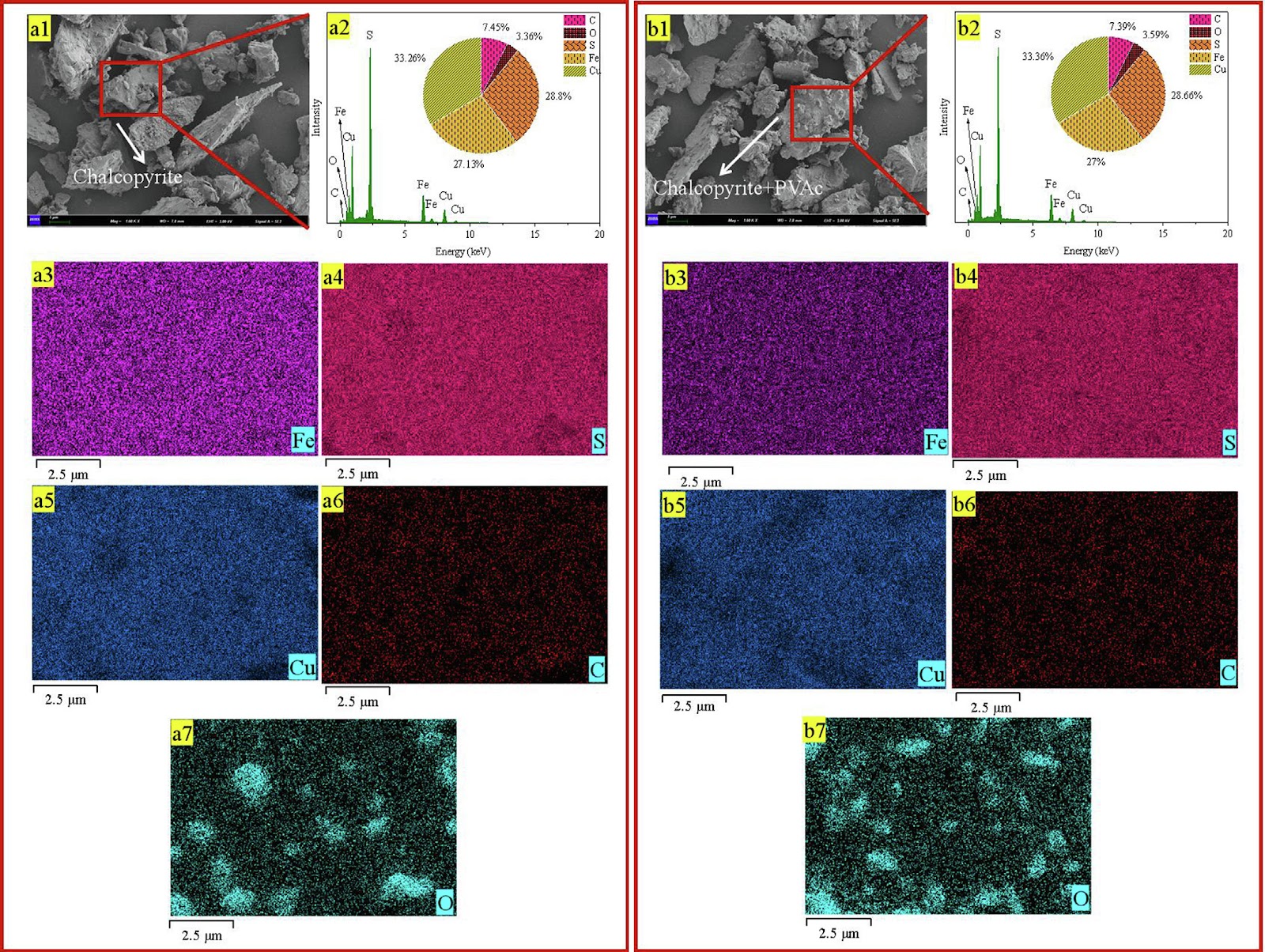
Chalcopyrite is often intergrown with talc, which, after grinding, forms ultrafine particles (<10 μm) that readily coat chalcopyrite surfaces, hindering flotation and causing significant losses in tailings. This study evaluates polyvinyl acetate (PVAc), a thermoplastic polymer, as a selective flocculant to enhance reverse flotation separation of chalcopyrite from ultrafine talc. Flotation tests showed that at a PVAc dosage of 40 mg/L, talc can be effectively and selectively removed, enabling efficient separation. Laser particle size analysis and scanning electron microscopy-energy dispersive spectrometry (SEM-EDS) confirmed that PVAc promotes selective talc aggregation without affecting chalcopyrite. X-ray photoelectron spectroscopy (XPS) and density functional theory (DFT) calculations revealed that hydrogen bonding between PVAc ester groups and surface hydroxyls on talc drives the flocculation, while chalcopyrite lacks suitable binding sites. PVAc adsorption also enhances talc hydrophobicity. Furthermore, particle-bubble coverage angle measurements and extended Derjaguin-Landau-Verwey-Overbeek (DLVO) theory theoretical calculations demonstrated that PVAc-induced flocculation increases attractive interactions between talc and bubbles, shifting the total interaction energy from repulsive to attractive and promoting bubble-particle attachment. This study clarifies the selective adsorption and flocculation mechanisms of PVAc and reveals the coupling of flocculation and flotation of ultrafine talc from a particle-bubble capture perspective, while expanding the potential of ester-based polymers for ultrafine mineral recovery.
1. Introduction
Ultrafine mineral particles, typically defined as those with particle sizes smaller than about 10 μm, are difficult to effectively recover and utilize during mineral processing and separation due to their small sizes. These particles cannot be efficiently recovered by froth flotation and are often discarded to tailings [1]. Tailings are the leftover waste materials after ore beneficiation and commonly contain pollutants such as heavy metals, acid-generating sulfide gangue, and chemical reagents. Long-term accumulation of wet fluid tailings poses severe environmental threats, including water pollution, air pollution, soil contamination, ecological damage, and potential geological hazards. The abandonment and storage of ultrafine minerals constitute latent pollution sources, posing a threat to human life.
In terms of the separation of ultrafine minerals, traditional methods such as gravity separation, magnetic separation, and conventional froth flotation are generally not effective. In contrast, floc-flotation has emerged as one of the most efficient approaches for recovering ultrafine minerals. This technique relies on the adsorption of polymeric flocculants to the mineral surface, where the polymers' bridging action promotes the aggregation of ultrafine particles into larger flocs, thus enhancing flotation performance [2]. Floc-flotation not only enhances the separation of ultrafine minerals, but also mitigates their environmental impact and contributes to resource recovery. By optimizing the choice of flocculants and flotation conditions, it is possible to improve mineral separation efficiency, reduce environmental contamination, and achieve more sustainable mineral resource recovery and tailings management.
Loading authentic research manuscript (Pages 1–5)...
Yu Xie, Wanzhong Yin, Qi Liu, Daowei Wang, Wenju Sun (2025). Reverse Floc-Flotation of Talc from Chalcopyrite Using Polyvinyl Acetate as a Flocculant: Adsorption and Bubble Capture Studies. Int. Journal of Mining Science and Technology (采矿与安全工程). https://doi.org/10.1016/j.ijmst.2025.08.016
Research & Educational Purpose Only:The translations, structured abstracts, analytical annotations, and data reports provided by SinoTechIntel are intended exclusively for academic research, internal corporate R&D, and educational benchmarking. They do not constitute formal engineering, chemical safety, legal, or professional advice.
Copyright & Intellectual Property Notice: Original copyright of the underlying source articles and experimental data remains with the respective authors, institutions, and original publishing journals. SinoTechIntel claims intellectual property only over its proprietary translations, analytical syntheses, and AEO structured enhancements in accordance with international fair use and academic citation principles.
Frequently Asked Questions
What is the main objective of this study?
The study evaluates polyvinyl acetate (PVAc) as a selective flocculant to enhance reverse flotation separation of chalcopyrite from ultrafine talc, addressing the challenge of talc slime coating that hinders chalcopyrite recovery.
How does PVAc selectively flocculate talc?
PVAc selectively flocculates talc through hydrogen bonding between its ester groups and surface hydroxyls on talc, while chalcopyrite lacks suitable binding sites, leading to selective aggregation of talc particles.
What mechanisms were revealed for bubble-particle attachment?
PVAc-induced flocculation increases attractive interactions between talc and bubbles, shifting the total interaction energy from repulsive to attractive, as demonstrated by coverage angle measurements and extended DLVO theory calculations.
What are the environmental implications of this research?
By improving the separation of ultrafine talc from chalcopyrite, the process reduces tailings volume and mitigates water and soil pollution caused by tailings accumulation, contributing to more sustainable mineral processing.
What is the significance of using PVAc as a flocculant?
PVAc, being rich in hydrophobic ester groups, enhances talc hydrophobicity and flotation efficiency, unlike traditional hydrophilic flocculants such as polyacrylamide, and expands the potential of ester-based polymers for ultrafine mineral recovery.
Related Technical Papers & Translations
Advances in Brain-Computer Interface Technology: A Comprehensive Review of Neural Signal Processing and Applications
Brain-computer interfaces (BCIs) have emerged as a transformative technology enabling direct communication between the brain and external devices, offering unprecedented opportunities for restoring motor function in paralyzed individuals and enhancing human-computer interaction. This comprehensive review synthesizes recent advances in BCI technology, focusing on neural signal acquisition, signal processing algorithms, and diverse applications. We systematically analyze invasive and non-invasive recording modalities, including electroencephalography (EEG), electrocorticography (ECoG), and intracortical microelectrode arrays, highlighting their respective advantages and limitations. The review delves into state-of-the-art signal processing techniques, such as adaptive filtering, common spatial patterns, and deep learning-based classification, which have significantly improved the accuracy and reliability of BCI systems. Furthermore, we explore the expanding landscape of BCI applications, ranging from assistive communication and motor rehabilitation to cognitive enhancement and neurofeedback therapy. Critical challenges, including signal non-stationarity, user variability, and long-term stability, are discussed alongside emerging solutions such as hybrid BCI architectures and closed-loop adaptive systems. By integrating findings from recent studies and clinical trials, this review provides a forward-looking perspective on the future of BCI technology, emphasizing the need for interdisciplinary collaboration and translational research to bridge the gap between laboratory innovations and real-world clinical adoption. Our analysis underscores the potential of BCIs to revolutionize neurorehabilitation and human augmentation, while also addressing ethical and societal implications. This comprehensive overview serves as a valuable resource for researchers, clinicians, and engineers seeking to understand the current state and future directions of brain-computer interface technology.
A Novel Multi-Scale Robotic System for Enhanced Surgical Precision and Autonomy in Minimally Invasive Procedures
Minimally invasive surgery (MIS) has revolutionized surgical practice by reducing patient trauma and recovery time. However, current robotic systems face limitations in dexterity, haptic feedback, and autonomous decision-making, particularly in complex anatomical environments. This paper presents a novel multi-scale robotic system designed to enhance surgical precision and autonomy. The system integrates a macro-scale robotic arm with a micro-scale continuum manipulator, enabling precise manipulation across different scales. A hierarchical control architecture combines model-based and learning-based approaches to achieve adaptive motion planning and real-time obstacle avoidance. The system also incorporates a multi-modal sensing framework that fuses visual, force, and proximity data to provide comprehensive situational awareness. Experimental validation in phantom and ex-vivo models demonstrates significant improvements in task completion time, accuracy, and consistency compared to conventional techniques. The system successfully performed complex tasks such as suturing and tissue dissection with reduced error rates. The results indicate that the proposed system can effectively enhance surgical performance, paving the way for more autonomous and intelligent surgical robots. Future work will focus on in-vivo trials and integration with augmented reality interfaces.
Integrated Multi-Omics Analysis of Tumor Microenvironment and Immune Infiltration in Hepatocellular Carcinoma: Implications for Prognosis and Immunotherapy
Hepatocellular carcinoma (HCC) is a highly heterogeneous malignancy with a complex tumor microenvironment (TME) that profoundly influences disease progression and therapeutic response. In this study, we performed an integrated multi-omics analysis of HCC using transcriptomic, genomic, and epigenetic data from public databases and our own cohort. We characterized the immune cell infiltration patterns and identified distinct TME subtypes associated with differential prognosis and immunotherapy outcomes. Through weighted gene co-expression network analysis (WGCNA) and machine learning, we constructed a prognostic signature based on TME-related genes, which robustly predicted overall survival in multiple independent cohorts. Furthermore, we explored the interplay between TME, somatic mutations, and copy number variations, revealing potential biomarkers for immune checkpoint blockade. Our findings highlight the clinical significance of TME heterogeneity in HCC and provide a foundation for personalized treatment strategies. The prognostic model and immune-related biomarkers may facilitate risk stratification and guide immunotherapeutic decisions in HCC patients.