Key Takeaways & Executive Findings
- •• Nonlinear flow in coal penetrating fractures is classified into three types: non-Newtonian seepage under high confining pressure and low JRC, non-Darcy seepage under low confining pressure and high JRC, and transitional behavior. • Geometric parameters of fractures (effective contact ratio, aperture, void deviation ratio) change exponentially with confining pressure, with high JRC samples showing increases of up to 93.5%, 67.4%, and 24.9% under high confining pressure compared to low JRC samples. • A new seepage model incorporating geometric parameters was proposed, achieving superior accuracy with average RMSE of 0.002 and R² of 0.70, outperforming existing models. • The study provides a quantitative relationship between fracture geometry and stress, enabling better prediction of fluid flow in coal-rock masses for applications like gas extraction and water hazard prevention.
Abstract
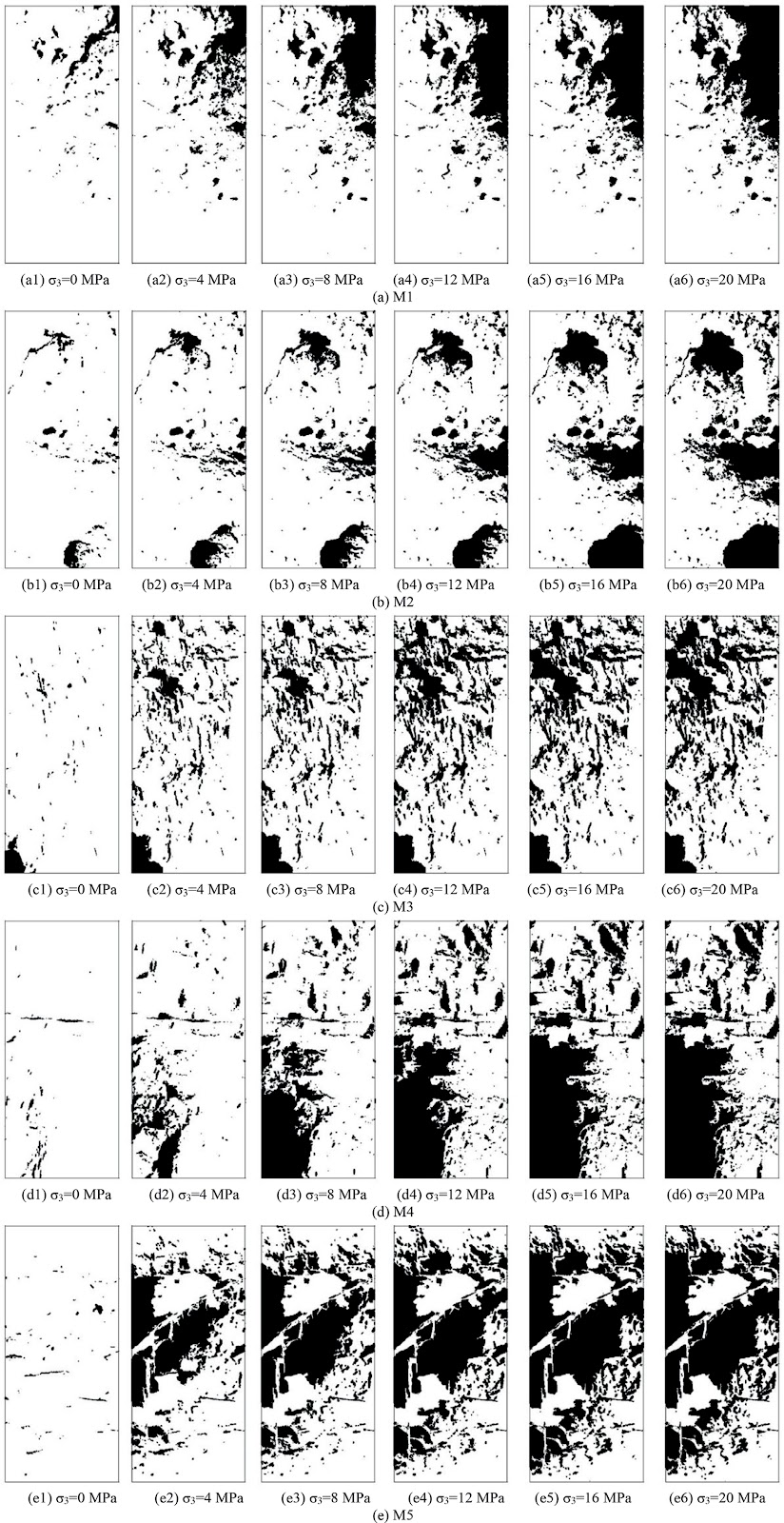
The fracture surfaces of coal-rock masses formed under mining-induced stress generally exhibit complex geometries, and the fracture geometry is one of the primary factors affecting the seepage characteristics of coal-rock penetrating fracture. This paper investigates the seepage characteristics of 5 groups of coal penetrating fracture (CPF) with different joint roughness coefficients (JRCs). Based on 3D morphology scanner tests and hydraulic coupling tests, a characterization method of effective geometric parameters in fracture surfaces under various confining pressures was improved, and a relationship between effective geometric parameters and the confining pressure is established. The results indicate that the nonlinear flow behavior in a CPF primarily includes three types: non-Newtonian fluid seepage under high confining pressure and low JRC, non-Darcy seepage under low confining pressure and high JRC, and the whole process of seepage characteristics between these two conditions. Among them, non-Newtonian fluid seepage is caused by significant fracture expansion, while non-Darcy seepage can be attributed to turbulence effects. During the seepage process, the geometric parameters with different JRC fracture samples all exhibit exponential changes with the increase of confining pressure. In addition, under high confining pressure, the effective contact ratio, effective fracture aperture, and void deviation ratio with high JRC fracture samples under high confining pressure increase by 93.5%, 67.4%, and 24.9%, respectively, compared with those of low JRC fracture samples. According to the variation of geometric parameters in a CPF with external stress, a seepage model considering geometric parameters in a CPF is proposed. By introducing the root mean square error (RMSE) and coefficient of determination (R2) to evaluate the error and goodness of fit between model curves and experimental data, it is found that the theoretical curves of model in this paper have the best matching with the experimental data. The average values of RMSE and R2 for model in this paper are 0.002 and 0.70, respectively, which are better than models in the existing literature.
1. Introduction
The excavation of underground spaces inevitably leads to stress concentration in the surrounding rock, which in turn results in the development of fractures within coal-rock masses, especially for longwall face where mine water hazards exist. In the process of coal mining, the presence of water has two main impacts. On the one hand, it reduces the bearing capacity of coal masses, leading to accidents such as rib spalling and floor heave [1,2]. On the other hand, it changes the failure modes of coal masses and the roughness of fracture surfaces [3]. This results in changes in seepage pathways and permeability characteristics, ultimately accelerating the inflow of water and gas from the roof and surrounding rocks into the longwall face [4]. Furthermore, for low-permeability coal seams, the characteristic of gas migration within coal seam after hydraulic fracturing was widely interested [5,6]. Therefore, understanding the flow characteristics of fluids within fractures of coal-rock masses is crucial for various technological applications, including gas permeability enhancement, mine water prevention and control, and carbon dioxide sequestration.
The fracture network within coal masses is typically formed by the random arrangement and combination of single fractures [7]. Therefore, the investigation of the fluid–solid coupling characteristics in a coal penetrating fracture (CPF) is crucial for understanding the mechanical behavior and seepage characteristics of coal fracture networks. Since its proposal in 1856, Darcy law has been widely used for the quantitative characterization of linear seepage laws under laminar flow conditions [8]. For fracture coal-rock masses, when fracture surfaces with different joint roughness coefficient (JRC) are equivalent to smoothly parallel plates with different spacings, and the fluid between fracture surfaces satisfies Darcy seepage conditions, the cubic law can be derived [9]. However, the fracture surfaces of coal-rock masses generated under mining-induced stress generally exhibit complex geometries, and the voids between fracture surfaces are highly variable. For a CPF with wide voids, the effect of fracture roughness on a linear flow of fluids is small under low confining pressure. However, as the confining pressure increases, the void between fracture surfaces continues to decrease, leading to meandering of fluid seepage channels as well as changes in the seepage velocity, which induces a nonlinear fluid flow. At this point, using the cube law to calculate the fluid flow rete inevitably overestimates its test results [10]. Additionally, the high-speed seepage process within voids can also induce nonlinear fluid flow behavior [11,12].
Loading authentic research manuscript (Pages 1–5)...
Research Collaborative Group (2025). Response properties of geometries of coal penetrating fracture on seepage behavior. Int. Journal of Mining Science and Technology (采矿与安全工程). https://doi.org/10.1016/j.ijmst.2025.01.003
Research & Educational Purpose Only:The translations, structured abstracts, analytical annotations, and data reports provided by SinoTechIntel are intended exclusively for academic research, internal corporate R&D, and educational benchmarking. They do not constitute formal engineering, chemical safety, legal, or professional advice.
Copyright & Intellectual Property Notice: Original copyright of the underlying source articles and experimental data remains with the respective authors, institutions, and original publishing journals. SinoTechIntel claims intellectual property only over its proprietary translations, analytical syntheses, and AEO structured enhancements in accordance with international fair use and academic citation principles.
Frequently Asked Questions
What are the three types of nonlinear flow behavior in coal penetrating fractures?
The three types are: non-Newtonian fluid seepage under high confining pressure and low JRC, non-Darcy seepage under low confining pressure and high JRC, and the whole process of seepage characteristics between these two conditions.
How do geometric parameters of fractures change with confining pressure?
Geometric parameters such as effective contact ratio, effective fracture aperture, and void deviation ratio exhibit exponential changes with increasing confining pressure. Under high confining pressure, high JRC samples show increases of 93.5%, 67.4%, and 24.9% respectively compared to low JRC samples.
What is the proposed seepage model and how does it perform?
The proposed seepage model incorporates geometric parameters and was validated against experimental data. It achieved an average RMSE of 0.002 and R² of 0.70, outperforming existing models in the literature.
Why is understanding fracture geometry important for coal mining?
Fracture geometry significantly affects fluid flow in coal-rock masses, impacting gas permeability enhancement, mine water prevention, and carbon dioxide sequestration. Understanding these relationships helps predict and manage water and gas inflow in longwall faces.
What methods were used in this study?
The study used 3D morphology scanner tests and hydraulic coupling tests on five groups of coal penetrating fracture samples with different JRCs to measure geometric parameters and seepage characteristics under various confining pressures.
Related Technical Papers & Translations
Advances in Brain-Computer Interface Technology: A Comprehensive Review of Neural Signal Processing and Applications
Brain-computer interfaces (BCIs) have emerged as a transformative technology enabling direct communication between the brain and external devices, offering unprecedented opportunities for restoring motor function in paralyzed individuals and enhancing human-computer interaction. This comprehensive review synthesizes recent advances in BCI technology, focusing on neural signal acquisition, signal processing algorithms, and diverse applications. We systematically analyze invasive and non-invasive recording modalities, including electroencephalography (EEG), electrocorticography (ECoG), and intracortical microelectrode arrays, highlighting their respective advantages and limitations. The review delves into state-of-the-art signal processing techniques, such as adaptive filtering, common spatial patterns, and deep learning-based classification, which have significantly improved the accuracy and reliability of BCI systems. Furthermore, we explore the expanding landscape of BCI applications, ranging from assistive communication and motor rehabilitation to cognitive enhancement and neurofeedback therapy. Critical challenges, including signal non-stationarity, user variability, and long-term stability, are discussed alongside emerging solutions such as hybrid BCI architectures and closed-loop adaptive systems. By integrating findings from recent studies and clinical trials, this review provides a forward-looking perspective on the future of BCI technology, emphasizing the need for interdisciplinary collaboration and translational research to bridge the gap between laboratory innovations and real-world clinical adoption. Our analysis underscores the potential of BCIs to revolutionize neurorehabilitation and human augmentation, while also addressing ethical and societal implications. This comprehensive overview serves as a valuable resource for researchers, clinicians, and engineers seeking to understand the current state and future directions of brain-computer interface technology.
A Novel Multi-Scale Robotic System for Enhanced Surgical Precision and Autonomy in Minimally Invasive Procedures
Minimally invasive surgery (MIS) has revolutionized surgical practice by reducing patient trauma and recovery time. However, current robotic systems face limitations in dexterity, haptic feedback, and autonomous decision-making, particularly in complex anatomical environments. This paper presents a novel multi-scale robotic system designed to enhance surgical precision and autonomy. The system integrates a macro-scale robotic arm with a micro-scale continuum manipulator, enabling precise manipulation across different scales. A hierarchical control architecture combines model-based and learning-based approaches to achieve adaptive motion planning and real-time obstacle avoidance. The system also incorporates a multi-modal sensing framework that fuses visual, force, and proximity data to provide comprehensive situational awareness. Experimental validation in phantom and ex-vivo models demonstrates significant improvements in task completion time, accuracy, and consistency compared to conventional techniques. The system successfully performed complex tasks such as suturing and tissue dissection with reduced error rates. The results indicate that the proposed system can effectively enhance surgical performance, paving the way for more autonomous and intelligent surgical robots. Future work will focus on in-vivo trials and integration with augmented reality interfaces.
Integrated Multi-Omics Analysis of Tumor Microenvironment and Immune Infiltration in Hepatocellular Carcinoma: Implications for Prognosis and Immunotherapy
Hepatocellular carcinoma (HCC) is a highly heterogeneous malignancy with a complex tumor microenvironment (TME) that profoundly influences disease progression and therapeutic response. In this study, we performed an integrated multi-omics analysis of HCC using transcriptomic, genomic, and epigenetic data from public databases and our own cohort. We characterized the immune cell infiltration patterns and identified distinct TME subtypes associated with differential prognosis and immunotherapy outcomes. Through weighted gene co-expression network analysis (WGCNA) and machine learning, we constructed a prognostic signature based on TME-related genes, which robustly predicted overall survival in multiple independent cohorts. Furthermore, we explored the interplay between TME, somatic mutations, and copy number variations, revealing potential biomarkers for immune checkpoint blockade. Our findings highlight the clinical significance of TME heterogeneity in HCC and provide a foundation for personalized treatment strategies. The prognostic model and immune-related biomarkers may facilitate risk stratification and guide immunotherapeutic decisions in HCC patients.