Key Takeaways & Executive Findings
- •• • Under mass-inertial confinement (mass ratio >45:1), composite propellant (AP/Al/RDX/binder) exhibits burning with maximum pressure <50 MPa and reaction fraction <1%, whereas PBX (HMX/CL-20) undergoes violent explosion with pressure up to 2 GPa and reaction fraction >50%, highlighting material-specific response critical for munition safety. • • Mass-inertial confinement enhances early pressurization by suppressing cavity growth; when pressure remains below cylinder yield strength (1090 MPa for 30CrMnSiA steel), confinement dominates pressurization, but above yield, combined inertial and structural effects lead to cylinder rupture and mass block upsetting, dictating structural response thresholds. • • The experimental setup enables simultaneous PDV measurement of cylinder radial expansion and mass block axial velocity, providing time-resolved data on reaction growth; for propellant, no cylinder deformation occurred, while for PBX, significant radial expansion and eventual breakup were observed, correlating with violence levels. • • Reaction violence is governed by the interplay of material reactivity and confinement: propellant's low reactivity (<1% reaction) under strong confinement remains benign, whereas PBX's high energy release (>50% reaction) overcomes confinement, leading to catastrophic failure—emphasizing the need for material-specific risk assessment in explosive containment design.
Abstract
To investigate the reaction-growth behavior of propellants and polymer-bonded explosives (PBX) after non-shock ignition under mass-inertial confinement, a thick-walled cylinder experimental setup was constructed. The setup provided strong radial structural confinement and incorporated a large mass block with a mass ratio exceeding 45:1 relative to the energetic material. Laser ignition (250 W) was used to initiate reactions, and multiple photonic Doppler velocimetry (PDV) probes simultaneously measured radial expansion velocity of the cylinder and axial velocity of the mass block top. High-speed photography and recovered debris analysis were employed to compare reaction evolution processes. Results show that mass-inertial confinement enhances pressure buildup during the early reaction phase, but the type of energetic material determines reaction-growth characteristics and violence under identical confinement. For the composite propellant (containing AP, aluminum, RDX, and energetic binder), mass-inertial confinement dominated early pressurization; the system exhibited axial mass block acceleration without yielding of the thick-walled cylinder. Maximum reaction pressure was below 50 MPa, reaction fraction was less than 1%, and nearly all propellant was recovered, indicating a burning reaction. For the PBX (containing HMX and CL-20), early pressurization was jointly influenced by mass-inertial and structural confinement; the cylinder underwent yielding and radial expansion, and the mass block showed local upsetting deformation. Maximum reaction pressure reached 2 GPa, reaction fraction exceeded 50%, and no explosive was recovered, indicating a violent explosion. These findings provide insights into non-shock ignition reaction-growth mechanisms and safety design of structural charges.
1. Introduction
Energetic materials under accidental stimuli such as low-velocity impact, bullet impact, fragment penetration, fire, or slow cook-off are susceptible to non-shock ignition, which can escalate to high-violence reactions, posing severe risks to personnel and infrastructure. Structural confinement—including casing strength and geometry—has been extensively studied, but the role of mass inertia from the material and attached masses has been insufficiently isolated. Prior studies often conflated structural strength with mass inertia, leaving a gap in understanding how mass-inertial confinement alone influences reaction growth, particularly during the early pressurization phase.
This work addresses that gap by employing a thick-walled cylinder setup that provides strong radial structural confinement while introducing a large mass block (mass ratio >45:1) to create significant axial mass-inertial confinement. By comparing a composite propellant and a PBX under identical conditions, the study delineates the distinct reaction-growth behaviors and violence levels, offering critical data for structural charge safety design and violence mitigation.
Loading authentic research manuscript (Pages 1–5)...
ZHOU Fu-kang, YANG Xiao-yuan, SHANG Hai-lin, PAN Chuan-yu, LI Jin-he, LI Tao (2026). Reaction-Growth Behavior of Energetic Materials under Mass-Inertial Confinement. Chinese Journal of Energetic Materials (含能材料). https://doi.org/10.11943/CJEM2026012
Research & Educational Purpose Only:The translations, structured abstracts, analytical annotations, and data reports provided by SinoTechIntel are intended exclusively for academic research, internal corporate R&D, and educational benchmarking. They do not constitute formal engineering, chemical safety, legal, or professional advice.
Copyright & Intellectual Property Notice: Original copyright of the underlying source articles and experimental data remains with the respective authors, institutions, and original publishing journals. SinoTechIntel claims intellectual property only over its proprietary translations, analytical syntheses, and AEO structured enhancements in accordance with international fair use and academic citation principles.
Frequently Asked Questions
What are the critical pressure thresholds that differentiate burning from explosion under mass-inertial confinement?
In this study, the composite propellant remained below 50 MPa and burned, while the PBX exceeded 2 GPa and exploded. The cylinder yield strength (1090 MPa) appears to be a critical threshold: below it, confinement dominates and reaction remains mild; above it, structural failure occurs, leading to violent expansion and explosion.
How does the mass ratio of inertial confinement affect reaction violence?
The mass ratio was >45:1, providing strong inertial confinement. This enhanced early pressurization by suppressing volume expansion. However, the material's intrinsic reactivity determined whether this pressure buildup led to burning or explosion. Higher mass ratios likely increase pressure buildup rates, but the ultimate violence depends on the energetic material's ability to sustain and propagate reaction.
What are the implications for scaling this experimental setup to larger charges or different geometries?
The setup uses a 50 mm diameter charge with a thick-walled cylinder. Scaling to larger sizes would require maintaining similar mass ratios and confinement strengths. The measured pressure and reaction fraction data can inform computational models for predicting reaction growth in realistic geometries, but careful attention must be paid to heat transfer and gas dynamics at larger scales.
How do the results inform safety design for munitions and propellant storage?
The stark contrast between propellant (burning) and PBX (explosion) under identical confinement underscores the need for material-specific safety assessments. For propellants, even strong confinement may not lead to explosion, but for PBX, confinement can exacerbate violence. Designers must consider both structural and inertial confinement to mitigate accidental escalation, possibly by incorporating pressure relief mechanisms or selecting less sensitive formulations.
Related Technical Papers & Translations
Blasting Failure Characteristics of Rock Specimens under In-Hole Layered Column Charge
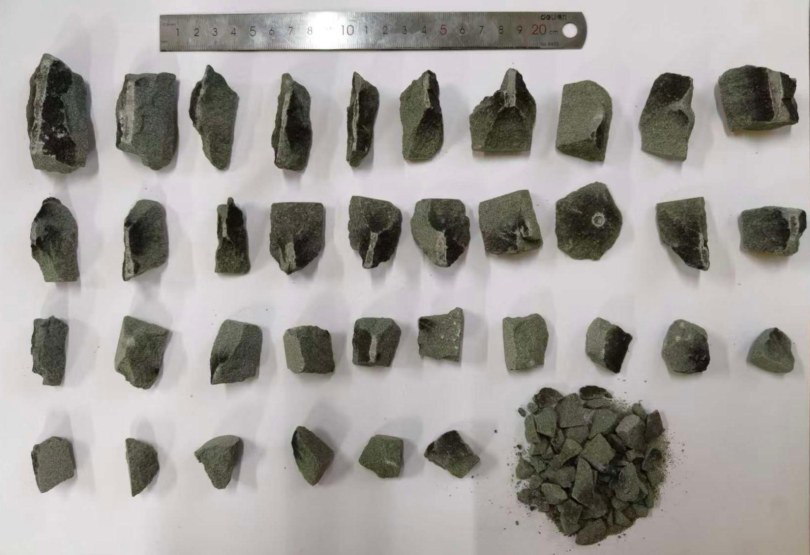
To improve rock fragmentation in open-pit deep-hole blasting, an in-hole layered column charge configuration was designed. Small-scale blasting tests on sandstone specimens were conducted under continuous and layered column charges to capture the failure process and final fragmentation. DEM-PBM coupled simulations visualized the dynamic fracture evolution and validated the experimental observations. Results show that under continuous charge, the top quarter of the specimen developed only a single blast-induced crack, splitting it into two parts, with horizontal fragment velocity of 2.0 m·s⁻¹ and a maximum block size of 9.0 cm. In contrast, layered charge produced multiple cracks in the top quarter, fragmenting it into smaller pieces, increasing horizontal velocity to 7.0 m·s⁻¹, and eliminating blocks larger than 5.0 cm. Simulations confirmed these trends, with maximum block size reduced from 8.8 cm to below 5.0 cm and velocity reaching 6.8 m·s⁻¹, closely matching experiments. Field trials in an open-pit coal mine overburden blasting demonstrated that layered charge reduced the boulder yield from 48.1% to 5.6%, significantly improving fragmentation. The findings confirm the practical effectiveness of in-hole layered column charge in enhancing rock breakage in deep-hole bench blasting.
Review on Ship Structural Damage and Protection Subjected to Underwater Contact Explosions
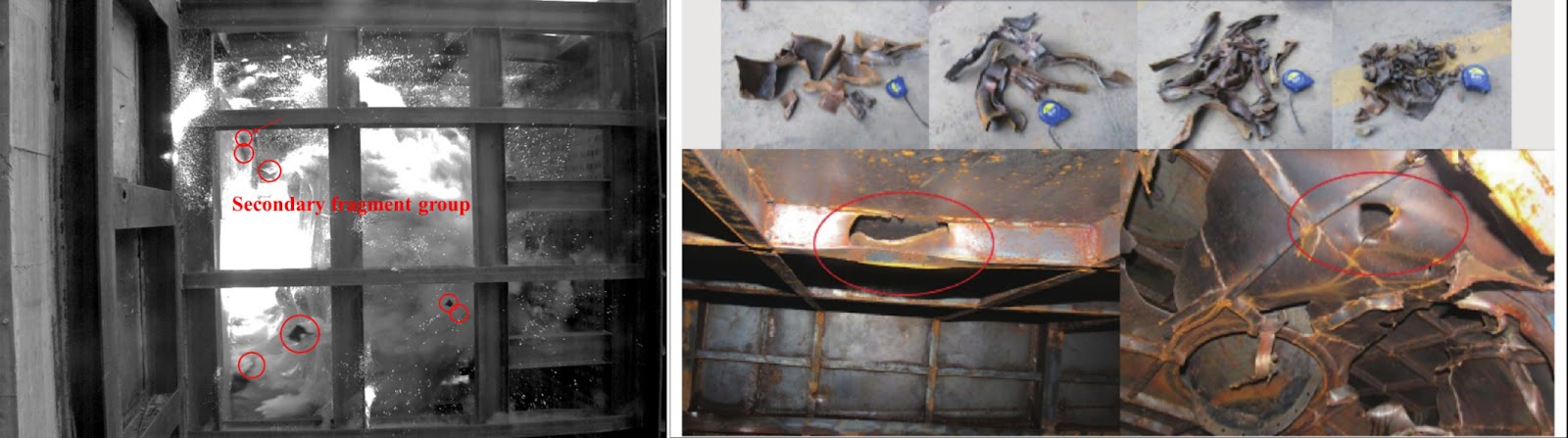
Underwater contact explosions from torpedoes and mines pose severe threats to ship survivability. The coupled effects of shock waves, bubbles, and secondary fragments induce complex structural damage. This review first analyzes the load characteristics of underwater contact explosions, detailing the spatial-temporal evolution of shock waves, bubbles, and secondary fragments. Subsequently, it examines protective mechanisms from two perspectives: multi-cabin structural protection and composite structure/material protection, focusing on damage suppression and energy dissipation. Finally, key technical challenges are summarized to guide future research. The review highlights that shock waves cause initial indentation and perforation of the outer plate, while bubble pulsation and collapse jets dominate subsequent large deformation and tearing of bulkheads. Experimental studies show that stiffened plates exhibit significant strain growth during bubble pulsation, potentially exceeding shock wave effects. Multi-cabin designs, such as liquid-filled compartments, effectively mitigate damage through energy absorption and impedance mismatch. Composite materials offer enhanced blast resistance but face scalability issues. The paper underscores the need for high-fidelity numerical methods and experimental validation to resolve controversies regarding dominant damage mechanisms. This work provides a comprehensive reference for advancing ship structural protection against underwater contact explosions.
Solubility and Thermodynamic Properties of β-HMX in Dimethyl Sulfoxide–Alcohol Binary Solvent Mixtures
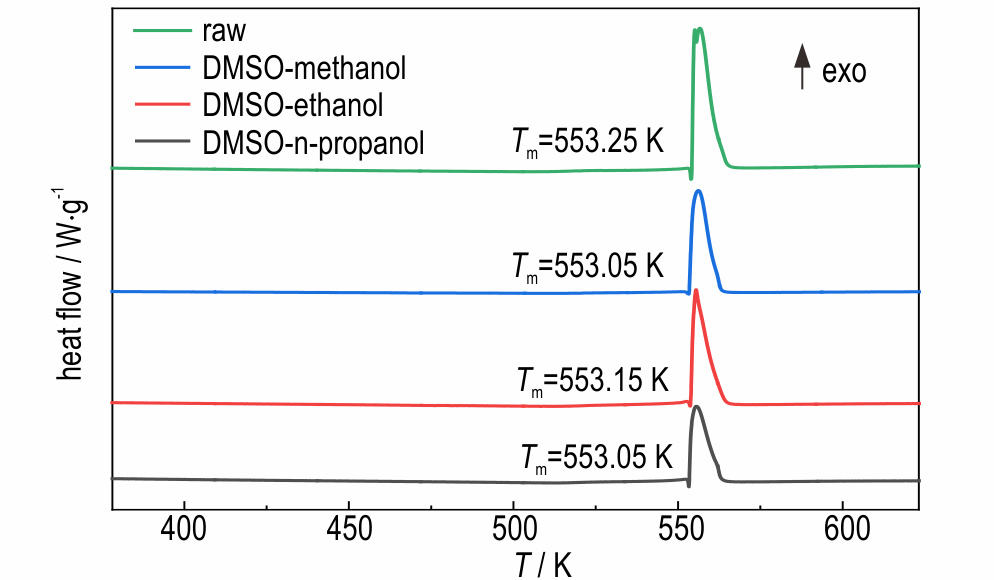
The solubility of β-octahydro-1,3,5,7-tetranitro-1,3,5,7-tetrazocine (β-HMX) in dimethyl sulfoxide (DMSO)–methanol, DMSO–ethanol, and DMSO–n-propanol binary solvent mixtures was measured using a static method over the temperature range of 293.15–343.15 K at atmospheric pressure. The mole fraction of alcohol in the mixed solvent was varied from 0 to 1. The experimental solubility data were correlated with the Apelblat, Jouyban–Acree, and NRTL models. The Apelblat model provided the best fit, with an average relative deviation (ARD) below 5% and a root-mean-square deviation (RMSD) below 0.11%. Thermodynamic properties, including Gibbs free energy, enthalpy, and entropy of dissolution, were derived from the NRTL model. The dissolution process was endothermic, entropy-driven, and spontaneous in all three solvent systems. Solid-phase characterization by PXRD and DSC confirmed that no polymorphic transition of β-HMX occurred under the experimental conditions. Solvent composition stability tests showed that the maximum relative change in solubility due to composition fluctuation was less than 6.3%, corresponding to an equivalent temperature variation of 1.4–2.7 K. These data provide a foundation for optimizing anti-solvent crystallization processes for β-HMX.