Key Takeaways & Executive Findings
- •• Low-rank coal is a promising precursor for carbon materials due to its abundance, high carbon content, and low cost, but its variability poses challenges for structural control. • Different processing strategies (activation, templating, etc.) are required to produce activated carbon, capacitive carbon, hard carbon, and graphite with tailored properties. • Coal rank and process parameters significantly influence the microstructure, surface chemistry, and electrochemical performance of the resulting carbon materials. • Coal-based carbons show great potential in adsorption, supercapacitors, and alkali metal batteries, but further research is needed to optimize performance and scalability.
Abstract
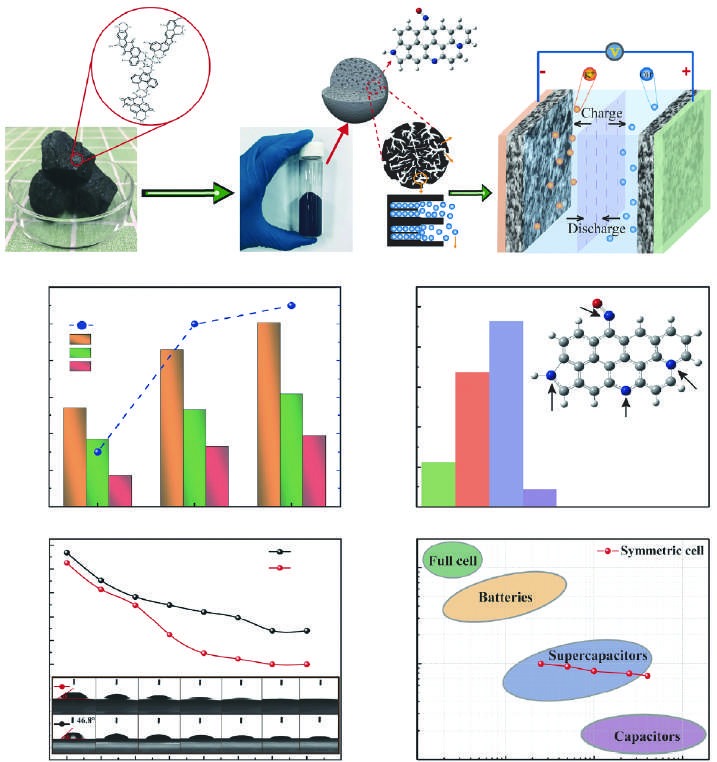
Low-rank coal is considered a high-quality precursor for carbon materials due to its abundant reserves, rich polycyclic aromatic hydrocarbons, high carbon content, and low cost. However, differences in ash content, microstructure, and interface among different low-rank coals lead to difficulties in effectively controlling the structure and performance of coal-based carbon materials. In recent years, researchers have proposed effective methods for regulating the microstructure and surface/interface of low-rank coal-based carbon materials. This review focuses on the differentiated strategies for preparing activated carbon, capacitive carbon, hard carbon, graphite, and nanocarbon materials from low-rank coal. It further discusses the effects of coal type and process on the microstructure, interface characteristics, and functional group types of coal-based carbon materials. Additionally, the applications of coal-based carbon materials in adsorption, supercapacitors, and alkali metal batteries are introduced. Finally, future research directions and challenges for low-rank coal-based carbon materials are prospected.
1. Introduction
Coal has supported the energy demands of human society and ensured energy security. Under the 'dual carbon' goals, clean and efficient utilization and materialization of coal have become important pathways for its future transformation. Coal is mainly formed from various amorphous, degraded plant remains. Over time, with increased pressure and heat, the degree of metamorphism of these remains gradually increases, forming peat, lignite, sub-bituminous coal, bituminous coal, and anthracite with different degrees of metamorphism (Fig. 1a). Although coals of different ranks differ in structure, their constituent elements are C, H, O, N, and S, and they contain abundant aromatic and aliphatic organic matter interconnected by aliphatic and ether bonds. Moreover, the molecular structure of coal is naturally similar to that of carbon materials, and it is rich in intermediate crystalline structures between amorphous carbon and graphite, known as 'turbostratic structure', which can be converted into various coal-based carbon materials through processing. Therefore, coal is not only a fossil fuel but also a high-quality precursor for carbon materials [1,2].
A wide variety of carbon materials can be prepared from coal, and related research is extensive. Carbon fibers [5], carbon nanotubes [6], carbon nanosheets [3], fullerenes [7], graphene [8], porous carbon spheres [9], carbon aerogels [10], carbon foams [11], and porous graphite spheres [12–14] have been reported using coals of different ranks, such as lignite, bituminous coal, and anthracite [1–4]. Among them, anthracite has long been used to prepare capacitive carbon, porous carbon, graphene, and other carbon materials [15], and reviews have been published, but anthracite has surface inertness and is difficult to activate for pore formation. Therefore, low-rank coal has attracted increasing attention and research due to its excellent aromatic and aliphatic structure tunability, high volatile content, and ease of pore formation, but systematic summaries and reviews are rare. Coal-based carbon materials not only break the disciplinary boundaries between coal chemistry and carbon materials but also achieve good profits in industry. Therefore, it is necessary to review the research on preparing carbon materials from low-rank coal in a specific field.
Loading authentic research manuscript (Pages 1–5)...
Wenge Song, Hongjiu Zeng, Bin Wang, Xianhong Huang, Xiaoming Li, Guohua Sun (2024). Research progress on carbon materials derived from low-rank coal. New Carbon Materials. https://doi.org/10.1016/S1872-5805_N
Research & Educational Purpose Only:The translations, structured abstracts, analytical annotations, and data reports provided by SinoTechIntel are intended exclusively for academic research, internal corporate R&D, and educational benchmarking. They do not constitute formal engineering, chemical safety, legal, or professional advice.
Copyright & Intellectual Property Notice: Original copyright of the underlying source articles and experimental data remains with the respective authors, institutions, and original publishing journals. SinoTechIntel claims intellectual property only over its proprietary translations, analytical syntheses, and AEO structured enhancements in accordance with international fair use and academic citation principles.
Frequently Asked Questions
What are the main types of carbon materials derived from low-rank coal?
Low-rank coal can be converted into various carbon materials including activated carbon, capacitive carbon, hard carbon, graphite, and nanocarbon materials such as graphene, carbon nanotubes, and carbon quantum dots.
Why is low-rank coal considered a promising precursor for carbon materials?
Low-rank coal is abundant, has high carbon content, contains polycyclic aromatic hydrocarbons, and is low cost. Its structure can be tuned to produce porous carbons with desirable properties for applications like adsorption and energy storage.
What are the challenges in using low-rank coal for carbon materials?
The main challenges include variability in ash content, microstructure, and surface properties among different low-rank coals, which make it difficult to control the structure and performance of the resulting carbon materials.
What applications do low-rank coal-based carbon materials have?
They are used in adsorption (e.g., water purification), supercapacitors, and alkali metal batteries (e.g., lithium-ion, sodium-ion) as electrode materials, as well as in other fields like catalysis and gas storage.
How does the preparation method affect the properties of low-rank coal-based carbons?
The preparation method, including activation (physical or chemical), hydrothermal carbonization, and templating, significantly influences the surface area, pore size distribution, surface chemistry, and electrochemical performance of the resulting carbon materials.
Related Technical Papers & Translations
Design and optimization of a high-efficiency distillation process for cellulosic fuel ethanol integrated with thermal coupling and molecular sieve adsorption
To address the challenges of high energy consumption and prominent costs in the traditional three-columns distillation process for cellulosic fuel ethanol, a distillation—molecular sieve coupling separation process is proposed. This process integrates a three-column (crude distillation column, first distillation column, second distillation column) system with a 3A molecular sieve adsorption deep dehydration unit. A thermal coupling network is constructed via differential pressure design (steam from medium/high-pressure columns as mutual heat sources, reboiler liquid waste heat for feed preheating), and molecular sieve adsorption conditions are optimized. The study first performs a thermodynamic consistency test on the ethanol—water system, determines optimal non-random two-liquid (NRTL) model binary interaction parameters via experimental data regression for Aspen Plus simulation. Aiming at minimum total annual cost (TAC), Aspen Plus is used to optimize process parameters (theoretical tray number, feed location, reflux ratio, side-draw position, etc.). Economic analysis shows this process reduces CO2 emission costs by 27.56%, TAC by 15.58% (to 5.123 × 10⁶ USD·a-1), and increases ethanol purity to >99.6%, providing an effective solution for green, efficient separation.
A cohesion loss model for determining residual strength of deep bedded sandstone
Rock residual strength, as an important input parameter, plays an indispensable role in proposing the reasonable and scientific scheme about stope design, underground tunnel excavation and stability evaluation of deep chambers. Therefore, previous residual strength models of rocks established were reviewed. And corresponding related problems were stated. Subsequently, starting from the effects of bedding and whole life-cycle evolution process, series of triaxial mechanical tests of deep bedded s
Federated model with contrastive learning and adaptive control variates for human activity recognition
Recent attention to privacy issues demands a communication-safe method for training human activity recognition (HAR) models on client activity data. Federated learning (FL) has become a compelling technique to facilitate model training between the server and clients while preserving data privacy. However, classical FL methods often assume independent and identically distributed (IID) data among clients. This assumption does not hold true in practical scenarios. Human activity in real-world scena