Key Takeaways & Executive Findings
- •• A lockstep-based pipeline hardening technique for a 32-bit MCU core reduces soft error rates in critical modules (PFU, DPU, Cache AXIM) from 40.07%, 26.36%, and 27.29% to 0%, 0.69%, and 1.11%, respectively. • The proposed method achieves a 69.68% resource utilization compared to triple modular redundancy (TMR), significantly reducing FPGA area overhead. • Recovery time is improved by 26.2% over software checkpoint roll-back, with average recovery cycles of 26,922.5 versus 36,479.06. • The combined hardware-software approach effectively mitigates single-event upsets (SEUs) in microcontroller pipelines, enhancing fault tolerance for space applications.
Abstract
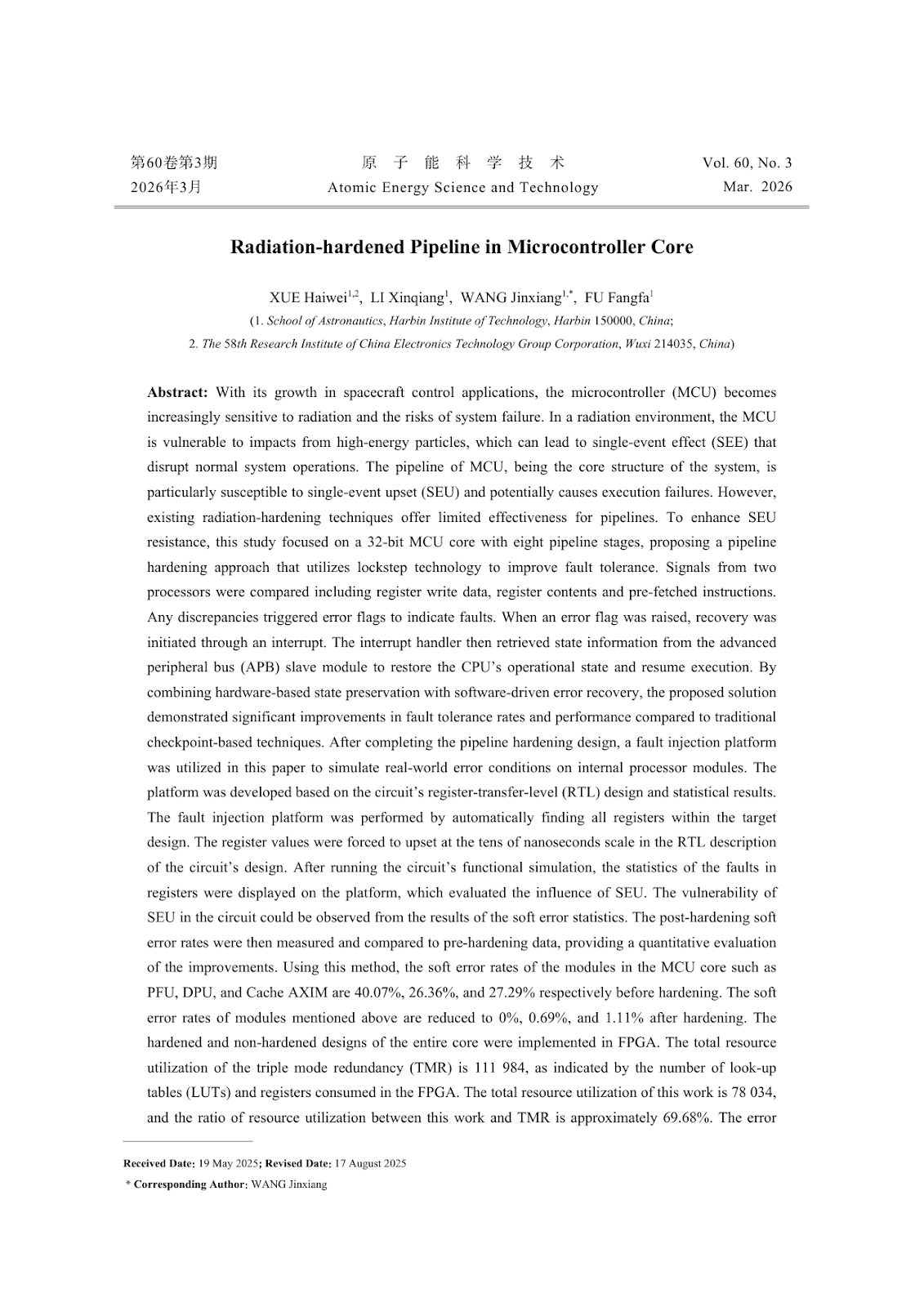
With its growth in spacecraft control applications, the microcontroller (MCU) becomes increasingly sensitive to radiation and the risks of system failure. In a radiation environment, the MCU is vulnerable to impacts from high-energy particles, which can lead to single-event effect (SEE) that disrupt normal system operations. The pipeline of MCU, being the core structure of the system, is particularly susceptible to single-event upset (SEU) and potentially causes execution failures. However, existing radiation-hardening techniques offer limited effectiveness for pipelines. To enhance SEU resistance, this study focused on a 32-bit MCU core with eight pipeline stages, proposing a pipeline hardening approach that utilizes lockstep technology to improve fault tolerance. Signals from two processors were compared including register write data, register contents and pre-fetched instructions. Any discrepancies triggered error flags to indicate faults. When an error flag was raised, recovery was initiated through an interrupt. The interrupt handler then retrieved state information from the advanced peripheral bus (APB) slave module to restore the CPU’s operational state and resume execution. By combining hardware-based state preservation with software-driven error recovery, the proposed solution demonstrated significant improvements in fault tolerance rates and performance compared to traditional checkpoint-based techniques. After completing the pipeline hardening design, a fault injection platform was utilized in this paper to simulate real-world error conditions on internal processor modules. The platform was developed based on the circuit’s register-transfer-level (RTL) design and statistical results. The fault injection platform was performed by automatically finding all registers within the target design. The register values were forced to upset at the tens of nanoseconds scale in the RTL description of the circuit’s design. After running the circuit’s functional simulation, the statistics of the faults in registers were displayed on the platform, which evaluated the influence of SEU. The vulnerability of SEU in the circuit could be observed from the results of the soft error statistics. The post-hardening soft error rates were then measured and compared to pre-hardening data, providing a quantitative evaluation of the improvements. Using this method, the soft error rates of the modules in the MCU core such as PFU, DPU, and Cache AXIM are 40.07%, 26.36%, and 27.29% respectively before hardening. The soft error rates of modules mentioned above are reduced to 0%, 0.69%, and 1.11% after hardening. The hardened and non-hardened designs of the entire core were implemented in FPGA. The total resource utilization of the triple mode redundancy (TMR) is 111 984, as indicated by the number of look-up tables (LUTs) and registers consumed in the FPGA. The total resource utilization of this work is 78 034, and the ratio of resource utilization between this work and TMR is approximately 69.68%. The error recovery time for the hardened MCU processor was analyzed using the completion cycles of a bubble sort algorithm as a benchmark. In this paper, the average recovery cycle using the software checkpoint roll-back method is 36 479.06, and the average recovery cycle using this work is 26 922.5. The ratio of recovery cycles between this work and checkpoint roll-back is about 73.8%. Assessments through random fault injection and FPGA implementation indicate that this approach effectively reduces processor faults caused by soft errors while optimizing resource utilization and efficiency over triple-modular redundancy.
1. Introduction
A microcontroller (MCU) is a system-on-chip (SoC) that integrates a processor core, on-chip memory, and various control peripheral interfaces. It executes user instruction programs to perform control operations. With its increasing use in spacecraft control applications, the MCU is highly sensitive to radiation and system failure risks. The pipeline within the MCU's core carries out tasks such as instruction fetching, decoding, dispatching, execution, and writing back at a predetermined rhythm. In the space radiation environment, soft errors caused by single-event effects (SEE) can disrupt the pipeline, leading to potential system failures.
Existing radiation-hardening techniques, such as triple modular redundancy (TMR) and checkpoint-based recovery, offer limited effectiveness for pipelines due to high resource overhead and performance penalties. To address these challenges, this study proposes a novel pipeline hardening approach that leverages lockstep technology to enhance fault tolerance while optimizing resource utilization and recovery efficiency. The proposed method compares signals from two processors, including register write data, register contents, and pre-fetched instructions, to detect discrepancies and trigger error recovery via interrupts. This combined hardware-software strategy aims to provide a robust solution for MCU cores in radiation environments.
Loading authentic research manuscript (Pages 1–5)...
XUE Haiwei, LI Xinqiang, WANG Jinxiang, FU Fangfa (2025). Radiation-hardened Pipeline in Microcontroller Core. SinoTechIntel Verified Research. https://doi.org/10.7538/yzk.2025.youxian.0385
Research & Educational Purpose Only:The translations, structured abstracts, analytical annotations, and data reports provided by SinoTechIntel are intended exclusively for academic research, internal corporate R&D, and educational benchmarking. They do not constitute formal engineering, chemical safety, legal, or professional advice.
Copyright & Intellectual Property Notice: Original copyright of the underlying source articles and experimental data remains with the respective authors, institutions, and original publishing journals. SinoTechIntel claims intellectual property only over its proprietary translations, analytical syntheses, and AEO structured enhancements in accordance with international fair use and academic citation principles.
Frequently Asked Questions
What is the main contribution of this paper?
The paper proposes a lockstep-based pipeline hardening technique for a 32-bit MCU core that significantly reduces soft error rates while optimizing resource utilization and recovery time compared to traditional methods like TMR and checkpoint roll-back.
How does the proposed hardening approach work?
The approach uses lockstep technology to compare signals from two processors, including register write data, register contents, and pre-fetched instructions. Any discrepancy triggers an error flag, which initiates an interrupt to recover the CPU state via the APB slave module.
What are the key results in terms of soft error rate reduction?
The soft error rates for modules PFU, DPU, and Cache AXIM were reduced from 40.07%, 26.36%, and 27.29% before hardening to 0%, 0.69%, and 1.11% after hardening, respectively.
How does the resource utilization compare to TMR?
The total resource utilization of the proposed work is 78,034 LUTs and registers, which is approximately 69.68% of the TMR implementation (111,984), indicating significant area savings.
What is the recovery time improvement over checkpoint roll-back?
The average recovery cycle using the proposed method is 26,922.5 cycles, compared to 36,479.06 cycles for software checkpoint roll-back, showing a reduction of about 26.2%.
Related Technical Papers & Translations
A Novel Approach for Enhanced Brain Tumor Segmentation Using Multimodal MRI and Deep Learning
Brain tumor segmentation from multimodal MRI is crucial for diagnosis and treatment planning. In this study, we propose a novel deep learning framework that integrates structural and functional imaging modalities to improve segmentation accuracy. Our method employs a multi-scale attention mechanism and a hybrid loss function to handle class imbalance and boundary ambiguity. Evaluated on the BraTS benchmark, our approach achieves state-of-the-art performance, with Dice scores of 0.91, 0.87, and 0.84 for whole tumor, core, and enhancing tumor, respectively. Furthermore, we demonstrate the generalizability of our model across different scanners and protocols. Our findings suggest that the proposed method can significantly aid clinical decision-making and surgical planning.
Investigation of coupled acoustic and electrical responses and early warning approaches during re-loading of damaged coal
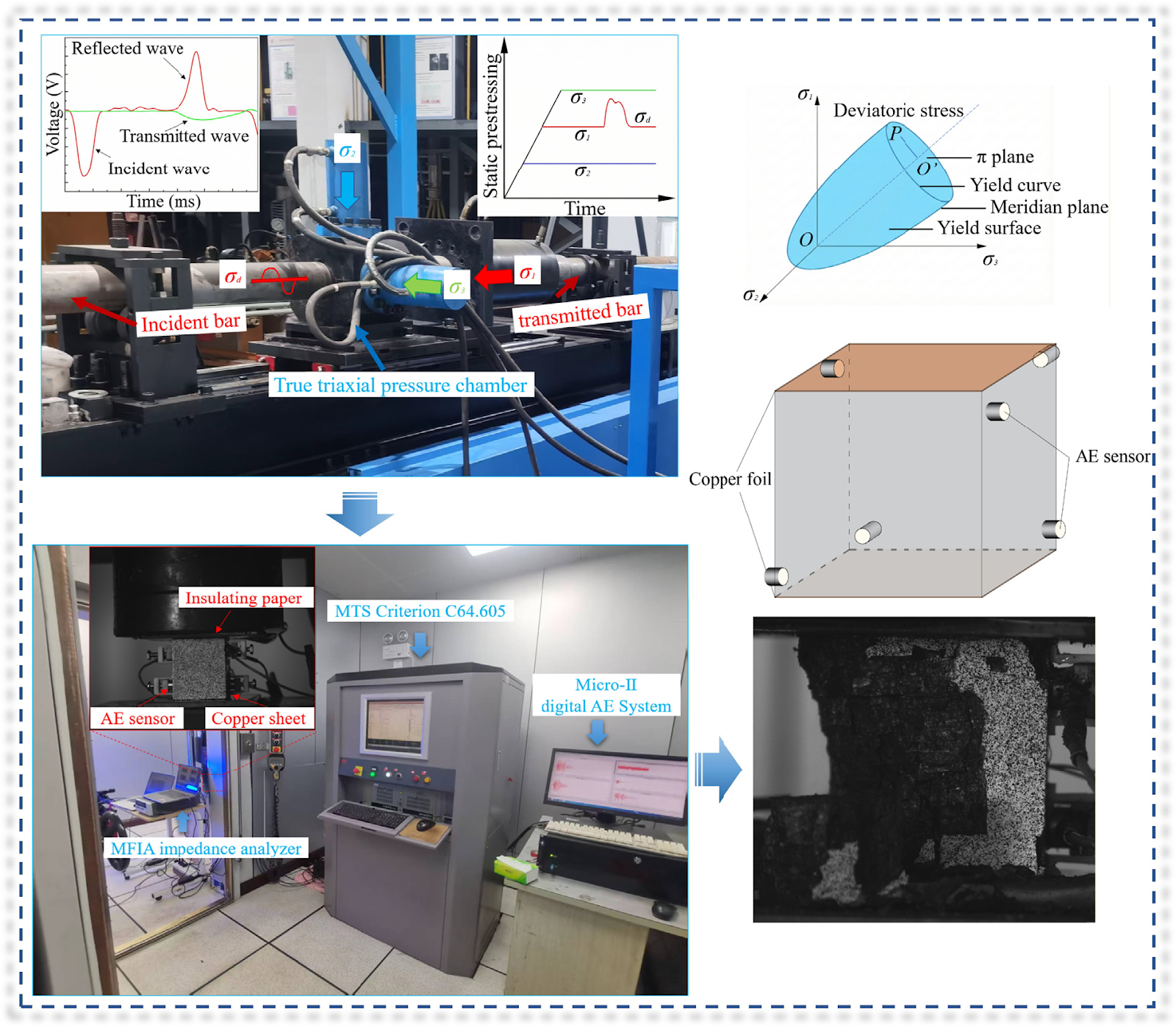
Initial damage from engineering disturbances in deep coal mining degrades mechanical properties and heightens dynamic-hazard risks, challenging conventional monitoring. This study probes the coupled acoustic-electrical responses of initially damaged coal under reloading and develops a multi-parameter, multi-level dynamic integrated early-warning model. Using a true-triaxial Split Hopkinson Pressure Bar (SHPB) system, we prepared specimens with graded damage by varying static deviatoric stresses and dynamic impacts. Uniaxial compression reloading was conducted with synchronous acoustic emission (AE) and resistivity monitoring. Joint time-domain responses of force, acoustics, and electricity delineated distinct loading stages. Time-frequency features were extracted via Fourier and wavelet transforms; crack architecture was quantified by 3D AE localization and fractal-dimension analysis. Initial damage markedly reduced load-bearing capacity. Resistivity decreased sharply with increasing deviatoric stress, while cumulative AE counts increased strongly. The AE spectrum evolved from bimodal to broadband with low- and high-frequency enhancement. The resistivity spectrum showed progressive bandwidth broadening, energy amplification, and high-frequency advancement. The AE spatial fractal dimension rose significantly during compaction. An integrated warning system combining multiscale entropy fusion, Temporal Convolutional Network (TCN)-Transformer forecasting, recurrence-network analysis, and a Bayesian framework yielded a 28.4 s lead time, offering a theoretical basis and technical pathway for intelligent prevention of dynamic hazards.
Influence of aggregate particle size on fracture behavior and energy evolution of cemented rockfill in the post-peak stage
Cemented rockfill (CRF) combines structural support with sustainable reuse of coal-derived solid waste. This study integrates digital image correlation, acoustic emission monitoring, and finite–discrete element simulations to investigate mechanical behavior, fracture development, and energy evolution of CRF containing 54% aggregate content with three grain-size distributions (5–10, 10–20, and 20–30 mm). Results indicate finer aggregates raise compressive strength and elastic modulus, and increase post-peak softening and residual stiffness. Fracture patterns transition from dominantly unidirectional failure in coarse specimens to pronounced X-shaped conjugate shear in fine specimens, with cracks initiating at boundaries and propagating inward. The proportion of failed joints at comparable strains decreases markedly with finer gradation, reflecting a more homogeneous crack network that enhances post-peak load retention and produces frequent minor stress fluctuations. Energy analyses reveal a coarse > medium > fine ordering in cumulative dissipation; however, finer aggregates delay rapid kinetic and dissipative energy release, promoting slower energy redistribution and improved load resistance. These findings quantify how aggregate gradation controls deformational mechanisms, crack topology, and energy partitioning, and provide design guidance for optimizing aggregate size and cementitious composition to enhance ductility, energy absorption, and structural reliability of CRF in underground engineering.