Key Takeaways & Executive Findings
- •• A novel porous nanofibrous dressing (NFD) enables spontaneous formation of MSC spheroids with controllable sizes, serving as an integrated platform for both formation and delivery. • The NFD, fabricated via electrospinning and homogeneous freeze-drying with thermal crosslinking, exhibits satisfactory elasticity and cytocompatibility. • MSC spheroids cultured on the NFD show enhanced secretion of VEGF, bFGF, and HGF, accelerating diabetic wound healing. • This work provides a competitive strategy for MSC spheroid-based therapy, addressing inefficiencies of traditional two-step approaches.
Abstract
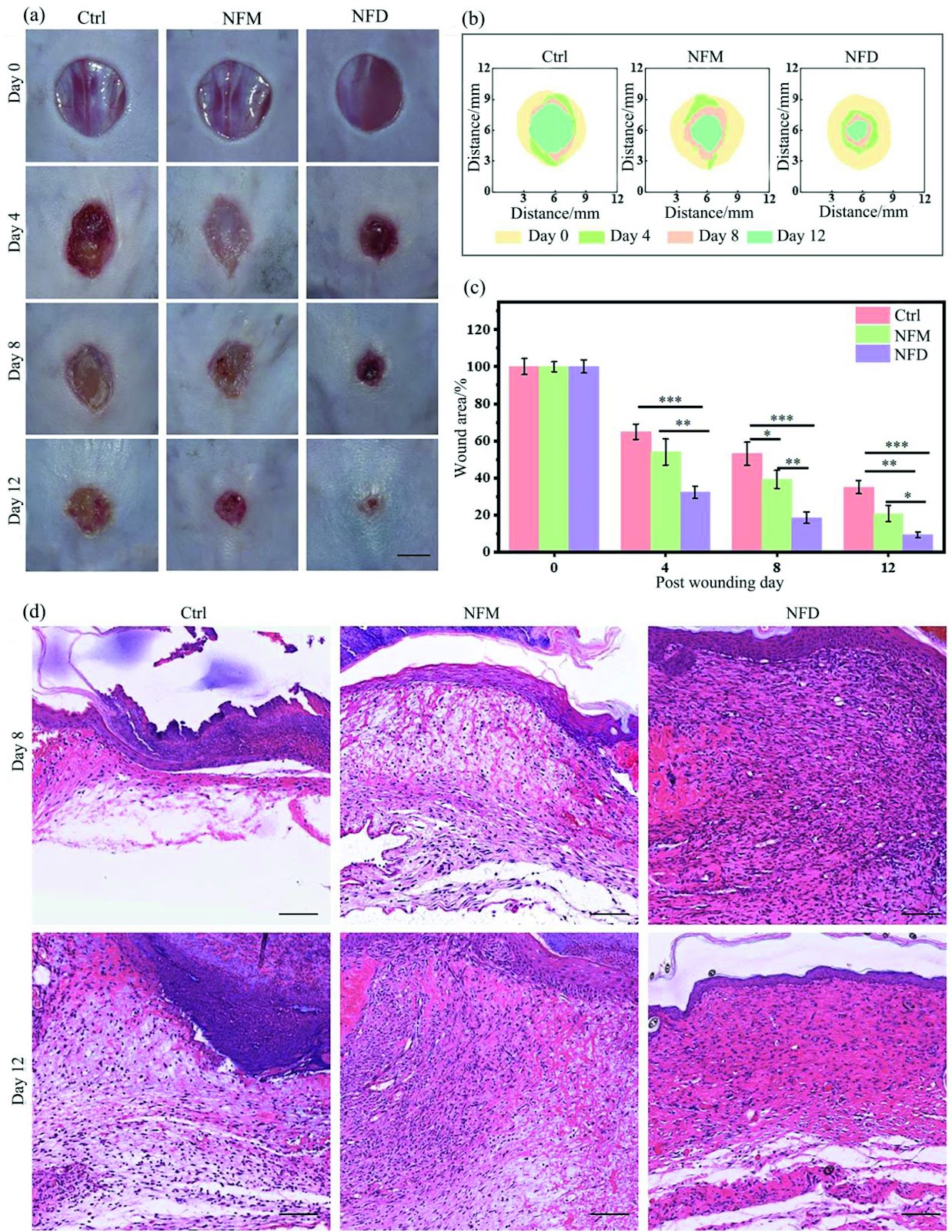
Delayed and nonhealing of diabetic wounds imposes substantial economic burdens and physical pain on patients. Mesenchymal stem cells (MSCs) promote diabetic wound healing. Particularly when MSCs aggregate into multicellular spheroids, their therapeutic effect is enhanced. However, traditional culture platforms are inadequate for the efficient preparation and delivery of MSC spheroids, resulting in inefficiencies and inconveniences in MSC spheroid therapy. In this study, a three-dimensional porous nanofibrous dressing (NFD) is prepared using a combination of electrospinning and homogeneous freeze-drying. Using thermal crosslinking, the NFD not only achieves satisfactory elasticity but also maintains notable cytocompatibility. Through the design of its structure and chemical composition, the NFD allows MSCs to spontaneously form MSC spheroids with controllable sizes, serving as MSC spheroid delivery systems for diabetic wound sites. Most importantly, MSC spheroids cultured on the NFD exhibit improved secretion of vascular endothelial growth factor, basic fibroblast growth factor, and hepatocyte growth factor, thereby accelerating diabetic wound healing. The NFD provides a competitive strategy for MSC spheroid formation and delivery to promote diabetic wound healing.
1. Introduction
In recent years, the prevalence of diabetes has increased annually, posing a global public health problem [1]. The worldwide prevalence of diabetes among individuals aged 20-79 years is predicted to be 12.2% in 2045 [2]. A wound that fails to heal for more than 90 days is considered a chronic wound [3]. Chronic wounds are common complications of diabetes that do not heal for long periods; therefore, they often carry the risk of amputation [4]. When chronic wounds appear on the feet of patients with diabetes mellitus, the risk of amputation is approximately 155 times higher than that in individuals without diabetes [5]. The traditional treatment strategies for diabetic wounds include topical dressings, pressure-relieving support, and antimicrobial treatment; however, the treatment effect is unsatisfactory and may cause secondary damage [6]. Therefore, there is an urgent need to develop advanced strategies for the effective treatment of diabetic wounds.
Owing to their multipotency and self-renewal capacity, mesenchymal stem cells (MSCs) replace damaged cells or tissues as well as accelerate wound healing by secreting a variety of growth factors [7]. MSCs can be dispersed or aggregated into multicellular spheroids to promote wound healing. Compared with dispersive MSCs, MSC spheroids have improved cell survival and overall function, providing new opportunities and broad prospects for diabetic wound healing [8,9]. Traditional MSC spheroid therapy requires two steps: MSC spheroid formation and delivery [10,11]. In this strategy, MSC spheroid formation depends on various culture platforms, such as spinner flasks, forced floats, and hanging drops [12,13]. Once MSC spheroids are formed, they must be transferred to the biomaterials that serve as carriers. However, this strategy is inefficient and is accompanied by the risk of losing spheroid function and activity. Therefore, the development of biomaterials capable of forming and delivering MSC spheroids is of considerable importance for MSC therapy.
The structure and chemical composition of biomaterials affect cell behavior [14,15]. When biomaterials possess a stereoscopic three-dimensional (3D) structure and exhibit lower cell adhesion than intercellular adhesion, dispersed cells tend to aggregate on the biomaterials to form multicellular spheroids [16,17]. Owing to its flexible structural design and chemical composition, electrospinning has attracted great attention in the field of biomaterials [18,19]. Additionally, electrospun nanofibers have many outstanding advantages, such as extracellular matrix-like structures, a large specific surface area, and high porosity, which support nutrient transport, cell survival, and cell communication [20]. Various nanofibers with 3D structures have been developed and used as biomaterials, providing new opportunities for stem cell therapy.
Loading authentic research manuscript (Pages 1–5)...
Kexin Zhang, Wenmin Zhang, Heng An, Zhe Huang, Yanzhen Wen, Xiangyu Jiao, Yongqiang Wen (2024). Porous nanofibrous dressing enables mesenchymal stem cell spheroid formation and delivery to promote diabetic wound healing. Chinese Journal of Chemical Engineering. https://doi.org/10.1016/j_cjche_1448
Research & Educational Purpose Only:The translations, structured abstracts, analytical annotations, and data reports provided by SinoTechIntel are intended exclusively for academic research, internal corporate R&D, and educational benchmarking. They do not constitute formal engineering, chemical safety, legal, or professional advice.
Copyright & Intellectual Property Notice: Original copyright of the underlying source articles and experimental data remains with the respective authors, institutions, and original publishing journals. SinoTechIntel claims intellectual property only over its proprietary translations, analytical syntheses, and AEO structured enhancements in accordance with international fair use and academic citation principles.
Frequently Asked Questions
What is the main innovation of this study?
The study develops a porous nanofibrous dressing (NFD) that enables both the formation and delivery of mesenchymal stem cell (MSC) spheroids, overcoming the inefficiencies of traditional two-step approaches. The NFD is fabricated via electrospinning and homogeneous freeze-drying, and it supports spontaneous spheroid formation with controllable sizes.
How does the nanofibrous dressing promote diabetic wound healing?
MSC spheroids cultured on the NFD exhibit enhanced secretion of vascular endothelial growth factor (VEGF), basic fibroblast growth factor (bFGF), and hepatocyte growth factor (HGF), which accelerate diabetic wound healing.
What are the key properties of the nanofibrous dressing?
The NFD has a three-dimensional porous structure, satisfactory elasticity, and notable cytocompatibility, achieved through thermal crosslinking. Its structure and chemical composition are designed to promote MSC spheroid formation.
What is the significance of using MSC spheroids over dispersed MSCs?
MSC spheroids have improved cell survival and overall function compared to dispersed MSCs, providing enhanced therapeutic effects for diabetic wound healing.
What is the publication source of this research?
The research is published in the Chinese Journal of Chemical Engineering, volume 68, pages 156-164, with DOI 10.1016/j.cjche.2024.01.005.
Related Technical Papers & Translations

Design and optimization of a high-efficiency distillation process for cellulosic fuel ethanol integrated with thermal coupling and molecular sieve adsorption
To address the challenges of high energy consumption and prominent costs in the traditional three-columns distillation process for cellulosic fuel ethanol, a distillation—molecular sieve coupling separation process is proposed. This process integrates a three-column (crude distillation column, first distillation column, second distillation column) system with a 3A molecular sieve adsorption deep dehydration unit. A thermal coupling network is constructed via differential pressure design (steam from medium/high-pressure columns as mutual heat sources, reboiler liquid waste heat for feed preheating), and molecular sieve adsorption conditions are optimized. The study first performs a thermodynamic consistency test on the ethanol—water system, determines optimal non-random two-liquid (NRTL) model binary interaction parameters via experimental data regression for Aspen Plus simulation. Aiming at minimum total annual cost (TAC), Aspen Plus is used to optimize process parameters (theoretical tray number, feed location, reflux ratio, side-draw position, etc.). Economic analysis shows this process reduces CO2 emission costs by 27.56%, TAC by 15.58% (to 5.123 × 10⁶ USD·a-1), and increases ethanol purity to >99.6%, providing an effective solution for green, efficient separation.

A cohesion loss model for determining residual strength of deep bedded sandstone
Rock residual strength, as an important input parameter, plays an indispensable role in proposing the reasonable and scientific scheme about stope design, underground tunnel excavation and stability evaluation of deep chambers. Therefore, previous residual strength models of rocks established were reviewed. And corresponding related problems were stated. Subsequently, starting from the effects of bedding and whole life-cycle evolution process, series of triaxial mechanical tests of deep bedded s

Federated model with contrastive learning and adaptive control variates for human activity recognition
Recent attention to privacy issues demands a communication-safe method for training human activity recognition (HAR) models on client activity data. Federated learning (FL) has become a compelling technique to facilitate model training between the server and clients while preserving data privacy. However, classical FL methods often assume independent and identically distributed (IID) data among clients. This assumption does not hold true in practical scenarios. Human activity in real-world scena